
Korean Weather Vocabulary at a Glance
This list follows a weather report from top to bottom: the sky, the water that falls, the wind, the temperature, the air and the warnings. It sits in Nature and the World. For the single word 날씨 and a short lookup, see weather in Korean. This page is the longer list.
| Group | Words | Use |
|---|---|---|
| Sun and sky | 8 | The sky and basic weather words |
| Rain and snow | 8 | Water that falls: rain, snow, sleet and frost |
| Wind and storms | 7 | Wind, typhoons, thunder and hail |
| Temperature | 9 | Temperature, heat, cold and extremes |
| Air quality | 7 | Fine dust, yellow dust, fog and masks |
| Weather reports | 6 | Words you read on a forecast or an alert |
Which Weather Words Should You Learn First?
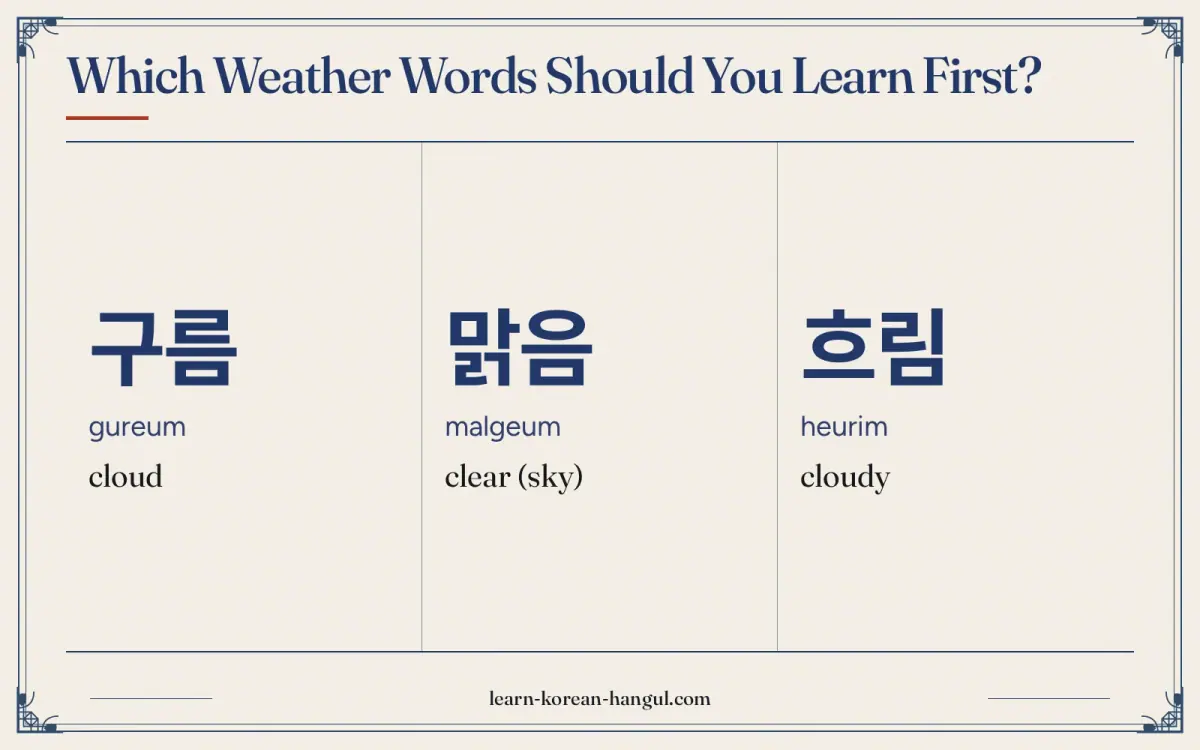
Learn 날씨, 비, 눈, 바람 and 구름 first, with the verbs 오다 and 불다. Then add 더워요 and 추워요 and 미세먼지. That set lets you ask about the weather and answer in plain speech.
- Words to say. 날씨, 비, 눈, 바람, 구름, 미세먼지, 장마.
- Words to recognise. 기온, 강수 확률, 주의보, 경보, 맑음, 흐림. They appear on forecasts and alerts.
- Words to attach to a number. 영상 and 영하 with 도. They need Sino-Korean numbers.
A useful split: 날씨 is the weather of a day, while 기후 (climate) is the long-term pattern, which is not on this list. 기온 is the temperature of the air in a report, and 온도 is any temperature, such as a room or a drink. The scene below shows a landscape with ten numbered conditions.
Word · 10
- 1
구름
gureum
cloud
- 2
맑음
malgeum
clear (sky)
- 3
흐림
heurim
cloudy
- 4
비
bi
rain
- 5
소나기
sonagi
sudden shower
- 6
폭우
pogu
downpour
- 7
바람
baram
wind
- 8
우박
ubak
hail
- 9
온도
ondo
temperature
- 10
한파
hanpa
cold wave
Sun and Sky
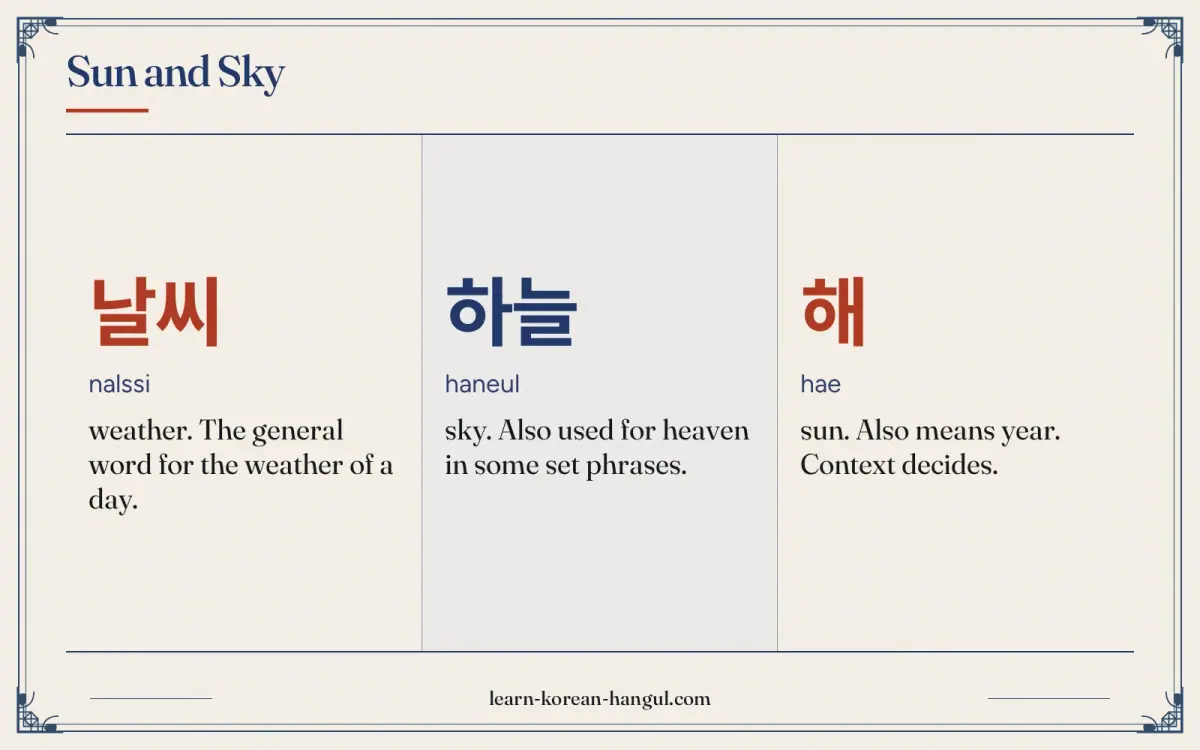
Weather talk starts with 날씨, the word for the weather itself, and the sky above it. 하늘 is the sky, 해 is the sun and 구름 is cloud. On a forecast the sky is written as a noun: 맑음 for clear and 흐림 for cloudy. In speech you use the verbs, 맑아요 and 흐려요. 무지개, the rainbow, is a favourite after-rain word.
| No. | Hangul | Revised Romanization | Meaning and note | Example sentence | Audio assetId |
|---|---|---|---|---|---|
| 1 | 날씨 | nalssi | weather. The general word for the weather of a day. | 오늘 날씨 어때요? (How is the weather today?) | au-pg-vocabulary-nature-weather-1; example: au-pg-vocabulary-nature-weather-46 |
| 2 | 하늘 | haneul | sky. Also used for heaven in some set phrases. | 하늘이 파래요. (The sky is blue.) | au-pg-vocabulary-nature-weather-2; example: au-pg-vocabulary-nature-weather-47 |
| 3 | 해 | hae | sun. Also means year. Context decides. | 해가 떴어요. (The sun has risen.) | au-pg-vocabulary-nature-weather-3; example: au-pg-vocabulary-nature-weather-48 |
| 4 | 햇빛 | haetbit | sunlight. Said [해삗] or [핻삗]. 해 + 빛 (light) with a linking ㅅ. | 햇빛이 강해요. (The sunlight is strong.) | au-pg-vocabulary-nature-weather-4; example: au-pg-vocabulary-nature-weather-49 |
| 5 | 구름 | gureum | cloud. Plural is not marked; 구름이 많아요 is many clouds. | 구름이 많아요. (There are many clouds.) | au-pg-vocabulary-nature-weather-5; example: au-pg-vocabulary-nature-weather-50 |
| 6 | 맑음 | malgeum | clear (sky). Said [말금]. The noun form seen on forecasts; speech uses 맑아요. | 내일은 맑음이에요. (Tomorrow will be clear.) | au-pg-vocabulary-nature-weather-6; example: au-pg-vocabulary-nature-weather-51 |
| 7 | 흐림 | heurim | cloudy. The noun form on forecasts; speech uses 흐려요. | 오후에는 흐림이에요. (The afternoon will be cloudy.) | au-pg-vocabulary-nature-weather-7; example: au-pg-vocabulary-nature-weather-52 |
| 8 | 무지개 | mujigae | rainbow. Appears after rain. | 무지개가 떴어요. (A rainbow appeared.) | au-pg-vocabulary-nature-weather-8; example: au-pg-vocabulary-nature-weather-53 |
Example Sentences
The most useful sentence on the page is the small-talk question 오늘 날씨 어때요?, how is the weather today. Ten answers cover most days: 맑아요, 흐려요, 비가 와요, 눈이 와요, 바람이 불어요, 더워요, 추워요, 따뜻해요, 시원해요, 미세먼지가 나빠요. Each one uses a different verb, so read them aloud. The verbs 맑다, 흐리다, 따뜻하다 and 시원하다 end in -아요/-어요/-해요, while 덥다 and 춥다 change ㅂ to 우: 더워요, 추워요.
The sky is the backdrop. Rain and snow are what falls out of it.
How Do You Say Rain and Snow in Korean?
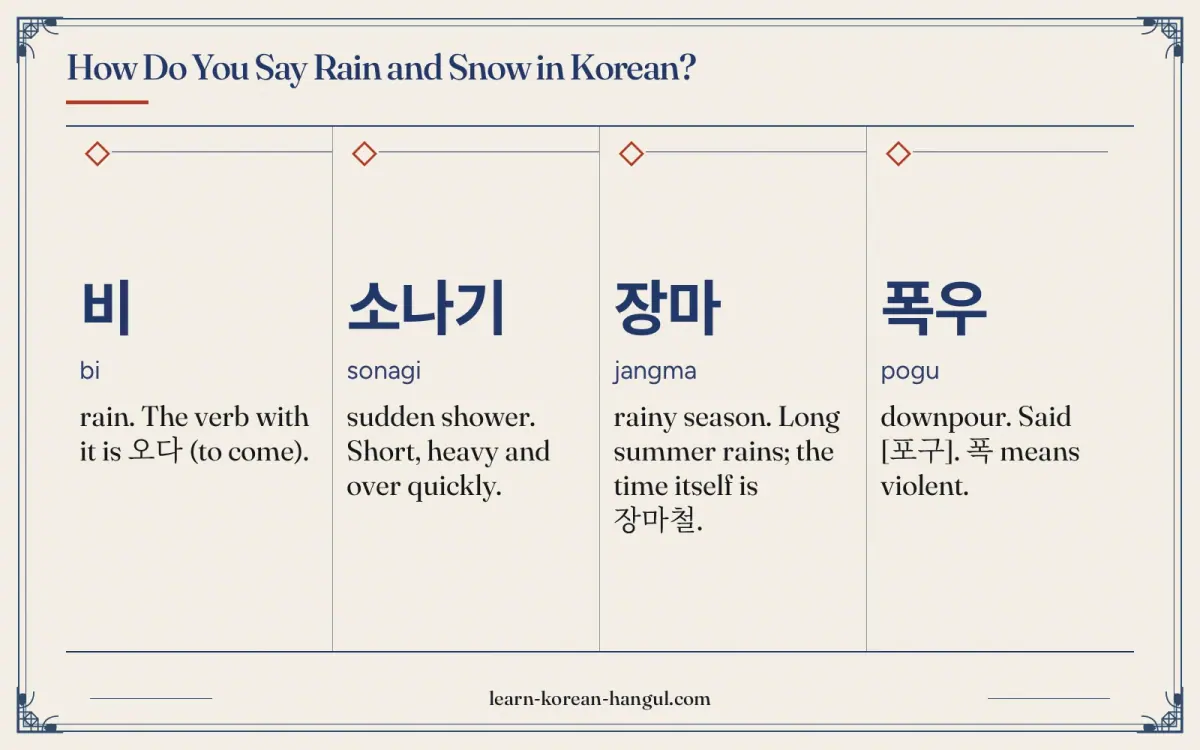
Rain is 비 and snow is 눈, and both use the verb 오다, to come: 비가 와요, 눈이 와요. You can also use 내리다, to fall, as in 눈이 내려요. Korean has a clear scale: 소나기 is a short shower, 폭우 is a downpour, 진눈깨비 is sleet and 폭설 is heavy snow. The prefix 폭 means violent, and it appears again in 폭풍 and 폭염. 장마 is the long rainy season of early summer.
| No. | Hangul | Revised Romanization | Meaning and note | Example sentence | Audio assetId |
|---|---|---|---|---|---|
| 9 | 비 | bi | rain. The verb with it is 오다 (to come). | 비가 와요. (It rains.) | au-pg-vocabulary-nature-weather-9; example: au-pg-vocabulary-nature-weather-54 |
| 10 | 소나기 | sonagi | sudden shower. Short, heavy and over quickly. | 갑자기 소나기가 왔어요. (A sudden shower came.) | au-pg-vocabulary-nature-weather-10; example: au-pg-vocabulary-nature-weather-55 |
| 11 | 장마 | jangma | rainy season. Long summer rains; the time itself is 장마철. | 장마가 끝났어요. (The rainy season has ended.) | au-pg-vocabulary-nature-weather-11; example: au-pg-vocabulary-nature-weather-56 |
| 12 | 폭우 | pogu | downpour. Said [포구]. 폭 means violent. | 폭우 때문에 길이 막혀요. (The roads are jammed because of the downpour.) | au-pg-vocabulary-nature-weather-12; example: au-pg-vocabulary-nature-weather-57 |
| 13 | 눈 | nun | snow. Same spelling as 눈 (eye). | 눈이 내려요. (Snow is falling.) | au-pg-vocabulary-nature-weather-13; example: au-pg-vocabulary-nature-weather-58 |
| 14 | 폭설 | pokseol | heavy snowfall. Said [폭썰]. | 폭설이 내렸어요. (Heavy snow fell.) | au-pg-vocabulary-nature-weather-14; example: au-pg-vocabulary-nature-weather-59 |
| 15 | 진눈깨비 | jinnunkkaebi | sleet. Said [진눈깨비]; rain and snow together. | 진눈깨비가 와요. (Sleet is falling.) | au-pg-vocabulary-nature-weather-15; example: au-pg-vocabulary-nature-weather-60 |
| 16 | 서리 | seori | frost. Forms on cold, clear mornings. | 아침에 서리가 내렸어요. (Frost settled this morning.) | au-pg-vocabulary-nature-weather-16; example: au-pg-vocabulary-nature-weather-61 |
Notice that 장마 is both a weather word and a calendar marker, and the seasons page places it in summer.
Wind and Storms
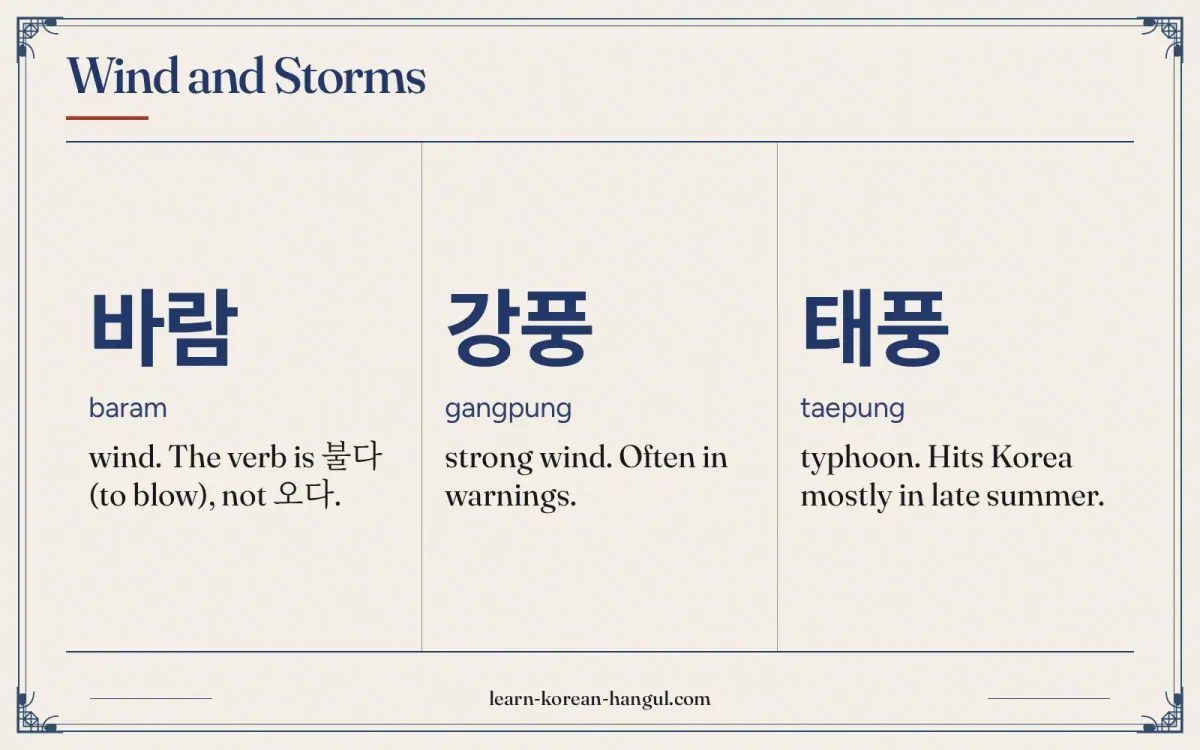
Wind is 바람, and it takes the verb 불다, to blow: 바람이 불어요. A strong wind is 강풍, a typhoon is 태풍 and a violent storm is 폭풍. 천둥 is the sound and 번개 is the flash. You see 번개 before you hear 천둥, but the set phrase is 천둥 번개. Hail is 우박, which falls with 떨어지다. See Korean Natural Disasters Vocabulary.
| No. | Hangul | Revised Romanization | Meaning and note | Example sentence | Audio assetId |
|---|---|---|---|---|---|
| 17 | 바람 | baram | wind. The verb is 불다 (to blow), not 오다. | 바람이 불어요. (The wind blows.) | au-pg-vocabulary-nature-weather-17; example: au-pg-vocabulary-nature-weather-62 |
| 18 | 강풍 | gangpung | strong wind. Often in warnings. | 강풍이 불고 있어요. (A strong wind is blowing.) | au-pg-vocabulary-nature-weather-18; example: au-pg-vocabulary-nature-weather-63 |
| 19 | 태풍 | taepung | typhoon. Hits Korea mostly in late summer. | 태풍이 와요. (A typhoon is coming.) | au-pg-vocabulary-nature-weather-19; example: au-pg-vocabulary-nature-weather-64 |
| 20 | 천둥 | cheondung | thunder. Often followed by 소리 (sound). | 천둥소리가 커요. (The thunder is loud.) | au-pg-vocabulary-nature-weather-20; example: au-pg-vocabulary-nature-weather-65 |
| 21 | 번개 | beongae | lightning. Verb is 치다 (to strike). | 번개가 쳤어요. (Lightning struck.) | au-pg-vocabulary-nature-weather-21; example: au-pg-vocabulary-nature-weather-66 |
| 22 | 우박 | ubak | hail. Verb 떨어지다 (to fall). | 우박이 떨어졌어요. (Hail fell.) | au-pg-vocabulary-nature-weather-22; example: au-pg-vocabulary-nature-weather-67 |
| 23 | 폭풍 | pokpung | storm. A violent storm; 폭 means violent. | 폭풍이 지나갔어요. (The storm has passed.) | au-pg-vocabulary-nature-weather-23; example: au-pg-vocabulary-nature-weather-68 |
Typhoons reach Korea mostly in the second half of summer. The wording on a warning page uses these same nouns.
How Do You Say Temperature in Korean?
Temperature is 온도 in general and 기온 on a weather report. 체감온도 is the feels-like temperature. To say a number, use 영상 for above zero and 영하 for below zero, then the number, then 도 (degrees): 영하 십 도. Numbers in a forecast are Sino-Korean: 십, 이십, 삼십. Extreme heat and cold have their own words, 폭염 and 한파. Two common phrases are 더위를 먹다 (to suffer in the heat) and 추위를 타다 (to be sensitive to the cold).
| No. | Hangul | Revised Romanization | Meaning and note | Example sentence | Audio assetId |
|---|---|---|---|---|---|
| 24 | 온도 | ondo | temperature. General word for any degree of heat. | 방 온도가 높아요. (The room temperature is high.) | au-pg-vocabulary-nature-weather-24; example: au-pg-vocabulary-nature-weather-69 |
| 25 | 기온 | gion | air temperature. The word on weather reports. | 오늘 기온은 이십 도예요. (Today's temperature is 20 degrees.) | au-pg-vocabulary-nature-weather-25; example: au-pg-vocabulary-nature-weather-70 |
| 26 | 체감온도 | chegamondo | feels-like temperature. What the air feels like with wind. | 체감온도는 영하 오 도예요. (The feels-like temperature is minus 5 degrees.) | au-pg-vocabulary-nature-weather-26; example: au-pg-vocabulary-nature-weather-71 |
| 27 | 영상 | yeongsang | above zero. Temperature above 0 degrees. Used before the number. | 기온이 영상 삼 도예요. (The temperature is plus 3 degrees.) | au-pg-vocabulary-nature-weather-27; example: au-pg-vocabulary-nature-weather-72 |
| 28 | 영하 | yeongha | below zero. Temperature below 0. Used before the number. | 아침 기온은 영하 십 도예요. (This morning's temperature is minus 10 degrees.) | au-pg-vocabulary-nature-weather-28; example: au-pg-vocabulary-nature-weather-73 |
| 29 | 더위 | deowi | heat. The noun from 덥다 (to be hot). | 더위를 먹었어요. (I suffered in the heat.) | au-pg-vocabulary-nature-weather-29; example: au-pg-vocabulary-nature-weather-74 |
| 30 | 추위 | chuwi | cold. The noun from 춥다 (to be cold). | 추위를 많이 타요. (I feel the cold a lot.) | au-pg-vocabulary-nature-weather-30; example: au-pg-vocabulary-nature-weather-75 |
| 31 | 폭염 | pogyeom | heatwave. The standard pronunciation is [포겸]; [퐁념], with an inserted ㄴ, is also widely heard. | 폭염 주의보가 내렸어요. (A heatwave advisory has been issued.) | au-pg-vocabulary-nature-weather-31; example: au-pg-vocabulary-nature-weather-76 |
| 32 | 한파 | hanpa | cold wave. A sharp drop in temperature. | 한파가 왔어요. (A cold wave has arrived.) | au-pg-vocabulary-nature-weather-32; example: au-pg-vocabulary-nature-weather-77 |
In daily talk you rarely say the number. You say 더워요 or 추워요 and, if needed, add 영상 or 영하 with the figure.
Air Quality
Air quality is a daily topic in Korea. 미세먼지 is fine dust and 초미세먼지 is ultrafine dust. 황사 is yellow dust, blown in from desert regions in spring. Forecast apps give a grade for each, usually 좋음 (good), 보통 (normal), 나쁨 (bad) and 매우 나쁨 (very bad). People wear a 마스크 on bad days and say 공기가 나빠요 about the air.
| No. | Hangul | Revised Romanization | Meaning and note | Example sentence | Audio assetId |
|---|---|---|---|---|---|
| 33 | 미세먼지 | misemeonji | fine dust (PM10). Tiny particles in the air; very common in Korean forecasts. | 오늘은 미세먼지가 나빠요. (The fine dust is bad today.) | au-pg-vocabulary-nature-weather-33; example: au-pg-vocabulary-nature-weather-78 |
| 34 | 초미세먼지 | chomisemeonji | ultrafine dust (PM2.5). 초 means super; the particles are smaller. | 초미세먼지 농도가 높아요. (The ultrafine dust level is high.) | au-pg-vocabulary-nature-weather-34; example: au-pg-vocabulary-nature-weather-79 |
| 35 | 황사 | hwangsa | yellow dust. Sand carried by wind, mostly in spring. | 봄에는 황사가 와요. (Yellow dust comes in spring.) | au-pg-vocabulary-nature-weather-35; example: au-pg-vocabulary-nature-weather-80 |
| 36 | 안개 | angae | fog. The verb is 끼다 (to settle in). | 안개가 껴서 앞이 안 보여요. (It is foggy, so I cannot see ahead.) | au-pg-vocabulary-nature-weather-36; example: au-pg-vocabulary-nature-weather-81 |
| 37 | 공기 | gonggi | air. Said [공기]. | 공기가 맑아요. (The air is clean.) | au-pg-vocabulary-nature-weather-37; example: au-pg-vocabulary-nature-weather-82 |
| 38 | 대기 오염 | daegi oyeom | air pollution. A two-word noun phrase. | 대기 오염이 심해요. (The air pollution is severe.) | au-pg-vocabulary-nature-weather-38; example: au-pg-vocabulary-nature-weather-83 |
| 39 | 마스크 | maseukeu | face mask. Loanword; the verb is 쓰다 (to wear on the face). | 마스크를 써요. (I wear a mask.) | au-pg-vocabulary-nature-weather-39; example: au-pg-vocabulary-nature-weather-84 |
안개 is natural fog and has nothing to do with pollution. Do not translate 미세먼지 as mist; it is dust.
How Do You Say Weather Reports in Korean?
A forecast is a 일기예보 or just 예보. The government agency is 기상청. A 강수 확률 is the chance of rain, usually given in percent, and 습도 is humidity. Alerts have two levels: 주의보 is an advisory and 경보 is a warning. They are attached to the thing they warn about, as in 태풍 주의보 or 한파 경보. Reading these words lets you follow a news bulletin or a phone alert.
| No. | Hangul | Revised Romanization | Meaning and note | Example sentence | Audio assetId |
|---|---|---|---|---|---|
| 40 | 일기예보 | ilgiyebo | weather forecast. Said [일기예보]. 예보 means forecast. | 일기예보를 봤어요. (I watched the weather forecast.) | au-pg-vocabulary-nature-weather-40; example: au-pg-vocabulary-nature-weather-85 |
| 41 | 강수 확률 | gangsu hwangnyul | chance of rain. Said [강수 황뉼]. Read as a percent. | 내일 강수 확률은 팔십 퍼센트예요. (Tomorrow's chance of rain is 80 percent.) | au-pg-vocabulary-nature-weather-41; example: au-pg-vocabulary-nature-weather-86 |
| 42 | 습도 | seupdo | humidity. Said [습또]. | 습도가 높아요. (The humidity is high.) | au-pg-vocabulary-nature-weather-42; example: au-pg-vocabulary-nature-weather-87 |
| 43 | 주의보 | juuibo | advisory. The lower alert level. Said [주의보] or [주이보]. | 태풍 주의보가 내렸어요. (A typhoon advisory has been issued.) | au-pg-vocabulary-nature-weather-43; example: au-pg-vocabulary-nature-weather-88 |
| 44 | 경보 | gyeongbo | warning. The higher alert level. | 한파 경보가 내렸어요. (A cold wave warning has been issued.) | au-pg-vocabulary-nature-weather-44; example: au-pg-vocabulary-nature-weather-89 |
| 45 | 기상청 | gisangcheong | Korea Meteorological Administration. The national weather agency. | 기상청 앱을 봐요. (I check the weather agency app.) | au-pg-vocabulary-nature-weather-45; example: au-pg-vocabulary-nature-weather-90 |
A phone alert with 경보 is more serious than one with 주의보. If you see 경보 and the word for a heavy event, stay indoors and follow local instructions.
How Do You Pronounce These Words?
Several weather words have tense sounds and sound changes. Standard pronunciation follows the National Institute of Korean Language (국립국어원) rules, and the romanization follows the Revised Romanization of Korean, which does not mark every sound change.
| Spelling | Sounds like | What changes |
|---|---|---|
| 맑음 | [말금] | Before a vowel, ㄹ of the cluster ㄺ stays and ㄱ moves to the next syllable. |
| 햇빛 | [해삗] or [핻삗] | The linking ㅅ makes ㅂ tense [ㅃ], and the last sound of 빛 is [ㄷ]. |
| 폭설 | [폭썰] | After a final ㄱ, ㅅ is said as tense [ㅆ]. |
| 폭염 | [포겸] | The final ㄱ links to the next syllable. Many speakers insert ㄴ and say [퐁념], but the standard is [포겸]. |
| 강수 확률 | [강수 황뉼] | ㄱ + ㄹ: the ㄹ becomes [ㄴ], and ㄱ becomes [ㅇ]. |
| 습도 | [습또] | After a final ㅂ, ㄷ is said as tense [ㄸ]. |
Tensing after a stop is the pattern to master: ㄱ, ㅂ or ㅅ at the end of a syllable makes the next ㄷ, ㅅ or ㅂ tight. Say 폭설 with a clear stop after 폭 and no breath on the next sound.
Audio and Slow Playback
Each word and sentence has its own clip. The five clips below replay the hardest words slowly. Play one, repeat it aloud, then play it again and compare.
What Mistakes Do Learners Make with Weather Words?
Five mistakes come up again and again.
- Using the wrong verb with wind. 바람이 와요 is wrong. Wind blows: 바람이 불어요. Rain and snow come: 비가 와요, 눈이 와요.
- Reading 미세먼지 as mist. It means fine dust. Mist or light fog is 안개.
- Saying the minus sign. Say 영하 오 도, not 마이너스 오 도, in a forecast. In casual speech, 마이너스 is also heard.
- Using 맑음 in speech. On a forecast 맑음 is fine. In conversation say 날씨가 맑아요 or just 맑아요.
- Mixing 온도 and 기온. Use 기온 for the air outside and 온도 for a room, a bath or a drink.
These mistakes are mostly about which verb or noun fits which context. Once those are clear, the vocabulary falls into place. The practice section turns the list into drills.
Practice: Flashcards and Worksheet
Use three steps. Run the flashcard deck in recognition mode until the 45 words come quickly. Switch to listening mode, then take the quiz. The deck holds every word on this page with audio, and your progress stays in your browser. The vocabulary flashcard decks page lists the other decks.
Practice · 95
- 01날씨
Show answer
headword 1: weather
- 02하늘
Show answer
headword 2: sky
- 03해
Show answer
headword 3: sun
- 04햇빛
Show answer
headword 4: sunlight
- 05구름
Show answer
headword 5: cloud
- 06맑음
Show answer
headword 6: clear (sky)
- 07흐림
Show answer
headword 7: cloudy
- 08무지개
Show answer
headword 8: rainbow
- 09비
Show answer
headword 9: rain
- 10소나기
Show answer
headword 10: sudden shower
- 11장마
Show answer
headword 11: rainy season
- 12폭우
Show answer
headword 12: downpour
- 13눈
Show answer
headword 13: snow
- 14폭설
Show answer
headword 14: heavy snowfall
- 15진눈깨비
Show answer
headword 15: sleet
- 16서리
Show answer
headword 16: frost
- 17바람
Show answer
headword 17: wind
- 18강풍
Show answer
headword 18: strong wind
- 19태풍
Show answer
headword 19: typhoon
- 20천둥
Show answer
headword 20: thunder
- 21번개
Show answer
headword 21: lightning
- 22우박
Show answer
headword 22: hail
- 23폭풍
Show answer
headword 23: storm
- 24온도
Show answer
headword 24: temperature
- 25기온
Show answer
headword 25: air temperature
- 26체감온도
Show answer
headword 26: feels-like temperature
- 27영상
Show answer
headword 27: above zero
- 28영하
Show answer
headword 28: below zero
- 29더위
Show answer
headword 29: heat
- 30추위
Show answer
headword 30: cold
- 31폭염
Show answer
headword 31: heatwave
- 32한파
Show answer
headword 32: cold wave
- 33미세먼지
Show answer
headword 33: fine dust (PM10)
- 34초미세먼지
Show answer
headword 34: ultrafine dust (PM2.5)
- 35황사
Show answer
headword 35: yellow dust
- 36안개
Show answer
headword 36: fog
- 37공기
Show answer
headword 37: air
- 38대기 오염
Show answer
headword 38: air pollution
- 39마스크
Show answer
headword 39: face mask
- 40일기예보
Show answer
headword 40: weather forecast
- 41강수 확률
Show answer
headword 41: chance of rain
- 42습도
Show answer
headword 42: humidity
- 43주의보
Show answer
headword 43: advisory
- 44경보
Show answer
headword 44: warning
- 45기상청
Show answer
headword 45: Korea Meteorological Administration
- 46오늘 날씨 어때요?
Show answer
example sentence for 날씨
- 47하늘이 파래요.
Show answer
example sentence for 하늘
- 48해가 떴어요.
Show answer
example sentence for 해
- 49햇빛이 강해요.
Show answer
example sentence for 햇빛
- 50구름이 많아요.
Show answer
example sentence for 구름
- 51내일은 맑음이에요.
Show answer
example sentence for 맑음
- 52오후에는 흐림이에요.
Show answer
example sentence for 흐림
- 53무지개가 떴어요.
Show answer
example sentence for 무지개
- 54비가 와요.
Show answer
example sentence for 비
- 55갑자기 소나기가 왔어요.
Show answer
example sentence for 소나기
- 56장마가 끝났어요.
Show answer
example sentence for 장마
- 57폭우 때문에 길이 막혀요.
Show answer
example sentence for 폭우
- 58눈이 내려요.
Show answer
example sentence for 눈
- 59폭설이 내렸어요.
Show answer
example sentence for 폭설
- 60진눈깨비가 와요.
Show answer
example sentence for 진눈깨비
- 61아침에 서리가 내렸어요.
Show answer
example sentence for 서리
- 62바람이 불어요.
Show answer
example sentence for 바람
- 63강풍이 불고 있어요.
Show answer
example sentence for 강풍
- 64태풍이 와요.
Show answer
example sentence for 태풍
- 65천둥소리가 커요.
Show answer
example sentence for 천둥
- 66번개가 쳤어요.
Show answer
example sentence for 번개
- 67우박이 떨어졌어요.
Show answer
example sentence for 우박
- 68폭풍이 지나갔어요.
Show answer
example sentence for 폭풍
- 69방 온도가 높아요.
Show answer
example sentence for 온도
- 70오늘 기온은 이십 도예요.
Show answer
example sentence for 기온
- 71체감온도는 영하 오 도예요.
Show answer
example sentence for 체감온도
- 72기온이 영상 삼 도예요.
Show answer
example sentence for 영상
- 73아침 기온은 영하 십 도예요.
Show answer
example sentence for 영하
- 74더위를 먹었어요.
Show answer
example sentence for 더위
- 75추위를 많이 타요.
Show answer
example sentence for 추위
- 76폭염 주의보가 내렸어요.
Show answer
example sentence for 폭염
- 77한파가 왔어요.
Show answer
example sentence for 한파
- 78오늘은 미세먼지가 나빠요.
Show answer
example sentence for 미세먼지
- 79초미세먼지 농도가 높아요.
Show answer
example sentence for 초미세먼지
- 80봄에는 황사가 와요.
Show answer
example sentence for 황사
- 81안개가 껴서 앞이 안 보여요.
Show answer
example sentence for 안개
- 82공기가 맑아요.
Show answer
example sentence for 공기
- 83대기 오염이 심해요.
Show answer
example sentence for 대기 오염
- 84마스크를 써요.
Show answer
example sentence for 마스크
- 85일기예보를 봤어요.
Show answer
example sentence for 일기예보
- 86내일 강수 확률은 팔십 퍼센트예요.
Show answer
example sentence for 강수 확률
- 87습도가 높아요.
Show answer
example sentence for 습도
- 88태풍 주의보가 내렸어요.
Show answer
example sentence for 주의보
- 89한파 경보가 내렸어요.
Show answer
example sentence for 경보
- 90기상청 앱을 봐요.
Show answer
example sentence for 기상청
- 91미세먼지
Show answer
slow playback: 미세먼지
- 92폭염
Show answer
slow playback: 폭염
- 93강수 확률
Show answer
slow playback: 강수 확률
- 94맑음
Show answer
slow playback: 맑음
- 95햇빛
Show answer
slow playback: 햇빛
Practice · 5
What does 구름 (gureum) mean?
Show answer
cloud
구름 means cloud. Example: 구름이 많아요. (There are many clouds.)
What does 비 (bi) mean?
Show answer
rain
비 means rain. Example: 비가 와요. (It rains.)
What does 폭우 (pogu) mean?
Show answer
downpour
폭우 means downpour. Example: 폭우 때문에 길이 막혀요. (The roads are jammed because of the downpour.)
What does 기온 (gion) mean?
Show answer
air temperature
기온 means air temperature. Example: 오늘 기온은 이십 도예요. (Today's temperature is 20 degrees.)
What does 한파 (hanpa) mean?
Show answer
cold wave
한파 means cold wave. Example: 한파가 왔어요. (A cold wave has arrived.)
Korean Weather Vocabulary Worksheet (PDF)
A printable worksheet for these words (word list, matching, writing practice, fill-in-the-blank exercises and answer key) is available in A4 and US Letter from the download card on this page. For practice, write today's weather in Korean each morning: 오늘은 맑아요, then the 기온.
Where to Go Next
After this page, continue with Korean Natural Disasters Vocabulary or Animals. For summer and winter patterns, see Seasons. To move up a level, return to Nature and the World.
Pages in This Section
See Korean Natural Disasters Vocabulary.
Frequently Asked Questions
How Do You Say Cloud in Korean?
Cloud is 구름 (gureum). Say 구름이 많아요 for there are many clouds, and 구름이 꼈어요 for it has clouded over. The word has no plural marking, so one cloud and many clouds are both 구름. On a forecast, a cloudy sky is written 흐림 or 구름 많음.
How Do You Pronounce 미세먼지 (misemeonji)?
Say mi-se-meon-ji with four even syllables. The word is not changed by any sound rule, so it is said as spelled. 미세 means tiny and 먼지 means dust. Press the audio button on this page to hear the word and the slow clip.
How Many Weather Words Should I Learn First?
Start with about ten: 날씨, 비, 눈, 바람, 구름, 더워요, 추워요, 미세먼지, 장마 and 태풍. With them you can answer 오늘 날씨 어때요? on most days. The whole list of 45 takes about nine days at five new words a day, with a short review of earlier words each day.
Where Can I Practise Weather Words with Flashcards?
Use the deck on this page, which holds all 45 words with Hangul, romanization and audio, in recognition and listening modes. The vocabulary flashcard decks page lists the decks for seasons, plants and other nature topics. Progress is saved only in your browser.
Is the Romanization on This Page Official?
It follows the Revised Romanization of Korean, which South Korea adopted on 7 July 2000 and whose rules the National Institute of Korean Language (국립국어원) publishes. It is a learning aid and does not mark every sound change, so rely on the Hangul and the audio.
Is There a Printable Worksheet for Weather Words?
A printable worksheet for these words (word list, matching, writing practice, fill-in-the-blank exercises and answer key) is available in A4 and US Letter from the download card on this page. For practice, use the flashcard deck, which carries the same 45 words, or copy the tables by hand. Writing one line about the weather each morning is a quick daily drill.