Korean Natural Disasters Vocabulary at a Glance
Korea has a monsoon rainy season, typhoons in late summer and autumn, heavy snow in some winters, wildfires in dry spring weather and occasional earthquakes. News, weather forecasts and phone alerts all use a set vocabulary for these events. Learning it helps you read a forecast, understand an alert on your phone and talk about the news. This list starts with the general words and storms, then covers floods and drought, earthquakes, fires, and the words of safety and alerts. It sits in Weather. For single-word lookups, see typhoon in Korean and earthquake in Korean.
| Group | Words | Use |
|---|---|---|
| Disaster words and storms | 6 | General disaster words, typhoons, wind, rain and snow |
| Floods and drought | 6 | Floods, landslides, the rainy season and drought |
| Earthquakes | 6 | Quakes, magnitude, aftershocks, tsunamis and volcanoes |
| Fire | 6 | Fire, wildfire, smoke and the people who respond |
| Safety and alerts | 6 | Phone alerts, alert levels, evacuation and rescue |
Which Natural Disaster Words Should You Learn First?
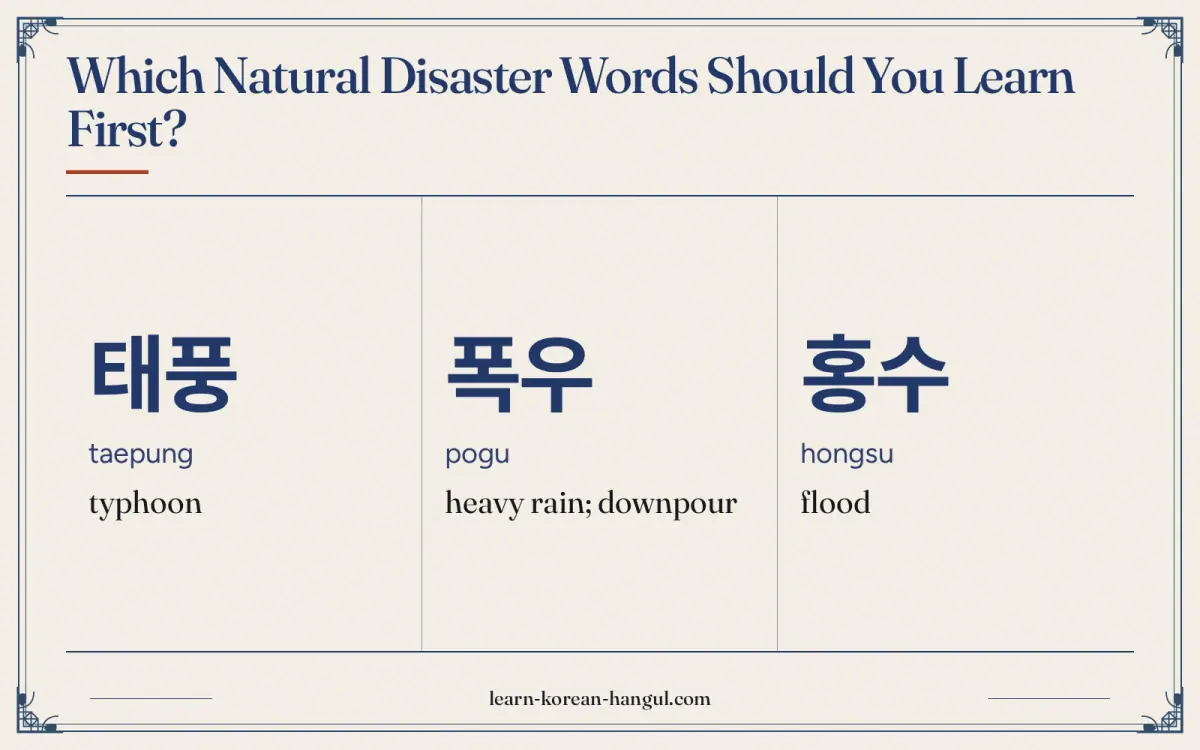
Learn 태풍, 지진, 홍수, 산불, 대피 and 재난 문자 first. They are the words you are most likely to see on a phone, on television or on a sign. Add 경보 and 주의보 next, since the difference between them tells you how serious a forecast is.
- Words to say. 태풍, 지진, 홍수, 산불, 불, 대피.
- Words to recognise. 재난 문자, 경보, 주의보, 대피소, 침수. They appear on phones, in forecasts and on signs.
- Words to match. 규모, 진도, 여진. Match them to the news after an earthquake.
Many disaster words are Sino-Korean, and the second syllable often tells you the type. 풍 means wind (태풍, 강풍, 폭풍), 우 means rain (폭우), 설 means snow (폭설) and 폭 at the start means violent or sudden. The scene below shows a coast and a mountain with numbered events that match the list.
Word · 10
- 1
태풍
taepung
typhoon
- 2
폭우
pogu
heavy rain; downpour
- 3
홍수
hongsu
flood
- 4
장마
jangma
rainy season; monsoon
- 5
가뭄
gamum
drought
- 6
지진
jijin
earthquake
- 7
화산
hwasan
volcano
- 8
산불
sanbul
wildfire; forest fire
- 9
경보
gyeongbo
warning (severe alert level)
- 10
대피소
daepiso
shelter; evacuation centre
Storms and General Disaster Words
Two general words open the list. 자연재해 is a natural disaster, and 재난 is a wider word for any disaster, including accidents. Then come the storm words. 태풍 is a typhoon, the big storm that arrives from the south in summer and early autumn. 강풍 is strong wind and 폭우 is heavy rain. 폭설 is heavy snow. The prefix 폭 means violent or sudden, and it shows up in many weather words.
| No. | Hangul | Revised Romanization | Meaning and note | Example sentence | Audio assetId |
|---|---|---|---|---|---|
| 1 | 자연재해 | jayeonjaehae | natural disaster. 자연 is nature and 재해 is damage or disaster. The standard term in news and law. | 자연재해는 갑자기 와요. (Natural disasters come suddenly.) | au-pg-vocabulary-nature-weather-natural-disasters-1; example: au-pg-vocabulary-nature-weather-natural-disasters-31 |
| 2 | 재난 | jaenan | disaster; calamity. A wider word. It covers natural and man-made events. Seen in 재난 문자. | 재난 상황에서는 침착해야 해요. (In a disaster you must stay calm.) | au-pg-vocabulary-nature-weather-natural-disasters-2; example: au-pg-vocabulary-nature-weather-natural-disasters-32 |
| 3 | 태풍 | taepung | typhoon. Used in forecasts with a number or name. The season runs through late summer and autumn. | 태풍이 오고 있어요. (A typhoon is coming.) | au-pg-vocabulary-nature-weather-natural-disasters-3; example: au-pg-vocabulary-nature-weather-natural-disasters-33 |
| 4 | 강풍 | gangpung | strong wind; gale. 강 means strong and 풍 means wind. Often paired with 주의보. | 강풍 때문에 나무가 쓰러졌어요. (A tree fell because of the strong wind.) | au-pg-vocabulary-nature-weather-natural-disasters-4; example: au-pg-vocabulary-nature-weather-natural-disasters-34 |
| 5 | 폭우 | pogu | heavy rain; downpour. Said [포구]: the final ㄱ links to the vowel of 우. 폭 means violent. | 밤새 폭우가 내렸어요. (Heavy rain fell all night.) | au-pg-vocabulary-nature-weather-natural-disasters-5; example: au-pg-vocabulary-nature-weather-natural-disasters-35 |
| 6 | 폭설 | pokseol | heavy snow; snowstorm. Said [폭썰]. After final ㄱ, ㅅ is tense. | 폭설로 길이 막혔어요. (The road was blocked by heavy snow.) | au-pg-vocabulary-nature-weather-natural-disasters-6; example: au-pg-vocabulary-nature-weather-natural-disasters-36 |
Example Sentences
Disaster sentences use three simple frames. The first is event + 이/가 + verb, as in 태풍이 오고 있어요 (a typhoon is coming), where 오고 있어요 is the present progressive. The second is cause + 때문에 + result, as in 강풍 때문에 나무가 쓰러졌어요 (because of the wind a tree fell). The third is cause + 로 + result, as in 폭설로 길이 막혔어요 (the road was blocked by snow). Most news sentences use the past tense, such as 내렸어요 or 쓰러졌어요, since they describe what already happened. Read each sentence aloud after its audio.
Storms often lead to the next group: too much water, or too little.
How Do You Say Floods and Drought in Korean?
Six words cover water in excess and in shortage. 홍수 is a flood and 침수 is when an area is flooded or submerged, for example a street or a basement. 산사태 is a landslide, which often follows heavy rain on a mountain. 장마 is the summer rainy season, a regular event and not a disaster in itself. 가뭄 is a drought, and 해일 is a storm surge or big wave that breaks over the coast.
| No. | Hangul | Revised Romanization | Meaning and note | Example sentence | Audio assetId |
|---|---|---|---|---|---|
| 7 | 홍수 | hongsu | flood. A large flood. The usual word in the news and in forecasts. | 홍수로 마을이 잠겼어요. (The village was flooded.) | au-pg-vocabulary-nature-weather-natural-disasters-7; example: au-pg-vocabulary-nature-weather-natural-disasters-37 |
| 8 | 침수 | chimsu | flooding; being submerged. Used for roads, houses and cars under water. The verb is 침수되다. | 지하 주차장이 침수됐어요. (The underground car park was flooded.) | au-pg-vocabulary-nature-weather-natural-disasters-8; example: au-pg-vocabulary-nature-weather-natural-disasters-38 |
| 9 | 산사태 | sansatae | landslide. 산 is mountain and 사태 here is a slide of earth and rocks (a different word from 사태, situation). | 비가 많이 오면 산사태가 날 수 있어요. (If it rains a lot a landslide can happen.) | au-pg-vocabulary-nature-weather-natural-disasters-9; example: au-pg-vocabulary-nature-weather-natural-disasters-39 |
| 10 | 장마 | jangma | rainy season; monsoon. Starts in early summer. People carry an umbrella and dry clothes indoors. | 장마가 시작됐어요. (The rainy season has started.) | au-pg-vocabulary-nature-weather-natural-disasters-10; example: au-pg-vocabulary-nature-weather-natural-disasters-40 |
| 11 | 가뭄 | gamum | drought. A long dry spell. Water use rules often follow a drought. | 올해는 가뭄이 심해요. (This year the drought is severe.) | au-pg-vocabulary-nature-weather-natural-disasters-11; example: au-pg-vocabulary-nature-weather-natural-disasters-41 |
| 12 | 해일 | haeil | storm surge; tidal wave. The sea rises over the shore. A tsunami is 쓰나미 or 지진해일. | 해일이 해안을 덮쳤어요. (A storm surge hit the coast.) | au-pg-vocabulary-nature-weather-natural-disasters-12; example: au-pg-vocabulary-nature-weather-natural-disasters-42 |
장마 and 홍수 are not the same. 장마 is a season that comes every year, and 홍수 is a flood that comes from too much rain.
Earthquakes
Earthquake vocabulary is short and precise. 지진 is an earthquake. 규모 is the magnitude, the size of the quake as a number, and 진도 is the intensity, how strongly the ground shook in a given place. 여진 is an aftershock. 쓰나미 is a tsunami, written with an English loanword, and 화산 is a volcano. The two numbers are easy to mix up: 규모 describes the quake as a whole, while 진도 changes from place to place.
| No. | Hangul | Revised Romanization | Meaning and note | Example sentence | Audio assetId |
|---|---|---|---|---|---|
| 13 | 지진 | jijin | earthquake. 지 is earth and 진 is shaking. The verb for it happening is 나다 or 발생하다. | 어젯밤에 지진이 났어요. (An earthquake happened last night.) | au-pg-vocabulary-nature-weather-natural-disasters-13; example: au-pg-vocabulary-nature-weather-natural-disasters-43 |
| 14 | 규모 | gyumo | magnitude; scale. The size of a quake. The same word also means scale or size in general. | 규모가 커요. (The magnitude is large.) | au-pg-vocabulary-nature-weather-natural-disasters-14; example: au-pg-vocabulary-nature-weather-natural-disasters-44 |
| 15 | 진도 | jindo | seismic intensity. The same sound is the island Jindo and the word for progress through a course. Context decides. | 진도는 장소마다 달라요. (The intensity differs from place to place.) | au-pg-vocabulary-nature-weather-natural-disasters-15; example: au-pg-vocabulary-nature-weather-natural-disasters-45 |
| 16 | 여진 | yeojin | aftershock. 여 means remaining. The shaking that follows a big quake. | 여진이 계속 있어요. (The aftershocks continue.) | au-pg-vocabulary-nature-weather-natural-disasters-16; example: au-pg-vocabulary-nature-weather-natural-disasters-46 |
| 17 | 쓰나미 | sseunami | tsunami. A loanword from Japanese. The formal term in news is 지진해일. | 쓰나미가 오면 높은 곳으로 가요. (If a tsunami comes, go to high ground.) | au-pg-vocabulary-nature-weather-natural-disasters-17; example: au-pg-vocabulary-nature-weather-natural-disasters-47 |
| 18 | 화산 | hwasan | volcano. Korea has volcanic mountains, such as Hallasan on Jeju. | 한라산은 화산이에요. (Hallasan is a volcano.) | au-pg-vocabulary-nature-weather-natural-disasters-18; example: au-pg-vocabulary-nature-weather-natural-disasters-48 |
Learn 규모 and 진도 as a pair. The news may report both after a quake, and they are not the same number.
How Do You Say Fire in Korean?
Fire has three common words. 불 is the everyday word for fire, and also for a light, so 불을 켜다 means to turn on a light. 화재 is a fire as an event or accident, the word in news and reports. 산불 is a wildfire, which most often affects Korea in the dry months of spring. 연기 is smoke, 소화기 is a fire extinguisher and 소방관 is a firefighter.
| No. | Hangul | Revised Romanization | Meaning and note | Example sentence | Audio assetId |
|---|---|---|---|---|---|
| 19 | 불 | bul | fire; light. With 이 it is 불이 [부리]. Also a light, as in 불을 끄다 (turn off the light). | 불이 났어요. (A fire broke out.) | au-pg-vocabulary-nature-weather-natural-disasters-19; example: au-pg-vocabulary-nature-weather-natural-disasters-49 |
| 20 | 화재 | hwajae | fire (accident); blaze. The formal word. Seen on signs, in news and in reports. | 건물에서 화재가 발생했어요. (A fire broke out in the building.) | au-pg-vocabulary-nature-weather-natural-disasters-20; example: au-pg-vocabulary-nature-weather-natural-disasters-50 |
| 21 | 산불 | sanbul | wildfire; forest fire. Said [산뿔]. The tense ㅃ marks a compound of mountain and fire. | 건조한 날씨에는 산불이 자주 나요. (In dry weather, wildfires break out often.) | au-pg-vocabulary-nature-weather-natural-disasters-21; example: au-pg-vocabulary-nature-weather-natural-disasters-51 |
| 22 | 연기 | yeongi | smoke. The same spelling also means acting, as in 연기를 하다. The sentence decides. | 연기가 많이 나요. (A lot of smoke is coming out.) | au-pg-vocabulary-nature-weather-natural-disasters-22; example: au-pg-vocabulary-nature-weather-natural-disasters-52 |
| 23 | 소화기 | sohwagi | fire extinguisher. 소화 is putting out a fire, and 기 is a device. Look for a red one in a building. | 소화기는 어디에 있어요? (Where is the fire extinguisher?) | au-pg-vocabulary-nature-weather-natural-disasters-23; example: au-pg-vocabulary-nature-weather-natural-disasters-53 |
| 24 | 소방관 | sobanggwan | firefighter. 소방 is fire fighting and 관 is an official. The fire station is 소방서. | 소방관이 불을 꺼요. (The firefighter puts out the fire.) | au-pg-vocabulary-nature-weather-natural-disasters-24; example: au-pg-vocabulary-nature-weather-natural-disasters-54 |
불 and 화재 are not the same register. Call out 불이야 (Fire) in danger, and write 화재 in a report.
Safety and Alerts
The last group is the vocabulary of official alerts. 재난 문자 is the disaster text message that your phone shows, usually with a loud tone. 경보 is a warning, the serious alert level, and 주의보 is an advisory, the earlier and lower alert level. 대피 is evacuation, 대피소 is a shelter and 구급차 is an ambulance. In an emergency in Korea, 119 is the number for fire and ambulance, and 112 is for the police. The Korea Meteorological Administration (기상청, kma.go.kr) issues weather alerts, and the Ministry of the Interior and Safety (행정안전부) handles disaster safety.
| No. | Hangul | Revised Romanization | Meaning and note | Example sentence | Audio assetId |
|---|---|---|---|---|---|
| 25 | 재난 문자 | jaenan munja | disaster alert text message. Said [재난 문짜]. Sent to phones in the affected area. | 재난 문자를 받았어요. (I received a disaster alert text.) | au-pg-vocabulary-nature-weather-natural-disasters-25; example: au-pg-vocabulary-nature-weather-natural-disasters-55 |
| 26 | 경보 | gyeongbo | warning (severe alert level). Higher than 주의보. A 태풍 경보 means a serious typhoon threat. | 태풍 경보가 내려졌어요. (A typhoon warning has been issued.) | au-pg-vocabulary-nature-weather-natural-disasters-26; example: au-pg-vocabulary-nature-weather-natural-disasters-56 |
| 27 | 주의보 | juuibo | advisory (early alert level). Said [주의보] or [주이보]. The lower level, issued before 경보. | 강풍 주의보가 내려졌어요. (A strong wind advisory has been issued.) | au-pg-vocabulary-nature-weather-natural-disasters-27; example: au-pg-vocabulary-nature-weather-natural-disasters-57 |
| 28 | 대피 | daepi | evacuation; taking shelter. The verb is 대피하다, and the polite command is 대피하세요. | 빨리 대피하세요. (Please evacuate quickly.) | au-pg-vocabulary-nature-weather-natural-disasters-28; example: au-pg-vocabulary-nature-weather-natural-disasters-58 |
| 29 | 대피소 | daepiso | shelter; evacuation centre. A safe place such as a school or hall, marked with a sign. | 가까운 대피소를 찾아요. (I look for the nearest shelter.) | au-pg-vocabulary-nature-weather-natural-disasters-29; example: au-pg-vocabulary-nature-weather-natural-disasters-59 |
| 30 | 구급차 | gugeupcha | ambulance. Call 119. The ambulance is dispatched by the fire and rescue service. | 구급차를 불러요. (I call an ambulance.) | au-pg-vocabulary-nature-weather-natural-disasters-30; example: au-pg-vocabulary-nature-weather-natural-disasters-60 |
The table below shows how a typical alert text is built. The example was written for this page to show the pattern. Real messages come from the authorities and their wording varies.
| Part of the message | Korean | Meaning |
|---|---|---|
| Sender tag | [행정안전부] | Ministry of the Interior and Safety |
| Alert type | 태풍 경보 | typhoon warning |
| Instruction 1 | 외출을 자제하세요. | Please avoid going out. |
| Instruction 2 | 안전한 곳으로 대피하세요. | Please evacuate to a safe place. |
Read it as one message: [행정안전부] 태풍 경보. 외출을 자제하세요. 안전한 곳으로 대피하세요. The alert type comes first, and the verbs end in 세요, a polite command. For other emergency language, see emergency phrases.
How Do You Pronounce These Words?
Disaster words are mostly said as written, but several have a tense consonant or a linking sound. Standard pronunciation follows the National Institute of Korean Language (국립국어원) rules, and the romanization follows the Revised Romanization of Korean, which writes linking (pogu) but does not show tensing caused by a neighbouring sound.
| Spelling | Sounds like | What changes |
|---|---|---|
| 폭우 | [포구] | The final ㄱ links to the vowel of 우. The Revised Romanization writes pogu. |
| 폭설 | [폭썰] | After final ㄱ, ㅅ becomes tense [ㅆ]. |
| 산불 | [산뿔] | The ㅂ is tense in this compound. |
| 재난 문자 | [재난 문짜] | The ㅈ of 문자 is tense [ㅉ] in this word. |
| 주의보 | [주의보] or [주이보] | The 의 in the middle of a word is often said as 이. |
| 불이 | [부리] | The final ㄹ links to the vowel of 이. |
The tense sounds in 폭설 and 산불 are the hardest. Close your throat slightly and say the sound without a puff of air. Compare the plain ㅅ in 소방관 and the plain ㅂ in 대피.
Audio and Slow Playback
Each word and sentence has its own clip. The five clips below replay the hardest words slowly. Play one, repeat it aloud, then play it again and compare.
What Mistakes Do Learners Make with Natural Disaster Words?
Five mistakes come up again and again.
- Mixing up 경보 and 주의보. 주의보 is the earlier, lower alert, and 경보 is the serious one. A 경보 means more danger than a 주의보.
- Mixing up 규모 and 진도. 규모 is the magnitude of the quake, and 진도 is how strongly it was felt in a place.
- Using 재난 for only natural events. 재난 covers any disaster, and 자연재해 is the term for natural ones.
- Confusing 장마 with a flood. 장마 is the rainy season and 홍수 is a flood.
- Pausing in the middle of 폭우. Say it as [포구], with the ㄱ linked to 우.
The practice section turns the list into drills.
Practice: Flashcards and Worksheet
Use three steps. Run the flashcard deck in recognition mode until the 30 words come quickly. Switch to listening mode, then take the quiz. The deck holds every word on this page with audio, and your progress stays in your browser. The vocabulary flashcard decks page lists the other decks.
Practice · 65
- 01자연재해
Show answer
headword 1: natural disaster
- 02재난
Show answer
headword 2: disaster; calamity
- 03태풍
Show answer
headword 3: typhoon
- 04강풍
Show answer
headword 4: strong wind; gale
- 05폭우
Show answer
headword 5: heavy rain; downpour
- 06폭설
Show answer
headword 6: heavy snow; snowstorm
- 07홍수
Show answer
headword 7: flood
- 08침수
Show answer
headword 8: flooding; being submerged
- 09산사태
Show answer
headword 9: landslide
- 10장마
Show answer
headword 10: rainy season; monsoon
- 11가뭄
Show answer
headword 11: drought
- 12해일
Show answer
headword 12: storm surge; tidal wave
- 13지진
Show answer
headword 13: earthquake
- 14규모
Show answer
headword 14: magnitude; scale
- 15진도
Show answer
headword 15: seismic intensity
- 16여진
Show answer
headword 16: aftershock
- 17쓰나미
Show answer
headword 17: tsunami
- 18화산
Show answer
headword 18: volcano
- 19불
Show answer
headword 19: fire; light
- 20화재
Show answer
headword 20: fire (accident); blaze
- 21산불
Show answer
headword 21: wildfire; forest fire
- 22연기
Show answer
headword 22: smoke
- 23소화기
Show answer
headword 23: fire extinguisher
- 24소방관
Show answer
headword 24: firefighter
- 25재난 문자
Show answer
headword 25: disaster alert text message
- 26경보
Show answer
headword 26: warning (severe alert level)
- 27주의보
Show answer
headword 27: advisory (early alert level)
- 28대피
Show answer
headword 28: evacuation; taking shelter
- 29대피소
Show answer
headword 29: shelter; evacuation centre
- 30구급차
Show answer
headword 30: ambulance
- 31자연재해는 갑자기 와요.
Show answer
example sentence for 자연재해
- 32재난 상황에서는 침착해야 해요.
Show answer
example sentence for 재난
- 33태풍이 오고 있어요.
Show answer
example sentence for 태풍
- 34강풍 때문에 나무가 쓰러졌어요.
Show answer
example sentence for 강풍
- 35밤새 폭우가 내렸어요.
Show answer
example sentence for 폭우
- 36폭설로 길이 막혔어요.
Show answer
example sentence for 폭설
- 37홍수로 마을이 잠겼어요.
Show answer
example sentence for 홍수
- 38지하 주차장이 침수됐어요.
Show answer
example sentence for 침수
- 39비가 많이 오면 산사태가 날 수 있어요.
Show answer
example sentence for 산사태
- 40장마가 시작됐어요.
Show answer
example sentence for 장마
- 41올해는 가뭄이 심해요.
Show answer
example sentence for 가뭄
- 42해일이 해안을 덮쳤어요.
Show answer
example sentence for 해일
- 43어젯밤에 지진이 났어요.
Show answer
example sentence for 지진
- 44규모가 커요.
Show answer
example sentence for 규모
- 45진도는 장소마다 달라요.
Show answer
example sentence for 진도
- 46여진이 계속 있어요.
Show answer
example sentence for 여진
- 47쓰나미가 오면 높은 곳으로 가요.
Show answer
example sentence for 쓰나미
- 48한라산은 화산이에요.
Show answer
example sentence for 화산
- 49불이 났어요.
Show answer
example sentence for 불
- 50건물에서 화재가 발생했어요.
Show answer
example sentence for 화재
- 51건조한 날씨에는 산불이 자주 나요.
Show answer
example sentence for 산불
- 52연기가 많이 나요.
Show answer
example sentence for 연기
- 53소화기는 어디에 있어요?
Show answer
example sentence for 소화기
- 54소방관이 불을 꺼요.
Show answer
example sentence for 소방관
- 55재난 문자를 받았어요.
Show answer
example sentence for 재난 문자
- 56태풍 경보가 내려졌어요.
Show answer
example sentence for 경보
- 57강풍 주의보가 내려졌어요.
Show answer
example sentence for 주의보
- 58빨리 대피하세요.
Show answer
example sentence for 대피
- 59가까운 대피소를 찾아요.
Show answer
example sentence for 대피소
- 60구급차를 불러요.
Show answer
example sentence for 구급차
- 61폭우
Show answer
slow playback: 폭우
- 62폭설
Show answer
slow playback: 폭설
- 63산불
Show answer
slow playback: 산불
- 64재난 문자
Show answer
slow playback: 재난 문자
- 65주의보
Show answer
slow playback: 주의보
Practice · 5
What does 태풍 (taepung) mean?
Show answer
typhoon
태풍 means typhoon. Example: 태풍이 오고 있어요. (A typhoon is coming.)
What does 홍수 (hongsu) mean?
Show answer
flood
홍수 means flood. Example: 홍수로 마을이 잠겼어요. (The village was flooded.)
What does 지진 (jijin) mean?
Show answer
earthquake
지진 means earthquake. Example: 어젯밤에 지진이 났어요. (An earthquake happened last night.)
What does 경보 (gyeongbo) mean?
Show answer
warning (severe alert level)
경보 means warning (severe alert level). Example: 태풍 경보가 내려졌어요. (A typhoon warning has been issued.)
What does 주의보 (juuibo) mean?
Show answer
advisory (early alert level)
주의보 means advisory (early alert level). Example: 강풍 주의보가 내려졌어요. (A strong wind advisory has been issued.)
Korean Natural Disasters Vocabulary Worksheet (PDF)
A printable worksheet for these words (word list, matching, writing practice, fill-in-the-blank exercises and answer key) is available in A4 and US Letter from the download card on this page. For practice, copy the sample alert text above and underline the alert type and the two instructions.
Where to Go Next
After this page, return to everyday weather on Weather, or look at the words for the landscape on Korean Landscape Words. For help in an emergency, see emergency phrases.
Frequently Asked Questions
How Do You Say Natural Disaster in Korean?
Natural disaster is 자연재해 (jayeonjaehae). The wider word 재난 (jaenan) means any disaster, including accidents. Say 자연재해는 갑자기 와요 for natural disasters come suddenly.
How Do You Say Typhoon and Earthquake in Korean?
Typhoon is 태풍 (taepung) and earthquake is 지진 (jijin). Say 태풍이 오고 있어요 for a typhoon is coming, and 어젯밤에 지진이 났어요 for an earthquake happened last night.
What Is the Difference between 경보 and 주의보?
Both are weather alerts from the Korea Meteorological Administration (기상청). 주의보 is an advisory, the lower and earlier level. 경보 is a warning, the higher level. A 경보 means more serious danger than a 주의보.
What Is a 재난 문자?
재난 문자 is a disaster alert text sent to phones in an affected area. It names the alert type and gives an instruction, such as 대피하세요 (please evacuate). The sample on this page was written to show the pattern.
How Many Natural Disaster Words Should I Learn First?
Start with about six: 태풍, 지진, 홍수, 산불, 대피 and 재난 문자. The whole list of 30 takes about six days at five new words a day, with review.
Is the Romanization on This Page Official?
It follows the Revised Romanization of Korean, which South Korea adopted on 7 July 2000 and whose rules the National Institute of Korean Language (국립국어원) publishes. It is a learning aid and does not mark every sound change, so rely on the Hangul and the audio.