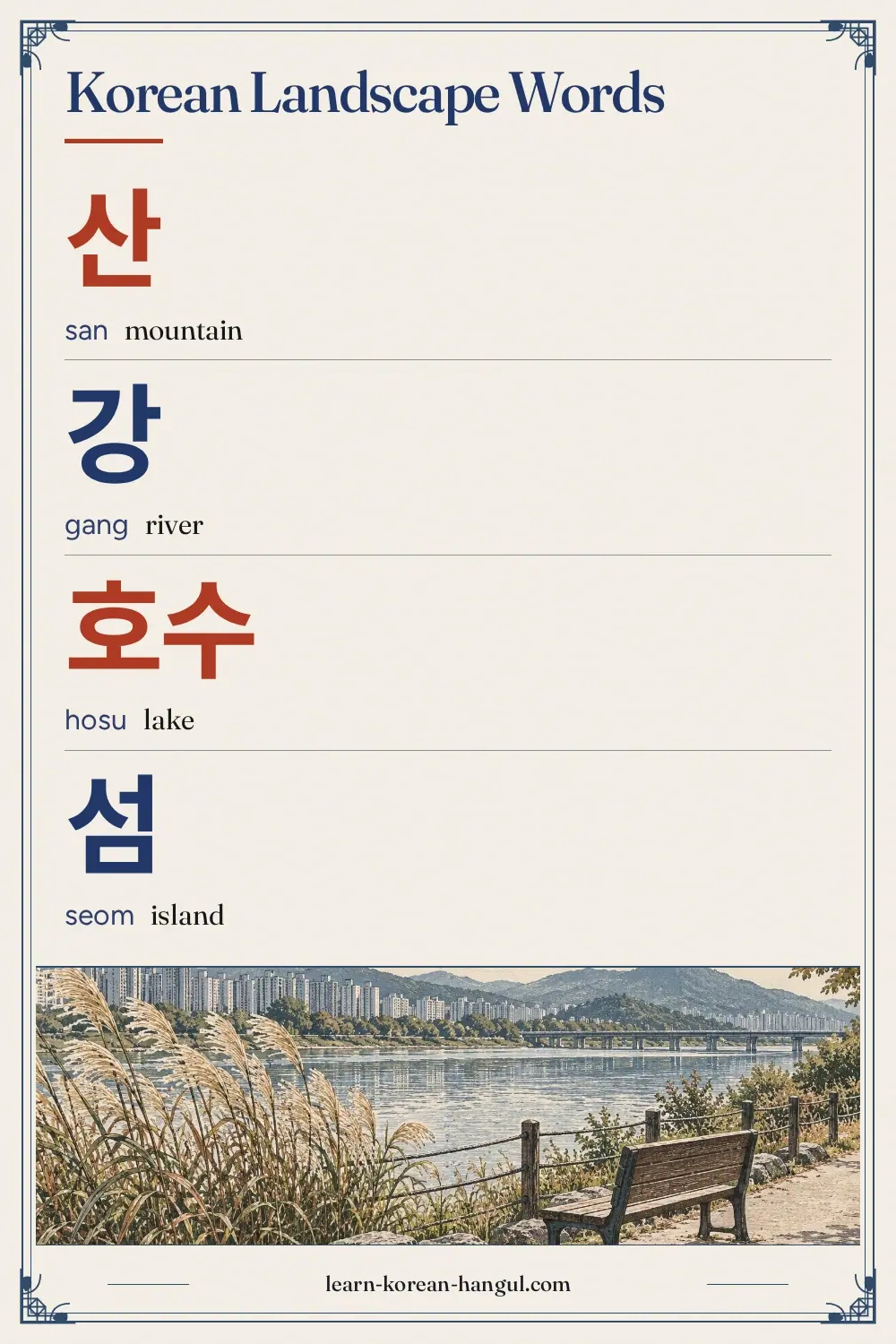
Korean Landscape Words at a Glance
Landscape words describe the world around you: the mountain you climb, the river you cross and the sky you look at. Korea is a mountainous country with a long coast, so these words appear in daily talk, in weather reports and in travel signs. Many are short native words, such as 물, 별, 섬 and 숲.
The list is arranged from the land to the water to the sky. The mountain group comes first and opens with the general word 자연 (nature). Then come rivers and lakes, the sea and coast, the sky and its lights, and forests and fields. Every word has one example sentence, so you can read the word in a sentence at once.
The list holds 40 words. By origin, the list has 23 native, 16 Sino-Korean and 1 mixed word. "Mixed" means a word that combines parts of different origins: 연못 joins Sino-Korean 연 (蓮, lotus) and native 못 (pond). Two of the most basic words are Sino-Korean even though they feel native: 산 (山, mountain) and 강 (江, river).
| Group | Words | Examples |
|---|---|---|
| Mountains and hills | 10 | 자연, 산, 언덕, 봉우리 |
| Rivers and lakes | 8 | 강, 호수, 폭포, 시내 |
| Sea and coast | 8 | 바다, 해변, 섬, 파도 |
| Sky and stars | 8 | 하늘, 해, 달, 별 |
| Forest and fields | 6 | 숲, 들, 풀, 평야 |
This list sits inside Geography and Countries. Words for hiking are on the mountains and hiking page, and the provinces are on Korean Provinces Vocabulary. For a single-word entry, see nature in korean.
Which Landscape Words Should You Learn First?
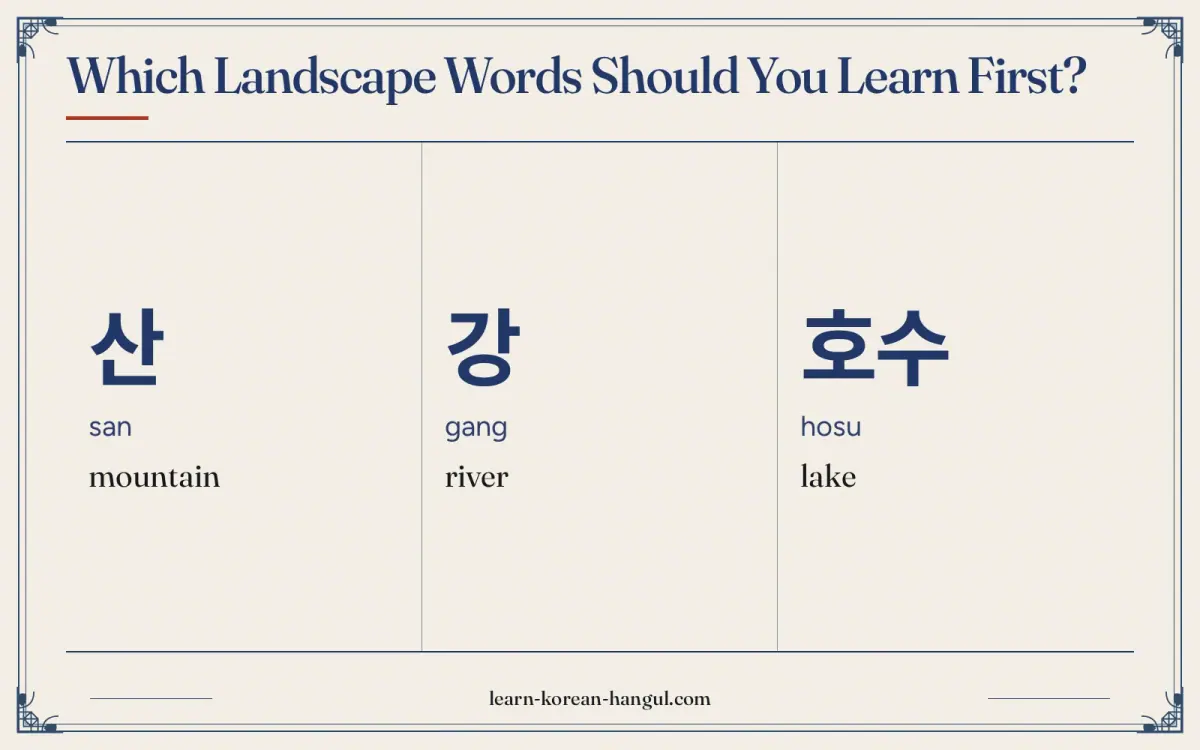
Start with five words you will use in almost any talk about nature: 자연, 산, 강, 바다 and 하늘. Use the scene to see eight features at once, then press play and the slow button on each of the five and say the word aloud.
Word · 8
- 1
산
san
mountain
- 2
강
gang
river
- 3
호수
hosu
lake
- 4
섬
seom
island
- 5
폭포
pokpo
waterfall
- 6
숲
sup
forest
- 7
들
deul
field; plain
- 8
바다
bada
sea; ocean
자연 (jayeon) means nature. The word is Sino-Korean. It means nature in general, from mountains to plants. Example: 한국의 자연은 아름다워요. (Korea's nature is beautiful.)
산 (san) means mountain. It is one syllable. In names it becomes a suffix: 한라산 is Mount Halla. Example: 한국에는 산이 많아요. (Korea has many mountains.)
강 (gang) means river. Example: 강이 길어요. (The river is long.)
바다 (bada) means sea; ocean. Example: 바다가 넓어요. (The sea is wide.)
하늘 (haneul) means sky; heaven. Example: 하늘이 맑아요. (The sky is clear.)
Mountains and Hills
Korea is a mountainous country, so the first group matters most. It has ten words, and the first one, 자연, is the general word for nature. The others name the parts of a mountain scene.
| No. | Hangul | Revised Romanization | Meaning | Origin | Example sentence | Audio assetId |
|---|---|---|---|---|---|---|
| 1 | 자연 | jayeon | nature | Sino-Korean | 한국의 자연은 아름다워요. (hangugui jayeoneun areumdawoyo; Korea's nature is beautiful.) | au-pg-vocabulary-nature-geography-landscape-1; example: au-pg-vocabulary-nature-geography-landscape-101 |
| 2 | 산 | san | mountain | Sino-Korean | 한국에는 산이 많아요. (hangugeneun sani manayo; Korea has many mountains.) | au-pg-vocabulary-nature-geography-landscape-2; example: au-pg-vocabulary-nature-geography-landscape-102 |
| 3 | 언덕 | eondeok | hill | native | 언덕 위에 집이 있어요. (eondeok wie jibi isseoyo; There is a house on the hill.) | au-pg-vocabulary-nature-geography-landscape-3; example: au-pg-vocabulary-nature-geography-landscape-103 |
| 4 | 봉우리 | bonguri | peak | native | 봉우리에 눈이 쌓였어요. (bongurie nuni ssayeosseoyo; Snow has piled up on the peak.) | au-pg-vocabulary-nature-geography-landscape-4; example: au-pg-vocabulary-nature-geography-landscape-104 |
| 5 | 계곡 | gyegok | valley; mountain stream | Sino-Korean | 여름에 계곡에서 놀아요. (yeoreume gyegogeseo norayo; In summer we play in the valley stream.) | au-pg-vocabulary-nature-geography-landscape-5; example: au-pg-vocabulary-nature-geography-landscape-105 |
| 6 | 바위 | bawi | rock; boulder | native | 바위가 커요. (bawiga keoyo; The rock is big.) | au-pg-vocabulary-nature-geography-landscape-6; example: au-pg-vocabulary-nature-geography-landscape-106 |
| 7 | 동굴 | donggul | cave | Sino-Korean | 동굴이 어두워요. (dongguri eoduwoyo; The cave is dark.) | au-pg-vocabulary-nature-geography-landscape-7; example: au-pg-vocabulary-nature-geography-landscape-107 |
| 8 | 절벽 | jeolbyeok | cliff | Sino-Korean | 절벽이 높아요. (jeolbyeogi nopayo; The cliff is high.) | au-pg-vocabulary-nature-geography-landscape-8; example: au-pg-vocabulary-nature-geography-landscape-108 |
| 9 | 화산 | hwasan | volcano | Sino-Korean | 화산이 폭발했어요. (hwasani pokbalhaesseoyo; The volcano erupted.) | au-pg-vocabulary-nature-geography-landscape-9; example: au-pg-vocabulary-nature-geography-landscape-109 |
| 10 | 돌 | dol | stone | native | 길에 돌이 많아요. (gire dori manayo; There are many stones on the road.) | au-pg-vocabulary-nature-geography-landscape-10; example: au-pg-vocabulary-nature-geography-landscape-110 |
- 산 is the word you hear most. It also works as a suffix in names: 설악산, 한라산, 백두산.
- 봉우리 means a peak, and 계곡 means a valley with a stream. In summer, many Koreans go to a 계곡 to cool off.
- 바위 and 돌 are both stones, but 바위 is large and 돌 is small.
Example Sentences
Landscape sentences use noun + 이/가 + adjective: 산이 높아요 (the mountain is high) and 강이 길어요 (the river is long). Use 이 after a consonant and 가 after a vowel. To say where something is, add 에: 언덕 위에 집이 있어요 (there is a house on the hill). To say where an action happens, add 에서: 계곡에서 놀아요 (we play in the valley stream). To say what you travel by, add (으)로: 섬에 배로 가요 (we go to the island by boat).
How Do You Say Rivers and Lakes in Korean?
Water words are short and very common. The group has eight words. 강 is the general word for a river, and the others name smaller or special waters, from a pond to a waterfall.
| No. | Hangul | Revised Romanization | Meaning | Origin | Example sentence | Audio assetId |
|---|---|---|---|---|---|---|
| 11 | 강 | gang | river | Sino-Korean | 강이 길어요. (gangi gireoyo; The river is long.) | au-pg-vocabulary-nature-geography-landscape-11; example: au-pg-vocabulary-nature-geography-landscape-111 |
| 12 | 호수 | hosu | lake | Sino-Korean | 호수가 조용해요. (hosuga joyonghaeyo; The lake is quiet.) | au-pg-vocabulary-nature-geography-landscape-12; example: au-pg-vocabulary-nature-geography-landscape-112 |
| 13 | 폭포 | pokpo | waterfall | Sino-Korean | 폭포 소리가 커요. (pokpo soriga keoyo; The sound of the waterfall is loud.) | au-pg-vocabulary-nature-geography-landscape-13; example: au-pg-vocabulary-nature-geography-landscape-113 |
| 14 | 시내 | sinae | stream; downtown | native | 시내가 맑아요. (sinaega malgayo; The stream is clear.) | au-pg-vocabulary-nature-geography-landscape-14; example: au-pg-vocabulary-nature-geography-landscape-114 |
| 15 | 연못 | yeonmot | pond | mixed | 연못에 물고기가 있어요. (yeonmose mulgogiga isseoyo; There are fish in the pond.) | au-pg-vocabulary-nature-geography-landscape-15; example: au-pg-vocabulary-nature-geography-landscape-115 |
| 16 | 개울 | gaeul | brook | native | 개울물이 차가워요. (gaeulmuri chagawoyo; The brook water is cold.) | au-pg-vocabulary-nature-geography-landscape-16; example: au-pg-vocabulary-nature-geography-landscape-116 |
| 17 | 샘 | saem | spring | native | 샘에서 물이 나와요. (saemeseo muri nawayo; Water comes out of the spring.) | au-pg-vocabulary-nature-geography-landscape-17; example: au-pg-vocabulary-nature-geography-landscape-117 |
| 18 | 물 | mul | water | native | 물이 맑아요. (muri malgayo; The water is clear.) | au-pg-vocabulary-nature-geography-landscape-18; example: au-pg-vocabulary-nature-geography-landscape-118 |
- 강 is also the suffix in river names: 한강 is the Han River, which flows through Seoul.
- 시내 means stream and also downtown. In 시내에 가요 it is downtown, and in 시내가 맑아요 it is a stream.
- 물 is the plain word for water, and it is part of many compounds, such as 물고기 (fish) and 물컵 (water glass).
Sea and Coast
Korea has coasts on three sides, so sea words are used often. The group has eight words. One of them, 갯벌 (tidal flat), names a kind of coast that is typical of the west and south of Korea.
| No. | Hangul | Revised Romanization | Meaning | Origin | Example sentence | Audio assetId |
|---|---|---|---|---|---|---|
| 19 | 바다 | bada | sea; ocean | native | 바다가 넓어요. (badaga neolbeoyo; The sea is wide.) | au-pg-vocabulary-nature-geography-landscape-19; example: au-pg-vocabulary-nature-geography-landscape-119 |
| 20 | 해변 | haebyeon | beach | Sino-Korean | 해변을 걸어요. (haebyeoneul georeoyo; I walk along the beach.) | au-pg-vocabulary-nature-geography-landscape-20; example: au-pg-vocabulary-nature-geography-landscape-120 |
| 21 | 섬 | seom | island | native | 섬에 배로 가요. (seome baero gayo; We go to the island by boat.) | au-pg-vocabulary-nature-geography-landscape-21; example: au-pg-vocabulary-nature-geography-landscape-121 |
| 22 | 파도 | pado | wave | Sino-Korean | 파도가 높아요. (padoga nopayo; The waves are high.) | au-pg-vocabulary-nature-geography-landscape-22; example: au-pg-vocabulary-nature-geography-landscape-122 |
| 23 | 모래 | morae | sand | native | 모래가 따뜻해요. (moraega ttatteutaeyo; The sand is warm.) | au-pg-vocabulary-nature-geography-landscape-23; example: au-pg-vocabulary-nature-geography-landscape-123 |
| 24 | 항구 | hanggu | port; harbor | Sino-Korean | 항구에 배가 많아요. (hanggue baega manayo; There are many ships at the port.) | au-pg-vocabulary-nature-geography-landscape-24; example: au-pg-vocabulary-nature-geography-landscape-124 |
| 25 | 해안 | haean | coast | Sino-Korean | 해안 도로를 달려요. (haean dororeul dallyeoyo; I drive along the coastal road.) | au-pg-vocabulary-nature-geography-landscape-25; example: au-pg-vocabulary-nature-geography-landscape-125 |
| 26 | 갯벌 | gaetbeol | tidal flat | native | 갯벌에서 조개를 잡아요. (gaetbeoreseo jogaereul jabayo; We catch clams on the tidal flat.) | au-pg-vocabulary-nature-geography-landscape-26; example: au-pg-vocabulary-nature-geography-landscape-126 |
- 바다 is the sea, 해변 is the beach and 해안 is the coastline. The three words are close but not the same.
- 섬 is an island. The big southern island is 제주도, and its name uses the suffix 도.
- 갯벌 is said [개뻘] or [갣뻘]: the ㅅ between the two parts makes the ㅂ tense.
How Do You Say Sky Words in Korean?
The sky group has eight words. They are short, and many have a second meaning in time words, such as 해 (sun and year) and 달 (moon and month). The group also has two words, 은하수 and 노을, that are loved in songs and poems.
| No. | Hangul | Revised Romanization | Meaning | Origin | Example sentence | Audio assetId |
|---|---|---|---|---|---|---|
| 27 | 하늘 | haneul | sky; heaven | native | 하늘이 맑아요. (haneuri malgayo; The sky is clear.) | au-pg-vocabulary-nature-geography-landscape-27; example: au-pg-vocabulary-nature-geography-landscape-127 |
| 28 | 해 | hae | sun | native | 해가 떠요. (haega tteoyo; The sun rises.) | au-pg-vocabulary-nature-geography-landscape-28; example: au-pg-vocabulary-nature-geography-landscape-128 |
| 29 | 달 | dal | moon | native | 달이 밝아요. (dari balgayo; The moon is bright.) | au-pg-vocabulary-nature-geography-landscape-29; example: au-pg-vocabulary-nature-geography-landscape-129 |
| 30 | 별 | byeol | star | native | 밤하늘에 별이 많아요. (bamhaneure byeori manayo; There are many stars in the night sky.) | au-pg-vocabulary-nature-geography-landscape-30; example: au-pg-vocabulary-nature-geography-landscape-130 |
| 31 | 구름 | gureum | cloud | native | 구름이 하얘요. (gureumi hayaeyo; The clouds are white.) | au-pg-vocabulary-nature-geography-landscape-31; example: au-pg-vocabulary-nature-geography-landscape-131 |
| 32 | 무지개 | mujigae | rainbow | native | 무지개가 떴어요. (mujigaega tteosseoyo; A rainbow has appeared.) | au-pg-vocabulary-nature-geography-landscape-32; example: au-pg-vocabulary-nature-geography-landscape-132 |
| 33 | 은하수 | eunhasu | Milky Way | Sino-Korean | 은하수가 보여요. (eunhasuga boyeoyo; The Milky Way is visible.) | au-pg-vocabulary-nature-geography-landscape-33; example: au-pg-vocabulary-nature-geography-landscape-133 |
| 34 | 노을 | noeul | sunset glow | native | 노을이 예뻐요. (noeuri yeppeoyo; The sunset glow is pretty.) | au-pg-vocabulary-nature-geography-landscape-34; example: au-pg-vocabulary-nature-geography-landscape-134 |
- 하늘 is the sky in daytime and the heavens in a religious sense, depending on the sentence.
- 해 and 달 each have two meanings. The sentence 해가 떠요 is the sun rising, and 올해 means this year.
- 무지개 is a rainbow. The verb that goes with it is 뜨다 (to rise), as in 무지개가 떴어요.
Forest and Fields
The last group has six words for the land that is not a mountain or a coast. They cover forest, field and desert, and they finish the list with words for the ground itself.
| No. | Hangul | Revised Romanization | Meaning | Origin | Example sentence | Audio assetId |
|---|---|---|---|---|---|---|
| 35 | 숲 | sup | forest | native | 숲에서 걸어요. (supeseo georeoyo; I walk in the forest.) | au-pg-vocabulary-nature-geography-landscape-35; example: au-pg-vocabulary-nature-geography-landscape-135 |
| 36 | 들 | deul | field; plain | native | 들에 꽃이 피어요. (deure kkochi pieoyo; Flowers bloom in the field.) | au-pg-vocabulary-nature-geography-landscape-36; example: au-pg-vocabulary-nature-geography-landscape-136 |
| 37 | 풀 | pul | grass | native | 풀이 자라요. (puri jarayo; The grass grows.) | au-pg-vocabulary-nature-geography-landscape-37; example: au-pg-vocabulary-nature-geography-landscape-137 |
| 38 | 평야 | pyeongya | plain | Sino-Korean | 평야가 넓어요. (pyeongyaga neolbeoyo; The plain is wide.) | au-pg-vocabulary-nature-geography-landscape-38; example: au-pg-vocabulary-nature-geography-landscape-138 |
| 39 | 사막 | samak | desert | Sino-Korean | 사막은 더워요. (samageun deowoyo; Deserts are hot.) | au-pg-vocabulary-nature-geography-landscape-39; example: au-pg-vocabulary-nature-geography-landscape-139 |
| 40 | 흙 | heuk | soil | native | 흙이 부드러워요. (heulgi budeureowoyo; The soil is soft.) | au-pg-vocabulary-nature-geography-landscape-40; example: au-pg-vocabulary-nature-geography-landscape-140 |
- 숲 is a forest, and 들 is an open field or meadow.
- 평야 is a wide flat plain. The word is Sino-Korean and appears in geography books and news.
- 흙 has two final letters, ㄹ and ㄱ. Alone, only ㄱ is heard: [흑]. Before a vowel, both return.
Place-Name Suffixes: 산, 강, 도, 호 and 해
Korean landmarks follow a pattern: the name of the place plus a word for what kind of place it is. 한라 + 산 = 한라산, which means Mount Halla, and 한 + 강 = 한강, which means the Han River. The kind-of-place word comes last, as in English "Han River" but unlike "Mount Halla".
| Suffix | Meaning | Name | Revised Romanization | Note |
|---|---|---|---|---|
| 산 (san) | mountain | 한라산 | Hallasan | the highest mountain in South Korea, on Jeju Island |
| 산 (san) | mountain | 설악산 | Seoraksan | a mountain park on the east side |
| 산 (san) | mountain | 백두산 | Baekdusan | a volcanic mountain on the Korea-China border |
| 강 (gang) | river | 한강 | Hangang | the river that flows through Seoul |
| 강 (gang) | river | 낙동강 | Nakdonggang | a long river in the southeast |
| 도 (do) | island | 제주도 | Jejudo | the large southern island |
| 호 (ho) | lake | 소양호 | Soyangho | a lake behind a dam in Gangwon Province |
| 해 (hae) | sea | 동해 | Donghae | the East Sea |
The pattern lets you read a map. If a name ends in 산, it is a mountain. If it ends in 강, it is a river. If it ends in 도, it is an island or a province. If it ends in 호 it is a lake, and 해 means sea.
Another well-known name is 독도 (Dokdo), the small islands in the East Sea. The islands are administered by South Korea, and Japan also claims them, so the name often appears in the news. For this vocabulary list, you only need to see that 독도 ends in 도, the island suffix.
Pairs That Look Alike
A few landscape words are close in meaning, and learners mix them up. These pairs are worth learning together.
| Pair | Difference | Example |
|---|---|---|
| 산 and 언덕 | 산 is a mountain, and 언덕 is a small hill | 산에 올라가요 (I climb a mountain) |
| 바다 and 해변 | 바다 is the sea, and 해변 is the beach beside it | 해변에서 놀아요 (I play on the beach) |
| 강 and 시내 | 강 is a large river, and 시내 is a small stream | 시내가 맑아요 (the stream is clear) |
| 해 and 달 | 해 is the sun, and 달 is the moon | 달이 밝아요 (the moon is bright) |
Two of these words have a second meaning that is easy to confuse. 해 means the sun and also a year, as in 올해 (this year). 달 means the moon and also a month, as in 다음 달 (next month). 시내 means a stream and also downtown, as in 시내에 가요 (I go downtown). The sentence tells you which one is meant.
The Sky and the Stars
The sky has the most poetic words in the list. 노을 (sunset glow) and 은하수 (the Milky Way) are often used in songs and poems. The name 은하수 comes from 은하 (silver river) plus 수 (water), so the Milky Way is a river of stars.
On a clear night you can say: 밤하늘에 별이 많아요 (there are many stars in the night sky). In the evening you can say: 노을이 예뻐요 (the sunset glow is pretty). Both sentences use the pattern noun + 이/가 + adjective or verb, which is the basic Korean sentence.
How Do You Pronounce These Words?
Landscape words contain final-consonant changes and a few tense sounds. The table lists five words, following the Standard Pronunciation rules (표준 발음법) of the 국립국어원.
| Word | Romanization | Said | Rule |
|---|---|---|---|
| 갯벌 | gaetbeol | [개뻘] or [갣뻘] | the ㅅ between the two parts (사이시옷) makes the ㅂ tense |
| 흙 | heuk | [흑] | the two final letters ㄹㄱ are reduced to one sound ㄱ |
| 숲 | sup | [숩] | the final ㅍ is said as [ㅂ] when nothing follows |
| 폭포 | pokpo | [폭포] | the final ㄱ of 폭 is held short and not released |
| 절벽 | jeolbyeok | [절벽] | the final ㄱ of 벽 is held short |
Revised Romanization is the official romanization system of South Korea, announced on 7 July 2000. It follows most sound changes, such as linking and nasalization, and it spells the written double letters (ㄲ as kk), but it does not show tensing caused by a neighbouring sound: 갯벌 is said [개뻘] or [갣뻘] but written gaetbeol. It is a learning aid, so always read the Hangul as well.
Audio and Slow Playback
Each headword and each example sentence has its own audio clip, and the five words in the learn-first section also have a slow clip at 0.8 times the speed. Nothing plays until you press a button. Listen once, repeat aloud, and only then check the romanization.
What Mistakes Do Learners Make with Landscape Words?
- Using 산 for a small hill. A small hill is 언덕, and 산 is a real mountain.
- Mixing 시내 (stream) with 시내 (downtown). They are spelled the same, so use the sentence to decide.
- Confusing 해 (sun, year) and 달 (moon, month) in time talk. 올해 is this year, and 다음 달 is next month.
- Forgetting the final ㅍ of 숲. Alone it is [숩], but before 이 it is [수피].
- Reading the romanization instead of the sounds. Words such as 갯벌 contain a tense sound, but Revised Romanization shows only gaetbeol.
Practice: Flashcards and Worksheet
Drill these 40 words with the vocabulary flashcard decks: each card shows the Hangul on one side and the meaning on the other, so you can test recall instead of recognition. Print a labelling sheet from the vocabulary worksheets and write the Korean word for each numbered feature in the scene above. A simple plan is to learn eight words a day, one group at a time.
Korean Landscape Words Worksheet
Try this five-question check, then say the words aloud once more.
Practice · 5
What does 자연 mean?
Show answer
nature
자연 (jayeon) means nature.
What does 화산 mean?
Show answer
volcano
화산 (hwasan) means volcano.
What does 샘 mean?
Show answer
spring
샘 (saem) means spring.
What does 해안 mean?
Show answer
coast
해안 (haean) means coast.
What does 은하수 mean?
Show answer
Milky Way
은하수 (eunhasu) means Milky Way.
Self-Test: 10 Sentences
Fill each blank with a word from this page. Say the whole sentence aloud when you have it. The answers follow the test.
- 한국의 ___은 아름다워요. (Korea's nature is beautiful.)
- ___에 눈이 쌓였어요. (Snow has piled up on the peak.)
- ___이 어두워요. (The cave is dark.)
- ___가 조용해요. (The lake is quiet.)
- ___가 맑아요. (The stream is clear.)
- ___가 넓어요. (The sea is wide.)
- ___가 따뜻해요. (The sand is warm.)
- ___ 도로를 달려요. (I drive along the coastal road.)
- ___이 하얘요. (The clouds are white.)
- ___이 예뻐요. (The sunset glow is pretty.)
Answers: 1. 자연; 2. 봉우리; 3. 동굴; 4. 호수; 5. 시내; 6. 바다; 7. 모래; 8. 해안; 9. 구름; 10. 노을.
A score of 8 or more suggests the words are settling in. If you scored lower, reread the groups where you missed words.
Where to Go Next
After landscape words, many learners move on to mountains and hiking and Korean Provinces Vocabulary. This list sits inside Geography and Countries.
Related pages:
- mountain in korean: a single-word entry with pronunciation notes, usage and more example sentences.
- river in korean: a single-word entry with pronunciation notes, usage and more example sentences.
Frequently Asked Questions
How Do You Say Nature in Korean?
Say 자연 (jayeon). It has two syllables, ja-yeon, and it covers mountains, rivers, plants and animals. The word also appears in compounds such as 자연스럽다 (natural). For a full word entry, see nature in korean.
How Do You Pronounce 산 (san)?
Say san: a plain s, then the open vowel ㅏ, then close with the tongue tip behind the upper teeth for the final ㄴ. It is one even syllable. For a full word entry, see mountain in korean.
How Many Landscape Words Should I Learn First?
Learn the five starter words, 자연, 산, 강, 바다 and 하늘, then add one group at a time. Eight new words a day with a short review of the older ones is a steady pace, and the whole list takes about five days. The river words 강, 시내 and 개울 make a good second set.
Where Can I Practise Landscape Words with Flashcards?
Use the vocabulary flashcard decks. Start with the mountain and water groups, then add the sky and field groups. Review the older cards before you add new ones, so the earlier words do not fade.
Is the Romanization on This Page Official?
Yes, as a learning aid. It follows the Revised Romanization of Korean, the system South Korea has officially used since 7 July 2000, and the page also gives the Hangul for every word. It follows most sound changes but does not show tensing: 갯벌 is written gaetbeol but the ㅂ is said tense. Treat the Hangul as the real spelling.
Is There a Printable Worksheet for Landscape Words?
The vocabulary worksheets page lists the printable sheets. The sheet for this topic is a labelling task built on the same illustrated scene as this page, so you write the Korean word next to each numbered feature.