What you'll learn
- Match all 30 honorific words to their English meanings and to their plain partners.
- Say five of them aloud with the help of the Revised Romanization and the audio.
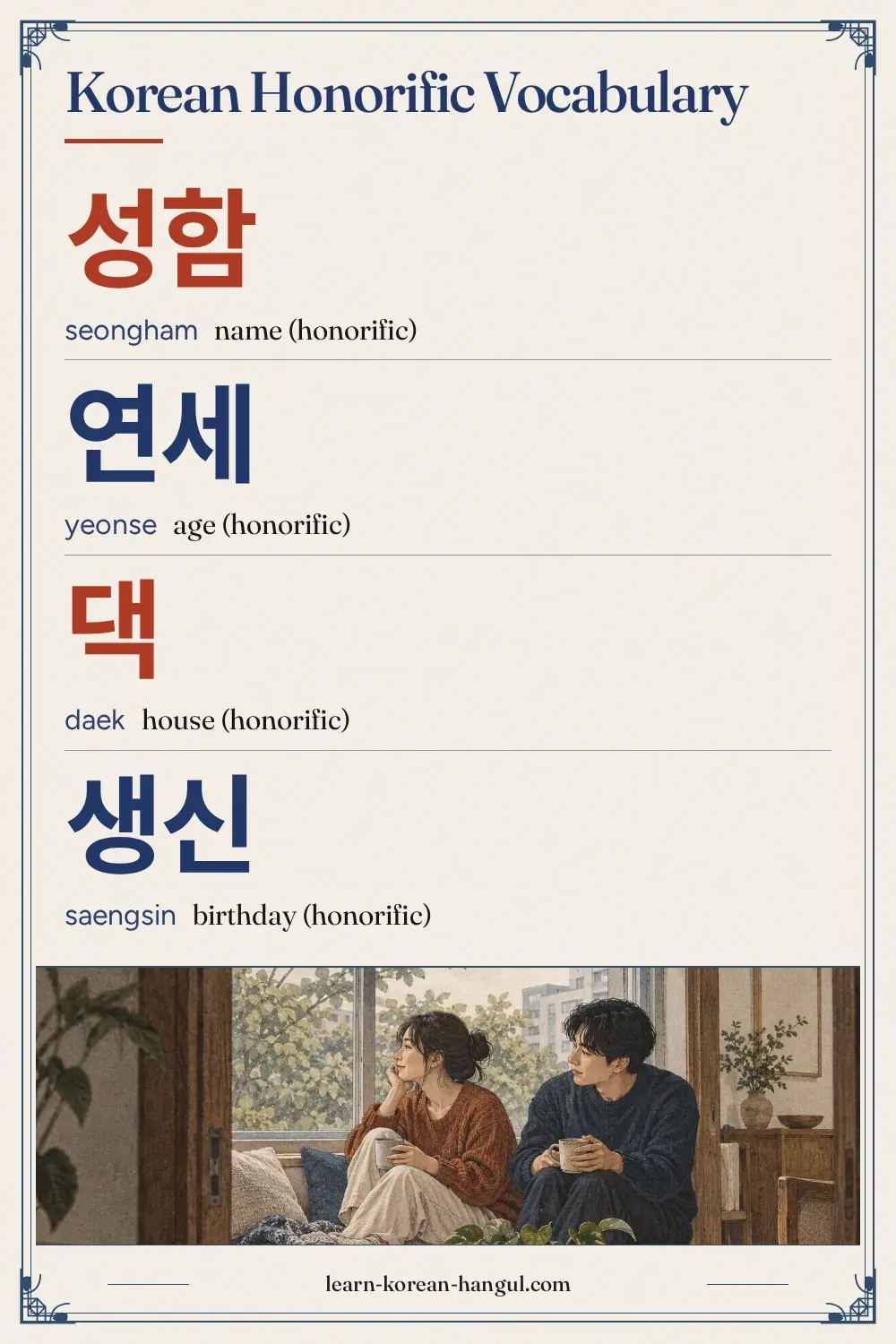
- Write two original sentences that use words such as 성함 (name, honorific) and 연세 (age, honorific).
- Tell an honorific word, which raises the other person, from a humble word, which lowers yourself.
Prerequisites: you can read Hangul and know the polite ending -아요/-어요. It also helps to know the honorific verb ending in honorific endings. Estimated time: about 75 minutes, plus short reviews on the following days.
Korean Honorific Vocabulary at a Glance
The list has 30 words in five groups. Korean marks respect in the words themselves: some nouns, particles and verbs have a respectful twin, and some words lower the speaker. The groups run from nouns to particles, humble words, swaps for common verbs and nouns, and titles that end in -님. It belongs to Relationships and Titles.
| Group | Words | Use |
|---|---|---|
| Honorific nouns | 7 | Respectful words for name, age and home |
| Honorific particles | 4 | Marking respect on subjects and recipients |
| Humble words | 6 | Lowering yourself |
| Honorific swaps | 6 | Respectful partners for common words |
| Titles with -님 | 7 | Titles that carry respect |
This page covers the vocabulary. For the honorific verb ending -(으)시- and the speech levels, see honorific endings. For a deeper look at the nouns, the korean honorific nouns page lists more of them.
Which Honorific Words Should You Learn First?
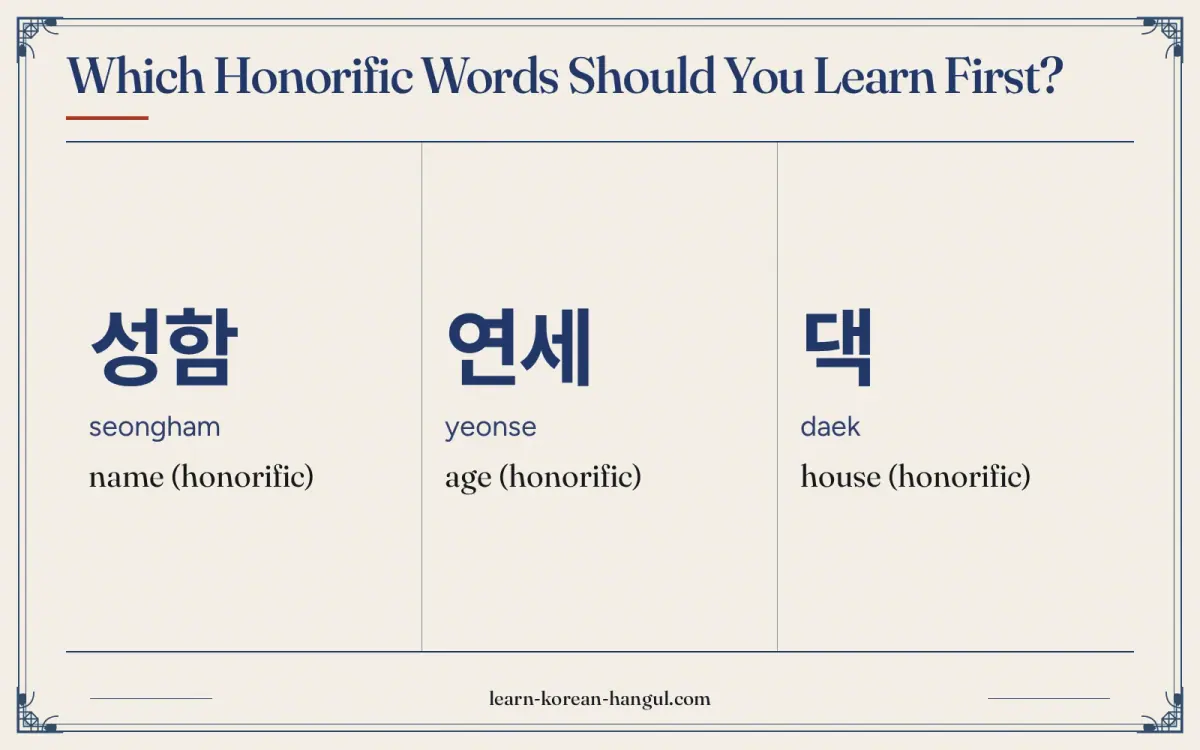
Learn 선생님 (teacher), 성함 (name), 연세 (age), 드시다 (to eat) and 계시다 (to be) first. With these five you can ask an older person their name and age and talk about what they are doing. A short question such as 성함이 어떻게 되세요? (What is your name?) needs only one noun and a verb ending. Then follow this order:
- Step 1: the five words above.
- Step 2: the other honorific nouns: 댁, 생신 and 분.
- Step 3: the particles 께서 and 께, and the humble words 저 and 저희.
- Step 4: the other swaps (진지, 말씀, 주무시다) and the titles with -님.
The scene below numbers ten of the objects and people from a family dinner with a guest, so you can tie each word to something you can point at.
Word · 10
- 1
성함
seongham
name (honorific)
- 2
연세
yeonse
age (honorific)
- 3
댁
daek
house (honorific)
- 4
생신
saengsin
birthday (honorific)
- 5
진지
jinji
meal (honorific)
- 6
말씀
malsseum
words; speech (honorific)
- 7
드시다
deusida
to eat (honorific)
- 8
주무시다
jumusida
to sleep (honorific)
- 9
계시다
gyesida
to be; to stay (honorific)
- 10
선생님
seonsaengnim
teacher; sir or madam
Tap a number to hear the word. Notice how many of the honorific words are Sino-Korean, such as 연세 and 생신, while 진지 and 드시다 are native.
Honorific Nouns (성함, 연세, 댁)
These seven nouns replace the plain word when you talk about an older or senior person. 성함 replaces 이름 (name), 연세 replaces 나이 (age), 댁 replaces 집 (house), 생신 replaces 생일 (birthday), 분 replaces 사람 (person), and 따님 and 아드님 replace daughter and son. They raise the person you are speaking to or about.
| No. | Hangul | Revised Romanization | Meaning and note | Example sentence | Audio assetId |
|---|---|---|---|---|---|
| 1 | 성함 | seongham | name (honorific). Replaces 이름. Used when asking an older person or a customer for their name. | 성함이 어떻게 되세요? (What is your name?) | au-pg-vocabulary-people-relationships-honorifics-1; example: au-pg-vocabulary-people-relationships-honorifics-31 |
| 2 | 연세 | yeonse | age (honorific). Replaces 나이. Used about elders. | 할아버지는 연세가 많으세요. (My grandfather is quite old.) | au-pg-vocabulary-people-relationships-honorifics-2; example: au-pg-vocabulary-people-relationships-honorifics-32 |
| 3 | 댁 | daek | house (honorific). Replaces 집. Also means your home when speaking to an elder. | 선생님 댁이 어디세요? (Where is your house, teacher?) | au-pg-vocabulary-people-relationships-honorifics-3; example: au-pg-vocabulary-people-relationships-honorifics-33 |
| 4 | 생신 | saengsin | birthday (honorific). Replaces 생일. Used for parents, grandparents and teachers. | 어머니 생신이 다음 주예요. (My mother's birthday is next week.) | au-pg-vocabulary-people-relationships-honorifics-4; example: au-pg-vocabulary-people-relationships-honorifics-34 |
| 5 | 분 | bun | person (honorific). Replaces 사람. Also a counter for people in polite speech. | 저분은 우리 선생님이세요. (That person is our teacher.) | au-pg-vocabulary-people-relationships-honorifics-5; example: au-pg-vocabulary-people-relationships-honorifics-35 |
| 6 | 따님 | ttanim | daughter (honorific). Used for someone else's daughter. Not for your own. | 사장님 따님이 오셨어요. (The boss's daughter has come.) | au-pg-vocabulary-people-relationships-honorifics-6; example: au-pg-vocabulary-people-relationships-honorifics-36 |
| 7 | 아드님 | adeunim | son (honorific). Used for someone else's son. Not for your own. | 아드님이 참 똑똑하세요. (Your son is very smart.) | au-pg-vocabulary-people-relationships-honorifics-7; example: au-pg-vocabulary-people-relationships-honorifics-37 |
The rule for this group is that honorific words are for other people, never for yourself. You can ask 성함이 어떻게 되세요? to a customer, but you introduce yourself with 제 이름은 민수예요, not with 성함. The same rule applies to the family nouns: you call someone else's daughter 따님, and your own is 딸. 분 is used as a counter too, as in 두 분 (two people, polite), which links to the people counters. The ending 되세요 in the first sentence comes from the verb 되다 with the honorific -(으)시-: it shows respect to the person you ask.
How Do You Say Honorific Particles (께서, 께) in Korean?
Particles attach to nouns, and four of them have honorific forms. 께서 replaces 이/가 for the subject, 께서는 and 께서도 replace 은/는 and 도, and 께 replaces 에게 and 한테 for the person who receives something. They go with honorific verbs that end in -(으)시-.
| No. | Hangul | Revised Romanization | Meaning and note | Example sentence | Audio assetId |
|---|---|---|---|---|---|
| 8 | 께서 | kkeseo | honorific subject particle. Replaces 이/가. The verb takes -(으)시-. | 선생님께서 말씀하셨어요. (The teacher said it.) | au-pg-vocabulary-people-relationships-honorifics-8; example: au-pg-vocabulary-people-relationships-honorifics-38 |
| 9 | 께서는 | kkeseoneun | honorific topic particle. Replaces 은/는. A topic about the respected person. | 할머니께서는 시장에 가셨어요. (Grandmother went to the market.) | au-pg-vocabulary-people-relationships-honorifics-9; example: au-pg-vocabulary-people-relationships-honorifics-39 |
| 10 | 께서도 | kkeseodo | honorific 'also' particle. Replaces 도. Adds also to the respected person. | 아버지께서도 오셨어요. (My father came too.) | au-pg-vocabulary-people-relationships-honorifics-10; example: au-pg-vocabulary-people-relationships-honorifics-40 |
| 11 | 께 | kke | to (honorific). Replaces 에게 and 한테 for the person who receives. | 할머니께 전화했어요. (I called my grandmother.) | au-pg-vocabulary-people-relationships-honorifics-11; example: au-pg-vocabulary-people-relationships-honorifics-41 |
The honorific particle and the honorific verb go together: 선생님께서 말씀하셨어요 has 께서 on the noun and 시 inside the verb 말씀하셨어요. If you use only one of them, the sentence feels uneven, so learners usually pair them. The particle 께 shows who receives, as in 할머니께 전화했어요, and is paired with a humble verb such as 드리다 when something is given: 할머니께 선물을 드렸어요. 께 is not used for the subject, and 께서 is not used for the receiver.
Humble Words (저, 저희)
Humble words work in the opposite direction from honorific words. They do not raise the other person. They lower the speaker or the speaker's group, and the result is respect. 저 and 저희 are the humble forms of I and we, and 드리다, 여쭈다, 뵙다 and 모시다 are humble verbs for giving, asking, meeting and accompanying.
| No. | Hangul | Revised Romanization | Meaning and note | Example sentence | Audio assetId |
|---|---|---|---|---|---|
| 12 | 저 | jeo | I (humble). The humble form of 나. Used with elders, customers and strangers. | 저는 학생이에요. (I am a student.) | au-pg-vocabulary-people-relationships-honorifics-12; example: au-pg-vocabulary-people-relationships-honorifics-42 |
| 13 | 저희 | jeohui | we; our (humble). The humble form of 우리. Used for your own group. Said [저히]. | 저희 부모님은 부산에 사세요. (My parents live in Busan.) | au-pg-vocabulary-people-relationships-honorifics-13; example: au-pg-vocabulary-people-relationships-honorifics-43 |
| 14 | 드리다 | deurida | to give (humble). The humble form of 주다. The receiver is higher than you. | 선생님께 꽃을 드렸어요. (I gave flowers to the teacher.) | au-pg-vocabulary-people-relationships-honorifics-14; example: au-pg-vocabulary-people-relationships-honorifics-44 |
| 15 | 여쭈다 | yeojjuda | to ask (humble). The humble form of 묻다. Also 여쭙다. | 선생님께 여쭤볼게요. (I will ask the teacher.) | au-pg-vocabulary-people-relationships-honorifics-15; example: au-pg-vocabulary-people-relationships-honorifics-45 |
| 16 | 뵙다 | boepda | to see; to meet (humble). The humble form of 보다 for meeting a senior person. | 내일 뵙겠습니다. (I will see you tomorrow.) | au-pg-vocabulary-people-relationships-honorifics-16; example: au-pg-vocabulary-people-relationships-honorifics-46 |
| 17 | 모시다 | mosida | to accompany; to attend (humble). Used for taking or serving an elder. | 부모님을 모시고 가요. (I take my parents along.) | au-pg-vocabulary-people-relationships-honorifics-17; example: au-pg-vocabulary-people-relationships-honorifics-47 |
저희 lowers your own group, such as your family or your company, in front of the listener. 저희 부모님 sounds respectful because you are lowering your own family. In the sentence 저희 부모님은 부산에 사세요, the verb 사세요 still carries the honorific -(으)시- because the subject is your parents, whom you respect. That is a useful example: the humble 저희 and the honorific 사세요 live in the same sentence. Remember that a humble verb needs a receiver or listener who is higher than you.
How Do You Say Honorific Swaps (밥-진지, 말-말씀) in Korean?
Some everyday words are replaced altogether when they refer to an elder. 밥 becomes 진지, 말 becomes 말씀, and the verbs 먹다, 자다, 있다 and 아프다 become 드시다, 주무시다, 계시다 and 편찮으시다. Learn them as pairs.
| No. | Hangul | Revised Romanization | Meaning and note | Example sentence | Audio assetId |
|---|---|---|---|---|---|
| 18 | 진지 | jinji | meal (honorific). Replaces 밥. Used for an elder's meal. | 할아버지, 진지 드세요. (Grandfather, please have your meal.) | au-pg-vocabulary-people-relationships-honorifics-18; example: au-pg-vocabulary-people-relationships-honorifics-48 |
| 19 | 말씀 | malsseum | words; speech (honorific). Replaces 말. Can also be humble: 말씀드리다 to tell a senior. | 선생님 말씀을 잘 들어요. (I listen well to the teacher's words.) | au-pg-vocabulary-people-relationships-honorifics-19; example: au-pg-vocabulary-people-relationships-honorifics-49 |
| 20 | 드시다 | deusida | to eat (honorific). Replaces 먹다. Also used for drinking. | 많이 드세요. (Please eat a lot.) | au-pg-vocabulary-people-relationships-honorifics-20; example: au-pg-vocabulary-people-relationships-honorifics-50 |
| 21 | 주무시다 | jumusida | to sleep (honorific). Replaces 자다. | 할머니는 지금 주무세요. (Grandmother is sleeping now.) | au-pg-vocabulary-people-relationships-honorifics-21; example: au-pg-vocabulary-people-relationships-honorifics-51 |
| 22 | 계시다 | gyesida | to be; to stay (honorific). Replaces 있다 for being in a place. Said [계시다] or [게시다]. | 아버지는 집에 계세요. (My father is at home.) | au-pg-vocabulary-people-relationships-honorifics-22; example: au-pg-vocabulary-people-relationships-honorifics-52 |
| 23 | 편찮으시다 | pyeonchaneusida | to be unwell (honorific). Replaces 아프다 for an elder. Said [편차느시다]. | 어머니가 편찮으세요. (My mother is unwell.) | au-pg-vocabulary-people-relationships-honorifics-23; example: au-pg-vocabulary-people-relationships-honorifics-53 |
These are separate words, not a suffix, so they must be memorized in pairs: 밥 and 진지, 먹다 and 드시다, 자다 and 주무시다, 있다 and 계시다. A good test is the question 진지 드셨어요? (Have you eaten?), which an older person is glad to hear. 있다 has two honorific forms: 계시다 for being in a place, as in 집에 계세요, and 있으시다 for having something, as in 시간 있으세요? (Do you have time?). 말씀 can be a swap for 말 (words) and also a humble verb partner: 말씀드리다 means to tell a senior person.
Titles with -님
The suffix 님 turns a title into a respectful address. You say 선생님 to a teacher, 사장님 to a boss and 고객님 to a customer. Add the suffix directly to the title, with no space. After a full name in forms and notices, 님 is spaced: 홍길동 님.
| No. | Hangul | Revised Romanization | Meaning and note | Example sentence | Audio assetId |
|---|---|---|---|---|---|
| 24 | 님 | nim | honorific suffix. Added to titles and, in notices, to full names with a space. | 홍길동 님, 안녕하세요. (Hello, Hong Gil-dong.) | au-pg-vocabulary-people-relationships-honorifics-24; example: au-pg-vocabulary-people-relationships-honorifics-54 |
| 25 | 선생님 | seonsaengnim | teacher; sir or madam. Also used for doctors, instructors and as a polite form of address. | 선생님, 질문 있어요. (Teacher, I have a question.) | au-pg-vocabulary-people-relationships-honorifics-25; example: au-pg-vocabulary-people-relationships-honorifics-55 |
| 26 | 사장님 | sajangnim | company president; boss. Also used for shop owners and restaurant owners. | 사장님은 회의 중이세요. (The boss is in a meeting.) | au-pg-vocabulary-people-relationships-honorifics-26; example: au-pg-vocabulary-people-relationships-honorifics-56 |
| 27 | 교수님 | gyosunim | professor. Used in universities. Always with 님. | 교수님 연구실이 어디예요? (Where is the professor's office?) | au-pg-vocabulary-people-relationships-honorifics-27; example: au-pg-vocabulary-people-relationships-honorifics-57 |
| 28 | 팀장님 | timjangnim | team leader. A workplace title. The title is used instead of the name. | 팀장님은 지금 자리에 안 계세요. (The team leader is not at their seat now.) | au-pg-vocabulary-people-relationships-honorifics-28; example: au-pg-vocabulary-people-relationships-honorifics-58 |
| 29 | 고객님 | gogaengnim | customer (polite). Used by shops and service staff to address a customer. | 고객님, 주문하시겠어요? (Sir or madam, would you like to order?) | au-pg-vocabulary-people-relationships-honorifics-29; example: au-pg-vocabulary-people-relationships-honorifics-59 |
| 30 | 어르신 | eoreusin | elder; respected senior. Used for elderly people. It has no 님, because the word itself is respectful. | 어르신, 여기 앉으세요. (Sir or madam, please sit here.) | au-pg-vocabulary-people-relationships-honorifics-30; example: au-pg-vocabulary-people-relationships-honorifics-60 |
In Korean workplaces, people use the title plus 님 instead of the person's name, so you hear 팀장님 more often than the team leader's name. Do not add a second respect word: 선생님님 is wrong, because 님 is already inside. The same is true of 어르신, which is a respectful noun and cannot take 님. In a notice or email, a name plus 님 (홍길동 님) is a polite way to address a person whose title you do not know. The ending in 주문하시겠어요? combines the honorific -(으)시- with -겠-, and it is the pattern shop staff use to ask what you will order.
How Do You Pronounce Korean Honorific Words?
Most honorific words are said as they are written, but a few change their sound. The National Institute of Korean Language (국립국어원) sets these changes in its standard pronunciation rules. Revised Romanization follows the spoken sound for linking, but it does not show tensing caused by a neighbouring sound.
| Spelling | Sounds like | What changes |
|---|---|---|
| 고객님 | [고갱님] | The final ㄱ turns into ㅇ before ㄴ. |
| 뵙겠습니다 | [뵙께씀니다] | ㄱ and ㅅ are tensed, and ㅂ turns into ㅁ before ㄴ. |
| 편찮으세요 | [편차느세요] | The ㅎ in ㄶ is silent, and the ㄴ moves to the next syllable. |
| 저희 | [저히] | ㅢ after ㅎ is said as 이. |
| 댁이 | [대기] | The final ㄱ moves to the next syllable. |
| 계세요 | [계세요] or [게세요] | The standard allows ㅖ in 계 to be said as ㅔ. |
Audio and Slow Playback
Each word and sentence has its own clip. The five clips below play the harder words slowly. Play a clip, say the word, then play it again and compare the ends of the syllables.
What Mistakes Do Learners Make with Honorific Words?
Five patterns catch learners when they speak to elders.
- Using honorific words for yourself. 성함 and 연세 are for other people. For yourself, use 이름 and 나이.
- Mixing up honorific and humble. 드시다 raises the other person who eats, while 드리다 lowers you when you give. Check who is doing the action.
- Adding 님 to a respectful word. 선생님 is correct, and 선생님님 is not. 어르신 already carries respect, so it takes no 님.
- Using 께서 without the verb ending. 선생님께서 말씀했어요 feels wrong. Pair 께서 with 말씀하셨어요.
- Reading 고객님 as written. The sound is [고갱님]. The final ㄱ turns into ㅇ before ㄴ.
If you remember who is raised and who is lowered, most of the trouble goes away. The practice section turns the list into drills.
Practice: Flashcards and Worksheet
Study in three steps. First, run the deck in recognition mode until the 30 words feel familiar. Second, switch to listening mode and tap the clip before the card turns. Third, take the five-question quiz below. The deck stores your progress in your browser. The vocabulary flashcard decks page lists the other decks.
Practice · 65
- 01성함
Show answer
headword 1: name (honorific)
- 02연세
Show answer
headword 2: age (honorific)
- 03댁
Show answer
headword 3: house (honorific)
- 04생신
Show answer
headword 4: birthday (honorific)
- 05분
Show answer
headword 5: person (honorific)
- 06따님
Show answer
headword 6: daughter (honorific)
- 07아드님
Show answer
headword 7: son (honorific)
- 08께서
Show answer
headword 8: honorific subject particle
- 09께서는
Show answer
headword 9: honorific topic particle
- 10께서도
Show answer
headword 10: honorific 'also' particle
- 11께
Show answer
headword 11: to (honorific)
- 12저
Show answer
headword 12: I (humble)
- 13저희
Show answer
headword 13: we; our (humble)
- 14드리다
Show answer
headword 14: to give (humble)
- 15여쭈다
Show answer
headword 15: to ask (humble)
- 16뵙다
Show answer
headword 16: to see; to meet (humble)
- 17모시다
Show answer
headword 17: to accompany; to attend (humble)
- 18진지
Show answer
headword 18: meal (honorific)
- 19말씀
Show answer
headword 19: words; speech (honorific)
- 20드시다
Show answer
headword 20: to eat (honorific)
- 21주무시다
Show answer
headword 21: to sleep (honorific)
- 22계시다
Show answer
headword 22: to be; to stay (honorific)
- 23편찮으시다
Show answer
headword 23: to be unwell (honorific)
- 24님
Show answer
headword 24: honorific suffix
- 25선생님
Show answer
headword 25: teacher; sir or madam
- 26사장님
Show answer
headword 26: company president; boss
- 27교수님
Show answer
headword 27: professor
- 28팀장님
Show answer
headword 28: team leader
- 29고객님
Show answer
headword 29: customer (polite)
- 30어르신
Show answer
headword 30: elder; respected senior
- 31성함이 어떻게 되세요?
Show answer
example sentence for 성함
- 32할아버지는 연세가 많으세요.
Show answer
example sentence for 연세
- 33선생님 댁이 어디세요?
Show answer
example sentence for 댁
- 34어머니 생신이 다음 주예요.
Show answer
example sentence for 생신
- 35저분은 우리 선생님이세요.
Show answer
example sentence for 분
- 36사장님 따님이 오셨어요.
Show answer
example sentence for 따님
- 37아드님이 참 똑똑하세요.
Show answer
example sentence for 아드님
- 38선생님께서 말씀하셨어요.
Show answer
example sentence for 께서
- 39할머니께서는 시장에 가셨어요.
Show answer
example sentence for 께서는
- 40아버지께서도 오셨어요.
Show answer
example sentence for 께서도
- 41할머니께 전화했어요.
Show answer
example sentence for 께
- 42저는 학생이에요.
Show answer
example sentence for 저
- 43저희 부모님은 부산에 사세요.
Show answer
example sentence for 저희
- 44선생님께 꽃을 드렸어요.
Show answer
example sentence for 드리다
- 45선생님께 여쭤볼게요.
Show answer
example sentence for 여쭈다
- 46내일 뵙겠습니다.
Show answer
example sentence for 뵙다
- 47부모님을 모시고 가요.
Show answer
example sentence for 모시다
- 48할아버지, 진지 드세요.
Show answer
example sentence for 진지
- 49선생님 말씀을 잘 들어요.
Show answer
example sentence for 말씀
- 50많이 드세요.
Show answer
example sentence for 드시다
- 51할머니는 지금 주무세요.
Show answer
example sentence for 주무시다
- 52아버지는 집에 계세요.
Show answer
example sentence for 계시다
- 53어머니가 편찮으세요.
Show answer
example sentence for 편찮으시다
- 54홍길동 님, 안녕하세요.
Show answer
example sentence for 님
- 55선생님, 질문 있어요.
Show answer
example sentence for 선생님
- 56사장님은 회의 중이세요.
Show answer
example sentence for 사장님
- 57교수님 연구실이 어디예요?
Show answer
example sentence for 교수님
- 58팀장님은 지금 자리에 안 계세요.
Show answer
example sentence for 팀장님
- 59고객님, 주문하시겠어요?
Show answer
example sentence for 고객님
- 60어르신, 여기 앉으세요.
Show answer
example sentence for 어르신
- 61고객님
Show answer
slow playback of 고객님
- 62뵙겠습니다
Show answer
slow playback of 뵙겠습니다
- 63편찮으세요
Show answer
slow playback of 편찮으세요
- 64저희
Show answer
slow playback of 저희
- 65여쭤요
Show answer
slow playback of 여쭤요
Practice · 5
What does 성함 (seongham) mean?
Show answer
name (honorific)
성함 is the honorific word for name. Example: 성함이 어떻게 되세요? (What is your name?)
Which word is the honorific for 밥 (meal)?
Show answer
진지
진지 is the honorific for 밥. Example: 할아버지, 진지 드세요. (Grandfather, please have your meal.)
Which word lowers the speaker when giving something?
Show answer
드리다
드리다 is the humble form of 주다. Example: 선생님께 꽃을 드렸어요. (I gave flowers to the teacher.)
Which particle marks an honorific subject?
Show answer
께서
께서 replaces 이/가 for a respected subject. Example: 선생님께서 말씀하셨어요. (The teacher said it.)
Which word is a respectful noun that does not take 님?
Show answer
어르신
어르신 is already respectful, so it takes no 님. Example: 어르신, 여기 앉으세요. (Sir or madam, please sit here.)
Korean Honorific Vocabulary Worksheet (PDF)
A printable worksheet for these words (word list, matching, writing practice, fill-in-the-blank exercises and answer key) is available in A4 and US Letter from the download card on this page. For additional practice, write the plain word and its honorific partner side by side on cards.
Where to Go Next
After this page, continue with Korean Pregnancy and Baby Vocabulary for family words, or with honorific endings to pair these nouns with the verb ending -(으)시-.
Frequently Asked Questions
What Is Honorific Vocabulary in Korean?
Honorific vocabulary is the set of respectful words that replace plain ones when you talk about or to an older or senior person. Examples are 성함 for name, 연세 for age and 드시다 for to eat. Humble words such as 저희 lower yourself instead. Together they show respect in the words, not only in the verb ending.
How Do You Say Name in the Honorific Form in Korean?
The honorific form of name is 성함 (seongham). Ask 성함이 어떻게 되세요? when you need an older person's name, for example at a clinic or a shop. For yourself, use 이름, as in 제 이름은 민수예요. The word 성함 is never used for yourself.
What Is the Difference between Honorific and Humble Words?
Honorific words raise the person you talk about, for example 연세 or 드시다. Humble words lower the speaker, for example 저희 or 드리다. Both create respect, but they point in different directions. Check who is the actor in the sentence and whether you want to raise them or lower yourself.
How Many Honorific Words Should I Learn First?
Five first: 선생님, 성함, 연세, 드시다 and 계시다. They let you address a teacher, ask a name and age, and talk about what an older person is doing. At five new words a day the 30 words take about a week with review.
Where Can I Practise Honorific Words with Flashcards?
Use the vocabulary flashcard decks. The deck for this page holds all 30 words with Hangul, romanization and audio, in recognition and listening modes. Your progress stays in your browser. Pair each honorific card with its plain partner when you review.
Is There a Printable Worksheet for Honorific Words?
A printable worksheet for these words (word list, matching, writing practice, fill-in-the-blank exercises and answer key) is available in A4 and US Letter from the download card on this page. For practice, the tables on this page can be copied by hand, and the deck carries the same 30 words.