
Korean Words for People at a Glance
Korean people vocabulary is organised by who and what you want to talk about. Each list below is its own page with 30 to 50 words, so this hub only routes you. It belongs to Korean Vocabulary, and it sits beside Daily Life and the Most Common Korean Words. For the single word family, see family in Korean.
| List | Best for | Level |
|---|---|---|
| Family Words | Introducing your family and relatives | A1 |
| Relationships and Titles | Addressing people politely and naming relationships | A2 |
| Jobs and Occupations | Small talk about work and careers | A1 |
| Body Parts | Visits to the doctor and talking about pain | A1 |
| Personality and Appearance | Describing character and appearance | A2 |
| Emotions | Naming and sharing feelings | A2 |
| Korean Kids and Toys Vocabulary | Toys, playground words and children's stories | A1 |
Which List Should You Open First?
Open the list that matches what you need this week. A new learner meeting Korean people usually starts with family and titles, because they come up in the first five minutes of a conversation. A traveller may start with the body list in case of a clinic visit. A student heading to work in Korea may start with jobs.
- To introduce yourself and your family. Start with Family Words, then introducing yourself.
- To address people politely. Start with Relationships and Titles, and read about language etiquette.
- For work and small talk. Start with Jobs and Occupations.
- For health and pain. Start with Body Parts.
- For describing people. Start with Personality and Appearance, then Emotions.




Which General People Words Do You Need on Day One?
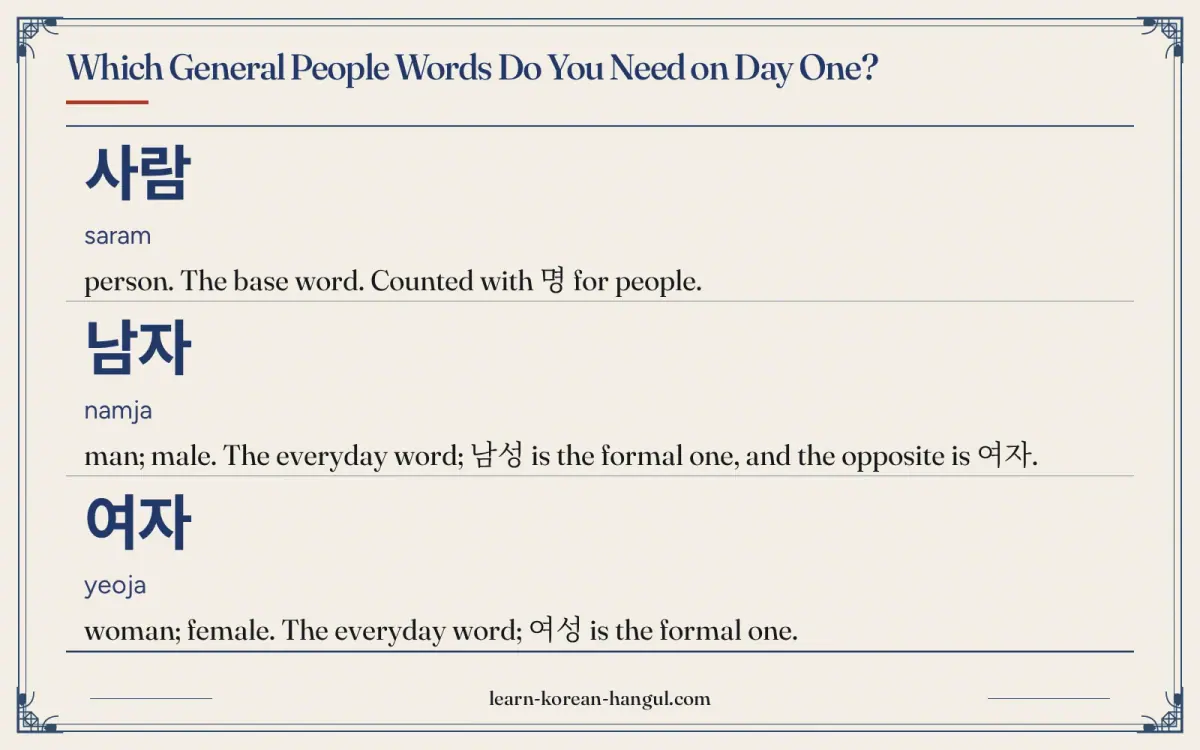
These 13 words are the base for every list on this page. They name the kinds of people you meet and the group words that appear in almost every sentence about people. None of them is hard to say, but several differ from the English word you would expect.
| No. | Hangul | Revised Romanization | Meaning and note | Example sentence | Audio assetId |
|---|---|---|---|---|---|
| 1 | 사람 | saram | person. The base word. Counted with 명 for people. | 좋은 사람이에요. (He or she is a good person.) | au-pg-vocabulary-people-1; example: au-pg-vocabulary-people-14 |
| 2 | 남자 | namja | man; male. The everyday word; 남성 is the formal one, and the opposite is 여자. | 남자가 걸어와요. (A man is walking over.) | au-pg-vocabulary-people-2; example: au-pg-vocabulary-people-15 |
| 3 | 여자 | yeoja | woman; female. The everyday word; 여성 is the formal one. | 여자가 웃고 있어요. (A woman is smiling.) | au-pg-vocabulary-people-3; example: au-pg-vocabulary-people-16 |
| 4 | 아이 | ai | child. Any child, also used for one's own child. | 아이가 자고 있어요. (The child is sleeping.) | au-pg-vocabulary-people-4; example: au-pg-vocabulary-people-17 |
| 5 | 어린이 | eorini | child (young, school age). A child of school age; used on signs and prices. | 어린이는 무료예요. (Children are free.) | au-pg-vocabulary-people-5; example: au-pg-vocabulary-people-18 |
| 6 | 어른 | eoreun | adult; elder. An adult, and also an elder to be respected. | 어른은 이천 원이에요. (Adults are 2,000 won.) | au-pg-vocabulary-people-6; example: au-pg-vocabulary-people-19 |
| 7 | 학생 | haksaeng | student. Said [학쌩]. Any school or university student. | 저는 학생이에요. (I am a student.) | au-pg-vocabulary-people-7; example: au-pg-vocabulary-people-20 |
| 8 | 친구 | chingu | friend. The usual word for friend, for any age. | 친구를 만나요. (I meet a friend.) | au-pg-vocabulary-people-8; example: au-pg-vocabulary-people-21 |
| 9 | 가족 | gajok | family. Your own family. | 우리 가족은 네 명이에요. (Our family has four members.) | au-pg-vocabulary-people-9; example: au-pg-vocabulary-people-22 |
| 10 | 손님 | sonnim | guest; customer. Both a guest in a home and a customer in a shop. | 손님이 왔어요. (A guest has arrived.) | au-pg-vocabulary-people-10; example: au-pg-vocabulary-people-23 |
| 11 | 이웃 | iut | neighbour. Said [이욷]. Someone who lives next door. | 이웃과 인사해요. (I greet my neighbour.) | au-pg-vocabulary-people-11; example: au-pg-vocabulary-people-24 |
| 12 | 외국인 | oegugin | foreigner. Said [외구긴]. The formal word; 외국 사람 is softer. | 외국인 친구가 있어요. (I have a foreign friend.) | au-pg-vocabulary-people-12; example: au-pg-vocabulary-people-25 |
| 13 | 우리 | uri | we; our. Where English says my, Korean often says our. | 우리 엄마는 선생님이에요. (My mom is a teacher.) | au-pg-vocabulary-people-13; example: au-pg-vocabulary-people-26 |
Three of these words repay a closer look. 아이 and 어린이 both mean child, but 어린이 is the public word on signs and prices, and 아이 is the word parents use for their own children. 손님 means both a guest in your home and a customer in a shop, so the setting tells you which. 외국인 is the formal word for a foreigner and is common in official writing. In casual talk people often use 외국 사람 or ask which country someone is from.
Hear the Starter Words
Press each button, repeat the word and compare.
What Is in the Family List?
The Family Words list covers parents, siblings, grandparents and relatives by name, including how each word changes with the speaker. A woman calls her older brother 오빠 and a man calls his 형, for example. Because Korean has separate words for relatives on the mother's and father's side, the list sorts them in groups that you can learn one at a time.
What Is in the Relationships and Titles List?
Relationships and Titles is a hub of six pages: terms of address such as 오빠 and 언니, seniority words such as 선배 (senior) and 후배 (junior), dating, friendship, pregnancy and baby words, and honorific words such as 성함 (name). Koreans often address each other by a title or a kinship word and not by name, so this section matters from the first week. The related page on language etiquette explains when each title fits.
What Is in the Jobs List?
Jobs and Occupations holds 50 job titles, from 의사 (doctor) to 농부 (farmer), with the patterns that build job titles from a workplace or a task. It answers the question 무슨 일을 하세요? (what do you do for work?), which is common in small talk.
What Is in the Body List?
Body Parts lists 45 words from the head to the feet and teaches the pain pattern 머리가 아파요 (my head hurts). It has a deeper child page on Korean Body Organs Vocabulary. For clinic words, see health vocabulary.
What Is in the Personality and Emotions Lists?
Personality and Appearance gives 34 nouns and labels for describing character, such as 성격 (personality), 장점 (strength) and MBTI. Emotions gives 40 nouns for feelings, such as 행복 (happiness) and 불안 (anxiety), and two words that have no English match: 정 and 눈치. For the adjective forms of feelings and the phrases that say them, see expressing feelings.
What Do All the Lists Have in Common?
Every published list follows the same layout: Hangul, Revised Romanization, English meaning, an audio button and an example sentence for each word. A scene with numbered objects shows the words in context, and a flashcard deck and a quiz let you test yourself. The romanization is a learning aid that follows the Revised Romanization of Korean, and it does not mark every sound change, so use the Hangul and the audio as your guide.
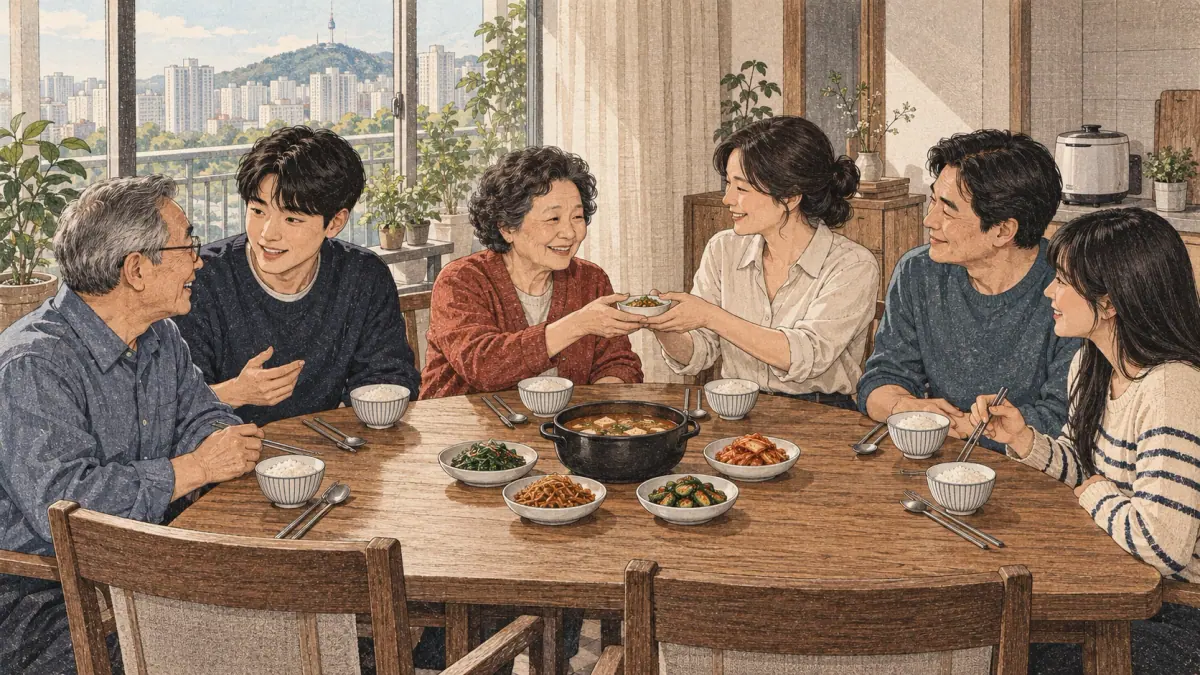
One habit shows up across all seven lists. Koreans say 우리 (our) where English says my when they talk about family and home. 우리 엄마 is literally our mom, and 우리 집 is our house, even when the speaker is talking about only their own. You saw it in the starter example above, and it is the first culture note to remember when you build sentences about people.
Practice: Flashcards and Worksheet
Begin with the 13 starter words, then work down the lists in the order you need them. The vocabulary flashcard decks page lists a deck for each topic, and the vocabulary worksheets page lists the printable sheets as they are published. Your progress in the decks stays in your browser.
Where to Go Next
Pick one list and finish it before you open the next. If you are unsure, start with Family Words. To go back up a level, return to Korean Vocabulary.
Frequently Asked Questions
Which People Word List Should I Start With?
Start with Family Words if you want to introduce your family, Relationships and Titles if you need to address people politely, and Jobs if you want small talk about work. Most beginners open family first because family questions arrive in the first minutes of a conversation.
How Are the Korean Words for People Organised?
The section has seven pages: family, relationships and titles, jobs, body, personality, emotions and kids. Six of the pages are word lists of 30 to 50 words in groups, with Hangul, Revised Romanization, audio and an example sentence for every word, plus a flashcard deck and a quiz. Relationships and Titles is a hub with its own word lists.
Do These Lists Include Verbs and Adjectives?
No. The lists cover nouns and short phrases. Verbs and adjectives, such as 아프다 (to hurt) and 행복하다 (to be happy), are covered in the verbs hub, which links back to these people lists for the nouns they go with.
Where Can I Find Flashcards and Worksheets for These Topics?
Each list page has its own flashcard deck, and the vocabulary flashcard decks page lists all of them. Printable worksheets can be found on the vocabulary worksheets page. Deck progress stays in your browser.