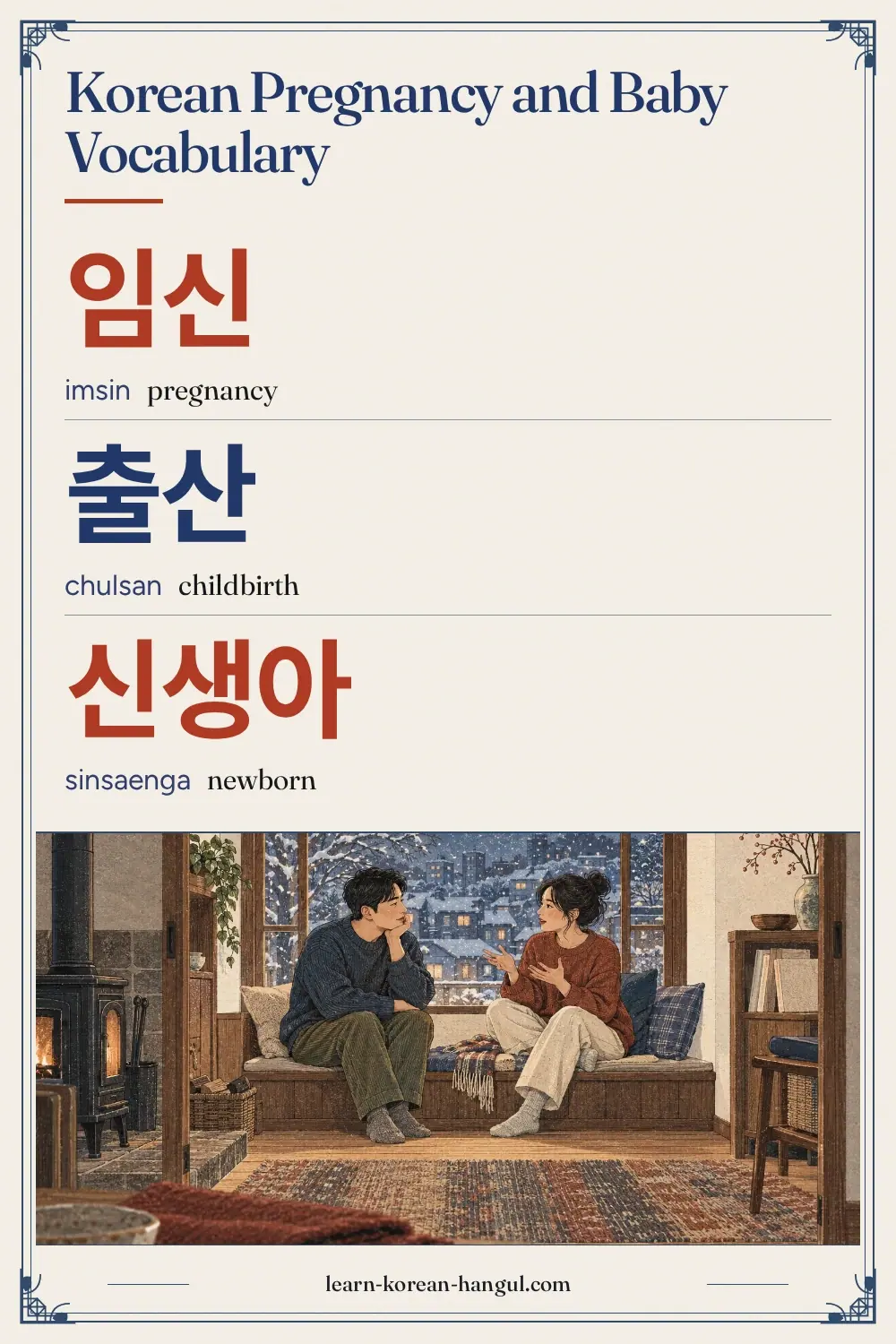
What you'll learn
- Match all 30 pregnancy and baby words to their English meanings.
- Say five of them aloud with the help of the Revised Romanization and the audio.
- Write two original sentences that use words such as 임신 (pregnancy) and 출산 (childbirth).
- Explain what 백일 and 돌 are, and tell the medical words from the family words.
Prerequisites: you can read Hangul and know the family words in Relationships and Titles. Estimated time: about 75 minutes, plus short reviews on the following days.
Korean Pregnancy and Baby Vocabulary at a Glance
The list has 30 words in five groups of six, in the order a family meets them: the months of pregnancy, the birth, the things a baby needs, the milestones of the first year, and the words for everyday parenting. It belongs to Relationships and Titles, and it is written for learners who want to talk with Korean friends and colleagues who are expecting or have a new baby.
| Group | Words | Use |
|---|---|---|
| Pregnancy | 6 | Expecting a child and prenatal checks |
| Birth | 6 | Hospital and the first weeks |
| Baby care items | 6 | What a baby needs at home |
| Baby milestones | 6 | Celebrations and early skills in the first years |
| Parenting words | 6 | Caring for and raising a child |
This page is a themed list. For the single word for baby with its meaning and one use, the dedicated page on baby in Korean gives that answer. Here the goal is the wider set of words around the baby.
Which Pregnancy and Baby Words Should You Learn First?
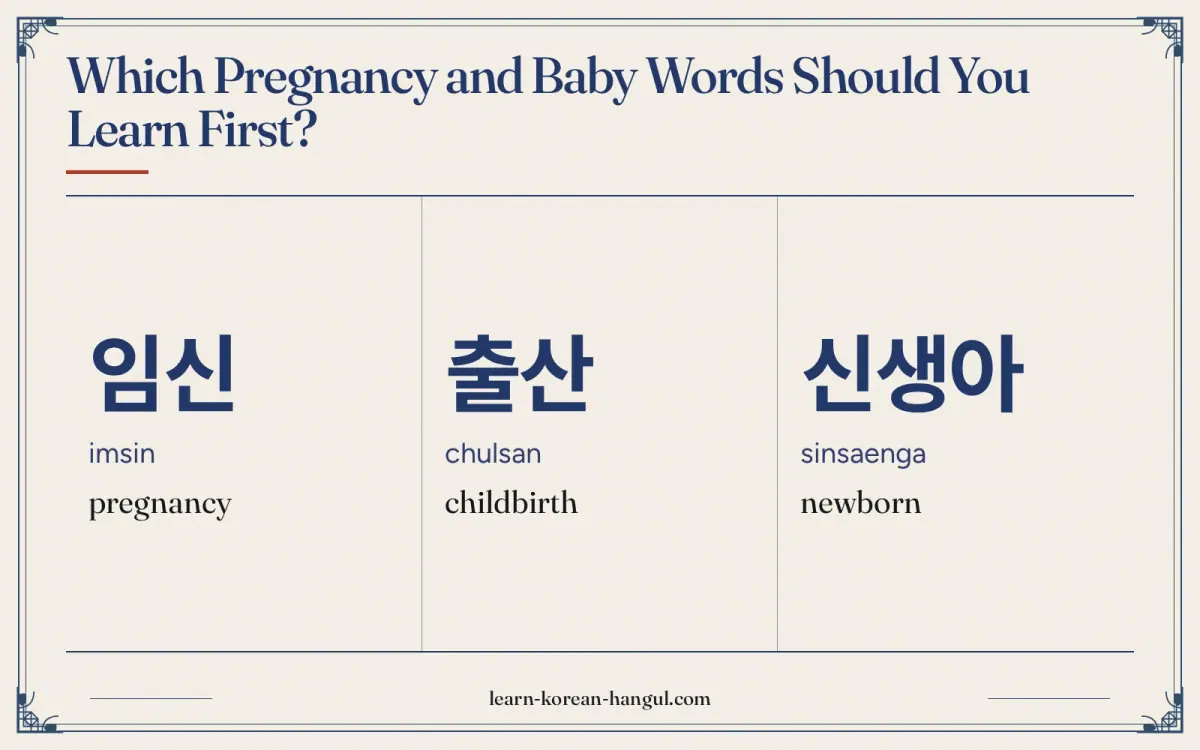
Learn 임신 (pregnancy), 출산 (childbirth), 기저귀 (diaper), 유모차 (stroller) and 돌 (first birthday) first. With these five you can follow most conversations about a new baby and say congratulations at a party. A short sentence such as 아내가 임신했어요 (my wife is pregnant) needs only the noun and the verb ending. Then follow this order:
- Step 1: the five words above.
- Step 2: the clinic words 산부인과, 초음파 and 신생아.
- Step 3: baby items: 젖병, 분유, 이유식 and 아기띠.
- Step 4: the culture words 백일, 돌잔치 and 돌잡이, then the parenting words.
The scene below numbers ten of the objects in a home with a new baby, so you can tie each word to something you can point at.
Word · 10
- 1
임신
imsin
pregnancy
- 2
출산
chulsan
childbirth
- 3
신생아
sinsaenga
newborn
- 4
기저귀
gijeogwi
diaper
- 5
젖병
jeotbyeong
baby bottle
- 6
유모차
yumocha
stroller
- 7
분유
bunyu
infant formula
- 8
백일
baegil
100th day
- 9
돌
dol
first birthday
- 10
어린이집
eorinijip
daycare center
Tap a number to hear the word. The word order of the scene follows the order of the sections below.
Pregnancy
Pregnancy words are used at the clinic, at work and among family. 임신 is the plain, neutral word. 임산부 names the pregnant woman, 태아 is the unborn child, and 초음파 is the ultrasound scan. 입덧 is the morning sickness many women have in the early months.
| No. | Hangul | Revised Romanization | Meaning and note | Example sentence | Audio assetId |
|---|---|---|---|---|---|
| 1 | 임신 | imsin | pregnancy. Medical and neutral. The verb is 임신하다 (to become pregnant). | 아내가 임신했어요. (anaega imsinhaesseoyo. My wife is pregnant.) | au-pg-vocabulary-people-relationships-baby-1; example: au-pg-vocabulary-people-relationships-baby-31 |
| 2 | 임산부 | imsanbu | pregnant woman. Seen on subway seats and signs reserved for expecting mothers. | 지하철에서 임산부에게 자리를 양보해요. (jihacheoreseo imsanbuege jarireul yangbohaeyo. On the subway I give my seat to a pregnant woman.) | au-pg-vocabulary-people-relationships-baby-2; example: au-pg-vocabulary-people-relationships-baby-32 |
| 3 | 태아 | taea | fetus. Medical word for the unborn child. | 태아의 심장 소리를 들었어요. (taeaui simjang sorireul deureosseoyo. I heard the fetus's heartbeat.) | au-pg-vocabulary-people-relationships-baby-3; example: au-pg-vocabulary-people-relationships-baby-33 |
| 4 | 태교 | taegyo | prenatal care. A tradition of calm thoughts, music and good habits during pregnancy. | 음악을 들으면서 태교를 해요. (eumageul deureumyeonseo taegyoreul haeyo. I do prenatal care by listening to music.) | au-pg-vocabulary-people-relationships-baby-4; example: au-pg-vocabulary-people-relationships-baby-34 |
| 5 | 입덧 | ipdeot | morning sickness. Tensed in speech: [입떧]. | 입덧이 심해요. (ipdeosi simhaeyo. My morning sickness is bad.) | au-pg-vocabulary-people-relationships-baby-5; example: au-pg-vocabulary-people-relationships-baby-35 |
| 6 | 초음파 | choeumpa | ultrasound. Sino-Korean 초 (beyond) + 음파 (sound wave). | 초음파 검사를 받았어요. (choeumpa geomsareul badasseoyo. I had an ultrasound.) | au-pg-vocabulary-people-relationships-baby-6; example: au-pg-vocabulary-people-relationships-baby-36 |
임신 is the word you will see on forms and hear at the clinic. Among friends and family, many people say 아기가 생겼어요 (a baby has come to us) when they share the news. 태교 is a good example of a culture word: it has no single English word, because it covers music, reading and mood as a way of caring for the child before birth. The verb 들으면서 combines 듣다 (to listen) with the ending -(으)면서 (while). 듣다 is a ㄷ irregular verb, so its ㄷ changes to ㄹ before a vowel, as in 들으면서 and 들었어요.
How Do You Say Birth in Korean?
Childbirth is 출산 (chulsan), and the verb 출산하다 means to give birth. A woman can also say 아기를 낳다 (to give birth to a baby), a native expression that is common in daily talk. The six words below cover the hospital and the first weeks at home.
| No. | Hangul | Revised Romanization | Meaning and note | Example sentence | Audio assetId |
|---|---|---|---|---|---|
| 7 | 출산 | chulsan | childbirth. Sino-Korean 출 (come out) + 산 (birth). Said [출싼]. | 다음 달에 출산해요. (daeum dare chulsanhaeyo. I am due to give birth next month.) | au-pg-vocabulary-people-relationships-baby-7; example: au-pg-vocabulary-people-relationships-baby-37 |
| 8 | 진통 | jintong | labor pains. 진 (a bout) + 통 (pain). Used for the contractions before birth. | 진통이 시작됐어요. (jintongi sijakdwaesseoyo. The labor pains have started.) | au-pg-vocabulary-people-relationships-baby-8; example: au-pg-vocabulary-people-relationships-baby-38 |
| 9 | 제왕절개 | jewangjeolgae | C-section. Written in Hangul with the Sino-Korean parts 제왕 (emperor) and 절개 (incision). | 제왕절개로 아기를 낳았어요. (jewangjeolgaero agireul naasseoyo. I had the baby by C-section.) | au-pg-vocabulary-people-relationships-baby-9; example: au-pg-vocabulary-people-relationships-baby-39 |
| 10 | 산부인과 | sanbuingwa | obstetrics and gynecology clinic. The department for pregnancy and women's health. Said [산부인꽈]. | 산부인과에 예약했어요. (sanbuingwae yeyakaesseoyo. I booked an appointment at the OB-GYN clinic.) | au-pg-vocabulary-people-relationships-baby-10; example: au-pg-vocabulary-people-relationships-baby-40 |
| 11 | 산후조리원 | sanhujoriwon | postpartum care center. A paid facility where mothers and newborns stay after birth in Korea. | 산후조리원에서 2주 동안 쉬어요. (sanhujoriwoneseo iju dongan swieoyo. I rest at the postpartum care center for two weeks.) | au-pg-vocabulary-people-relationships-baby-11; example: au-pg-vocabulary-people-relationships-baby-41 |
| 12 | 신생아 | sinsaenga | newborn. Sino-Korean 신 (new) + 생 (born) + 아 (child). | 신생아는 하루 종일 자요. (sinsaenganeun haru jongil jayo. A newborn sleeps all day.) | au-pg-vocabulary-people-relationships-baby-12; example: au-pg-vocabulary-people-relationships-baby-42 |
Two verbs say give birth. 출산하다 is formal and used in news and at work, while 낳다 is the everyday native verb: 아기를 낳았어요 (I gave birth to a baby). The same 낳다 also appears in 아이를 낳다 (to have a child). 산후조리원 is long, so break it into three parts: 산후 (after birth), 조리 (care and recovery) and 원 (an institution). The word 산부인과 also splits into parts: 산 (birth), 부인 (woman) and 과 (department), and the 과 is said tense: [산부인꽈].
Baby Care Items
Here are the items to put on a shopping list for a new baby. 기저귀 (diaper), 젖병 (bottle) and 분유 (formula) are daily purchases, 유모차 is the big purchase, and 아기띠 and 이유식 appear once the baby is out of the house and starting to eat.
| No. | Hangul | Revised Romanization | Meaning and note | Example sentence | Audio assetId |
|---|---|---|---|---|---|
| 13 | 기저귀 | gijeogwi | diaper. Native word. The verb for changing it is 갈다. | 기저귀를 갈아요. (gijeogwireul garayo. I change the diaper.) | au-pg-vocabulary-people-relationships-baby-13; example: au-pg-vocabulary-people-relationships-baby-43 |
| 14 | 젖병 | jeotbyeong | baby bottle. 젖 (milk) + 병 (bottle). Said [젇뼝]. | 젖병을 소독해요. (jeotbyeongeul sodokaeyo. I sterilize the bottle.) | au-pg-vocabulary-people-relationships-baby-14; example: au-pg-vocabulary-people-relationships-baby-44 |
| 15 | 분유 | bunyu | infant formula. Sino-Korean 분 (powder) + 유 (milk). Mixed with the verb 타다. | 분유를 타요. (bunyureul tayo. I mix formula.) | au-pg-vocabulary-people-relationships-baby-15; example: au-pg-vocabulary-people-relationships-baby-45 |
| 16 | 유모차 | yumocha | stroller. 유모 (nurse) + 차 (vehicle). The word for the pushchair. | 유모차를 밀어요. (yumochareul mireoyo. I push the stroller.) | au-pg-vocabulary-people-relationships-baby-16; example: au-pg-vocabulary-people-relationships-baby-46 |
| 17 | 아기띠 | agitti | baby carrier. 아기 (baby) + 띠 (band). Worn on the front or back. | 아기띠로 아기를 안아요. (agittiro agireul anayo. I carry the baby in a carrier.) | au-pg-vocabulary-people-relationships-baby-17; example: au-pg-vocabulary-people-relationships-baby-47 |
| 18 | 이유식 | iyusik | baby food. Food that replaces milk step by step, from soft porridge. | 이유식을 만들어요. (iyusigeul mandeureoyo. I make baby food.) | au-pg-vocabulary-people-relationships-baby-18; example: au-pg-vocabulary-people-relationships-baby-48 |
Look at the verb in the formula sentence: 타다 means to ride, as in 버스를 타요, and it also means to mix a drink, as in 분유를 타요 and 커피를 타요 (I make instant coffee). The context tells you which one. The verbs in this group are practical: 갈다 (to change or replace), 밀다 (to push), 안다 (to hold in the arms) and 만들다 (to make). 이유식 is usually made at home and given in stages, so you may hear stages named as 초기 (early) and 후기 (late).
How Do You Say Baby Milestones (백일, 돌) in Korean?
Two parties mark the first year. 백일 (baegil) is the 100th day after birth, and 돌 (dol) is the first birthday. The first birthday is also called 첫돌 (cheotdol), and for a toddler's second birthday people may say 두 돌. The other words in this group name what a baby learns to do.
| No. | Hangul | Revised Romanization | Meaning and note | Example sentence | Audio assetId |
|---|---|---|---|---|---|
| 19 | 백일 | baegil | 100th day. 백 (100) + 일 (day). Said [배길]. | 아기가 백일이 됐어요. (agiga baegiri dwaesseoyo. The baby has turned 100 days old.) | au-pg-vocabulary-people-relationships-baby-19; example: au-pg-vocabulary-people-relationships-baby-49 |
| 20 | 돌 | dol | first birthday. Also the word for stone, so check the context. | 다음 주가 아기 돌이에요. (daeum juga agi dorieyo. Next week is the baby's first birthday.) | au-pg-vocabulary-people-relationships-baby-20; example: au-pg-vocabulary-people-relationships-baby-50 |
| 21 | 돌잔치 | doljanchi | first birthday party. 돌 + 잔치 (feast or party). | 돌잔치에 초대받았어요. (doljanchie chodaebadasseoyo. I was invited to the first birthday party.) | au-pg-vocabulary-people-relationships-baby-21; example: au-pg-vocabulary-people-relationships-baby-51 |
| 22 | 돌잡이 | doljabi | first birthday object pick. The baby picks one object from a table, and the choice is said to hint at the future. | 돌잡이에서 연필을 잡았어요. (doljabieseo yeonpireul jabasseoyo. At the doljabi the baby picked a pencil.) | au-pg-vocabulary-people-relationships-baby-22; example: au-pg-vocabulary-people-relationships-baby-52 |
| 23 | 걸음마 | georeumma | first steps. Used with 떼다 (to take off) in 걸음마를 떼다. Said [거름마]. | 아기가 걸음마를 시작했어요. (agiga georeummareul sijakaesseoyo. The baby has started to walk.) | au-pg-vocabulary-people-relationships-baby-23; example: au-pg-vocabulary-people-relationships-baby-53 |
| 24 | 옹알이 | ongari | babbling. The early sounds a baby makes. Said [옹아리]. | 아기가 옹알이를 해요. (agiga ongarireul haeyo. The baby is babbling.) | au-pg-vocabulary-people-relationships-baby-24; example: au-pg-vocabulary-people-relationships-baby-54 |
백일 and 돌 are family events, and the invitation 돌잔치에 초대받았어요 is one you may meet if you work or study in Korea. For 백일, families traditionally share white steamed rice cake (백설기 baekseolgi) with relatives and neighbours. At the 돌잡이, a table holds objects such as thread, money and a pencil, and what the baby grabs is joked about as a sign of the child's future. These are customs, not rules, and families keep them in different ways.
Parenting Words
The last group covers the day-to-day words of parents. 육아 (child-rearing) is the general topic, 수유 and 모유 name feeding, 예방접종 is the vaccination schedule, and 어린이집 and 베이비시터 name the people and places who care for the child while parents work.
| No. | Hangul | Revised Romanization | Meaning and note | Example sentence | Audio assetId |
|---|---|---|---|---|---|
| 25 | 육아 | yuga | child-rearing. Sino-Korean 육 (raise) + 아 (child). Said [유가]. | 육아가 힘들어요. (yugaga himdeureoyo. Child-rearing is hard.) | au-pg-vocabulary-people-relationships-baby-25; example: au-pg-vocabulary-people-relationships-baby-55 |
| 26 | 수유 | suyu | nursing; feeding. The act of feeding a baby, by breast or bottle. Said as written. | 밤에도 수유해요. (bamedo suyuhaeyo. I feed the baby even at night.) | au-pg-vocabulary-people-relationships-baby-26; example: au-pg-vocabulary-people-relationships-baby-56 |
| 27 | 모유 | moyu | breast milk. 모 (mother) + 유 (milk). | 모유가 아기에게 좋아요. (moyuga agiege joayo. Breast milk is good for the baby.) | au-pg-vocabulary-people-relationships-baby-27; example: au-pg-vocabulary-people-relationships-baby-57 |
| 28 | 예방접종 | yebangjeopjong | vaccination. Sino-Korean. Said [예방접쫑]. | 예방접종 일정을 확인해요. (yebangjeopjong iljeongeul hwaginhaeyo. I check the vaccination schedule.) | au-pg-vocabulary-people-relationships-baby-28; example: au-pg-vocabulary-people-relationships-baby-58 |
| 29 | 어린이집 | eorinijip | daycare center. 어린이 (child) + 집 (house). For children under school age. | 어린이집에 보내요. (eorinijibe bonaeyo. I send my child to daycare.) | au-pg-vocabulary-people-relationships-baby-29; example: au-pg-vocabulary-people-relationships-baby-59 |
| 30 | 베이비시터 | beibisiteo | babysitter. Loanword from English. Spelled as one word. | 베이비시터를 구해요. (beibisiteoreul guhaeyo. I am looking for a babysitter.) | au-pg-vocabulary-people-relationships-baby-30; example: au-pg-vocabulary-people-relationships-baby-60 |
육아 appears in many compounds: 육아 일기 (parenting diary) and 육아용품 (baby goods) are common. The most useful pattern in this group is the verb with a place: 어린이집에 보내요 uses 에 for the destination and 보내다 for sending someone, so the sentence means I send the child to daycare. For an exact term in an official form, such as a leave of absence for child care, check the wording on the official form rather than guessing.
아기, 애기 and 아이: Three Words for a Young Child
Korean uses three words for a young child. 아기 (agi) is the standard word for a baby or a toddler, and it is what you will see in books and on signs. 애기 (aegi) is a common casual variant in speech, and 아이 (ai) is the general word for a child of any age. Learners should write 아기 and may hear 애기. The single-word page on baby in Korean gives the full explanation.
Medical Words and Family Words
The words on this page come in two registers. Medical words such as 임신, 출산 and 진통 are neutral and are the right choice with a doctor, on a form or in the news. Family talk uses native phrases: 아기가 생겼어요 for being pregnant, 아기를 낳았어요 for giving birth, and 아기가 태어났어요 for the baby has been born. Pregnancy is a private subject in many places, so wait for the other person to bring it up, and offer congratulations with 축하해요 once they have.
How Do You Pronounce Korean Pregnancy and Baby Words?
Several baby words change their sound. The National Institute of Korean Language (국립국어원) sets these changes in its standard pronunciation rules. Revised Romanization follows the spoken sound for linking, but it does not show tensing caused by a neighbouring sound.
| Spelling | Sounds like | What changes |
|---|---|---|
| 출산 | [출싼] | In Sino-Korean words, a final ㄹ tenses a following ㅅ. |
| 입덧 | [입떧] | ㄷ is tensed after a final ㅂ. |
| 젖병 | [젇뼝] | The final ㅈ is said as ㄷ, then ㅂ is tensed. |
| 백일 | [배길] | The final ㄱ links to the vowel that follows. |
| 걸음마 | [거름마] | The final ㄹ links to the vowel that follows. |
| 예방접종 | [예방접쫑] | ㅈ is tensed after a final ㅂ. |
Audio and Slow Playback
Each word and sentence has its own clip. The five clips below play the harder words slowly. Play a clip, say the word, then play it again and compare the ends of the syllables.
What Mistakes Do Learners Make with Pregnancy and Baby Words?
Five patterns catch learners when they talk about babies.
- Using medical words in casual talk. 임신했어요 is correct, but between friends 아기가 생겼어요 is warmer. Use the medical word at a clinic.
- Reading 출산 as written. The sound is [출싼]. A tense ㅅ after ㄹ is normal in Sino-Korean words, and English speakers often say chul-san with a plain s.
- Using 돌 for every birthday. 돌 on its own is the first birthday, and 두 돌 is used only for a toddler. Later birthdays are 생일, as in 생일 파티.
- Mixing up 타다 meanings. 분유를 타요 means to mix formula, not to ride it. The verb follows the object.
- Calling the baby 애기 in writing. Speech often has 애기, but the standard written form is 아기.
If you keep the registers apart and remember the one verb with two meanings, most of the trouble goes away. The practice section turns the list into drills.
Practice: Flashcards and Worksheet
Study in three steps. First, run the deck in recognition mode until the 30 words feel familiar. Second, switch to listening mode and tap the clip before the card turns. Third, take the five-question quiz below. The deck stores your progress in your browser. The vocabulary flashcard decks page lists the other decks.
Practice · 65
- 01임신
Show answer
headword 1: pregnancy
- 02임산부
Show answer
headword 2: pregnant woman
- 03태아
Show answer
headword 3: fetus
- 04태교
Show answer
headword 4: prenatal care
- 05입덧
Show answer
headword 5: morning sickness
- 06초음파
Show answer
headword 6: ultrasound
- 07출산
Show answer
headword 7: childbirth
- 08진통
Show answer
headword 8: labor pains
- 09제왕절개
Show answer
headword 9: C-section
- 10산부인과
Show answer
headword 10: obstetrics and gynecology clinic
- 11산후조리원
Show answer
headword 11: postpartum care center
- 12신생아
Show answer
headword 12: newborn
- 13기저귀
Show answer
headword 13: diaper
- 14젖병
Show answer
headword 14: baby bottle
- 15분유
Show answer
headword 15: infant formula
- 16유모차
Show answer
headword 16: stroller
- 17아기띠
Show answer
headword 17: baby carrier
- 18이유식
Show answer
headword 18: baby food
- 19백일
Show answer
headword 19: 100th day
- 20돌
Show answer
headword 20: first birthday
- 21돌잔치
Show answer
headword 21: first birthday party
- 22돌잡이
Show answer
headword 22: first birthday object pick
- 23걸음마
Show answer
headword 23: first steps
- 24옹알이
Show answer
headword 24: babbling
- 25육아
Show answer
headword 25: child-rearing
- 26수유
Show answer
headword 26: nursing; feeding
- 27모유
Show answer
headword 27: breast milk
- 28예방접종
Show answer
headword 28: vaccination
- 29어린이집
Show answer
headword 29: daycare center
- 30베이비시터
Show answer
headword 30: babysitter
- 31아내가 임신했어요.
Show answer
example sentence for 임신
- 32지하철에서 임산부에게 자리를 양보해요.
Show answer
example sentence for 임산부
- 33태아의 심장 소리를 들었어요.
Show answer
example sentence for 태아
- 34음악을 들으면서 태교를 해요.
Show answer
example sentence for 태교
- 35입덧이 심해요.
Show answer
example sentence for 입덧
- 36초음파 검사를 받았어요.
Show answer
example sentence for 초음파
- 37다음 달에 출산해요.
Show answer
example sentence for 출산
- 38진통이 시작됐어요.
Show answer
example sentence for 진통
- 39제왕절개로 아기를 낳았어요.
Show answer
example sentence for 제왕절개
- 40산부인과에 예약했어요.
Show answer
example sentence for 산부인과
- 41산후조리원에서 2주 동안 쉬어요.
Show answer
example sentence for 산후조리원
- 42신생아는 하루 종일 자요.
Show answer
example sentence for 신생아
- 43기저귀를 갈아요.
Show answer
example sentence for 기저귀
- 44젖병을 소독해요.
Show answer
example sentence for 젖병
- 45분유를 타요.
Show answer
example sentence for 분유
- 46유모차를 밀어요.
Show answer
example sentence for 유모차
- 47아기띠로 아기를 안아요.
Show answer
example sentence for 아기띠
- 48이유식을 만들어요.
Show answer
example sentence for 이유식
- 49아기가 백일이 됐어요.
Show answer
example sentence for 백일
- 50다음 주가 아기 돌이에요.
Show answer
example sentence for 돌
- 51돌잔치에 초대받았어요.
Show answer
example sentence for 돌잔치
- 52돌잡이에서 연필을 잡았어요.
Show answer
example sentence for 돌잡이
- 53아기가 걸음마를 시작했어요.
Show answer
example sentence for 걸음마
- 54아기가 옹알이를 해요.
Show answer
example sentence for 옹알이
- 55육아가 힘들어요.
Show answer
example sentence for 육아
- 56밤에도 수유해요.
Show answer
example sentence for 수유
- 57모유가 아기에게 좋아요.
Show answer
example sentence for 모유
- 58예방접종 일정을 확인해요.
Show answer
example sentence for 예방접종
- 59어린이집에 보내요.
Show answer
example sentence for 어린이집
- 60베이비시터를 구해요.
Show answer
example sentence for 베이비시터
- 61산후조리원
Show answer
slow playback of 산후조리원
- 62제왕절개
Show answer
slow playback of 제왕절개
- 63예방접종
Show answer
slow playback of 예방접종
- 64옹알이
Show answer
slow playback of 옹알이
- 65젖병
Show answer
slow playback of 젖병
Practice · 5
What does 임신 (imsin) mean?
Show answer
pregnancy
임신 means pregnancy. Example: 아내가 임신했어요. (My wife is pregnant.)
What does 출산 (chulsan) mean?
Show answer
childbirth
출산 means childbirth. Example: 다음 달에 출산해요. (I am due to give birth next month.)
Which word is the first birthday?
Show answer
돌
돌 is the first birthday, and 백일 is the 100th day. Example: 다음 주가 아기 돌이에요. (Next week is the baby's first birthday.)
What does 분유를 타요 mean?
Show answer
I mix formula
타다 also means to mix a drink. 분유를 타요 means I mix formula.
Which word names the place where parents send a small child while they work?
Show answer
어린이집
어린이집 is a daycare center. Example: 어린이집에 보내요. (I send my child to daycare.)
Korean Pregnancy and Baby Vocabulary Worksheet (PDF)
A printable worksheet for these words (word list, matching, writing practice, fill-in-the-blank exercises and answer key) is available in A4 and US Letter from the download card on this page. For additional practice, write the five groups on cards and sort them by hand.
Where to Go Next
After this page, continue with Korean Honorific Vocabulary for the respectful words you use with elders, or with Korean Friendship Vocabulary for words about friends.
Frequently Asked Questions
How Do You Say Pregnancy in Korean?
Pregnancy is 임신 (imsin). The verb is 임신하다, so I am pregnant is 임신했어요 in the past form that Korean uses for a state that has begun. Among friends, people often say 아기가 생겼어요 instead. The word is neutral and is safe at a clinic or at work.
How Do You Say Childbirth in Korean?
Childbirth is 출산 (chulsan), and the verb 출산하다 means to give birth. In daily talk, people use the native verb 낳다, as in 아기를 낳았어요. The first syllable ends in ㄹ, so the ㅅ that follows is said with a tense sound: [출싼]. The audio plays it.
How Many Pregnancy and Baby Words Should I Learn First?
Five first: 임신, 출산, 기저귀, 유모차 and 돌. They let you follow a short conversation about a new baby. At five new words a day the 30 words take about a week with review. Add the clinic words next, and the culture words 백일 and 돌잔치 last.
What Are 백일 and 돌 in Korea?
백일 is the 100th day after birth and 돌 is the first birthday. Families celebrate them with food, and 돌 includes the 돌잡이, where the baby picks an object. Both are family customs, so a gift or a kind message is welcome when you are invited. Dress and gifts differ from family to family.
Where Can I Practise Pregnancy and Baby Words with Flashcards?
Use the vocabulary flashcard decks. The deck for this page holds all 30 words with Hangul, romanization and audio, in recognition and listening modes. Your progress stays in your browser. Give the sound-change words extra time in listening mode.
Is There a Printable Worksheet for Pregnancy and Baby Words?
A printable worksheet for these words (word list, matching, writing practice, fill-in-the-blank exercises and answer key) is available in A4 and US Letter from the download card on this page. For practice, the tables on this page can be copied by hand, and the deck carries the same 30 words.