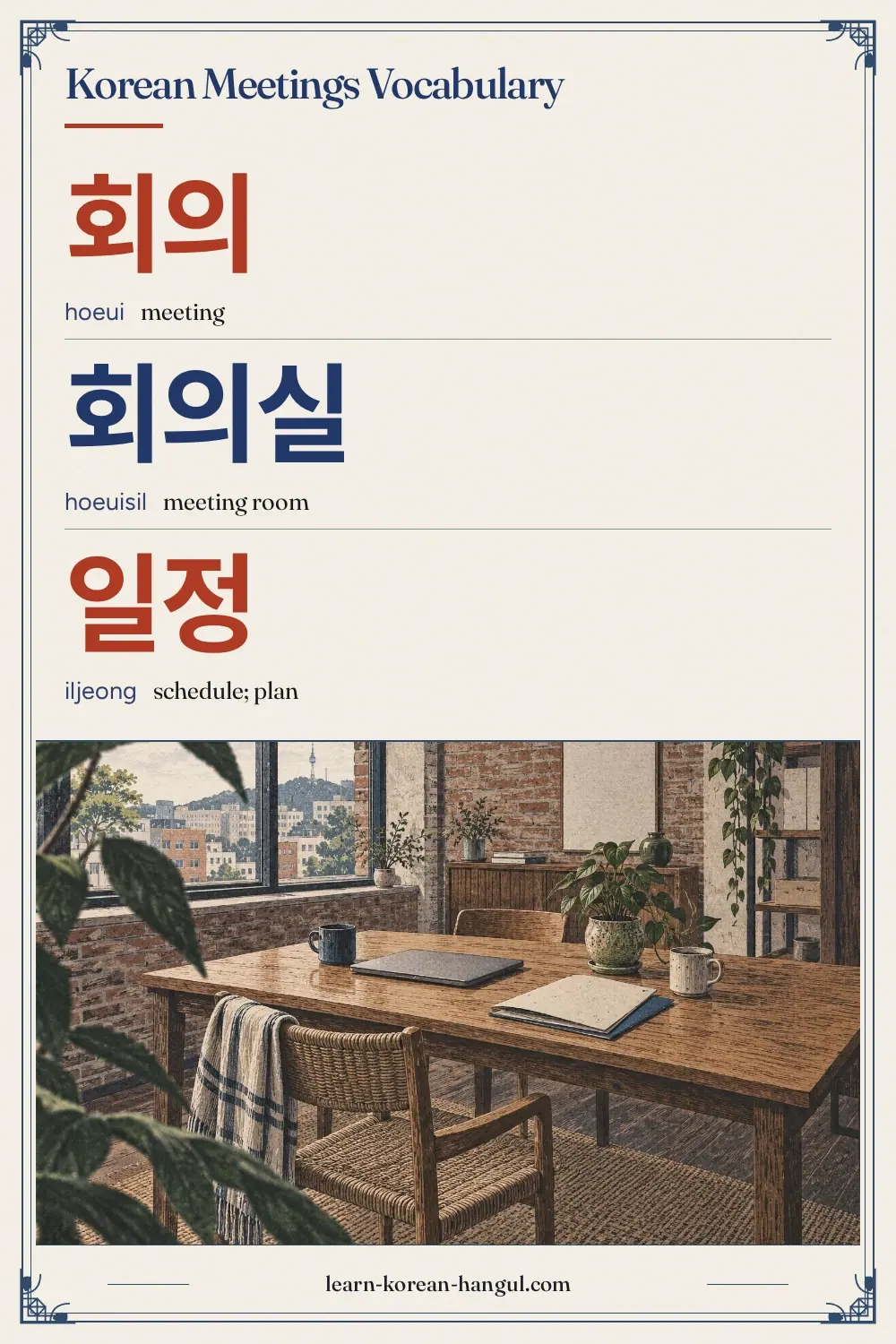
Korean Meetings Vocabulary at a Glance
The list has 30 words in five groups of six, and the groups follow the life of one meeting. First you set it up, then people speak, someone presents, the group decides, and finally someone writes up the result and keeps an eye on the deadline. It belongs to Office and Business. For the spoken lines that go with these nouns, see work phrases. Nearly all the words are Sino-Korean, so the same short parts return: 의 (opinion, meaning), 발 (put out) and 정 (decide) each turn up in several words.
| Group | Words | Use |
|---|---|---|
| Setting up | 6 | The meeting, the room, the schedule and who comes |
| Speaking in the meeting | 6 | Remarks, opinions, discussion and the chair |
| Presentations | 6 | Presenting, materials, slides and questions |
| Decisions | 6 | Proposals, votes and agreement |
| Minutes and deadlines | 6 | Writing up, reporting and keeping to time |
Meetings are a formal setting, so the words come with polite endings and titles. A colleague with a title is addressed with 님, as in 팀장님 (team leader). The example sentences in the tables use the everyday polite -요 style so that you can read them easily, and the section on the language of a meeting shows the formal -ㅂ니다 style that a chair uses.
Which Meetings Words Should You Learn First?
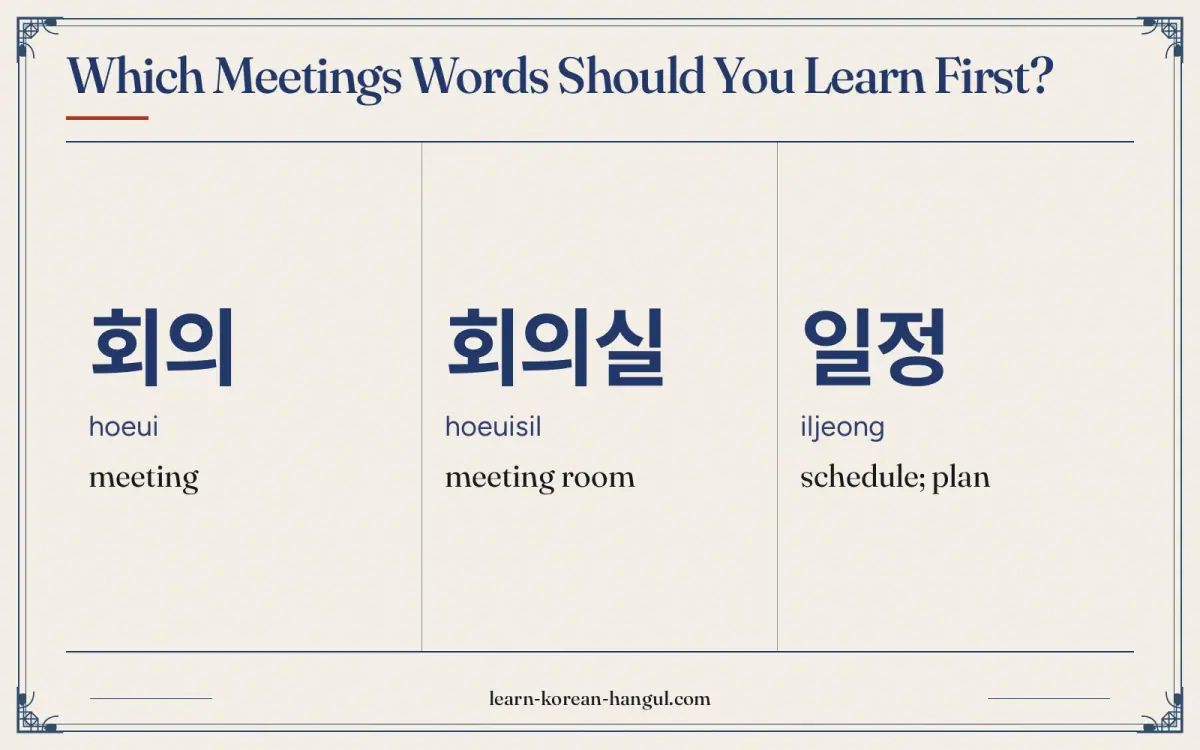
Learn 회의 (meeting), 일정 (schedule), 의견 (opinion), 발표 (presentation) and 마감 (deadline) first. They let you say that you have a meeting, ask when it is, give an opinion and talk about a due date. 회의가 있어요 (I have a meeting) is the most useful sentence on this page for a new learner.
- Words to say. 회의, 일정, 의견, 발표, 마감, 확인. They fill ordinary office talk.
- Words to recognise. 안건, 회의록, 질의응답, 담당자. You read them on invitations, agendas and emails.
- Words for decisions. 찬성, 반대, 합의, 결정. They matter when a group has to choose.
The scene below shows a meeting room with ten numbered objects and ideas from the list, so that you can tie each word to a picture.
Word · 10
- 1
회의
hoeui
meeting
- 2
회의실
hoeuisil
meeting room
- 3
일정
iljeong
schedule; plan
- 4
안건
angeon
agenda item
- 5
발표
balpyo
presentation; announcement
- 6
자료
jaryo
materials; data
- 7
슬라이드
seullaideu
slide
- 8
회의록
hoeuirok
minutes (of a meeting)
- 9
마감
magam
deadline; closing
- 10
담당자
damdangja
person in charge
Setting up a Meeting
A meeting starts before anyone sits down. Someone books the room, sets the time and sends the agenda. These six words cover that stage. 회의 is the general word, and it is the root of 회의실 (meeting room) and 회의록 (minutes), which you will meet later.
| No. | Hangul | Revised Romanization | Meaning and note | Example sentence | Audio assetId |
|---|---|---|---|---|---|
| 1 | 회의 | hoeui | meeting. The standard allows [회의] and [훼이]. A work meeting. | 회의가 있어요. (I have a meeting.) | au-pg-vocabulary-school-work-office-meetings-1; example: au-pg-vocabulary-school-work-office-meetings-31 |
| 2 | 회의실 | hoeuisil | meeting room. 회의 plus 실, room. | 회의실이 어디예요? (Where is the meeting room?) | au-pg-vocabulary-school-work-office-meetings-2; example: au-pg-vocabulary-school-work-office-meetings-32 |
| 3 | 일정 | iljeong | schedule; plan. Said [일쩡]. The set of times and dates. | 이번 주 일정이 많아요. (I have a full schedule this week.) | au-pg-vocabulary-school-work-office-meetings-3; example: au-pg-vocabulary-school-work-office-meetings-33 |
| 4 | 안건 | angeon | agenda item. Said [안껀]. One topic on the list. | 오늘 안건은 세 가지예요. (Today's agenda has three items.) | au-pg-vocabulary-school-work-office-meetings-4; example: au-pg-vocabulary-school-work-office-meetings-34 |
| 5 | 참석 | chamseok | attendance. Being present at an event. | 회의에 참석해요. (I attend the meeting.) | au-pg-vocabulary-school-work-office-meetings-5; example: au-pg-vocabulary-school-work-office-meetings-35 |
| 6 | 준비 | junbi | preparation. Also the root of 준비하다. | 회의를 준비해요. (I prepare for the meeting.) | au-pg-vocabulary-school-work-office-meetings-6; example: au-pg-vocabulary-school-work-office-meetings-36 |
Example Sentences
The frame in these examples is a noun, a particle and a verb. The particle 에 follows the meeting you attend, as in 회의에 참석해요, while 을/를 follows the thing you prepare, as in 회의를 준비해요. Say each sentence aloud after the audio.
안건 is worth a note. It is one item on the agenda, and a meeting can have many. The counter that goes with it is 가지 (kind, item), so 세 가지 means three items. 일정 can mean a single schedule or the whole plan for a week, and the context tells you which.
What Do People Say during a Korean Meeting?
Once the meeting is under way, people speak in turns. The chair opens the floor, someone gives a remark, and the group discusses. These six words name what is said and who leads. They are also the words that appear in minutes and news about meetings.
| No. | Hangul | Revised Romanization | Meaning and note | Example sentence | Audio assetId |
|---|---|---|---|---|---|
| 7 | 발언 | bareon | remark; speaking out. Said [바런]. Saying something in a formal setting. | 발언을 해요. (I make a remark.) | au-pg-vocabulary-school-work-office-meetings-7; example: au-pg-vocabulary-school-work-office-meetings-37 |
| 8 | 의견 | uigyeon | opinion. A view you hold or give. | 의견이 있어요. (I have an opinion.) | au-pg-vocabulary-school-work-office-meetings-8; example: au-pg-vocabulary-school-work-office-meetings-38 |
| 9 | 토론 | toron | discussion; debate. More structured than a chat. | 토론을 시작해요. (We start the discussion.) | au-pg-vocabulary-school-work-office-meetings-9; example: au-pg-vocabulary-school-work-office-meetings-39 |
| 10 | 설명 | seolmyeong | explanation. Making something clear. | 설명을 들어요. (I listen to the explanation.) | au-pg-vocabulary-school-work-office-meetings-10; example: au-pg-vocabulary-school-work-office-meetings-40 |
| 11 | 논의 | nonui | discussion; deliberation. The standard allows [노늬] and [노니]. Talking something over to decide it. | 이 문제를 논의해요. (We discuss this problem.) | au-pg-vocabulary-school-work-office-meetings-11; example: au-pg-vocabulary-school-work-office-meetings-41 |
| 12 | 사회자 | sahoeja | chair; moderator. The person who runs the meeting. | 사회자가 시작해요. (The chair begins.) | au-pg-vocabulary-school-work-office-meetings-12; example: au-pg-vocabulary-school-work-office-meetings-42 |
토론 and 논의 are close but not equal. 토론 is a debate in which people hold different views and argue them, while 논의 is a working discussion aimed at a decision. The first fits a class or a panel, and the second fits an office. 사회자 is made of 사회 (conducting a programme) and 자 (person), and it is the same word as the host of a wedding or a show.
Presentations
Presentations are common in Korean offices, and the vocabulary is mostly borrowed or built from short Sino-Korean pieces. A 발표 is a talk, the 자료 is what you hand out, and a 슬라이드 is what you show. Questions come at the end in a 질의응답.
| No. | Hangul | Revised Romanization | Meaning and note | Example sentence | Audio assetId |
|---|---|---|---|---|---|
| 13 | 발표 | balpyo | presentation; announcement. Also used for announcing results. | 발표를 준비해요. (I prepare a presentation.) | au-pg-vocabulary-school-work-office-meetings-13; example: au-pg-vocabulary-school-work-office-meetings-43 |
| 14 | 발표자 | balpyoja | presenter. 발표 plus 자, person. | 발표자가 앞에 서요. (The presenter stands at the front.) | au-pg-vocabulary-school-work-office-meetings-14; example: au-pg-vocabulary-school-work-office-meetings-44 |
| 15 | 자료 | jaryo | materials; data. Papers, files and figures that support a point. | 자료를 보내요. (I send the materials.) | au-pg-vocabulary-school-work-office-meetings-15; example: au-pg-vocabulary-school-work-office-meetings-45 |
| 16 | 슬라이드 | seullaideu | slide. Loanword from English. | 슬라이드가 열 장이에요. (There are ten slides.) | au-pg-vocabulary-school-work-office-meetings-16; example: au-pg-vocabulary-school-work-office-meetings-46 |
| 17 | 질의응답 | jiruieungdap | question-and-answer session. 질의 is asking; 응답 is replying. | 발표 후에 질의응답이 있어요. (There is a Q&A after the presentation.) | au-pg-vocabulary-school-work-office-meetings-17; example: au-pg-vocabulary-school-work-office-meetings-47 |
| 18 | 요약 | yoyak | summary. A short version of a longer text. | 요약을 써요. (I write a summary.) | au-pg-vocabulary-school-work-office-meetings-18; example: au-pg-vocabulary-school-work-office-meetings-48 |
발표 has a second meaning, announcement, so 결과 발표 means the announcement of results. In a meeting, the context makes it clear that it is a talk. The counter for slides and sheets of paper is 장, so 열 장 means ten sheets. 자료 is also the word for data in a report, which makes it useful far beyond this page.
How Do You Say Decisions in Korean?
A meeting exists to decide something, and Korean has a ladder of words for how a group gets there. Someone makes a 제안, people say 찬성 or 반대, the group reaches a 합의, and the chair records the 결정. Learn the words in this order and you can follow the whole process.
| No. | Hangul | Revised Romanization | Meaning and note | Example sentence | Audio assetId |
|---|---|---|---|---|---|
| 19 | 결정 | gyeoljeong | decision. Said [결쩡]. The final choice. | 결정을 내려요. (We make a decision.) | au-pg-vocabulary-school-work-office-meetings-19; example: au-pg-vocabulary-school-work-office-meetings-49 |
| 20 | 제안 | jean | proposal; suggestion. Something put forward for others to judge. | 제안을 받아요. (I receive a proposal.) | au-pg-vocabulary-school-work-office-meetings-20; example: au-pg-vocabulary-school-work-office-meetings-50 |
| 21 | 찬성 | chanseong | agreement; support (for a vote). Voting or speaking in favour. | 저는 찬성해요. (I am in favour.) | au-pg-vocabulary-school-work-office-meetings-21; example: au-pg-vocabulary-school-work-office-meetings-51 |
| 22 | 반대 | bandae | opposition; objection. Also means the opposite side. | 반대 의견이 많아요. (There are many opposing opinions.) | au-pg-vocabulary-school-work-office-meetings-22; example: au-pg-vocabulary-school-work-office-meetings-52 |
| 23 | 합의 | habui | agreement (reached). The standard allows [하븨] and [하비]. Two sides settle together. | 합의를 해요. (We reach an agreement.) | au-pg-vocabulary-school-work-office-meetings-23; example: au-pg-vocabulary-school-work-office-meetings-53 |
| 24 | 동의 | dongui | consent; agreement. The standard allows [동의] and [동이]. Saying yes to a point. | 모두 동의해요. (Everyone agrees.) | au-pg-vocabulary-school-work-office-meetings-24; example: au-pg-vocabulary-school-work-office-meetings-54 |
The three agreement words differ in size. 찬성 is a vote in favour of a proposal, 동의 is saying yes to a point, and 합의 is the shared result after a discussion between sides. The verb that goes with 결정 is 내리다 (to bring down), so 결정을 내려요 is the set phrase. 반대 also means the opposite of something, as in 반대 방향, the other direction, so check the noun that follows.
Two more outcomes are common in office meetings: 승인 (seungin, approval by someone with authority) and 보류 (boryu, putting an item on hold). A chair may close an item with 이 안건은 보류하겠습니다 (We will put this item on hold). To disagree politely, praise the point first and then offer another view: 좋은 의견이지만, 다른 방법도 생각해 보면 좋겠습니다 (That is a good point, but it would be good to consider another way too). A softer 반대 is more welcome than a blunt 반대합니다.
Minutes and Deadlines
The meeting ends, and the work begins. Someone writes up the minutes, someone reports to a manager, and everyone watches the deadline. These last six words turn the talk into action.
| No. | Hangul | Revised Romanization | Meaning and note | Example sentence | Audio assetId |
|---|---|---|---|---|---|
| 25 | 회의록 | hoeuirok | minutes (of a meeting). 록 means record. | 회의록을 써요. (I write the minutes.) | au-pg-vocabulary-school-work-office-meetings-25; example: au-pg-vocabulary-school-work-office-meetings-55 |
| 26 | 보고 | bogo | report; reporting. Telling a superior what happened. | 팀장님께 보고해요. (I report to the team leader.) | au-pg-vocabulary-school-work-office-meetings-26; example: au-pg-vocabulary-school-work-office-meetings-56 |
| 27 | 마감 | magam | deadline; closing. The last moment for a task or a shop. | 마감이 내일이에요. (The deadline is tomorrow.) | au-pg-vocabulary-school-work-office-meetings-27; example: au-pg-vocabulary-school-work-office-meetings-57 |
| 28 | 기한 | gihan | time limit; due date. A date set in advance. | 기한을 지켜요. (I keep to the time limit.) | au-pg-vocabulary-school-work-office-meetings-28; example: au-pg-vocabulary-school-work-office-meetings-58 |
| 29 | 담당자 | damdangja | person in charge. The one who owns a task. | 담당자가 누구예요? (Who is the person in charge?) | au-pg-vocabulary-school-work-office-meetings-29; example: au-pg-vocabulary-school-work-office-meetings-59 |
| 30 | 확인 | hwagin | confirmation; checking. Said [화긴]. Making sure something is right. | 메일을 확인해요. (I check my email.) | au-pg-vocabulary-school-work-office-meetings-30; example: au-pg-vocabulary-school-work-office-meetings-60 |
마감 and 기한 are close. 마감 is the closing point of something, such as a task or a shop's day, while 기한 is a time limit set for a job. People say 마감 시간 for the closing time. The particle 께 in 팀장님께 is the honorific form of 에게 (to), and it is used when the person who receives the report is above you. 담당자 is built from 담당 (taking charge) and 자 (person), which is the same 자 as in 사회자 and 발표자. In many offices the person who runs a meeting is called the 진행자 (jinhaengja), and the people who attend are 참석자 (chamseokja). After the meeting, someone usually shares the minutes: 회의록을 공유해 주세요 (Please share the minutes), where 공유 (gongyu) means sharing.
What Does the Language of a Meeting Sound Like?
A chair or a presenter uses the formal polite style, which ends in -ㅂ니다 or -습니다. A short opening might sound like this: 회의를 시작하겠습니다. 오늘 안건은 두 가지입니다. 자료를 확인해 주세요. 감사합니다. Each line ends in a formal ending, and the noun 안건 appears in the second line. The everyday -요 ending is common between colleagues who know each other, but listen to what the chair uses and follow it.
Titles matter as much as endings. Colleagues are called by a title with 님, such as 팀장님 (team leader), and not by name. The honorific 께 replaces 에게 for a person above you, as in 팀장님께 보고해요. When you give an opinion, a soft opener such as 제 의견은 이렇습니다 (my opinion is this) sounds more polite than a blunt statement. You will meet more fixed lines on work phrases.
How Do You Pronounce Meetings Words?
Most meetings words are Sino-Korean, and they show the same few sound changes again and again. The standard pronunciation rules of the National Institute of Korean Language (국립국어원) describe each one. The Revised Romanization of Korean does not show tensing caused by a neighbouring sound, so rely on the Hangul and the audio.
| Spelling | Sounds like | What changes |
|---|---|---|
| 일정 | [일쩡] | After the final ㄹ of 일, the ㅈ of 정 is said tense. |
| 안건 | [안껀] | The ㄱ of 건 is said tense after the final ㄴ; the spelling does not show it. |
| 결정 | [결쩡] | After the final ㄹ of 결, the ㅈ of 정 is said tense. |
| 발언 | [바런] | The final ㄹ of 발 moves onto the empty ㅇ of 언. |
| 확인 | [화긴] | The final ㄱ of 확 moves onto the empty ㅇ of 인. |
| 회의 | [회의] or [훼이] | The standard allows two forms; the second is common in speech. |
Two habits cover most of the list. A Sino-Korean ㄹ makes a following ㅈ tense, which is why 일정 and 결정 both end in a strong jeong. And a final consonant moves forward when the next syllable starts with ㅇ, so 발언 sounds like ba-reon and 확인 sounds like hwa-gin. Learn the spoken form with the spelling, and do not pause between syllables.
Audio and Slow Playback
Each word and sentence has its own clip. Five clips replay the hardest words slowly: an agenda item, a schedule, a decision, a remark and a check. Play one, repeat it aloud, then play it again and compare.
What Mistakes Do Learners Make with Meetings Words?
Five confusions come up again and again.
- Using 회의 for a social gathering. 회의 is a work meeting. For a gathering of friends or a club, say 모임. So 회의가 있어요 means I have a work meeting, and 모임이 있어요 means I have a get-together.
- Mixing 발표 and 발언. 발표 is a prepared talk or an announcement, and 발언 is a single remark in the discussion. You prepare a 발표, and you make a 발언 when the chair gives you the floor.
- Treating 찬성, 동의 and 합의 as one word. 찬성 is support for a proposal, 동의 is consent to a point, and 합의 is the agreement two sides reach together. Use 합의 only when both sides have moved.
- Using 마감 for every date. 마감 is the closing point of a task, as in 마감이 내일이에요. A birthday or a party date is not a 마감. A date you must keep is a 기한.
- Dropping 님 from a title. Calling a manager 팀장 without 님 sounds blunt when you speak to the person. Use 팀장님. In writing about them, the short form is fine.
In every case a neighbouring word does a nearby job. Keep the pairs together, such as 회의 and 모임, 발표 and 발언, and 마감 and 기한, and the rest of the 30 words stay in place.
Practice: Flashcards and Worksheet
Study in three steps. First, run the deck in recognition mode until the 30 words come quickly. Second, switch to listening mode and play the clip before you flip each card. Third, take the five-question quiz. Progress stays in your browser, and the vocabulary flashcard decks page lists the other decks.
Practice · 30
- 01회의
Show answer
hoeui
meeting
- 02회의실
Show answer
hoeuisil
meeting room
- 03일정
Show answer
iljeong
schedule; plan
- 04안건
Show answer
angeon
agenda item
- 05참석
Show answer
chamseok
attendance
- 06준비
Show answer
junbi
preparation
- 07발언
Show answer
bareon
remark; speaking out
- 08의견
Show answer
uigyeon
opinion
- 09토론
Show answer
toron
discussion; debate
- 10설명
Show answer
seolmyeong
explanation
- 11논의
Show answer
nonui
discussion; deliberation
- 12사회자
Show answer
sahoeja
chair; moderator
- 13발표
Show answer
balpyo
presentation; announcement
- 14발표자
Show answer
balpyoja
presenter
- 15자료
Show answer
jaryo
materials; data
- 16슬라이드
Show answer
seullaideu
slide
- 17질의응답
Show answer
jiruieungdap
question-and-answer session
- 18요약
Show answer
yoyak
summary
- 19결정
Show answer
gyeoljeong
decision
- 20제안
Show answer
jean
proposal; suggestion
- 21찬성
Show answer
chanseong
agreement; support (for a vote)
- 22반대
Show answer
bandae
opposition; objection
- 23합의
Show answer
habui
agreement (reached)
- 24동의
Show answer
dongui
consent; agreement
- 25회의록
Show answer
hoeuirok
minutes (of a meeting)
- 26보고
Show answer
bogo
report; reporting
- 27마감
Show answer
magam
deadline; closing
- 28기한
Show answer
gihan
time limit; due date
- 29담당자
Show answer
damdangja
person in charge
- 30확인
Show answer
hwagin
confirmation; checking
Practice · 5
What does 일정 (iljeong) mean?
Show answer
schedule; plan
일정 means schedule; plan. Example: 이번 주 일정이 많아요. (I have a full schedule this week.)
What does 의견 (uigyeon) mean?
Show answer
opinion
의견 means opinion. Example: 의견이 있어요. (I have an opinion.)
What does 발표 (balpyo) mean?
Show answer
presentation; announcement
발표 means presentation; announcement. Example: 발표를 준비해요. (I prepare a presentation.)
What does 결정 (gyeoljeong) mean?
Show answer
decision
결정 means decision. Example: 결정을 내려요. (We make a decision.)
What does 마감 (magam) mean?
Show answer
deadline; closing
마감 means deadline; closing. Example: 마감이 내일이에요. (The deadline is tomorrow.)
Korean Meetings Vocabulary Worksheet (PDF)
A printable worksheet for these words (word list, matching, writing practice, fill-in-the-blank exercises and answer key) is available in A4 and US Letter from the download card on this page. For additional practice, write three lines about a meeting you have this week, using 일정, 안건 and 마감.
Where to Go Next
After this page, continue with Korean Email and Letters Vocabulary for the written side of office life, or work phrases for the lines you say. To move up a level, return to Office and Business.
Frequently Asked Questions
How Do You Say Meeting in Korean?
Meeting is 회의 (hoeui). It means a work meeting, and the standard allows both [회의] and [훼이]. A gathering of friends is a 모임. The room is 회의실, and the minutes are 회의록. The single-word page on meeting in Korean gives more detail.
How Do You Pronounce 안건 (angeon)?
Say an-geon in two beats, with the second consonant tense: [안껀]. The ㄱ of 건 is said strong after the final ㄴ, although the spelling does not show it. The vowel ㅓ is a relaxed, unrounded sound. Press the audio button on this page to hear the word and the slow clip.
How Many Meetings Words Should I Learn First?
Start with about six: 회의, 일정, 의견, 발표, 마감 and 확인. They let you say that you have a meeting, ask the time, give an opinion and talk about a due date. The whole list of 30 takes about six days at five new words a day, with a short review of earlier words each day.
Where Can I Practise Meetings Words with Flashcards?
Use the deck on this page, which holds all 30 words with Hangul, romanization and audio, in recognition and listening modes. The vocabulary flashcard decks page lists the decks for other topics. Progress is saved only in your browser.
Is the Romanization on This Page Official?
It follows the Revised Romanization of Korean, which South Korea adopted in 2000 and whose rules the National Institute of Korean Language (국립국어원) publishes. It is a learning aid, and it does not show tensing caused by a neighbouring sound, so rely on the Hangul and the audio.
Is There a Printable Worksheet for Meetings Words?
A printable worksheet for these words (word list, matching, writing practice, fill-in-the-blank exercises and answer key) is available in A4 and US Letter from the download card on this page. For practice, use the flashcard deck, which carries the same 30 words, or copy the tables by hand.