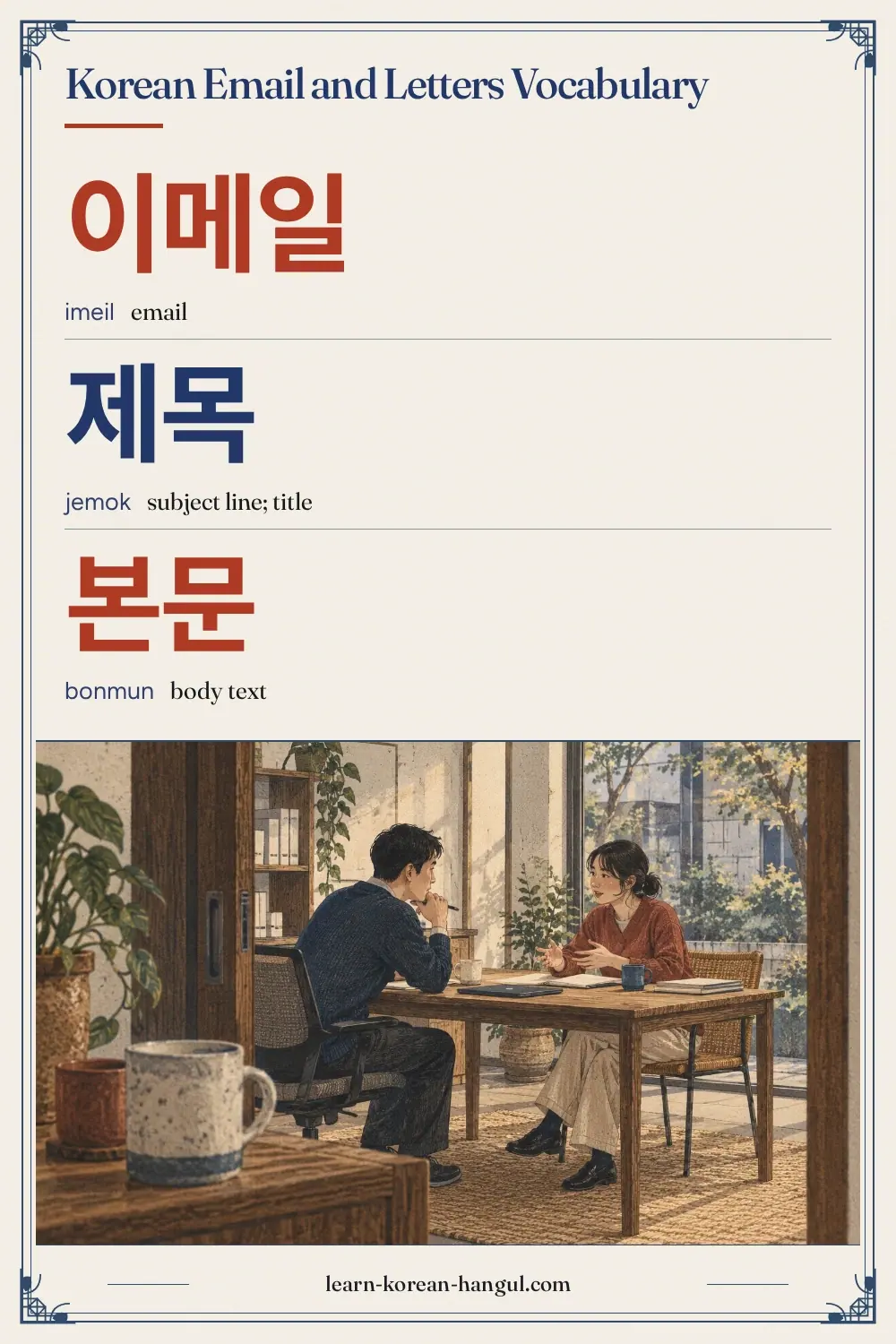
Korean Email and Letters Vocabulary at a Glance
The list has 30 words in five groups of six. It follows a message from the empty screen to the reply: the parts of an email, the greeting and the closing, the attachment, the paper letter and the chat app that often replaces both. It belongs to Office and Business and sits beside Korean Job Interview Vocabulary and Korean Meetings Vocabulary. Many words are formal Sino-Korean nouns, and the register matters: the same idea has an everyday word and a business word, such as 답장 and 회신.
| Group | Words | Use |
|---|---|---|
| Email parts | 6 | The fields of an email |
| Greetings and closings | 6 | Openings, thanks and requests |
| Attachments and replies | 6 | Files, replies and forwarding |
| Formal letters | 6 | Paper letters and addresses |
| Messaging apps | 6 | Texts, chats and notifications |
Which Email and Letter Words Should You Learn First?
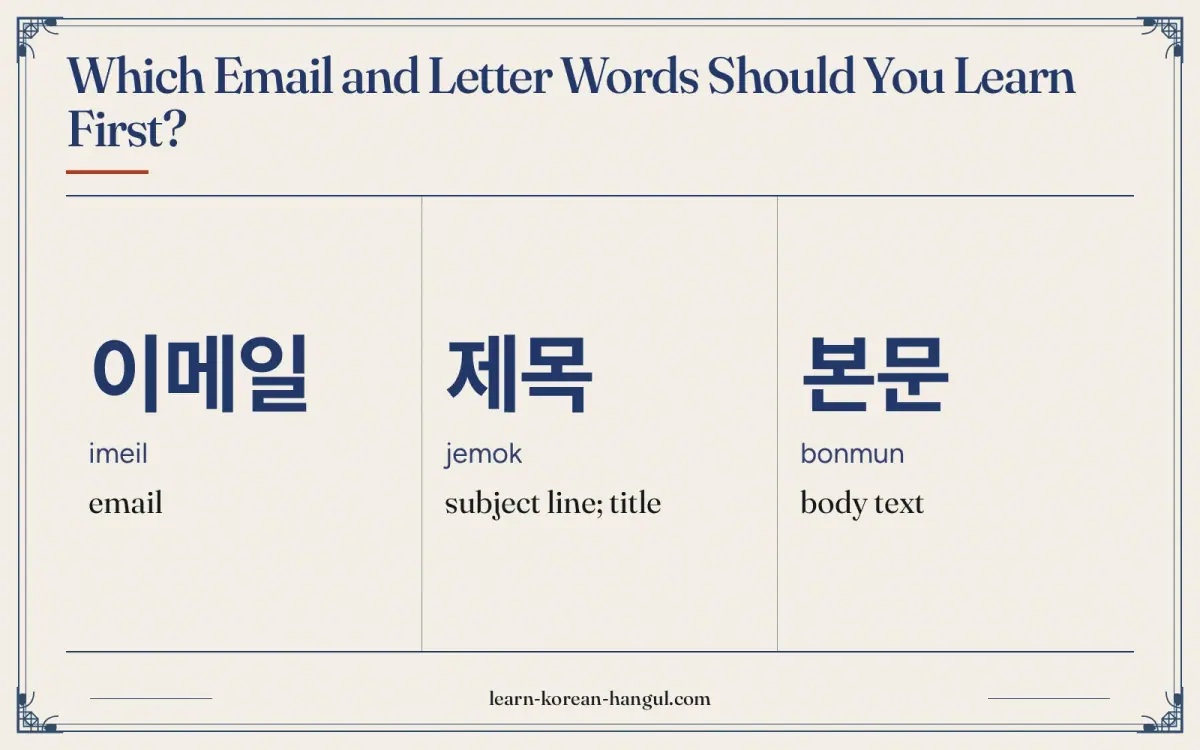
Learn 이메일 (email), 제목 (subject), 첨부 파일 (attachment), 답장 (reply) and 감사합니다 (thank you) first. They cover the basic life of a message. Then add 부탁드립니다 and 회신 for formal requests, and 문자 and 카카오톡 for chat.
- Words to say. 이메일, 제목, 답장, 문자, 카카오톡.
- Words to recognise. 받는 사람, 보내는 사람, 참조, 첨부 파일, 전송. They are labels on the screen.
- Words for formal writing. 회신, 부탁드립니다, 드림, 귀하, 문의.
The scene below numbers ten of the 30 words, from the subject line to the envelope. Play the clip on each item to hear the headword.
Word · 10
- 1
이메일
imeil
email
- 2
제목
jemok
subject line; title
- 3
본문
bonmun
body text
- 4
받는 사람
banneun saram
recipient
- 5
참조
chamjo
CC (carbon copy)
- 6
첨부 파일
cheombu pail
attachment
- 7
전송
jeonsong
sending; transmission
- 8
편지
pyeonji
letter
- 9
봉투
bongtu
envelope
- 10
카카오톡
kakaotok
KakaoTalk
Email Parts
An email has the same parts in Korean as in English, and the labels on the screen use the words below. You fill in the 받는 사람, write a 제목 and a 본문, and decide who goes in 참조. The two long labels, 받는 사람 and 보내는 사람, are built from a verb in its describing form plus 사람 (person), so they mean "the person who receives" and "the person who sends".
| No. | Hangul | Revised Romanization | Meaning and note | Example sentence | Audio assetId |
|---|---|---|---|---|---|
| 1 | 이메일 | imeil | email. A loanword for the message and the system. Often shortened to 메일. | 이메일을 보내요. (I send an email.) | au-pg-vocabulary-school-work-office-email-1; example: au-pg-vocabulary-school-work-office-email-31 |
| 2 | 제목 | jemok | subject line; title. The line at the top of an email, and the title of a book or film. | 제목을 써요. (I write the subject line.) | au-pg-vocabulary-school-work-office-email-2; example: au-pg-vocabulary-school-work-office-email-32 |
| 3 | 본문 | bonmun | body text. 본 means main and 문 means text. | 본문에 인사말을 써요. (I write a greeting in the body.) | au-pg-vocabulary-school-work-office-email-3; example: au-pg-vocabulary-school-work-office-email-33 |
| 4 | 받는 사람 | banneun saram | recipient. Said [반는 사람]. Literally "the person who receives". | 받는 사람의 주소를 확인해요. (I check the recipient's address.) | au-pg-vocabulary-school-work-office-email-4; example: au-pg-vocabulary-school-work-office-email-34 |
| 5 | 보내는 사람 | bonaeneun saram | sender. Literally "the person who sends". | 보내는 사람은 김 대리예요. (The sender is Assistant Manager Kim.) | au-pg-vocabulary-school-work-office-email-5; example: au-pg-vocabulary-school-work-office-email-35 |
| 6 | 참조 | chamjo | CC (carbon copy). The box for people who should see the email. 숨은 참조 is BCC. | 팀장님을 참조에 넣어요. (I put the team leader in CC.) | au-pg-vocabulary-school-work-office-email-6; example: au-pg-vocabulary-school-work-office-email-36 |
That building block is useful beyond email. A verb stem plus -는 describes a noun in the present, so 받는 사람 is "a person who receives" and 먹는 사람 would be "a person who eats". The loanword 이메일 is often shortened to 메일 in speech and on the screen, and you will see both. Email addresses are read aloud with 골뱅이 (at sign, literally a sea snail) for @ and 점 (dot) for the full stop, so a Korean speaker says the @ as 골뱅이. The label 제목 is the same word as a book title, so context shows which one is meant. The single-word entry for email in Korean explains 이메일 in more depth.
How Do You Say Greetings and Closings in Korean?
A Korean business email follows a fixed shape. It opens with 안녕하세요, then gives your name and your company or team. It states the request in one or two plain sentences, closes with thanks, and ends with your name and 드림. Work emails rarely open with a word for "dear". The formal tone comes from the verb endings, and the words below carry it.
| No. | Hangul | Revised Romanization | Meaning and note | Example sentence | Audio assetId |
|---|---|---|---|---|---|
| 7 | 안녕하세요 | annyeonghaseyo | hello; the usual email opening. Most emails open with it, then your name and company. | 안녕하세요, 박지영입니다. (Hello, this is Park Jiyoung.) | au-pg-vocabulary-school-work-office-email-7; example: au-pg-vocabulary-school-work-office-email-37 |
| 8 | 감사합니다 | gamsahamnida | thank you. The standard closing line of a business email. | 확인해 주셔서 감사합니다. (Thank you for checking.) | au-pg-vocabulary-school-work-office-email-8; example: au-pg-vocabulary-school-work-office-email-38 |
| 9 | 문의 | munui | inquiry; question. Said [무늬]. Used on websites as 문의하기, "contact us". | 문의 사항이 있으면 연락 주세요. (If you have any questions, please contact me.) | au-pg-vocabulary-school-work-office-email-9; example: au-pg-vocabulary-school-work-office-email-39 |
| 10 | 부탁드립니다 | butakdeurimnida | I ask; please (humble, formal). Said [부탁뜨림니다]. Ends formal requests: 확인 부탁드립니다. | 회신 부탁드립니다. (Please reply.) | au-pg-vocabulary-school-work-office-email-10; example: au-pg-vocabulary-school-work-office-email-40 |
| 11 | 드림 | deurim | sincerely (after a name). Written after the sender's name. 올림 is more humble. | 박지영 드림. (Sincerely, Park Jiyoung.) | au-pg-vocabulary-school-work-office-email-11; example: au-pg-vocabulary-school-work-office-email-41 |
| 12 | 안부 | anbu | regards; news of someone's well-being. Used in 안부를 전하다, to pass on regards. | 부장님께 안부 전해 주세요. (Please give my regards to the department head.) | au-pg-vocabulary-school-work-office-email-12; example: au-pg-vocabulary-school-work-office-email-42 |
A short model shows the shape: 안녕하세요, 박지영입니다. 회의 자료를 첨부 파일로 보내 드립니다. 확인 후 회신 부탁드립니다. 감사합니다. 박지영 드림. The first line is the greeting and the name, the second says what is attached, the third makes the request and the last two close the email. The ending -ㅂ니다 in 입니다 and 보내 드립니다 is the formal style, and the humble verb 드리다 (give, with respect) is used when the action is done for the reader. The word 문의 means an inquiry and appears on company websites as 문의하기. The sound of 부탁드립니다 is [부탁뜨림니다]: the ㄷ after the final ㄱ is tense, and the ㅂ before ㄴ turns to ㅁ. For the same expressions in speech, see the work phrases page.
Attachments and Replies
After the greeting comes the work of the email: a file, a reply, a forward. These words are on the buttons of every mail screen. A 첨부 파일 is an attachment, a 답장 is a reply and a 전달 is a forward. The send button is often labelled 전송. The formal word for a reply, 회신, replaces 답장 in business writing, so you will see both depending on the sender.
| No. | Hangul | Revised Romanization | Meaning and note | Example sentence | Audio assetId |
|---|---|---|---|---|---|
| 13 | 첨부 파일 | cheombu pail | attachment. 첨부 is attaching. Also written 첨부파일. | 첨부 파일을 확인해 주세요. (Please check the attachment.) | au-pg-vocabulary-school-work-office-email-13; example: au-pg-vocabulary-school-work-office-email-43 |
| 14 | 답장 | dapjang | reply. Said [답짱]. The everyday word. | 답장을 기다려요. (I wait for a reply.) | au-pg-vocabulary-school-work-office-email-14; example: au-pg-vocabulary-school-work-office-email-44 |
| 15 | 회신 | hoesin | reply (formal). The formal word, used in 회신 부탁드립니다. | 내일까지 회신해 주세요. (Please reply by tomorrow.) | au-pg-vocabulary-school-work-office-email-15; example: au-pg-vocabulary-school-work-office-email-45 |
| 16 | 전달 | jeondal | forwarding; passing on. The button that forwards an email is labelled 전달. | 이 메일을 팀장님께 전달해요. (I forward this email to the team leader.) | au-pg-vocabulary-school-work-office-email-16; example: au-pg-vocabulary-school-work-office-email-46 |
| 17 | 전송 | jeonsong | sending; transmission. The send button on many screens. | 전송 버튼을 눌러요. (I press the send button.) | au-pg-vocabulary-school-work-office-email-17; example: au-pg-vocabulary-school-work-office-email-47 |
| 18 | 수신 | susin | receiving; incoming. 수신 is the receiving side. The opposite is 발신, sending. | 수신 확인을 해요. (I confirm receipt.) | au-pg-vocabulary-school-work-office-email-18; example: au-pg-vocabulary-school-work-office-email-48 |
The pair 수신 and 발신 is worth learning. 수신 is the receiving side and 발신 is the sending side, so a 수신 확인 confirms that a message was received and a 발신 번호 is the number a call or message came from. The letters 수 and 발 appear in many words: 발송 is dispatching and 수령 is receiving goods. The two reply words differ only in register. Use 답장 with colleagues you know well and 회신 in formal emails, as in 회신 부탁드립니다. The verb 누르다 (to press) in the send example is a 르 verb, and it becomes 눌러요. Notice that a forward goes 께 (to a respected person): 팀장님께 전달해요.
How Do You Say Formal Letters in Korean?
Paper letters are rarer than email but still used for official notices, invitations, thank-you cards and mail between companies. A 편지 goes in a 봉투, carries an 우표 and shows the 주소 and 우편번호. In formal documents, the recipient's name is followed by 귀하, a respectful word that works like "To:" or "Dear". Reading these words helps with the mail you receive.
| No. | Hangul | Revised Romanization | Meaning and note | Example sentence | Audio assetId |
|---|---|---|---|---|---|
| 19 | 편지 | pyeonji | letter. A handwritten or printed letter. | 편지를 써요. (I write a letter.) | au-pg-vocabulary-school-work-office-email-19; example: au-pg-vocabulary-school-work-office-email-49 |
| 20 | 봉투 | bongtu | envelope. Also a paper bag. | 봉투에 주소를 써요. (I write the address on the envelope.) | au-pg-vocabulary-school-work-office-email-20; example: au-pg-vocabulary-school-work-office-email-50 |
| 21 | 우표 | upyo | postage stamp. Said [우표]. 우 is mail and 표 is a ticket or stamp. | 우표를 붙여요. (I stick on a stamp.) | au-pg-vocabulary-school-work-office-email-21; example: au-pg-vocabulary-school-work-office-email-51 |
| 22 | 주소 | juso | address. Also used for an email address: 이메일 주소. | 주소를 알려 주세요. (Please tell me the address.) | au-pg-vocabulary-school-work-office-email-22; example: au-pg-vocabulary-school-work-office-email-52 |
| 23 | 우편번호 | upyeonbeonho | postal code. 우편 is mail and 번호 is a number. | 우편번호는 다섯 자리 숫자예요. (The postal code is a five-digit number.) | au-pg-vocabulary-school-work-office-email-23; example: au-pg-vocabulary-school-work-office-email-53 |
| 24 | 귀하 | gwiha | "to" (formal, after a name). Written after the recipient's name in formal documents. | 이름 뒤에 귀하를 써요. (I write 귀하 after the name.) | au-pg-vocabulary-school-work-office-email-24; example: au-pg-vocabulary-school-work-office-email-54 |
A Korean address is written from the largest unit to the smallest, and the postal code is a five-digit number. The envelope carries both the sender and the recipient, and the labels are the same ones as in email: 받는 사람 and 보내는 사람. The suffix 귀하 is placed after the name, as in 박지영 귀하, and a very formal letter may add a title. Colleagues are addressed with 님 instead of 귀하, so reserve 귀하 for official documents. A formal letter also ends differently from an English one: the date comes after the body, and the sender's name with 드림 or 올림 comes last, as in 2026년 10월 9일, 박지영 올림. The messages and letters page on the writing side shows how to lay out a short note or card, and the word list here gives the vocabulary for the envelope.
Messaging Apps
A great deal of daily work communication happens in chat apps, not in email. The general words are 문자 for a text message and 메시지 for a message in any app. KakaoTalk, 카카오톡, is a very widely used chat app, and many teams keep a 단체방 for a project. Two small features have their own names: 읽음, the mark that a message was read, and 알림, the notification that tells you a message came.
| No. | Hangul | Revised Romanization | Meaning and note | Example sentence | Audio assetId |
|---|---|---|---|---|---|
| 25 | 문자 | munja | text message. Said [문짜]. 문자 also means a letter or character. | 문자를 보내요. (I send a text message.) | au-pg-vocabulary-school-work-office-email-25; example: au-pg-vocabulary-school-work-office-email-55 |
| 26 | 메시지 | mesiji | message. A loanword used in every chat app. | 메시지가 왔어요. (A message has arrived.) | au-pg-vocabulary-school-work-office-email-26; example: au-pg-vocabulary-school-work-office-email-56 |
| 27 | 카카오톡 | kakaotok | KakaoTalk. A very widely used chat app. People say 카톡. | 카카오톡으로 연락해요. (I get in touch by KakaoTalk.) | au-pg-vocabulary-school-work-office-email-27; example: au-pg-vocabulary-school-work-office-email-57 |
| 28 | 단체방 | danchebang | group chat. 단체 is a group and 방 is a room. | 단체방에 사진을 올려요. (I post a photo in the group chat.) | au-pg-vocabulary-school-work-office-email-28; example: au-pg-vocabulary-school-work-office-email-58 |
| 29 | 읽음 | ilgeum | read (receipt). Said [일금]. The mark that shows a message was read. | 읽음 표시가 없어요. (There is no read mark.) | au-pg-vocabulary-school-work-office-email-29; example: au-pg-vocabulary-school-work-office-email-59 |
| 30 | 알림 | allim | notification. From 알리다, to let someone know. | 알림이 많이 와요. (Many notifications come in.) | au-pg-vocabulary-school-work-office-email-30; example: au-pg-vocabulary-school-work-office-email-60 |
The tone of a chat is lighter than the tone of an email, but work chats still use polite endings. A short message to a superior might say 확인했습니다 (I have checked) or 알겠습니다 (understood), and a friend might get 확인했어요. The word 읽음 gives rise to a custom of its own: leaving a message on 읽음 without a reply can feel rude, so people often send a short answer. The word 문자 has two meanings, a text message and a written character, and the sound [문짜] is the same for both. Context separates them, as in 문자를 보내요 (I send a text) and 한글 문자 (the Hangul script).
How Do You Pronounce These Words?
Email words are mostly formal Sino-Korean nouns, so tense sounds and linking appear in a few of them. A plain consonant becomes tense after some final sounds, a final consonant moves to the next vowel, and ㄷ before ㄴ turns to ㄴ. Standard pronunciation follows the National Institute of Korean Language (국립국어원) rules. Revised Romanization shows the nasal and linking changes but not the tensing.
| Spelling | Sounds like | What changes |
|---|---|---|
| 받는 사람 | [반는 사람] | The final ㄷ sound of 받 becomes ㄴ before ㄴ. |
| 문의 | [무늬] | The final ㄴ of 문 moves to the vowel of 의. |
| 부탁드립니다 | [부탁뜨림니다] | The ㄷ after the final ㄱ is tense, and ㅂ before ㄴ becomes ㅁ. |
| 답장 | [답짱] | The ㅈ after the final ㅂ is tense. |
| 문자 | [문짜] | The ㅈ is tense in this word, as the standard pronunciation records it. |
| 읽음 | [일금] | In ㄺ the ㄱ moves to the next syllable and the ㄹ stays. |
Audio and Slow Playback
Each word and example has its own clip, and five more replay the hardest words slowly. Play 부탁드립니다 first and tap out the syllables, then compare the tense 뜨 and the m sound in 림 with the clip.
What Mistakes Do Learners Make with Email and Letter Words?
Five slips are common in Korean business writing.
- Translating "Dear" word for word. Korean emails open with 안녕하세요 and your name, not with a word for dear. A literal copy sounds odd.
- Using 부탁해요 in a formal email. It is polite but casual. Business writing prefers 부탁드립니다, with the humble 드리다.
- Mixing 답장 and 회신. 답장 is everyday and 회신 is formal. Use 회신 with clients and 답장 with colleagues you know.
- Using 귀하 for a colleague. 귀하 belongs to official documents. For a person, use the name plus 님.
- Leaving out the sender's name after 드림. The closing needs a name before it, as in 박지영 드림.
Keep the shape of the email in mind: greeting and name, one or two plain sentences, thanks, and the sign-off. Fixed phrases such as 확인 부탁드립니다 and 감사합니다 can be copied whole, so learn them as blocks first.
Practice: Flashcards and Worksheet
Study in three steps. First, run the deck in recognition mode until the 30 words feel familiar. Second, switch to listening mode and play the clip before you flip each card. Third, take the five-question quiz. Your deck progress stays in your browser, and the vocabulary flashcard decks page lists the other decks.
Practice · 65
- 01이메일
Show answer
headword 1: email
- 02제목
Show answer
headword 2: subject line; title
- 03본문
Show answer
headword 3: body text
- 04받는 사람
Show answer
headword 4: recipient
- 05보내는 사람
Show answer
headword 5: sender
- 06참조
Show answer
headword 6: CC (carbon copy)
- 07안녕하세요
Show answer
headword 7: hello; the usual email opening
- 08감사합니다
Show answer
headword 8: thank you
- 09문의
Show answer
headword 9: inquiry; question
- 10부탁드립니다
Show answer
headword 10: I ask; please (humble, formal)
- 11드림
Show answer
headword 11: sincerely (after a name)
- 12안부
Show answer
headword 12: regards; news of someone's well-being
- 13첨부 파일
Show answer
headword 13: attachment
- 14답장
Show answer
headword 14: reply
- 15회신
Show answer
headword 15: reply (formal)
- 16전달
Show answer
headword 16: forwarding; passing on
- 17전송
Show answer
headword 17: sending; transmission
- 18수신
Show answer
headword 18: receiving; incoming
- 19편지
Show answer
headword 19: letter
- 20봉투
Show answer
headword 20: envelope
- 21우표
Show answer
headword 21: postage stamp
- 22주소
Show answer
headword 22: address
- 23우편번호
Show answer
headword 23: postal code
- 24귀하
Show answer
headword 24: "to" (formal, after a name)
- 25문자
Show answer
headword 25: text message
- 26메시지
Show answer
headword 26: message
- 27카카오톡
Show answer
headword 27: KakaoTalk
- 28단체방
Show answer
headword 28: group chat
- 29읽음
Show answer
headword 29: read (receipt)
- 30알림
Show answer
headword 30: notification
- 31이메일을 보내요.
Show answer
example sentence for 이메일
- 32제목을 써요.
Show answer
example sentence for 제목
- 33본문에 인사말을 써요.
Show answer
example sentence for 본문
- 34받는 사람의 주소를 확인해요.
Show answer
example sentence for 받는 사람
- 35보내는 사람은 김 대리예요.
Show answer
example sentence for 보내는 사람
- 36팀장님을 참조에 넣어요.
Show answer
example sentence for 참조
- 37안녕하세요, 박지영입니다.
Show answer
example sentence for 안녕하세요
- 38확인해 주셔서 감사합니다.
Show answer
example sentence for 감사합니다
- 39문의 사항이 있으면 연락 주세요.
Show answer
example sentence for 문의
- 40회신 부탁드립니다.
Show answer
example sentence for 부탁드립니다
- 41박지영 드림.
Show answer
example sentence for 드림
- 42부장님께 안부 전해 주세요.
Show answer
example sentence for 안부
- 43첨부 파일을 확인해 주세요.
Show answer
example sentence for 첨부 파일
- 44답장을 기다려요.
Show answer
example sentence for 답장
- 45내일까지 회신해 주세요.
Show answer
example sentence for 회신
- 46이 메일을 팀장님께 전달해요.
Show answer
example sentence for 전달
- 47전송 버튼을 눌러요.
Show answer
example sentence for 전송
- 48수신 확인을 해요.
Show answer
example sentence for 수신
- 49편지를 써요.
Show answer
example sentence for 편지
- 50봉투에 주소를 써요.
Show answer
example sentence for 봉투
- 51우표를 붙여요.
Show answer
example sentence for 우표
- 52주소를 알려 주세요.
Show answer
example sentence for 주소
- 53우편번호는 다섯 자리 숫자예요.
Show answer
example sentence for 우편번호
- 54이름 뒤에 귀하를 써요.
Show answer
example sentence for 귀하
- 55문자를 보내요.
Show answer
example sentence for 문자
- 56메시지가 왔어요.
Show answer
example sentence for 메시지
- 57카카오톡으로 연락해요.
Show answer
example sentence for 카카오톡
- 58단체방에 사진을 올려요.
Show answer
example sentence for 단체방
- 59읽음 표시가 없어요.
Show answer
example sentence for 읽음
- 60알림이 많이 와요.
Show answer
example sentence for 알림
- 61부탁드립니다
Show answer
slow playback: I ask; please (humble, formal)
- 62받는 사람
Show answer
slow playback: recipient
- 63첨부 파일
Show answer
slow playback: attachment
- 64우편번호
Show answer
slow playback: postal code
- 65읽음
Show answer
slow playback: read (receipt)
Practice · 5
What does 제목 (jemok) mean?
Show answer
subject line; title
제목 means subject line; title. Example: 제목을 써요. (I write the subject line.)
What does 참조 (chamjo) mean?
Show answer
CC (carbon copy)
참조 means CC (carbon copy). Example: 팀장님을 참조에 넣어요. (I put the team leader in CC.)
What does 첨부 파일 (cheombu pail) mean?
Show answer
attachment
첨부 파일 means attachment. Example: 첨부 파일을 확인해 주세요. (Please check the attachment.)
What does 우표 (upyo) mean?
Show answer
postage stamp
우표 means postage stamp. Example: 우표를 붙여요. (I stick on a stamp.)
What does 읽음 (ilgeum) mean?
Show answer
read (receipt)
읽음 means read (receipt). Example: 읽음 표시가 없어요. (There is no read mark.)
Korean Email and Letters Vocabulary Worksheet (PDF)
A printable worksheet for these words (word list, matching, writing practice, fill-in-the-blank exercises and answer key) is available in A4 and US Letter from the download card on this page. Meanwhile, write the five-line model email from this page with your own name and a different attachment, and read it aloud.
Where to Go Next
After this page, continue with Korean Job Interview Vocabulary for the documents you send when you apply, or with Korean Meetings Vocabulary for the spoken side of work. To move up a level, return to Office and Business.
Frequently Asked Questions
How Do You Say Email in Korean?
Email is 이메일 (imeil), a loanword that is often shortened to 메일. The subject line is 제목, an attachment is 첨부 파일 and a reply is 답장. The single-word page on email in Korean gives more detail.
How Do You Pronounce 제목 (jemok)?
Say je-mok in two beats. The je is a soft j plus the vowel ㅔ, like the "e" in "bed". The second syllable ends in a closed k sound, as in "book" said without releasing the k. The standard pronunciation is [제목], with no sound change when you say it alone. Press the audio button to hear it.
How Many Email and Letter Words Should I Learn First?
Five: 이메일, 제목, 첨부 파일, 답장 and 감사합니다. They cover the basic life of a message. At five new words a day the full 30 take six days plus review. Add 부탁드립니다 when you start writing to clients.
Where Can I Practise Email and Letter Words with Flashcards?
Use the vocabulary flashcard decks. The deck for this page holds all 30 words with Hangul, romanization and audio. Your progress stays in your browser. Try listening mode on 부탁드립니다 and 받는 사람, because their spoken forms differ from the spelling.
Is the Romanization on This Page Official?
It follows the Revised Romanization of Korean, which South Korea adopted on 7 July 2000 and whose rules the National Institute of Korean Language (국립국어원) publishes. It is a learning aid. It shows changes such as banneun saram but not tense sounds such as the ㄸ in [부탁뜨림니다], so rely on the Hangul and the audio.
Is There a Printable Worksheet for Email and Letter Words?
A printable worksheet for these words (word list, matching, writing practice, fill-in-the-blank exercises and answer key) is available in A4 and US Letter from the download card on this page. For practice, copy the tables by hand and write one example sentence for each of the five groups.