
Business Korean Vocabulary at a Glance
The list has 50 words in five groups of ten. It follows a working day and a working year: where you work and with whom, how decisions are made, the papers that go with them, pay and time off, and trips and events away from the desk. It belongs to School and Work and it is the hub of four deeper pages, which are listed at the end. Almost every word is a noun, and most are built from short Sino-Korean parts, so one word you learn here helps you guess a dozen more.
| Group | Words | Use |
|---|---|---|
| Workplace | 10 | Places, people and the word for work |
| Meetings | 10 | Meetings, instructions and approval |
| Email and documents | 10 | Papers, contracts and approvals |
| Pay and benefits | 10 | Salary, hours and work culture |
| Business trips and events | 10 | Travel, clients and company events |
Business Korean is mostly a written and formal register, but the words below are also the ones spoken in a polite office. For the sentences you say to a colleague, such as greeting someone as they leave, see the work phrases page. This page is the vocabulary behind those phrases.
Which Office and Business Words Should You Learn First?
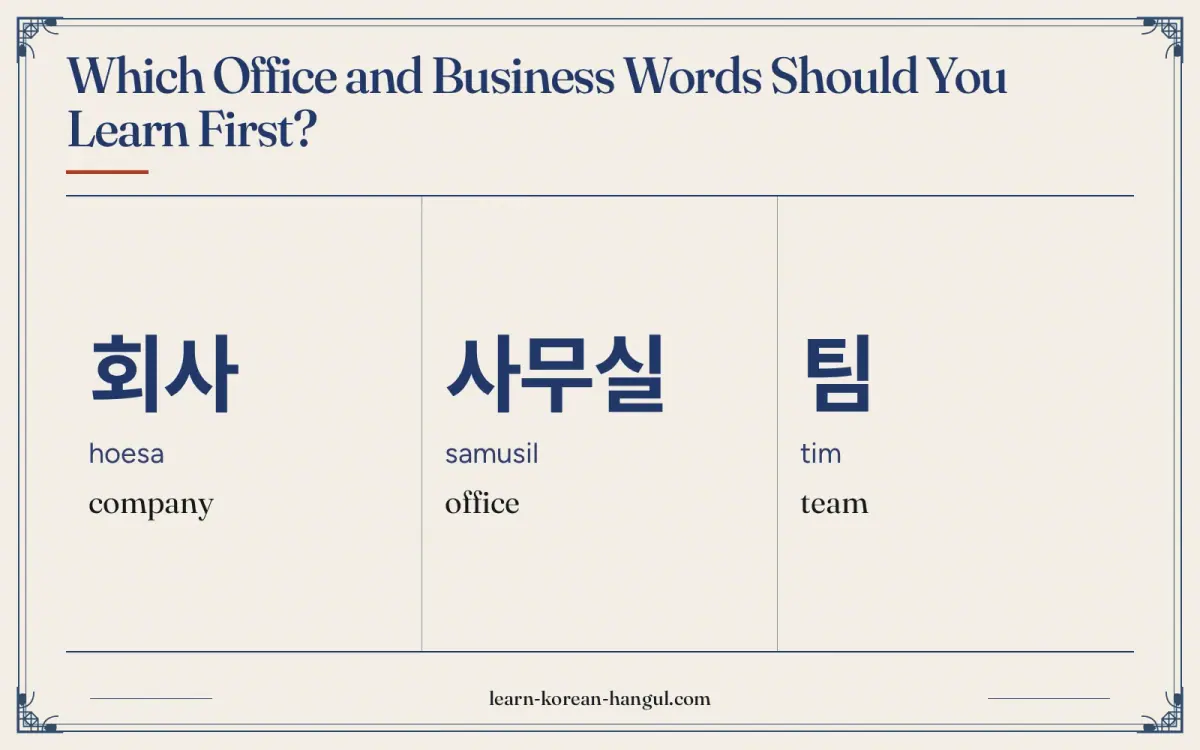
Learn 회사 (company), 일 (work), 회의 (meeting), 출근 (going to work) and 퇴근 (leaving work) first. They cover the shape of a working day. Add 월급 and 휴가 when you talk about pay and time off, and 출장 as soon as you travel for work.
- Words to say. 회사, 일, 회의, 출근, 퇴근, 월급.
- Words to recognise. 결재, 승인, 업무, 서류, 계약서. They appear in writing.
- Words for work culture. 회식, 야근, 휴가, 퇴직.
The scene below shows an office with twelve of the 50 words, from the desk to the business card. Play the clip on each item to hear the headword.
Word · 12
- 1
회사
hoesa
company
- 2
사무실
samusil
office
- 3
팀
tim
team
- 4
동료
dongnyo
colleague
- 5
회의
hoeui
meeting
- 6
보고서
bogoseo
report (written)
- 7
계약서
gyeyakseo
contract (document)
- 8
명함
myeongham
business card
- 9
월급
wolgeup
monthly salary
- 10
출근
chulgeun
going to work
- 11
출장
chuljang
business trip
- 12
워크숍
wokeusyop
workshop; staff retreat
Workplace
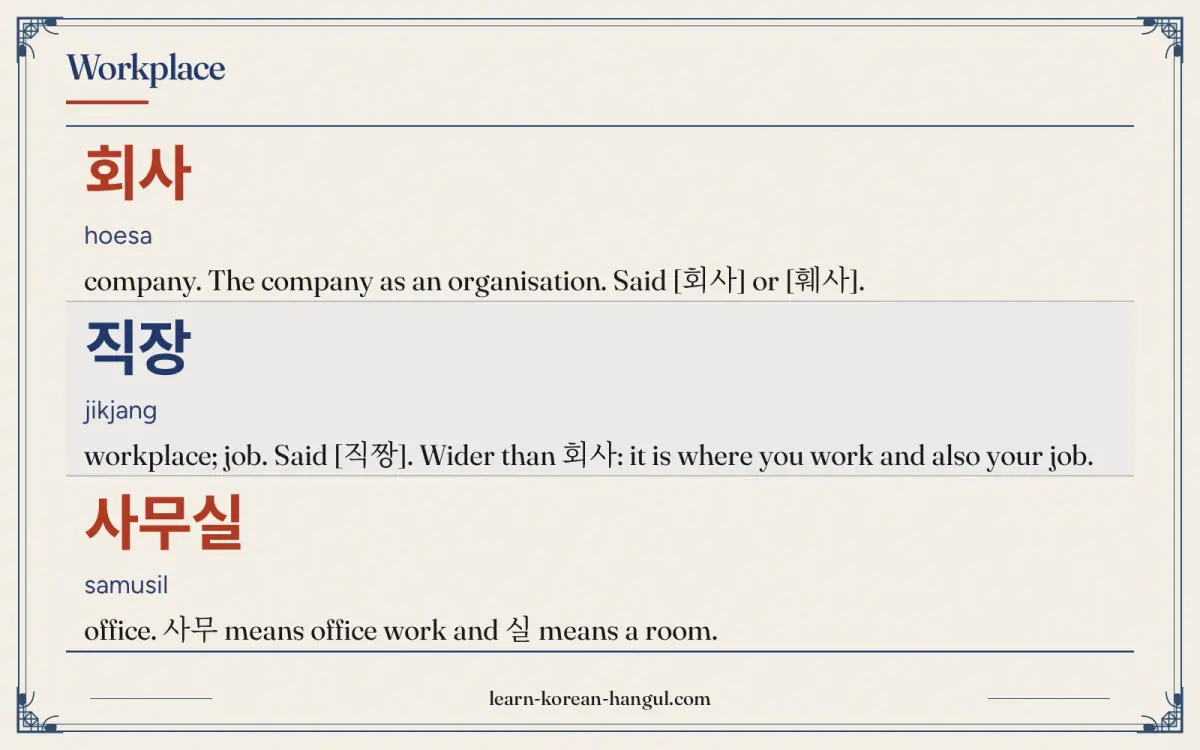
The first ten words name the place and the people. 회사 is the company, 직장 is the workplace, 사무실 is the office and 부서 and 팀 are the units inside it. People are 동료 (colleagues), 상사 (superiors), 사장 (the boss) and 직원 (employees). The last word, 일, is the most common of all: it means work, a task and a matter, depending on the sentence.
| No. | Hangul | Revised Romanization | Meaning and note | Example sentence | Audio assetId |
|---|---|---|---|---|---|
| 1 | 회사 | hoesa | company. The company as an organisation. Said [회사] or [훼사]. | 저는 회사에 다녀요. (I work at a company.) | au-pg-vocabulary-school-work-office-1; example: au-pg-vocabulary-school-work-office-51 |
| 2 | 직장 | jikjang | workplace; job. Said [직짱]. Wider than 회사: it is where you work and also your job. | 직장이 서울에 있어요. (My workplace is in Seoul.) | au-pg-vocabulary-school-work-office-2; example: au-pg-vocabulary-school-work-office-52 |
| 3 | 사무실 | samusil | office. 사무 means office work and 실 means a room. | 사무실은 삼 층에 있어요. (The office is on the third floor.) | au-pg-vocabulary-school-work-office-3; example: au-pg-vocabulary-school-work-office-53 |
| 4 | 부서 | buseo | department. A unit inside a company, such as sales. | 어느 부서에서 일해요? (Which department do you work in?) | au-pg-vocabulary-school-work-office-4; example: au-pg-vocabulary-school-work-office-54 |
| 5 | 팀 | tim | team. A loanword. Smaller than a 부서. | 우리 팀은 다섯 명이에요. (Our team has five people.) | au-pg-vocabulary-school-work-office-5; example: au-pg-vocabulary-school-work-office-55 |
| 6 | 동료 | dongnyo | colleague. Said [동뇨]. A person at the same workplace. | 동료와 점심을 먹어요. (I eat lunch with a colleague.) | au-pg-vocabulary-school-work-office-6; example: au-pg-vocabulary-school-work-office-56 |
| 7 | 상사 | sangsa | superior; boss. Anyone above you in the chain. Different from 사장. | 상사에게 보고해요. (I report to my superior.) | au-pg-vocabulary-school-work-office-7; example: au-pg-vocabulary-school-work-office-57 |
| 8 | 사장 | sajang | boss; company president. The head of a company, and in speech the boss. | 우리 사장님은 친절하세요. (Our boss is kind.) | au-pg-vocabulary-school-work-office-8; example: au-pg-vocabulary-school-work-office-58 |
| 9 | 직원 | jigwon | employee; staff. Said [지권]. Any person employed by a company. | 직원이 백 명이에요. (The company has a hundred employees.) | au-pg-vocabulary-school-work-office-9; example: au-pg-vocabulary-school-work-office-59 |
| 10 | 일 | il | work; job; thing to do. Also means a matter or task. The Sino-Korean 일 is a day or the number one. | 오늘 일이 많아요. (I have a lot of work today.) | au-pg-vocabulary-school-work-office-10; example: au-pg-vocabulary-school-work-office-60 |
Two pairs need care. 회사 and 직장 overlap, but 직장 is the wider word: it is the place where you work and also your job as a whole, as in 직장을 구해요 (I look for a job), while 회사 is the company as an organisation. Likewise, 상사 is any person above you, while 사장 is the head of the company. The word 일 needs a verb to say what happens to it: 일해요 is "I work", and 일이 있어요 is "I have something to do". The Sino-Korean 일 meaning day is a different word with the same sound, found in 매일 (every day) and in dates such as 십 일 (the 10th). For titles of rank such as 과장 and 부장, see Korean Company Ranks and Job Titles. The single-word entries on company in Korean and office in Korean cover the headwords in more detail.
How Do You Say Meetings in Korean?
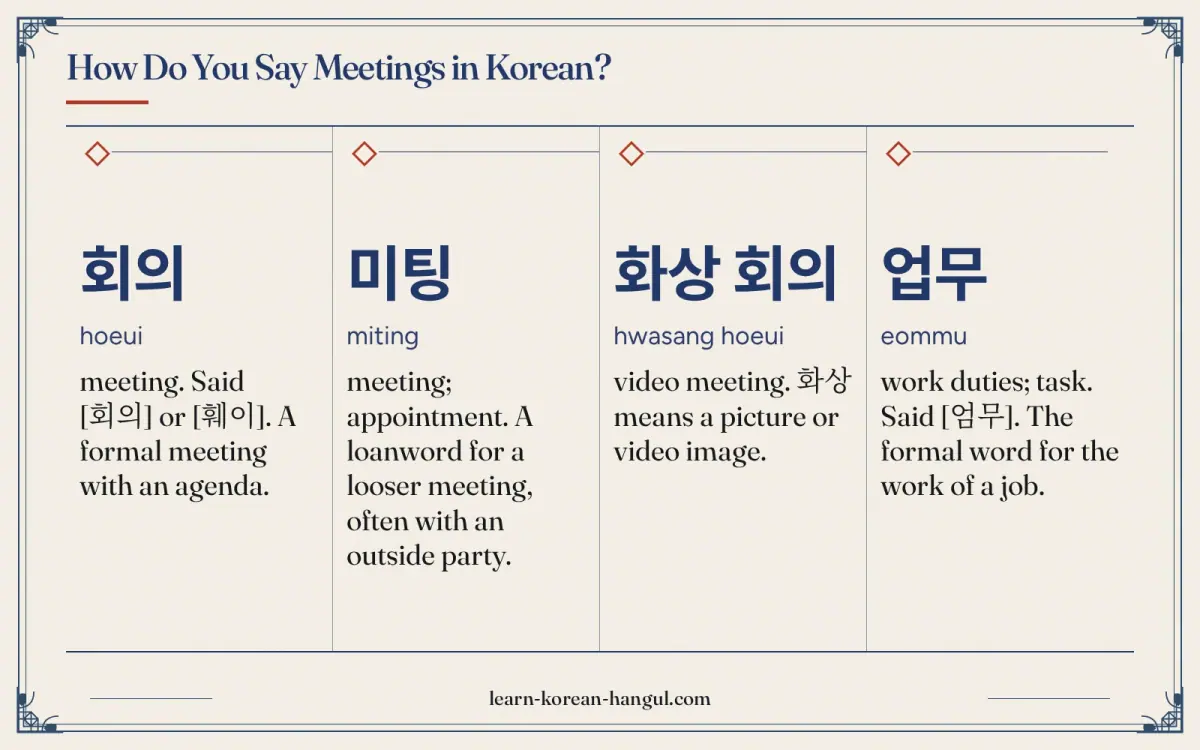
Work is organised through meetings and instructions, and this group names the steps. A 회의 is a formal meeting, a 미팅 is a looser one and a 화상 회의 is held by video. The work itself is 업무. Instructions come down as 지시, discussion goes sideways as 협의 and 검토, and approval goes up as 승인. The last two words, 공유 and 마감, are about sharing and deadlines.
| No. | Hangul | Revised Romanization | Meaning and note | Example sentence | Audio assetId |
|---|---|---|---|---|---|
| 11 | 회의 | hoeui | meeting. Said [회의] or [훼이]. A formal meeting with an agenda. | 회의는 두 시에 시작해요. (The meeting starts at two.) | au-pg-vocabulary-school-work-office-11; example: au-pg-vocabulary-school-work-office-61 |
| 12 | 미팅 | miting | meeting; appointment. A loanword for a looser meeting, often with an outside party. | 오후에 거래처와 미팅이 있어요. (I have a meeting with a client company this afternoon.) | au-pg-vocabulary-school-work-office-12; example: au-pg-vocabulary-school-work-office-62 |
| 13 | 화상 회의 | hwasang hoeui | video meeting. 화상 means a picture or video image. | 화상 회의로 해요. (We do it by video meeting.) | au-pg-vocabulary-school-work-office-13; example: au-pg-vocabulary-school-work-office-63 |
| 14 | 업무 | eommu | work duties; task. Said [엄무]. The formal word for the work of a job. | 오늘 업무를 정리해요. (I sort out today's tasks.) | au-pg-vocabulary-school-work-office-14; example: au-pg-vocabulary-school-work-office-64 |
| 15 | 지시 | jisi | instruction; order. Given by a superior to a subordinate. | 부장님의 지시를 받아요. (I receive an instruction from the department head.) | au-pg-vocabulary-school-work-office-15; example: au-pg-vocabulary-school-work-office-65 |
| 16 | 협의 | hyeobui | consultation; agreeing together. Said [혀븨]. Talking until two sides agree. | 부서끼리 협의해요. (The departments consult each other.) | au-pg-vocabulary-school-work-office-16; example: au-pg-vocabulary-school-work-office-66 |
| 17 | 검토 | geomto | review; consideration. Looking over a plan or a document before a decision. | 보고서를 검토해요. (I review the report.) | au-pg-vocabulary-school-work-office-17; example: au-pg-vocabulary-school-work-office-67 |
| 18 | 승인 | seungin | approval; authorisation. Formal permission, usually from a superior. | 승인이 필요해요. (Approval is needed.) | au-pg-vocabulary-school-work-office-18; example: au-pg-vocabulary-school-work-office-68 |
| 19 | 공유 | gongyu | sharing. Sharing a file or information with a team. | 파일을 공유해요. (I share the file.) | au-pg-vocabulary-school-work-office-19; example: au-pg-vocabulary-school-work-office-69 |
| 20 | 마감 | magam | deadline; closing. The final time for handing something in. | 마감이 금요일이에요. (The deadline is Friday.) | au-pg-vocabulary-school-work-office-20; example: au-pg-vocabulary-school-work-office-70 |
The group shows how Korean offices describe decisions: not with a single verb, but with a chain of nouns plus 하다. A plan is 검토해요 (reviewed), 협의해요 (discussed), 승인받아요 (approved) and 공유해요 (shared). The nouns stay the same whatever the speaker's rank, and only the verb ending changes with politeness. For the specific words of the meeting itself, such as 안건 (agenda item) and 회의록 (minutes), see Korean Meetings Vocabulary. The word 미팅 is a loanword and is less formal than 회의, so use 회의 in an invitation to a department and 미팅 for an appointment with a person. The word 마감 is also used in shops for closing time, as in 마감 시간 (closing time).
Email and Documents
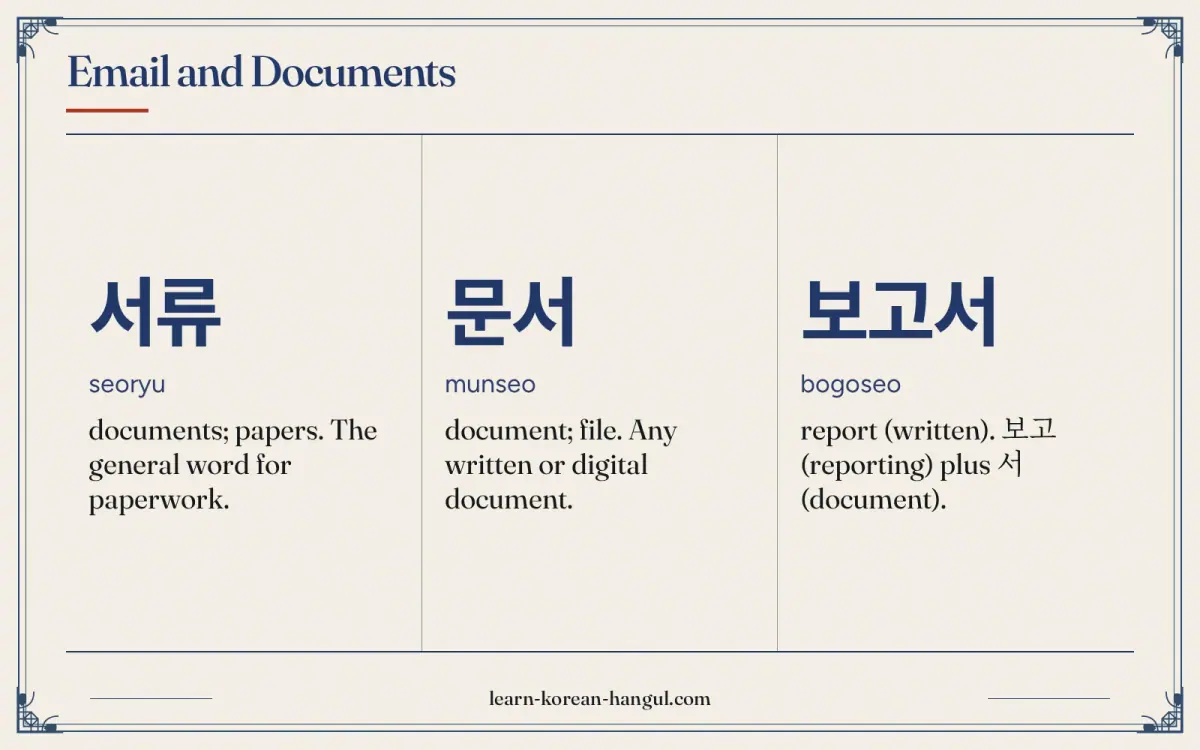
Paperwork has its own vocabulary, and many of the words end in 서, which means a written document. A 보고서 is a report, a 계약서 is a contract and a 신청서 is an application form. Others are general: 서류 for papers, 문서 for a document or file and 자료 for materials. The group closes with the objects of exchange: 명함 (a business card), 이메일 (email) and 복사 (photocopying).
| No. | Hangul | Revised Romanization | Meaning and note | Example sentence | Audio assetId |
|---|---|---|---|---|---|
| 21 | 서류 | seoryu | documents; papers. The general word for paperwork. | 서류를 준비해요. (I prepare the documents.) | au-pg-vocabulary-school-work-office-21; example: au-pg-vocabulary-school-work-office-71 |
| 22 | 문서 | munseo | document; file. Any written or digital document. | 문서를 저장해요. (I save the document.) | au-pg-vocabulary-school-work-office-22; example: au-pg-vocabulary-school-work-office-72 |
| 23 | 보고서 | bogoseo | report (written). 보고 (reporting) plus 서 (document). | 보고서를 내일까지 내요. (I hand in the report by tomorrow.) | au-pg-vocabulary-school-work-office-23; example: au-pg-vocabulary-school-work-office-73 |
| 24 | 계약서 | gyeyakseo | contract (document). Said [계약써]. 계약 is the contract and 서 the paper. | 계약서에 서명해요. (I sign the contract.) | au-pg-vocabulary-school-work-office-24; example: au-pg-vocabulary-school-work-office-74 |
| 25 | 자료 | jaryo | materials; data. Used for meeting handouts and research data. | 회의 자료를 준비해요. (I prepare the meeting materials.) | au-pg-vocabulary-school-work-office-25; example: au-pg-vocabulary-school-work-office-75 |
| 26 | 신청서 | sincheongseo | application form. 신청 (applying) plus 서 (document). | 신청서를 작성해요. (I fill in the application form.) | au-pg-vocabulary-school-work-office-26; example: au-pg-vocabulary-school-work-office-76 |
| 27 | 명함 | myeongham | business card. Exchanging cards is a ritual at a first meeting. | 명함을 주고받아요. (We exchange business cards.) | au-pg-vocabulary-school-work-office-27; example: au-pg-vocabulary-school-work-office-77 |
| 28 | 결재 | gyeoljae | approval of a document by a superior. Not 결제 (payment). Said [결째]. | 부장님께 결재를 받아요. (I get the department head to approve it.) | au-pg-vocabulary-school-work-office-28; example: au-pg-vocabulary-school-work-office-78 |
| 29 | 이메일 | imeil | email. The loanword. Often shortened to 메일. | 이메일로 보내 주세요. (Please send it by email.) | au-pg-vocabulary-school-work-office-29; example: au-pg-vocabulary-school-work-office-79 |
| 30 | 복사 | boksa | copying; photocopy. Said [복싸]. The verb is 복사하다. | 서류를 복사해요. (I photocopy the documents.) | au-pg-vocabulary-school-work-office-30; example: au-pg-vocabulary-school-work-office-80 |
The ending 서 is the key to this group. It means a document, so 보고 plus 서 makes 보고서, 계약 plus 서 makes 계약서 and 신청 plus 서 makes 신청서. The word 결재 is one to learn carefully. It means that a superior approves a document, as in 부장님께 결재를 받아요, and it is a different word from 결제 (payment), though the two are spelled almost alike and said [결째] and [결쩨]. Business cards are often given and received with both hands, and it is polite to read one before you put it away. The long-form email vocabulary, with subject lines and replies, is on the Korean Email and Letters Vocabulary page.
How Do You Say Pay and Benefits in Korean?
The pay words come in three levels: 월급 is the monthly salary, 연봉 is the annual figure quoted in an offer and 급여 is the formal word on a pay slip. A 보너스 is extra pay, and 휴가 is leave. The rest of the group describes the working day: 출근 and 퇴근 for starting and finishing, 야근 for working late, 회식 for the team dinner and 퇴직 for leaving a company. Together they form the vocabulary of Korean work culture.
| No. | Hangul | Revised Romanization | Meaning and note | Example sentence | Audio assetId |
|---|---|---|---|---|---|
| 31 | 월급 | wolgeup | monthly salary. Pay by the month. | 월급을 받아요. (I receive my salary.) | au-pg-vocabulary-school-work-office-31; example: au-pg-vocabulary-school-work-office-81 |
| 32 | 연봉 | yeonbong | annual salary. Pay by the year, the figure quoted in job offers. | 연봉 협상을 해요. (I negotiate the annual salary.) | au-pg-vocabulary-school-work-office-32; example: au-pg-vocabulary-school-work-office-82 |
| 33 | 급여 | geubyeo | pay; wages. The formal word on pay slips. | 급여 명세서를 확인해요. (I check the pay slip.) | au-pg-vocabulary-school-work-office-33; example: au-pg-vocabulary-school-work-office-83 |
| 34 | 보너스 | boneoseu | bonus. A loanword. | 보너스를 받았어요. (I got a bonus.) | au-pg-vocabulary-school-work-office-34; example: au-pg-vocabulary-school-work-office-84 |
| 35 | 휴가 | hyuga | leave; vacation. Time off work, paid or unpaid. | 다음 주에 휴가예요. (I am on leave next week.) | au-pg-vocabulary-school-work-office-35; example: au-pg-vocabulary-school-work-office-85 |
| 36 | 출근 | chulgeun | going to work. No tensing in this Sino-Korean word: [출근]. | 아침 아홉 시에 출근해요. (I go to work at nine in the morning.) | au-pg-vocabulary-school-work-office-36; example: au-pg-vocabulary-school-work-office-86 |
| 37 | 퇴근 | toegeun | leaving work. The opposite of 출근. Not 퇴직. | 여섯 시에 퇴근해요. (I leave work at six.) | au-pg-vocabulary-school-work-office-37; example: au-pg-vocabulary-school-work-office-87 |
| 38 | 야근 | yageun | overtime; working late. 야 means night. | 오늘 야근해요. (I work late today.) | au-pg-vocabulary-school-work-office-38; example: au-pg-vocabulary-school-work-office-88 |
| 39 | 회식 | hoesik | company dinner. A team meal after work. | 금요일에 회식이 있어요. (There is a team dinner on Friday.) | au-pg-vocabulary-school-work-office-39; example: au-pg-vocabulary-school-work-office-89 |
| 40 | 퇴직 | toejik | retirement; leaving a job. Leaving a company for good. | 올해 퇴직해요. (I retire this year.) | au-pg-vocabulary-school-work-office-40; example: au-pg-vocabulary-school-work-office-90 |
Work-culture words carry more than their dictionary meaning. A 회식 is a team dinner after work, and attitudes to attending it vary between companies and generations, so treat it as a custom to understand and not as a rule. The pair 출근 and 퇴근 shows how the language marks direction: 출 means go out and 퇴 means retreat, so you "go out to work" and "retreat from work". Do not confuse 퇴근 (leaving work for the day) with 퇴직 (leaving a company). A related culture word is 눈치 (nunchi), the skill of reading a situation, which people use when they talk about whether to leave before the boss. Salaries and benefits differ widely and are set by each company and by labour law, so this page teaches only the words. For the words of a job offer, see Korean Job Interview Vocabulary.
Business Trips and Events
The last group is about work away from the desk. A 출장 is a business trip, often to a 거래처, a client or partner company. The trip costs 출장비. At the other end are the people and the deal: a 고객, a 계약 and 협력 between companies. Companies also hold 행사 (events), 워크숍 (staff retreats) and 접대 (entertaining guests), which are part of how business relationships are kept.
| No. | Hangul | Revised Romanization | Meaning and note | Example sentence | Audio assetId |
|---|---|---|---|---|---|
| 41 | 출장 | chuljang | business trip. Said [출짱]. | 다음 주에 출장을 가요. (I go on a business trip next week.) | au-pg-vocabulary-school-work-office-41; example: au-pg-vocabulary-school-work-office-91 |
| 42 | 해외 출장 | haeoe chuljang | overseas business trip. 해외 means overseas. | 해외 출장을 준비해요. (I prepare for an overseas business trip.) | au-pg-vocabulary-school-work-office-42; example: au-pg-vocabulary-school-work-office-92 |
| 43 | 출장비 | chuljangbi | travel expenses. Said [출짱비]. 비 means cost. | 출장비를 신청해요. (I apply for travel expenses.) | au-pg-vocabulary-school-work-office-43; example: au-pg-vocabulary-school-work-office-93 |
| 44 | 거래처 | georaecheo | client company; business partner. 거래 is a deal and 처 is a place. | 거래처에 전화해요. (I call the client company.) | au-pg-vocabulary-school-work-office-44; example: au-pg-vocabulary-school-work-office-94 |
| 45 | 고객 | gogaek | customer; client. A person who buys. | 고객이 문의했어요. (A customer made an inquiry.) | au-pg-vocabulary-school-work-office-45; example: au-pg-vocabulary-school-work-office-95 |
| 46 | 계약 | gyeyak | contract; signing a contract. The deal itself, not the paper. | 내일 계약을 해요. (We sign the contract tomorrow.) | au-pg-vocabulary-school-work-office-46; example: au-pg-vocabulary-school-work-office-96 |
| 47 | 협력 | hyeomnyeok | cooperation. Said [혐녁]. | 두 회사가 협력해요. (The two companies cooperate.) | au-pg-vocabulary-school-work-office-47; example: au-pg-vocabulary-school-work-office-97 |
| 48 | 행사 | haengsa | event. A company event or ceremony. | 회사 행사에 참석해요. (I attend a company event.) | au-pg-vocabulary-school-work-office-48; example: au-pg-vocabulary-school-work-office-98 |
| 49 | 워크숍 | wokeusyop | workshop; staff retreat. The standard spelling of the loanword. Often an offsite team event. | 팀 워크숍이 있어요. (There is a team workshop.) | au-pg-vocabulary-school-work-office-49; example: au-pg-vocabulary-school-work-office-99 |
| 50 | 접대 | jeopdae | entertaining business guests. Said [접때]. | 거래처를 접대해요. (I entertain the client company.) | au-pg-vocabulary-school-work-office-50; example: au-pg-vocabulary-school-work-office-100 |
The word 출장 is the key one. 출 means going out, so a 출장 is going out of your usual office to work somewhere else. It is usually paired with 가다 (to go) or 오다 (to come), as in 출장을 가요 and 출장에서 돌아와요. A 해외 출장 is a trip overseas. The word 접대 is specific to hosting a business guest, usually with a meal, and it is different from the general verb for serving. The loanword 워크숍 is a spelling to watch: the standard form follows the loanword rules and ends in 숍, not 샵, though you will see 워크샵 online. The single-word entry on business trip in Korean covers 출장 in more depth.
How Do You Pronounce These Words?
Business words are mostly Sino-Korean, and they follow one clear rule: a final ㄹ makes only a following ㄷ, ㅅ or ㅈ tense, and leaves ㄱ, ㅂ and the rest plain. That is why 출장 is [출짱] but 출근 stays [출근]. Other sounds change by linking or by nasals. Standard pronunciation follows the National Institute of Korean Language (국립국어원) rules. Revised Romanization shows the nasal changes but not the tensing.
| Spelling | Sounds like | What changes |
|---|---|---|
| 직장 | [직짱] | The ㅈ after the final ㄱ is tense. |
| 동료 | [동뇨] | The ㄹ of 료 becomes ㄴ after ㅇ. |
| 일정 (schedule) | [일쩡] | Sino-Korean ㄹ makes the ㅈ tense. |
| 결재 | [결째] | The same rule: ㄹ makes the ㅈ tense. |
| 출장 | [출짱] | The same rule: ㄹ makes the ㅈ tense. |
| 출근 | [출근] | No tensing: a Sino-Korean ㄹ leaves ㄱ plain. |
| 업무 | [엄무] | The final ㅂ becomes ㅁ before ㅁ. |
| 협력 | [혐녁] | The ㄹ becomes ㄴ after ㅂ, then ㅂ becomes ㅁ before ㄴ. |
Audio and Slow Playback
Each word and example has its own clip, and five more replay the hardest words slowly. Play 출장 and 출근 one after the other and listen for the tense sound in the first and the plain sound in the second.
What Mistakes Do Learners Make with Office and Business Words?
Five slips are common in Korean workplaces.
- Using 직장 and 회사 as exact synonyms. 회사 is the company, and 직장 is the workplace or the job. Say 회사에 다녀요 for the company you work at, and 직장을 구해요 for finding a job.
- Mixing 결재 and 결제. 결재 is a superior approving a document, and 결제 is paying. They look alike, but they are different words.
- Hearing 일 as the number one. The word for work, 일, and the number 일 (one) sound the same. The verb tells you which: 일해요 is work, 일 번 is number one.
- Confusing 퇴근 and 퇴직. 퇴근 is leaving work for the day and 퇴직 is leaving the company for good.
- Calling the boss by one word. 상사 is any superior and 사장 is the head of the company. 상사 is not used as a form of address: say 사장님 to the head of the company, and use the title plus 님 for other superiors, as in 부장님.
Say the tense sounds in 출장 and 일정 aloud and keep 출근 plain. When you are unsure of a title, use the polite 님 form, and when a word is the same as one you know, check its verb. Companies differ in how they use these words, so listen to how your own workplace speaks.
Practice: Flashcards and Worksheet
Study in three steps. First, run the deck in recognition mode until the 50 words feel familiar, working one group of ten at a time. Second, switch to listening mode and play the clip before you flip each card. Third, take the five-question quiz. Your deck progress stays in your browser, and the vocabulary flashcard decks page lists the other decks.
Practice · 105
- 01회사
Show answer
headword 1: company
- 02직장
Show answer
headword 2: workplace; job
- 03사무실
Show answer
headword 3: office
- 04부서
Show answer
headword 4: department
- 05팀
Show answer
headword 5: team
- 06동료
Show answer
headword 6: colleague
- 07상사
Show answer
headword 7: superior; boss
- 08사장
Show answer
headword 8: boss; company president
- 09직원
Show answer
headword 9: employee; staff
- 10일
Show answer
headword 10: work; job; thing to do
- 11회의
Show answer
headword 11: meeting
- 12미팅
Show answer
headword 12: meeting; appointment
- 13화상 회의
Show answer
headword 13: video meeting
- 14업무
Show answer
headword 14: work duties; task
- 15지시
Show answer
headword 15: instruction; order
- 16협의
Show answer
headword 16: consultation; agreeing together
- 17검토
Show answer
headword 17: review; consideration
- 18승인
Show answer
headword 18: approval; authorisation
- 19공유
Show answer
headword 19: sharing
- 20마감
Show answer
headword 20: deadline; closing
- 21서류
Show answer
headword 21: documents; papers
- 22문서
Show answer
headword 22: document; file
- 23보고서
Show answer
headword 23: report (written)
- 24계약서
Show answer
headword 24: contract (document)
- 25자료
Show answer
headword 25: materials; data
- 26신청서
Show answer
headword 26: application form
- 27명함
Show answer
headword 27: business card
- 28결재
Show answer
headword 28: approval of a document by a superior
- 29이메일
Show answer
headword 29: email
- 30복사
Show answer
headword 30: copying; photocopy
- 31월급
Show answer
headword 31: monthly salary
- 32연봉
Show answer
headword 32: annual salary
- 33급여
Show answer
headword 33: pay; wages
- 34보너스
Show answer
headword 34: bonus
- 35휴가
Show answer
headword 35: leave; vacation
- 36출근
Show answer
headword 36: going to work
- 37퇴근
Show answer
headword 37: leaving work
- 38야근
Show answer
headword 38: overtime; working late
- 39회식
Show answer
headword 39: company dinner
- 40퇴직
Show answer
headword 40: retirement; leaving a job
- 41출장
Show answer
headword 41: business trip
- 42해외 출장
Show answer
headword 42: overseas business trip
- 43출장비
Show answer
headword 43: travel expenses
- 44거래처
Show answer
headword 44: client company; business partner
- 45고객
Show answer
headword 45: customer; client
- 46계약
Show answer
headword 46: contract; signing a contract
- 47협력
Show answer
headword 47: cooperation
- 48행사
Show answer
headword 48: event
- 49워크숍
Show answer
headword 49: workshop; staff retreat
- 50접대
Show answer
headword 50: entertaining business guests
- 51저는 회사에 다녀요.
Show answer
example sentence for 회사
- 52직장이 서울에 있어요.
Show answer
example sentence for 직장
- 53사무실은 삼 층에 있어요.
Show answer
example sentence for 사무실
- 54어느 부서에서 일해요?
Show answer
example sentence for 부서
- 55우리 팀은 다섯 명이에요.
Show answer
example sentence for 팀
- 56동료와 점심을 먹어요.
Show answer
example sentence for 동료
- 57상사에게 보고해요.
Show answer
example sentence for 상사
- 58우리 사장님은 친절하세요.
Show answer
example sentence for 사장
- 59직원이 백 명이에요.
Show answer
example sentence for 직원
- 60오늘 일이 많아요.
Show answer
example sentence for 일
- 61회의는 두 시에 시작해요.
Show answer
example sentence for 회의
- 62오후에 거래처와 미팅이 있어요.
Show answer
example sentence for 미팅
- 63화상 회의로 해요.
Show answer
example sentence for 화상 회의
- 64오늘 업무를 정리해요.
Show answer
example sentence for 업무
- 65부장님의 지시를 받아요.
Show answer
example sentence for 지시
- 66부서끼리 협의해요.
Show answer
example sentence for 협의
- 67보고서를 검토해요.
Show answer
example sentence for 검토
- 68승인이 필요해요.
Show answer
example sentence for 승인
- 69파일을 공유해요.
Show answer
example sentence for 공유
- 70마감이 금요일이에요.
Show answer
example sentence for 마감
- 71서류를 준비해요.
Show answer
example sentence for 서류
- 72문서를 저장해요.
Show answer
example sentence for 문서
- 73보고서를 내일까지 내요.
Show answer
example sentence for 보고서
- 74계약서에 서명해요.
Show answer
example sentence for 계약서
- 75회의 자료를 준비해요.
Show answer
example sentence for 자료
- 76신청서를 작성해요.
Show answer
example sentence for 신청서
- 77명함을 주고받아요.
Show answer
example sentence for 명함
- 78부장님께 결재를 받아요.
Show answer
example sentence for 결재
- 79이메일로 보내 주세요.
Show answer
example sentence for 이메일
- 80서류를 복사해요.
Show answer
example sentence for 복사
- 81월급을 받아요.
Show answer
example sentence for 월급
- 82연봉 협상을 해요.
Show answer
example sentence for 연봉
- 83급여 명세서를 확인해요.
Show answer
example sentence for 급여
- 84보너스를 받았어요.
Show answer
example sentence for 보너스
- 85다음 주에 휴가예요.
Show answer
example sentence for 휴가
- 86아침 아홉 시에 출근해요.
Show answer
example sentence for 출근
- 87여섯 시에 퇴근해요.
Show answer
example sentence for 퇴근
- 88오늘 야근해요.
Show answer
example sentence for 야근
- 89금요일에 회식이 있어요.
Show answer
example sentence for 회식
- 90올해 퇴직해요.
Show answer
example sentence for 퇴직
- 91다음 주에 출장을 가요.
Show answer
example sentence for 출장
- 92해외 출장을 준비해요.
Show answer
example sentence for 해외 출장
- 93출장비를 신청해요.
Show answer
example sentence for 출장비
- 94거래처에 전화해요.
Show answer
example sentence for 거래처
- 95고객이 문의했어요.
Show answer
example sentence for 고객
- 96내일 계약을 해요.
Show answer
example sentence for 계약
- 97두 회사가 협력해요.
Show answer
example sentence for 협력
- 98회사 행사에 참석해요.
Show answer
example sentence for 행사
- 99팀 워크숍이 있어요.
Show answer
example sentence for 워크숍
- 100거래처를 접대해요.
Show answer
example sentence for 접대
- 101협력
Show answer
slow playback: cooperation
- 102결재
Show answer
slow playback: approval of a document by a superior
- 103접대
Show answer
slow playback: entertaining business guests
- 104계약서
Show answer
slow playback: contract (document)
- 105해외 출장
Show answer
slow playback: overseas business trip
Practice · 5
What does 직장 (jikjang) mean?
Show answer
workplace; job
직장 means workplace; job. Example: 직장이 서울에 있어요. (My workplace is in Seoul.)
What does 업무 (eommu) mean?
Show answer
work duties; task
업무 means work duties; task. Example: 오늘 업무를 정리해요. (I sort out today's tasks.)
What does 결재 (gyeoljae) mean?
Show answer
approval of a document by a superior
결재 means approval of a document by a superior. Example: 부장님께 결재를 받아요. (I get the department head to approve it.)
What does 출근 (chulgeun) mean?
Show answer
going to work
출근 means going to work. Example: 아침 아홉 시에 출근해요. (I go to work at nine in the morning.)
What does 협력 (hyeomnyeok) mean?
Show answer
cooperation
협력 means cooperation. Example: 두 회사가 협력해요. (The two companies cooperate.)
Business Korean Vocabulary Worksheet (PDF)
A printable worksheet for these words (word list, matching, writing practice, fill-in-the-blank exercises and answer key) is available in A4 and US Letter from the download card on this page. Meanwhile, describe your own working day in five Korean sentences, using 출근, 회의, 일, 퇴근 and one pay word.
Where to Go Next
After this page, choose the deeper list you need: Korean Company Ranks and Job Titles for titles, Korean Email and Letters Vocabulary for writing, Korean Job Interview Vocabulary for finding a job, or Korean Meetings Vocabulary for meetings. To move up a level, return to School and Work.
Pages in This Section
- Korean Company Ranks and Job Titles: from 사원 to 회장, with the rank ladder and how to address each title.
- Korean Email and Letters Vocabulary: email parts, greetings and closings, attachments, formal letters and chat apps.
- Korean Job Interview Vocabulary: application documents, interview stages, questions and results.
- Korean Meetings Vocabulary: agendas, presentations, decisions, minutes and deadlines.
Frequently Asked Questions
How Do You Say Boss in Korean?
Boss is 사장 (sajang) for the head of a company or the owner of a business, and 상사 (sangsa) for any superior. To speak to a boss, add 님: 사장님. A shop owner is also called 사장님 by customers. The single-word page on boss in Korean gives more detail.
How Do You Pronounce 출장 (chuljang)?
Say chul-jjang in two beats, with a tense sound at the start of the second syllable. The ㄹ at the end of 출 makes the ㅈ tense, so the standard pronunciation is [출짱]. Revised Romanization writes chuljang and does not show the tense sound. Press the audio button to hear it.
How Many Office and Business Words Should I Learn First?
Five: 회사, 일, 회의, 출근 and 퇴근. They cover the shape of a working day. At five new words a day the full 50 take ten days plus review. Add 월급 and 휴가 for pay and time off.
Where Can I Practise Office and Business Words with Flashcards?
Use the vocabulary flashcard decks. The deck for this page holds all 50 words with Hangul, romanization and audio. Your progress stays in your browser. Study one group of ten at a time, and use listening mode on 출장, 결재 and 협력.
Is the Romanization on This Page Official?
It follows the Revised Romanization of Korean, which South Korea adopted on 7 July 2000 and whose rules the National Institute of Korean Language (국립국어원) publishes. It is a learning aid. It shows nasal changes such as hyeomnyeok, but it does not show tensing caused by a neighbouring sound, such as the [ㅉ] in 출장 [출짱], so rely on the Hangul and the audio.
Is There a Printable Worksheet for Office and Business Words?
A printable worksheet for these words (word list, matching, writing practice, fill-in-the-blank exercises and answer key) is available in A4 and US Letter from the download card on this page. For practice, copy the tables by hand and write one example sentence for each of the five groups.