
School Subjects in Korean at a Glance
The list has 30 words in five groups of six. It starts with the six subjects that appear in almost every student's timetable, then adds the science and maths branches, the languages and humanities, the arts and practical subjects, and finally the words that talk about subjects. It belongs to School and Work, and it pairs with the wider school list on school vocabulary. Almost every subject is a Sino-Korean word with a short ending: 학 means study of, as in 수학 and 과학, and 어 means language, as in 영어 and 일본어.
| Group | Words | Use |
|---|---|---|
| Core subjects | 6 | Korean, English, math, science, social studies and history |
| Sciences and maths | 6 | Physics, chemistry, biology, earth science, geometry and statistics |
| Languages and humanities | 6 | Foreign languages, geography and ethics |
| Arts and practical subjects | 6 | Art, music, PE, technology, home economics and informatics |
| Words about subjects | 6 | Required and elective subjects, workbooks and private study |
Subject names are short, so they are easy to memorise. The harder part is to use them in a sentence, and the section on naming a class shows the pattern that works with every word on this list.
Which School Subjects Should You Learn First?
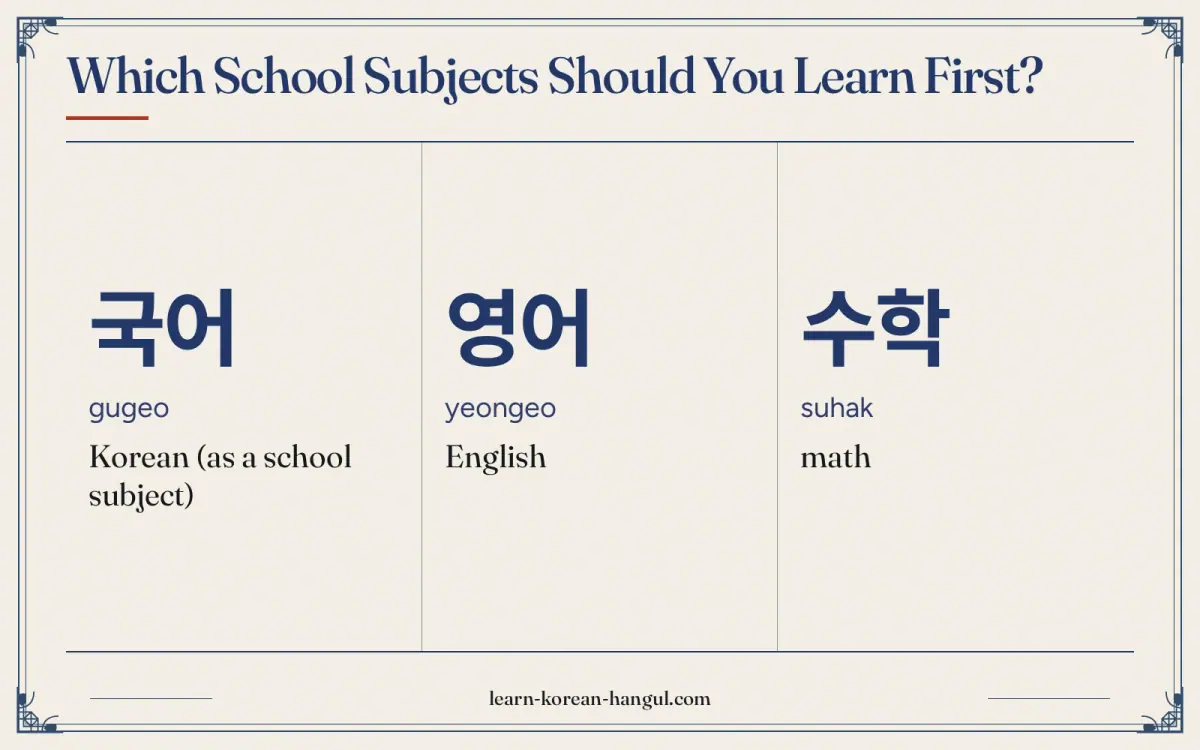
Learn 국어 (Korean), 영어 (English), 수학 (math), 과학 (science) and 역사 (history) first. They are the five that nearly every student studies, and they give you the sentence 수학을 좋아해요 (I like math). Ask 어떤 과목을 좋아해요? (Which subject do you like?) and a new friend can answer with one word.
- Words to say. 국어, 영어, 수학, 과학, 역사, 미술, 음악, 체육. They fill small talk about school.
- Words to recognise. 물리, 화학, 생물, 지리, 윤리, 정보. You see them on timetables and report cards.
- Words for choices. 과목, 필수 과목, 선택 과목. They matter when a school lets you choose.
The scene below shows a timetable board with ten numbered subjects, so that you can tie each word to a picture.
Word · 10
- 1
국어
gugeo
Korean (as a school subject)
- 2
영어
yeongeo
English
- 3
수학
suhak
math
- 4
과학
gwahak
science
- 5
역사
yeoksa
history
- 6
화학
hwahak
chemistry
- 7
미술
misul
art
- 8
음악
eumak
music
- 9
체육
cheyuk
physical education
- 10
과목
gwamok
school subject
Core Subjects
These six subjects are the base of a Korean timetable. All six are two-syllable Sino-Korean words, and most end in a piece that tells you the kind of subject: 어 for language, as in 국어 and 영어, and 학 for study of, as in 수학 and 과학.
| No. | Hangul | Revised Romanization | Meaning and note | Example sentence | Audio assetId |
|---|---|---|---|---|---|
| 1 | 국어 | gugeo | Korean (as a school subject). Said [구거]. 국 means nation; 어 means language. | 국어 시간이에요. (It is Korean class.) | au-pg-vocabulary-school-work-subjects-1; example: au-pg-vocabulary-school-work-subjects-31 |
| 2 | 영어 | yeongeo | English. 영 is England; 어 is language. | 영어를 좋아해요. (I like English.) | au-pg-vocabulary-school-work-subjects-2; example: au-pg-vocabulary-school-work-subjects-32 |
| 3 | 수학 | suhak | math. Not the same 수학 as in 수학여행. | 수학이 어려워요. (Math is hard.) | au-pg-vocabulary-school-work-subjects-3; example: au-pg-vocabulary-school-work-subjects-33 |
| 4 | 과학 | gwahak | science. The general subject; branches are in the next group. | 과학이 재미있어요. (Science is fun.) | au-pg-vocabulary-school-work-subjects-4; example: au-pg-vocabulary-school-work-subjects-34 |
| 5 | 사회 | sahoe | social studies. Also means society. | 사회 숙제가 있어요. (There is social studies homework.) | au-pg-vocabulary-school-work-subjects-5; example: au-pg-vocabulary-school-work-subjects-35 |
| 6 | 역사 | yeoksa | history. Said [역싸]. | 역사를 좋아해요. (I like history.) | au-pg-vocabulary-school-work-subjects-6; example: au-pg-vocabulary-school-work-subjects-36 |
Example Sentences
The simplest frame is the subject plus 을/를 plus a verb. 영어를 좋아해요 means I like English, and 역사를 좋아해요 means I like history. For a statement about the subject itself, use 이/가: 수학이 어려워요. Say each sentence aloud after the audio.
수학 is a homophone trap. It means math here, and it also appears in 수학여행 (school trip), where it is a different word that means study. Context settles it, since a subject name stands alone or before 시간. For the single-word pages, see science in Korean, history in Korean and English in Korean. The page on 국어, the Korean subject explains why the subject is not called 한국어.
How Do You Say Science and Maths Subjects in Korean?
Once students reach middle and high school, 과학 splits into four, and 수학 has its own branches. The names are built from two Sino-Korean pieces, so most of them are easy to read. This group gives the four sciences, plus two branches of mathematics.
| No. | Hangul | Revised Romanization | Meaning and note | Example sentence | Audio assetId |
|---|---|---|---|---|---|
| 7 | 물리 | mulli | physics. Said [물리]. 물 here means thing, not water. | 물리는 어려워요. (Physics is hard.) | au-pg-vocabulary-school-work-subjects-7; example: au-pg-vocabulary-school-work-subjects-37 |
| 8 | 화학 | hwahak | chemistry. 화 means change; 학 means study. | 화학 실험을 해요. (We do a chemistry experiment.) | au-pg-vocabulary-school-work-subjects-8; example: au-pg-vocabulary-school-work-subjects-38 |
| 9 | 생물 | saengmul | biology. 생 is life; 물 is thing. | 생물 시간에 개구리를 봤어요. (In biology class we saw a frog.) | au-pg-vocabulary-school-work-subjects-9; example: au-pg-vocabulary-school-work-subjects-39 |
| 10 | 지구과학 | jigugwahak | earth science. 지구 is the earth. | 지구과학을 배워요. (I learn earth science.) | au-pg-vocabulary-school-work-subjects-10; example: au-pg-vocabulary-school-work-subjects-40 |
| 11 | 기하 | giha | geometry. A branch of 수학. | 기하 문제를 풀어요. (I solve geometry problems.) | au-pg-vocabulary-school-work-subjects-11; example: au-pg-vocabulary-school-work-subjects-41 |
| 12 | 통계 | tonggye | statistics. Numbers about groups and chances. | 통계를 공부해요. (I study statistics.) | au-pg-vocabulary-school-work-subjects-12; example: au-pg-vocabulary-school-work-subjects-42 |
The first four words are a family. 물리, 화학 and 생물 are the three basic sciences, and 지구과학 is the fourth, built from 지구 (earth) and 과학 (science). 과학 is the umbrella word, so you can say 과학 시간 for a general science class. The single-word page on chemistry in Korean goes deeper on 화학. The mathematical terms that you use inside these lessons, such as plus and minus, are on math in Korean.
Languages and Humanities
Languages are easy to name in Korean, because the ending 어 means language and the first part names the country. The same ending serves every language on this list. Humanities subjects use the 학 and 리 endings that you saw earlier.
| No. | Hangul | Revised Romanization | Meaning and note | Example sentence | Audio assetId |
|---|---|---|---|---|---|
| 13 | 한국어 | hangugeo | Korean (language). Said [한구거]. Used for Korean as a foreign language. | 한국어를 배워요. (I learn Korean.) | au-pg-vocabulary-school-work-subjects-13; example: au-pg-vocabulary-school-work-subjects-43 |
| 14 | 중국어 | junggugeo | Chinese (language). Said [중구거]. | 중국어가 어려워요. (Chinese is hard.) | au-pg-vocabulary-school-work-subjects-14; example: au-pg-vocabulary-school-work-subjects-44 |
| 15 | 일본어 | ilboneo | Japanese (language). Said [일보너]. | 일본어를 공부해요. (I study Japanese.) | au-pg-vocabulary-school-work-subjects-15; example: au-pg-vocabulary-school-work-subjects-45 |
| 16 | 한문 | hanmun | classical Chinese; Chinese characters. A school subject on Chinese characters. | 한문 시간에 한자를 써요. (In Hanmun class I write Chinese characters.) | au-pg-vocabulary-school-work-subjects-16; example: au-pg-vocabulary-school-work-subjects-46 |
| 17 | 지리 | jiri | geography. 지 is land; 리 is reason. | 지리 시험이 있어요. (There is a geography exam.) | au-pg-vocabulary-school-work-subjects-17; example: au-pg-vocabulary-school-work-subjects-47 |
| 18 | 윤리 | yulli | ethics. Said [율리]. A subject on right and wrong. | 윤리 수업을 들어요. (I take an ethics class.) | au-pg-vocabulary-school-work-subjects-18; example: au-pg-vocabulary-school-work-subjects-48 |
The country plus 어 pattern gives you a whole family: 영어, 중국어, 일본어, 한국어. Add the country and you can build more, such as 프랑스어 (French) and 스페인어 (Spanish). 한국어 and 국어 are both Korean, but 국어 is the school subject for Korean students, and 한국어 is the name for the language as it is taught to foreign learners. Hanja, the Chinese characters used in Korean, are covered on the hanja pages of this site, and 한문 is the subject that teaches them in school.
Arts and Practical Subjects
The remaining subjects are the ones that students do with their hands, voices and bodies. Many Koreans remember them as the most enjoyable lessons of the week. They are also easy to say, because most are two-syllable words.
| No. | Hangul | Revised Romanization | Meaning and note | Example sentence | Audio assetId |
|---|---|---|---|---|---|
| 19 | 미술 | misul | art. Drawing, painting and crafts. | 미술 시간에 그림을 그려요. (In art class I draw a picture.) | au-pg-vocabulary-school-work-subjects-19; example: au-pg-vocabulary-school-work-subjects-49 |
| 20 | 음악 | eumak | music. Said [으막]. | 음악을 들어요. (I listen to music.) | au-pg-vocabulary-school-work-subjects-20; example: au-pg-vocabulary-school-work-subjects-50 |
| 21 | 체육 | cheyuk | physical education. Sports and exercise class. | 체육 시간에 달려요. (We run in PE class.) | au-pg-vocabulary-school-work-subjects-21; example: au-pg-vocabulary-school-work-subjects-51 |
| 22 | 기술 | gisul | technology; craft. Part of the combined subject 기술·가정. | 기술 시간에 만들어요. (We make things in technology class.) | au-pg-vocabulary-school-work-subjects-22; example: au-pg-vocabulary-school-work-subjects-52 |
| 23 | 가정 | gajeong | home economics. Also means home or family. | 가정 시간에 요리해요. (We cook in home economics.) | au-pg-vocabulary-school-work-subjects-23; example: au-pg-vocabulary-school-work-subjects-53 |
| 24 | 정보 | jeongbo | informatics; information. The subject on computers and coding. | 정보 수업이 재미있어요. (The informatics class is fun.) | au-pg-vocabulary-school-work-subjects-24; example: au-pg-vocabulary-school-work-subjects-54 |
미술 and 음악 are paired in schools, and they are often called 예체능 (arts and PE) together with 체육. Each of them has a single-word page on this site: art in Korean and music in Korean. 기술 and 가정 are often written together as 기술·가정 because they form one subject in many schools. The word 가정 also means home, so the meaning depends on the lesson you are speaking about.
Words about Subjects
The last group is the vocabulary you use when you talk about subjects, not the subjects themselves. It covers choosing a subject, practising it and getting extra help. Two of these words, 학원 and 과외, are part of Korean school life in a way that has no exact English match.
| No. | Hangul | Revised Romanization | Meaning and note | Example sentence | Audio assetId |
|---|---|---|---|---|---|
| 25 | 과목 | gwamok | school subject. The general word for any subject. | 어떤 과목을 좋아해요? (Which subject do you like?) | au-pg-vocabulary-school-work-subjects-25; example: au-pg-vocabulary-school-work-subjects-55 |
| 26 | 필수 과목 | pilsu gwamok | required subject. 필수 means essential. | 영어는 필수 과목이에요. (English is a required subject.) | au-pg-vocabulary-school-work-subjects-26; example: au-pg-vocabulary-school-work-subjects-56 |
| 27 | 선택 과목 | seontaek gwamok | elective subject. 선택 means choice. | 선택 과목을 골라요. (I choose an elective.) | au-pg-vocabulary-school-work-subjects-27; example: au-pg-vocabulary-school-work-subjects-57 |
| 28 | 문제집 | munjejip | workbook; problem book. A book of practice questions. | 수학 문제집을 풀어요. (I do a math workbook.) | au-pg-vocabulary-school-work-subjects-28; example: au-pg-vocabulary-school-work-subjects-58 |
| 29 | 학원 | hagwon | private academy; cram school. Said [하권]. Extra lessons after school. | 학원에 다녀요. (I attend a private academy.) | au-pg-vocabulary-school-work-subjects-29; example: au-pg-vocabulary-school-work-subjects-59 |
| 30 | 과외 | gwaoe | private tutoring. The standard allows [과외] and [과웨]. | 과외를 받아요. (I get private tutoring.) | au-pg-vocabulary-school-work-subjects-30; example: au-pg-vocabulary-school-work-subjects-60 |
과목 is the right word to ask about subjects in general: 어떤 과목을 좋아해요? 필수 과목 and 선택 과목 are a pair, and both end in 과목. 학원 is an after-school academy where students study a subject such as English or math, and it is a common part of student life in Korea. 과외 is one-to-one or small-group tutoring, often at home. The ending 집 in 문제집 means collection, as in 사진집 (photo book), and it turns a noun into a book.
How Do You Name a Class with a Subject Word?
Put the subject before 시간 (time) and you have the class: 수학 시간 is math class, 영어 시간 is English class and 체육 시간 is PE. Put it before 선생님 and you have the teacher: 영어 선생님 is the English teacher. Put it before 숙제 and you have the homework: 미술 숙제 is art homework. The pattern is always the subject first, then the thing, with no particle between.
To say what you study, add 을/를 and a verb: 영어를 공부해요 (I study English). To say that a subject is hard or fun, use 이/가 and an adjective: 수학이 어려워요 (Math is hard), 음악이 재미있어요 (Music is fun). You can combine them: 영어 시간에 단어를 배워요 (I learn words in English class). The pattern works with all 30 words, so practise it with five of them today.
A Korean timetable is a 시간표 (siganpyo), and each lesson slot is a 교시 (gyosi, class period), counted with Sino-Korean numbers: 일 교시 is first period and 삼 교시 is third period. On a printed timetable the days run across the top (월, 화, 수, 목, 금) and the periods run down the side, often written 1교시, 2교시. To read one slot aloud, say the day, the period and the subject: 월요일 일 교시는 국어예요 (Monday first period is Korean). A period is usually 40 minutes in elementary school, 45 in middle school and 50 in high school, but schools set their own timetables.
How Do You Pronounce School Subject Words?
Subject names are short, but several have sound changes at the join between syllables. The standard pronunciation rules of the National Institute of Korean Language (국립국어원) describe each one. The Revised Romanization of Korean follows the spelling closely, but it does not show tensing caused by a neighbouring sound, so rely on the Hangul and the audio.
| Spelling | Sounds like | What changes |
|---|---|---|
| 국어 | [구거] | The final ㄱ of 국 moves onto the empty ㅇ of 어. |
| 역사 | [역싸] | After the final ㄱ, the ㅅ of 사 is said tense. |
| 한국어 | [한구거] | The final ㄱ of 국 moves onto the empty ㅇ of 어. |
| 일본어 | [일보너] | The final ㄴ of 본 moves onto the empty ㅇ of 어. |
| 윤리 | [율리] | The ㄴ of 윤 becomes ㄹ before ㄹ. |
| 학원 | [하권] | The final ㄱ of 학 moves onto the empty ㅇ of 원. |
Two habits cover most of the list. A final consonant moves forward when the next syllable starts with ㅇ, which is why every language word ending in 어 loses its break: 국어 sounds like gu-geo. And a consonant is said tense after some endings, as in 역사. Learn the spoken form with the spelling, and do not pause between syllables.
Audio and Slow Playback
Each word and sentence has its own clip. Five clips replay the hardest words slowly: Korean as a subject, history, ethics, private academy and the language name. Play one, repeat it aloud, then play it again and compare.
What Mistakes Do Learners Make with School Subject Words?
Five confusions come up again and again.
- Saying 한국어 time for Korean class at a Korean school. At a Korean school, the Korean lesson is 국어 시간. 한국어 is the name of the language when a foreigner learns it, as in 한국어 수업. Both exist, but each fits a different setting.
- Leaving out 시간 when naming a class. 수학 on its own is the subject. For the class, say 수학 시간. 수학이 있어요 means there is math, and 수학 시간이 있어요 is closer to there is a math class.
- Mixing 수학 and 수학여행. 수학 is math. 수학여행 is a school trip, in which 수학 means study. The two share a sound, not a meaning.
- Reading 물리 as water. 물 means water on its own, but the 물 in 물리 means thing, as in 생물 and 동물. 물리 is physics.
- Treating 과목 and 학과 as one word. 과목 is a school subject. 학과 is a university department. A student takes many 과목 inside one 학과.
In each case the same sounds carry two meanings, or two nearby words do different jobs. Keep the pairs together, such as 국어 and 한국어, 수학 and 수학여행, and 과목 and 학과, and the rest of the 30 words stay in place.
Practice: Flashcards and Worksheet
Study in three steps. First, run the deck in recognition mode until the 30 words come quickly. Second, switch to listening mode and play the clip before you flip each card. Third, take the five-question quiz. Progress stays in your browser, and the vocabulary flashcard decks page lists the other decks.
Practice · 30
- 01국어
Show answer
gugeo
Korean (as a school subject)
- 02영어
Show answer
yeongeo
English
- 03수학
Show answer
suhak
math
- 04과학
Show answer
gwahak
science
- 05사회
Show answer
sahoe
social studies
- 06역사
Show answer
yeoksa
history
- 07물리
Show answer
mulli
physics
- 08화학
Show answer
hwahak
chemistry
- 09생물
Show answer
saengmul
biology
- 10지구과학
Show answer
jigugwahak
earth science
- 11기하
Show answer
giha
geometry
- 12통계
Show answer
tonggye
statistics
- 13한국어
Show answer
hangugeo
Korean (language)
- 14중국어
Show answer
junggugeo
Chinese (language)
- 15일본어
Show answer
ilboneo
Japanese (language)
- 16한문
Show answer
hanmun
classical Chinese; Chinese characters
- 17지리
Show answer
jiri
geography
- 18윤리
Show answer
yulli
ethics
- 19미술
Show answer
misul
art
- 20음악
Show answer
eumak
music
- 21체육
Show answer
cheyuk
physical education
- 22기술
Show answer
gisul
technology; craft
- 23가정
Show answer
gajeong
home economics
- 24정보
Show answer
jeongbo
informatics; information
- 25과목
Show answer
gwamok
school subject
- 26필수 과목
Show answer
pilsu gwamok
required subject
- 27선택 과목
Show answer
seontaek gwamok
elective subject
- 28문제집
Show answer
munjejip
workbook; problem book
- 29학원
Show answer
hagwon
private academy; cram school
- 30과외
Show answer
gwaoe
private tutoring
Practice · 5
What does 수학 (suhak) mean?
Show answer
math
수학 means math. Example: 수학이 어려워요. (Math is hard.)
What does 화학 (hwahak) mean?
Show answer
chemistry
화학 means chemistry. Example: 화학 실험을 해요. (We do a chemistry experiment.)
What does 중국어 (junggugeo) mean?
Show answer
Chinese (language)
중국어 means Chinese (language). Example: 중국어가 어려워요. (Chinese is hard.)
What does 미술 (misul) mean?
Show answer
art
미술 means art. Example: 미술 시간에 그림을 그려요. (In art class I draw a picture.)
What does 학원 (hagwon) mean?
Show answer
private academy; cram school
학원 means private academy; cram school. Example: 학원에 다녀요. (I attend a private academy.)
School Subjects in Korean Worksheet (PDF)
A printable worksheet for these words (word list, matching, writing practice, fill-in-the-blank exercises and answer key) is available in A4 and US Letter from the download card on this page. For additional practice, write your own weekly timetable in Korean, using the subject plus 시간 for each class.
Where to Go Next
After this page, continue with school vocabulary for the rest of school life, or Office and Business when you are ready for the work world. To move up a level, return to School and Work.
Frequently Asked Questions
How Do You Say Math in Korean?
Math is 수학 (suhak). It is a two-syllable Sino-Korean word, and 학 means study of. Say 수학이 어려워요 for math is hard. The word 수학 also appears in 수학여행 (school trip), where it means something else. The page on math in Korean covers numbers and terms.
How Do You Pronounce 국어 (gugeo)?
Say gu-geo in two beats. The final ㄱ of 국 moves onto the empty ㅇ of 어, so the word sounds like [구거]. Do not stop after gug. The vowel ㅓ is a relaxed, unrounded sound. Press the audio button on this page to hear the word and the slow clip.
How Many School Subjects Should I Learn First?
Start with five: 국어, 영어, 수학, 과학 and 역사. They let you say which subject you like. The whole list of 30 takes about six days at five new words a day, with a short review of earlier words each day.
What Is the Difference between 국어 and 한국어?
Both mean the Korean language. 국어 is the school subject for Korean students, and it literally means the national language. 한국어 is the usual name for Korean as a foreign language. A Korean timetable says 국어, and a language institute says 한국어.
Where Can I Practise Subject Words with Flashcards?
Use the deck on this page, which holds all 30 words with Hangul, romanization and audio, in recognition and listening modes. The vocabulary flashcard decks page lists the decks for other topics. Progress is saved only in your browser.
Is the Romanization on This Page Official?
It follows the Revised Romanization of Korean, which South Korea adopted in 2000 and whose rules the National Institute of Korean Language (국립국어원) publishes. It is a learning aid, and it does not show tensing caused by a neighbouring sound, so rely on the Hangul and the audio.