
Korean School Words at a Glance
The list has 50 words in five groups of ten, and it works as a map of the whole school topic. It belongs to School and Work. Each group here gives you the first ten words of a theme, and four deeper lists below it take the theme further. For the single word on its own, see school in Korean, and for the names of lessons, see school subjects. A good number of the words are built from the Sino-Korean piece 학 (study) or 교 (school or teach), so each word you learn makes the next one easier.
| List | Best for | Level |
|---|---|---|
| Korean Classroom Vocabulary | Classroom objects, people in class and lesson words | A1 |
| Korean Stationery Vocabulary | Pens, paper and the things on a desk | A1 |
| Korean Exams and Grades Vocabulary | Tests, scores and results | A2 |
| Korean University Majors Vocabulary | Majors, campus life and study abroad | A2 |
The five groups on this page are School levels and years, Places and classroom items, People at school, The school day, and Exams, vacations and events. Many of these words end in 교 (school), 생 (student) or 식 (ceremony), so you can guess new words from the ending.
Which School Words Should You Learn First?
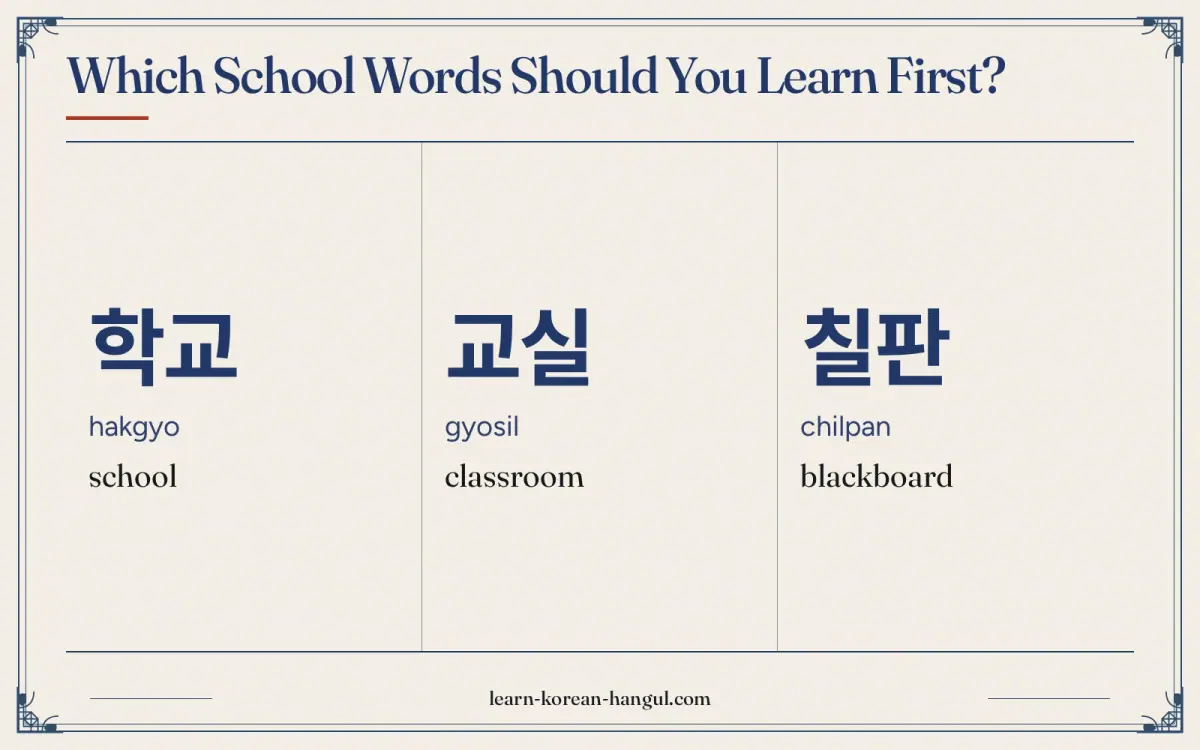
Learn 학교 (school), 학년 (school year), 선생님 (teacher), 학생 (student) and 방학 (vacation) first. With them you can already say where you study, which year you are in and when you are free. 저는 대학생이에요 (I am a university student) is the sentence most learners need on day one.
- Words to say. 학교, 학년, 선생님, 학생, 시험, 방학. They fill small talk about study.
- Words to recognise. 신입생, 졸업생, 입학식, 급식. You see them on signs, forms and in the news.
- Words for events. 소풍, 운동회, 수학여행. They name the school events that Koreans remember from childhood.
The scene below shows a school with ten numbered places and objects, so that you can tie each word to a picture.
Word · 10
- 1
학교
hakgyo
school
- 2
교실
gyosil
classroom
- 3
칠판
chilpan
blackboard
- 4
책상
chaeksang
desk
- 5
도서관
doseogwan
library
- 6
운동장
undongjang
sports field; playground
- 7
체육관
cheyukgwan
gym; sports hall
- 8
식당
sikdang
canteen; restaurant
- 9
교복
gyobok
school uniform
- 10
가방
gabang
bag
School Levels and the School Year
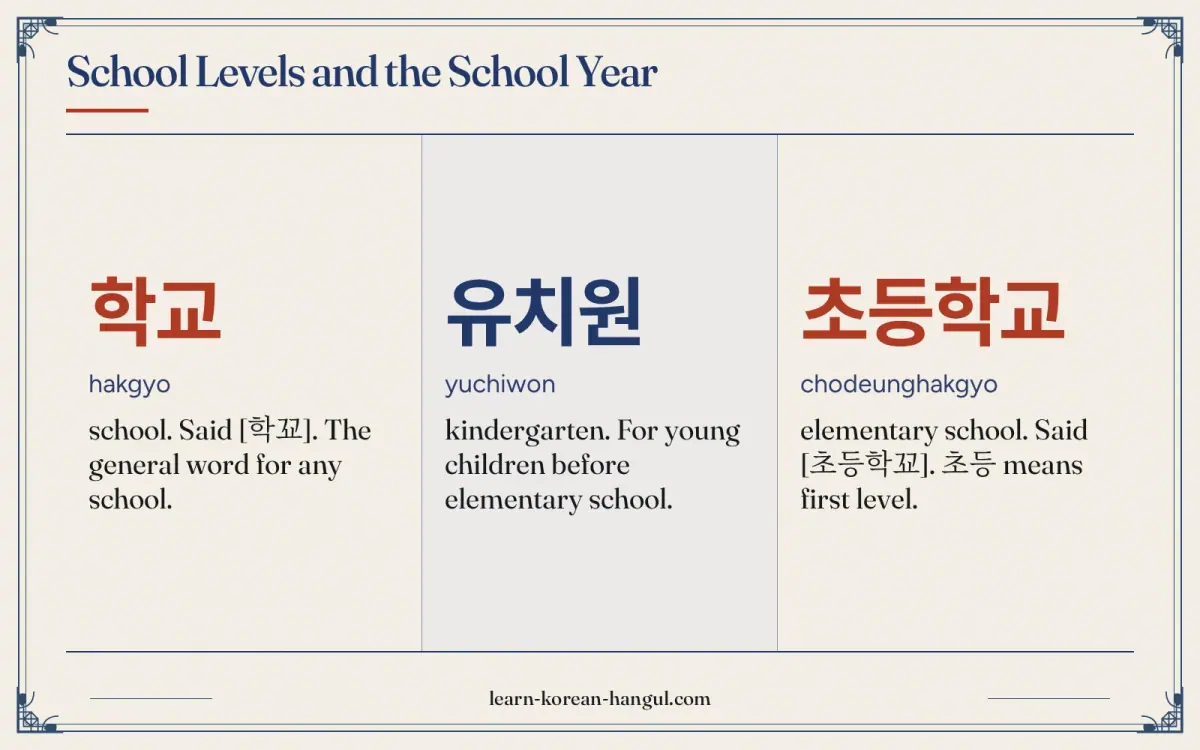
A Korean student moves through a ladder of schools, and each rung has a name that ends in 학교 or 원. The path most learners hear about runs from kindergarten to elementary school, middle school, high school and university. Years inside a school are counted with 학년, using Sino-Korean numbers, so 일 학년 is first year and 삼 학년 is third year.
| No. | Hangul | Revised Romanization | Meaning and note | Example sentence | Audio assetId |
|---|---|---|---|---|---|
| 1 | 학교 | hakgyo | school. Said [학꾜]. The general word for any school. | 학교에 가요. (I go to school.) | au-pg-vocabulary-school-work-school-1; example: au-pg-vocabulary-school-work-school-51 |
| 2 | 유치원 | yuchiwon | kindergarten. For young children before elementary school. | 동생이 유치원에 다녀요. (My younger sibling attends kindergarten.) | au-pg-vocabulary-school-work-school-2; example: au-pg-vocabulary-school-work-school-52 |
| 3 | 초등학교 | chodeunghakgyo | elementary school. Said [초등학꾜]. 초등 means first level. | 초등학교가 가까워요. (The elementary school is near.) | au-pg-vocabulary-school-work-school-3; example: au-pg-vocabulary-school-work-school-53 |
| 4 | 중학교 | junghakgyo | middle school. Said [중학꾜]. 중 means middle. | 중학교에 다녀요. (I attend middle school.) | au-pg-vocabulary-school-work-school-4; example: au-pg-vocabulary-school-work-school-54 |
| 5 | 고등학교 | godeunghakgyo | high school. Said [고등학꾜]. 고등 means higher level. | 고등학교를 졸업했어요. (I graduated from high school.) | au-pg-vocabulary-school-work-school-5; example: au-pg-vocabulary-school-work-school-55 |
| 6 | 대학교 | daehakgyo | university. Said [대학꾜]. Often shortened to 대학. | 대학교에서 공부해요. (I study at university.) | au-pg-vocabulary-school-work-school-6; example: au-pg-vocabulary-school-work-school-56 |
| 7 | 학년 | hangnyeon | school year; grade. Said [항년]. Counted with Sino-Korean numbers. | 저는 이 학년이에요. (I am in my second year.) | au-pg-vocabulary-school-work-school-7; example: au-pg-vocabulary-school-work-school-57 |
| 8 | 학기 | hakgi | semester; term. Said [학끼]. A school year has two. | 새 학기가 시작돼요. (The new semester begins.) | au-pg-vocabulary-school-work-school-8; example: au-pg-vocabulary-school-work-school-58 |
| 9 | 입학 | iphak | entering a school. Said [이팍]. The verb is 입학하다. | 올해 대학교에 입학해요. (I enter university this year.) | au-pg-vocabulary-school-work-school-9; example: au-pg-vocabulary-school-work-school-59 |
| 10 | 졸업 | joreop | graduation. Said [조럽]. The verb is 졸업하다. | 졸업이 가까워요. (Graduation is near.) | au-pg-vocabulary-school-work-school-10; example: au-pg-vocabulary-school-work-school-60 |
Example Sentences
The frame 학교 + 에 + a verb is the first one to learn. The particle 에 marks where you go or attend, as in 학교에 가요 and 유치원에 다녀요. For a place where you do something, use 에서, as in 대학교에서 공부해요. Say each sentence aloud after the audio.
학년 is a counter, so it follows a number: 일 학년, 이 학년, 삼 학년. It is one of the counters on counters for things. The same Sino-Korean numbers count the school levels inside the name, as in 중학교 일 학년 (first year of middle school). 대학교 is the full word for a university, and 대학 is the short everyday form, as in 대학에 가요 (I go to college).
Places and Classroom Items
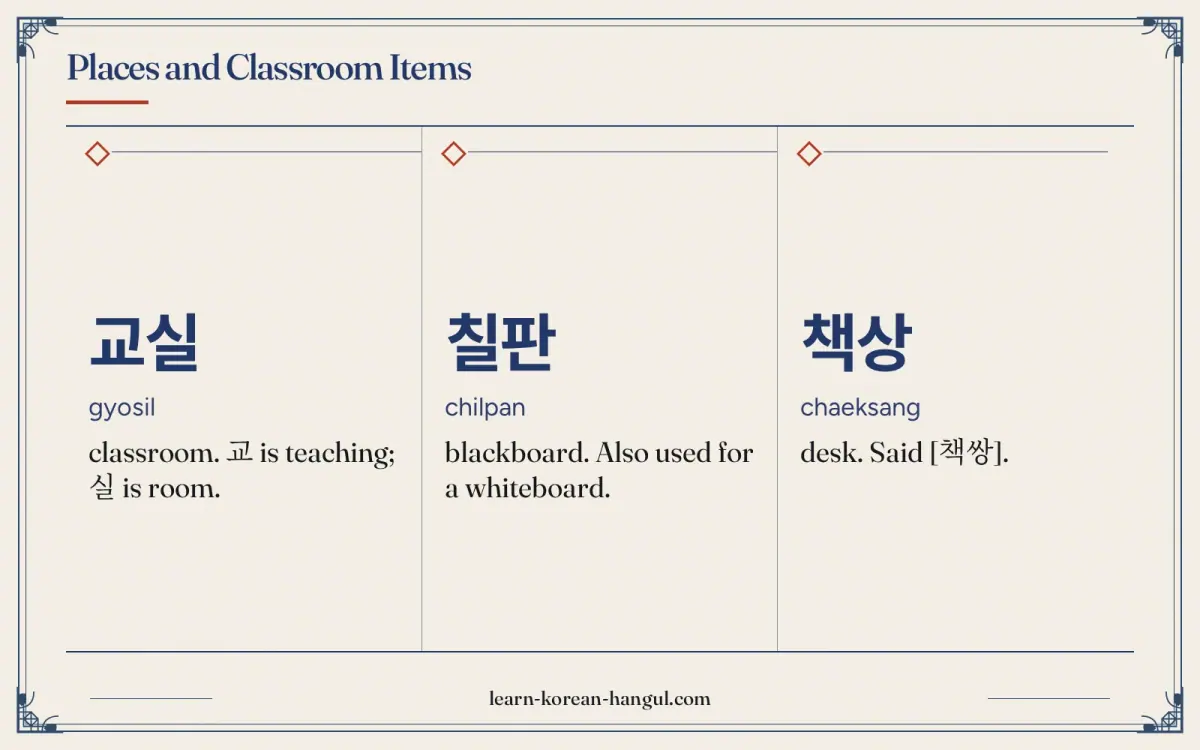
Next come the places in a school and the things in a classroom. Most are Sino-Korean compounds that end in 실 (room) or 관 (hall), so the ending tells you what kind of place it is. The longer lists on classroom items are on the classroom vocabulary page.
| No. | Hangul | Revised Romanization | Meaning and note | Example sentence | Audio assetId |
|---|---|---|---|---|---|
| 11 | 교실 | gyosil | classroom. 교 is teaching; 실 is room. | 교실에 학생이 있어요. (There are students in the classroom.) | au-pg-vocabulary-school-work-school-11; example: au-pg-vocabulary-school-work-school-61 |
| 12 | 칠판 | chilpan | blackboard. Also used for a whiteboard. | 칠판에 써요. (I write on the board.) | au-pg-vocabulary-school-work-school-12; example: au-pg-vocabulary-school-work-school-62 |
| 13 | 책상 | chaeksang | desk. Said [책쌍]. | 책상이 커요. (The desk is big.) | au-pg-vocabulary-school-work-school-13; example: au-pg-vocabulary-school-work-school-63 |
| 14 | 교과서 | gyogwaseo | textbook. 교과 is school subject; 서 is book. | 교과서를 펴요. (I open the textbook.) | au-pg-vocabulary-school-work-school-14; example: au-pg-vocabulary-school-work-school-64 |
| 15 | 도서관 | doseogwan | library. 관 marks a large public building. | 도서관에서 책을 읽어요. (I read books in the library.) | au-pg-vocabulary-school-work-school-15; example: au-pg-vocabulary-school-work-school-65 |
| 16 | 운동장 | undongjang | sports field; playground. The open yard of a school. | 운동장에서 놀아요. (We play on the field.) | au-pg-vocabulary-school-work-school-16; example: au-pg-vocabulary-school-work-school-66 |
| 17 | 체육관 | cheyukgwan | gym; sports hall. Said [체육꽌]. 체육 is physical education. | 체육관은 지하에 있어요. (The gym is in the basement.) | au-pg-vocabulary-school-work-school-17; example: au-pg-vocabulary-school-work-school-67 |
| 18 | 식당 | sikdang | canteen; restaurant. Said [식땅]. The place to eat. | 식당에서 점심을 먹어요. (I eat lunch in the canteen.) | au-pg-vocabulary-school-work-school-18; example: au-pg-vocabulary-school-work-school-68 |
| 19 | 교무실 | gyomusil | teachers' office. 교무 is the work of running a school. | 교무실에 가요. (I go to the teachers' office.) | au-pg-vocabulary-school-work-school-19; example: au-pg-vocabulary-school-work-school-69 |
| 20 | 복도 | bokdo | corridor; hallway. Said [복또]. | 복도가 길어요. (The corridor is long.) | au-pg-vocabulary-school-work-school-20; example: au-pg-vocabulary-school-work-school-70 |
Notice how the endings sort the places. 실 means a room, as in 교실 and 교무실. 관 means a hall or large building, as in 도서관 and 체육관. 장 means a place or field, as in 운동장. Once you know these three, many other place words become easy to read. The particle 에서 follows a place where an action happens, so 도서관에서 책을 읽어요 means I read books in the library.
Who Is Who at School?
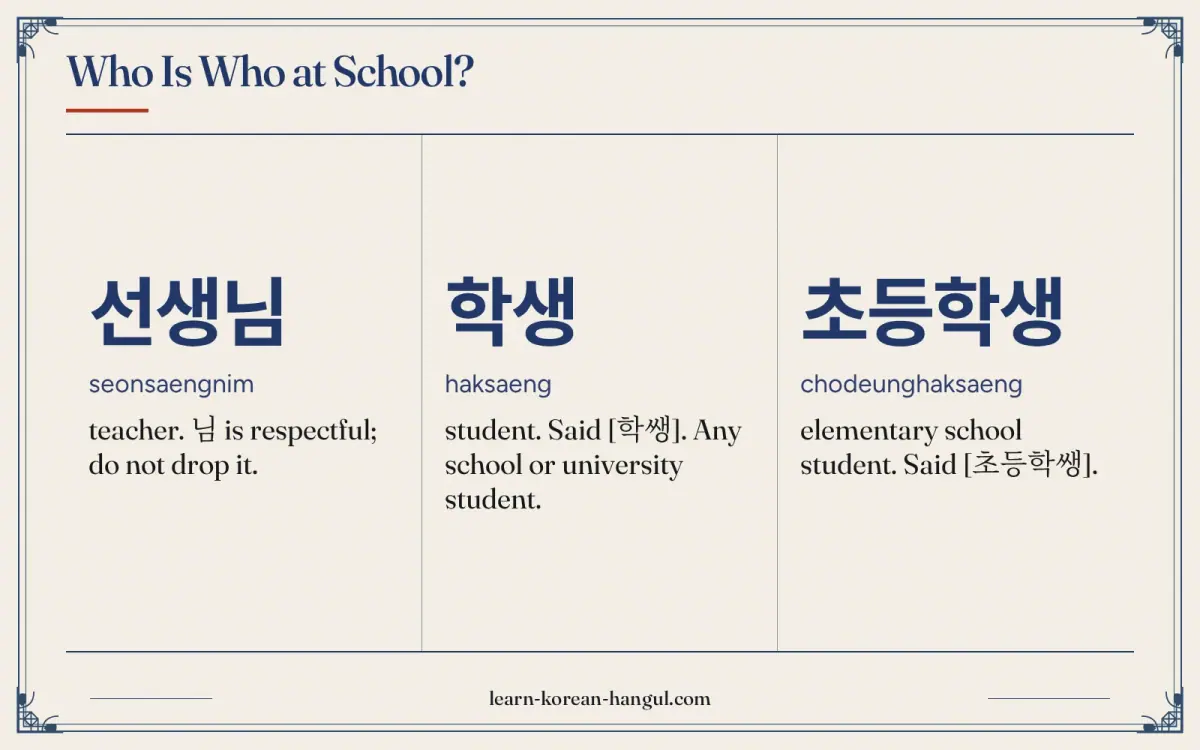
Korean has a word for each stage of a student's life, and most of them end in 생, which means student. This group gives you the common ones, from elementary school to university, and the names of a few special groups such as new students, graduates and transfer students.
| No. | Hangul | Revised Romanization | Meaning and note | Example sentence | Audio assetId |
|---|---|---|---|---|---|
| 21 | 선생님 | seonsaengnim | teacher. 님 is respectful; do not drop it. | 선생님이 설명해요. (The teacher explains.) | au-pg-vocabulary-school-work-school-21; example: au-pg-vocabulary-school-work-school-71 |
| 22 | 학생 | haksaeng | student. Said [학쌩]. Any school or university student. | 학생들이 운동장에 있어요. (The students are on the field.) | au-pg-vocabulary-school-work-school-22; example: au-pg-vocabulary-school-work-school-72 |
| 23 | 초등학생 | chodeunghaksaeng | elementary school student. Said [초등학쌩]. | 동생은 초등학생이에요. (My younger sibling is an elementary school student.) | au-pg-vocabulary-school-work-school-23; example: au-pg-vocabulary-school-work-school-73 |
| 24 | 중학생 | junghaksaeng | middle school student. Said [중학쌩]. | 저는 중학생이에요. (I am a middle school student.) | au-pg-vocabulary-school-work-school-24; example: au-pg-vocabulary-school-work-school-74 |
| 25 | 고등학생 | godeunghaksaeng | high school student. Said [고등학쌩]. | 고등학생은 공부를 많이 해요. (High school students study a lot.) | au-pg-vocabulary-school-work-school-25; example: au-pg-vocabulary-school-work-school-75 |
| 26 | 대학생 | daehaksaeng | university student. Said [대학쌩]. | 친구는 대학생이에요. (My friend is a university student.) | au-pg-vocabulary-school-work-school-26; example: au-pg-vocabulary-school-work-school-76 |
| 27 | 신입생 | sinipsaeng | new student; freshman. Said [시닙쌩]. 신입 means newly entered. | 신입생이 인사해요. (The new students say hello.) | au-pg-vocabulary-school-work-school-27; example: au-pg-vocabulary-school-work-school-77 |
| 28 | 졸업생 | joreopsaeng | graduate; alumnus. Said [조럽쌩]. | 졸업생이 학교에 와요. (A graduate comes to the school.) | au-pg-vocabulary-school-work-school-28; example: au-pg-vocabulary-school-work-school-78 |
| 29 | 전학생 | jeonhaksaeng | transfer student. Said [전학쌩]. 전학 means changing schools. | 전학생이 왔어요. (A transfer student has arrived.) | au-pg-vocabulary-school-work-school-29; example: au-pg-vocabulary-school-work-school-79 |
| 30 | 교장 선생님 | gyojang seonsaengnim | principal. 교장 is the head of a school; add 선생님 to address. | 교장 선생님이 말해요. (The principal speaks.) | au-pg-vocabulary-school-work-school-30; example: au-pg-vocabulary-school-work-school-80 |
The ending 생 turns a school name into a student of that school: 초등학교 becomes 초등학생, and 대학교 becomes 대학생. The ㅅ of 생 is said tense after the final ㄱ, so 학생 sounds like hak-ssaeng. 선생님 means teacher but literally means one born earlier, and the respect marker 님 is built in, so you never add another. A principal is 교장 선생님 in speech. At university the teachers are professors, addressed as 교수님 (gyosunim), not 선생님.
The School Day
A school day has a clear shape: you go to school in the morning, sit through lessons, eat lunch, and go home. The words below name the parts of that day and the things you carry. They are everyday words, and many appear in dramas about school life.
| No. | Hangul | Revised Romanization | Meaning and note | Example sentence | Audio assetId |
|---|---|---|---|---|---|
| 31 | 등교 | deunggyo | going to school. The act of attending in the morning. | 아침에 등교해요. (I go to school in the morning.) | au-pg-vocabulary-school-work-school-31; example: au-pg-vocabulary-school-work-school-81 |
| 32 | 하교 | hagyo | leaving school. The opposite of 등교. | 세 시에 하교해요. (I leave school at three.) | au-pg-vocabulary-school-work-school-32; example: au-pg-vocabulary-school-work-school-82 |
| 33 | 수업 | sueop | lesson; class. A lesson, not a group of students. | 수업이 끝나요. (The lesson ends.) | au-pg-vocabulary-school-work-school-33; example: au-pg-vocabulary-school-work-school-83 |
| 34 | 점심시간 | jeomsimsigan | lunch break. 점심 is lunch; 시간 is time. | 점심시간이 한 시간이에요. (Lunch break is one hour.) | au-pg-vocabulary-school-work-school-34; example: au-pg-vocabulary-school-work-school-84 |
| 35 | 급식 | geupsik | school meal. Said [급씩]. A meal served by the school. | 급식이 맛있어요. (The school meal is tasty.) | au-pg-vocabulary-school-work-school-35; example: au-pg-vocabulary-school-work-school-85 |
| 36 | 도시락 | dosirak | packed lunch. A lunch box you bring from home. | 도시락을 싸요. (I pack a lunch.) | au-pg-vocabulary-school-work-school-36; example: au-pg-vocabulary-school-work-school-86 |
| 37 | 교복 | gyobok | school uniform. 교 is school; 복 is clothes. | 교복을 입어요. (I wear a school uniform.) | au-pg-vocabulary-school-work-school-37; example: au-pg-vocabulary-school-work-school-87 |
| 38 | 가방 | gabang | bag. Any bag you carry, such as a school bag. | 가방이 무거워요. (My bag is heavy.) | au-pg-vocabulary-school-work-school-38; example: au-pg-vocabulary-school-work-school-88 |
| 39 | 지각 | jigak | lateness; being late. Used for school and work. | 오늘 지각했어요. (I was late today.) | au-pg-vocabulary-school-work-school-39; example: au-pg-vocabulary-school-work-school-89 |
| 40 | 결석 | gyeolseok | absence. Said [결썩]. Missing a day of school. | 어제 결석했어요. (I was absent yesterday.) | au-pg-vocabulary-school-work-school-40; example: au-pg-vocabulary-school-work-school-90 |
등교 and 하교 are a pair, and the first letters 등 and 하 tell them apart: 등 is going up to school, and 하 is coming down from it. Work has its own pair built the same way, 출근 and 퇴근 (going to work and leaving work), with different first syllables. 지각 and 결석 are the two school sins, being late and being absent. Both take 하다, so 지각했어요 means I was late.
Exams, Vacations and Events
The last group is the school calendar: the exam, the grade, the vacations and the events that mark the year. Korean schools have two long vacations, one in summer and one in winter, and both end in 방학. The exam words are only introduced here, because the full list is on the exams and grades page.
| No. | Hangul | Revised Romanization | Meaning and note | Example sentence | Audio assetId |
|---|---|---|---|---|---|
| 41 | 시험 | siheom | exam; test. You take it with 보다. | 내일 시험이 있어요. (I have an exam tomorrow.) | au-pg-vocabulary-school-work-school-41; example: au-pg-vocabulary-school-work-school-91 |
| 42 | 성적 | seongjeok | grades; results. Standard [성적], with no tensing, though [성쩍] is often heard. | 성적이 올라요. (My grades go up.) | au-pg-vocabulary-school-work-school-42; example: au-pg-vocabulary-school-work-school-92 |
| 43 | 방학 | banghak | school vacation. A long break between terms. | 곧 방학이에요. (Vacation is soon.) | au-pg-vocabulary-school-work-school-43; example: au-pg-vocabulary-school-work-school-93 |
| 44 | 여름 방학 | yeoreum banghak | summer vacation. 여름 is summer. | 여름 방학에 여행해요. (I travel during the summer vacation.) | au-pg-vocabulary-school-work-school-44; example: au-pg-vocabulary-school-work-school-94 |
| 45 | 겨울 방학 | gyeoul banghak | winter vacation. 겨울 is winter. | 겨울 방학에 스키를 타요. (I ski during the winter vacation.) | au-pg-vocabulary-school-work-school-45; example: au-pg-vocabulary-school-work-school-95 |
| 46 | 소풍 | sopung | school outing; picnic. A day trip, often to a park. | 내일 소풍을 가요. (We go on an outing tomorrow.) | au-pg-vocabulary-school-work-school-46; example: au-pg-vocabulary-school-work-school-96 |
| 47 | 운동회 | undonghoe | sports day. A day of races and games. | 운동회에서 달려요. (I run at sports day.) | au-pg-vocabulary-school-work-school-47; example: au-pg-vocabulary-school-work-school-97 |
| 48 | 수학여행 | suhangnyeohaeng | school trip. Said [수항녀행]. 수학 here is study, not math. | 수학여행을 가요. (We go on a school trip.) | au-pg-vocabulary-school-work-school-48; example: au-pg-vocabulary-school-work-school-98 |
| 49 | 입학식 | iphaksik | entrance ceremony. Said [이팍씩]. 식 is ceremony. | 입학식이 있어요. (There is an entrance ceremony.) | au-pg-vocabulary-school-work-school-49; example: au-pg-vocabulary-school-work-school-99 |
| 50 | 졸업식 | joreopsik | graduation ceremony. Said [조럽씩]. | 졸업식에서 사진을 찍어요. (I take photos at the graduation ceremony.) | au-pg-vocabulary-school-work-school-50; example: au-pg-vocabulary-school-work-school-100 |
식 means ceremony, and it joins any event word: 입학식, 졸업식 and many more. 수학여행 is a trap for new learners, because 수학 on its own means math, but in this word the 수학 is a different one, written with other Chinese characters, and means study. Schools set their own event dates, so check the calendar at your school.
How Do Korean School Levels Work?
The usual path is kindergarten, elementary school, middle school, high school and then university. Each school is named with 학교 and a level word: 초등 (first level), 중 (middle) and 고등 (higher). University is 대학교, and the school after it is 대학원 (graduate school). The usual pattern is 6-3-3-4: six years of elementary school, three of middle school, three of high school and usually four of university. Children normally start elementary school in March of the year after the calendar year in which they turn six. Within a school you count the years with 학년: 고등학교 삼 학년 is the last year of high school, and each year is split into classes called 반, as in 일 반 or 이 반. The school year in Korea usually begins in the spring, in March, and a year is split into two 학기 (semesters). The exact dates are set by each school each year, so check with the school.
Students in each level have their own name: 초등학생, 중학생, 고등학생 and 대학생. The group of all pupils in a school is 학생들, with the plural marker 들 added. A short way to say your level is the noun plus 이에요 or 예요, as in 저는 고등학생이에요 (I am a high school student). Three more words come up in any talk about school life: 숙제 (sukje, homework), 동아리 (dongari, school club) and 학원 (hagwon, a private after-school academy that many Korean students attend).
How Do You Pronounce School Words?
School words are almost all Sino-Korean, and they share a small set of sound changes. The standard pronunciation rules of the National Institute of Korean Language (국립국어원) describe each one. The Revised Romanization of Korean does not show tensing caused by a neighbouring sound, and it writes ㅎ in nouns such as iphak, so rely on the Hangul and the audio.
| Spelling | Sounds like | What changes |
|---|---|---|
| 학교 | [학꾜] | After the final ㄱ of 학, the ㄱ of 교 is said tense. |
| 학년 | [항년] | The final ㄱ is said as ㅇ before ㄴ. |
| 입학 | [이팍] | The final ㅂ of 입 moves forward and joins ㅎ into a strong ㅍ sound. |
| 졸업 | [조럽] | The final ㅂ of 업 moves onto the empty ㅇ. |
| 급식 | [급씩] | After the final ㅂ of 급, the ㅅ of 식 is said tense. |
| 체육관 | [체육꽌] | After the final ㄱ of 육, the ㄱ of 관 is said tense. |
Three habits cover most of the list. After a final ㄱ or ㅂ, the next consonant is said tense, as in 학교, 급식 and 체육관. Before ㄴ, a final ㄱ is said as ㅇ, as in 학년. And a final consonant moves forward when the next syllable starts with ㅇ, as in 졸업. Learn the spoken form with the spelling, and do not pause between syllables.
Audio and Slow Playback
Each word and sentence has its own clip. Five clips replay the hardest words slowly: school, school year, entering school, graduation and school meal. Play one, repeat it aloud, then play it again and compare.
What Mistakes Do Learners Make with School Words?
Five confusions come up again and again.
- Saying 대학 and 대학교 as different things. In everyday talk they mean the same thing. 대학교 is the full name, and 대학 is the short form. In an address or on a form, use 대학교. A 대학 can also mean a faculty inside a university.
- Using 학년 as the name of a class. 학년 is a school year or grade. A class is 반. So 이 학년 삼 반 means second year, class three. Do not use 학년 for a single lesson, which is 수업.
- Reading 수학여행 as a maths trip. 수학여행 is a school trip. The 수학 in it means study, and the 수학 meaning math is a different word that happens to sound the same.
- Adding 님 twice to 선생님. 선생님 already has 님. Writing 선생님님 is a doubled suffix. Address your teacher as 선생님.
- Mixing 방학 and 휴가. 방학 is a school vacation. 휴가 is time off from work. A student has 방학, and a worker has 휴가.
In each case a similar word covers a nearby idea. Keep the pairs together, such as 대학 and 대학교, 학년 and 반, and 방학 and 휴가, and the rest of the 50 words stay in place.
Practice: Flashcards and Worksheet
Study in three steps. First, run the deck in recognition mode and take one group of ten words at a time. Second, switch to listening mode and play the clip before you flip each card. Third, take the five-question quiz. Progress stays in your browser, and the vocabulary flashcard decks page lists the other decks.
Practice · 50
- 01학교
Show answer
hakgyo
school
- 02유치원
Show answer
yuchiwon
kindergarten
- 03초등학교
Show answer
chodeunghakgyo
elementary school
- 04중학교
Show answer
junghakgyo
middle school
- 05고등학교
Show answer
godeunghakgyo
high school
- 06대학교
Show answer
daehakgyo
university
- 07학년
Show answer
hangnyeon
school year; grade
- 08학기
Show answer
hakgi
semester; term
- 09입학
Show answer
iphak
entering a school
- 10졸업
Show answer
joreop
graduation
- 11교실
Show answer
gyosil
classroom
- 12칠판
Show answer
chilpan
blackboard
- 13책상
Show answer
chaeksang
desk
- 14교과서
Show answer
gyogwaseo
textbook
- 15도서관
Show answer
doseogwan
library
- 16운동장
Show answer
undongjang
sports field; playground
- 17체육관
Show answer
cheyukgwan
gym; sports hall
- 18식당
Show answer
sikdang
canteen; restaurant
- 19교무실
Show answer
gyomusil
teachers' office
- 20복도
Show answer
bokdo
corridor; hallway
- 21선생님
Show answer
seonsaengnim
teacher
- 22학생
Show answer
haksaeng
student
- 23초등학생
Show answer
chodeunghaksaeng
elementary school student
- 24중학생
Show answer
junghaksaeng
middle school student
- 25고등학생
Show answer
godeunghaksaeng
high school student
- 26대학생
Show answer
daehaksaeng
university student
- 27신입생
Show answer
sinipsaeng
new student; freshman
- 28졸업생
Show answer
joreopsaeng
graduate; alumnus
- 29전학생
Show answer
jeonhaksaeng
transfer student
- 30교장 선생님
Show answer
gyojang seonsaengnim
principal
- 31등교
Show answer
deunggyo
going to school
- 32하교
Show answer
hagyo
leaving school
- 33수업
Show answer
sueop
lesson; class
- 34점심시간
Show answer
jeomsimsigan
lunch break
- 35급식
Show answer
geupsik
school meal
- 36도시락
Show answer
dosirak
packed lunch
- 37교복
Show answer
gyobok
school uniform
- 38가방
Show answer
gabang
bag
- 39지각
Show answer
jigak
lateness; being late
- 40결석
Show answer
gyeolseok
absence
- 41시험
Show answer
siheom
exam; test
- 42성적
Show answer
seongjeok
grades; results
- 43방학
Show answer
banghak
school vacation
- 44여름 방학
Show answer
yeoreum banghak
summer vacation
- 45겨울 방학
Show answer
gyeoul banghak
winter vacation
- 46소풍
Show answer
sopung
school outing; picnic
- 47운동회
Show answer
undonghoe
sports day
- 48수학여행
Show answer
suhangnyeohaeng
school trip
- 49입학식
Show answer
iphaksik
entrance ceremony
- 50졸업식
Show answer
joreopsik
graduation ceremony
Practice · 5
What does 학년 (hangnyeon) mean?
Show answer
school year; grade
학년 means school year; grade. Example: 저는 이 학년이에요. (I am in my second year.)
What does 체육관 (cheyukgwan) mean?
Show answer
gym; sports hall
체육관 means gym; sports hall. Example: 체육관은 지하에 있어요. (The gym is in the basement.)
What does 대학생 (daehaksaeng) mean?
Show answer
university student
대학생 means university student. Example: 친구는 대학생이에요. (My friend is a university student.)
What does 급식 (geupsik) mean?
Show answer
school meal
급식 means school meal. Example: 급식이 맛있어요. (The school meal is tasty.)
What does 운동회 (undonghoe) mean?
Show answer
sports day
운동회 means sports day. Example: 운동회에서 달려요. (I run at sports day.)
Korean School Words Worksheet (PDF)
A printable worksheet for these words (word list, matching, writing practice, fill-in-the-blank exercises and answer key) is available in A4 and US Letter from the download card on this page. For additional practice, write five sentences about your own school week, using 학년, 수업, 점심시간, 숙제 and 방학.
Where to Go Next
After this page, continue with Korean Classroom Vocabulary or school subjects. To go further into study life, open Korean Exams and Grades Vocabulary. When you are ready for work, see Office and Business, and to move up a level, return to School and Work.
Frequently Asked Questions
How Do You Say School in Korean?
School is 학교 (hakgyo), said [학꾜]. The word is built from 학 (study) and 교 (school). Add a level before it to name a kind of school, as in 초등학교 (elementary school) and 고등학교 (high school). The single-word page on school in Korean gives more detail.
How Do You Pronounce 학년 (hangnyeon)?
Say hang-nyeon in two beats. The final ㄱ of 학 is said as ㅇ because the next sound is ㄴ, so the word sounds like [항년]. Do not say hak-nyeon. The vowel ㅕ is a short y plus eo. Press the audio button on this page to hear the word and the slow clip.
How Many School Words Should I Learn First?
Start with five: 학교, 학년, 선생님, 학생 and 방학. They let you say where you study, which year you are in and when you are free. The whole list of 50 takes about ten days at five new words a day, with a short review of earlier words each day.
What Are the School Levels in Korean?
The usual path is 유치원 (kindergarten), 초등학교 (elementary school), 중학교 (middle school), 고등학교 (high school) and 대학교 (university). Years inside a school are counted with 학년, as in 삼 학년 for third year.
Where Can I Practise School Words with Flashcards?
Use the deck on this page, which holds all 50 words with Hangul, romanization and audio, in recognition and listening modes. The vocabulary flashcard decks page lists the decks for other topics. Progress is saved only in your browser.
Is the Romanization on This Page Official?
It follows the Revised Romanization of Korean, which South Korea adopted in 2000 and whose rules the National Institute of Korean Language (국립국어원) publishes. It is a learning aid, and it does not show tensing caused by a neighbouring sound, so rely on the Hangul and the audio.