How English Words Sound in Korean at a Glance
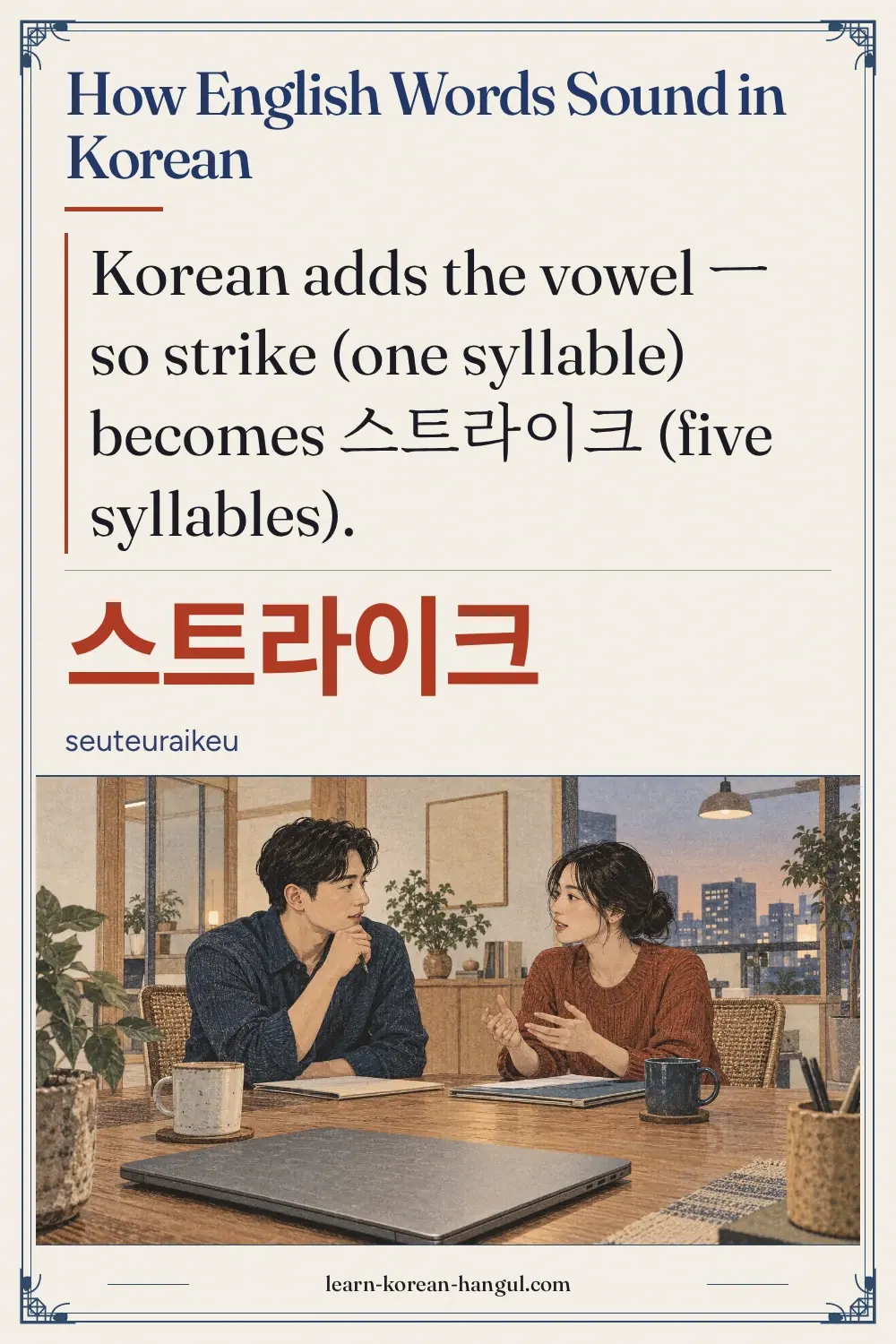
English words sound different in Korean because Korean has fewer sounds and stricter syllables. Every Korean syllable needs a vowel, and a syllable can end in only one consonant sound. So an English word is reshaped: a vowel is added, a missing sound is replaced by the closest Korean one, and the spelling follows the sounds, not the English letters. The best-known example is 스트라이크 (seuteuraikeu). English "strike" has one syllable, and Korean 스트라이크 has five. This lesson shows the patterns behind that change, with about 40 examples, and ends with a short sorting quiz.
| Pattern | What it does | Example |
|---|---|---|
| Added vowel ㅡ | Breaks up consonant groups and ends words that finish on a consonant Korean cannot use | 스트라이크 |
| Sound replacement | Swaps a missing English sound for the nearest Korean one | f becomes ㅍ, v becomes ㅂ |
| Fixed final consonants | Allows only seven letters at the end of a syllable in loanword spelling | 북, 볼, 팀, 링 |
| Even syllable beat | Gives each syllable about the same weight | 컴퓨터 |
This lesson belongs to the Konglish and Loanwords list. The list shows the words, and this lesson explains why they look the way they do. For the words that look English but mean something else, see Konglish Examples and False Friends.
Which English Loanword Sounds Should You Learn First?
Learn the added vowel ㅡ first, then f and v, then the final consonant rules. The added vowel explains the most words, so it gives the biggest return. The order below takes about 45 minutes.
- Step one (10 minutes). Read the added vowel ㅡ section and say 스트라이크, 스트레스 and 스프링 aloud.
- Step two (10 minutes). Learn f, v, th and z: 팬, 비타민, 스릴 and 제로.
- Step three (10 minutes). Learn the final consonant rule: 북 and 캡 against 케이크 and 노트.
- Step four (10 minutes). Read the stress section and the spelling principles.
- Step five (5 minutes). Do the sorting quiz at the end.
The audio buttons in the tables let you hear every Korean word. Cover the right-hand columns, say the Korean word, and then check it.
Vowels Added to Final Consonants
Korean syllables follow the pattern consonant + vowel (+ consonant). English words often end in a consonant that Korean cannot place at the end of a syllable, or have two or three consonants in a row. Korean solves both problems with the vowel ㅡ (eu). It is the weakest vowel, so it sounds like a light, spread-lip breath. The rule has two halves.
First, a short vowel followed by a final p, t or k at the end of a word uses a batchim, a final consonant letter: book becomes 북 (buk), and cap becomes 캡 (kaep). Second, a long vowel or a diphthong before a final p, t or k gets ㅡ after it: cake becomes 케이크 (keikeu), and note becomes 노트 (noteu). Short vowels and long vowels both exist in English, and Korean writing tracks the difference in this way.
| No. | English word | Hangul | Revised Romanization | What happens | Audio assetId |
|---|---|---|---|---|---|
| 1 | book | 북 | buk | Short vowel + final k: the k becomes the batchim ㄱ | au-pg-vocabulary-word-types-loanwords-sound-rules-1 |
| 2 | cap | 캡 | kaep | Short vowel + final p: the p becomes the batchim ㅂ | au-pg-vocabulary-word-types-loanwords-sound-rules-2 |
| 3 | rock | 록 | rok | Short vowel + final k: batchim ㄱ | au-pg-vocabulary-word-types-loanwords-sound-rules-3 |
| 4 | cake | 케이크 | keikeu | Long vowel + final k: the k gets the vowel ㅡ, so the word grows a syllable | au-pg-vocabulary-word-types-loanwords-sound-rules-4 |
| 5 | note | 노트 | noteu | Long vowel + final t: the t gets the vowel ㅡ | au-pg-vocabulary-word-types-loanwords-sound-rules-5 |
| 6 | rope | 로프 | ropeu | Long vowel + final p: the p gets the vowel ㅡ | au-pg-vocabulary-word-types-loanwords-sound-rules-6 |
| 7 | bus | 버스 | beoseu | The final s is always written 스 with a vowel | au-pg-vocabulary-word-types-loanwords-sound-rules-7 |
| 8 | ball | 볼 | bol | Final l is written with the batchim ㄹ | au-pg-vocabulary-word-types-loanwords-sound-rules-8 |
| 9 | team | 팀 | tim | Final m is written with the batchim ㅁ | au-pg-vocabulary-word-types-loanwords-sound-rules-9 |
| 10 | ring | 링 | ring | Final ng is written with the batchim ㅇ | au-pg-vocabulary-word-types-loanwords-sound-rules-10 |
Notice also how the consonants m, n, l and ng stay as batchim at the end: team 팀, ball 볼, ring 링. Loanword spelling allows seven letters as a final consonant: ㄱ, ㄴ, ㄹ, ㅁ, ㅂ, ㅅ and ㅇ. The English s is the exception to a pattern, because it is written 스, as in 버스.
Worked Examples
Take the word "bus". The English word has one syllable and ends in s. Korean cannot say a final s as a clean sound, so the s gets a vowel: 버스 has two syllables, beo and seu. Now take "cake". The English word has one syllable, a long vowel and a final k. The vowel is long, so the k gets ㅡ: 케이크 has three syllables, ke, i and keu. Last, "book". The vowel is short and the k is final, so the k stays as a batchim: 북 has one syllable.
Try one yourself. "Rope" has a long vowel and a final p. By the rule, the p gets ㅡ, so the word is 로프 (ropeu). Check it in the table above.
What Do You Need to Know about F, V, TH and Z Sounds?
Korean has no f, v, th or z. It replaces each with its nearest sound. English f becomes ㅍ, a p sound with a puff of air. English v becomes ㅂ. English th, as in "thrill", becomes ㅅ. English z becomes ㅈ. The letters p, b, s and j do the work of the missing sounds.
| No. | English word | Hangul | Revised Romanization | What happens | Audio assetId |
|---|---|---|---|---|---|
| 11 | fan | 팬 | paen | English f is written ㅍ | au-pg-vocabulary-word-types-loanwords-sound-rules-11 |
| 12 | coffee | 커피 | keopi | English f is written ㅍ, even in the middle of a word | au-pg-vocabulary-word-types-loanwords-sound-rules-12 |
| 13 | film | 필름 | pilleum | f is ㅍ; the l before m is written twice (ㄹㄹ) with ㅡ between, so film has two syllables | au-pg-vocabulary-word-types-loanwords-sound-rules-13 |
| 14 | fork | 포크 | pokeu | f is ㅍ, and the final k gets the vowel ㅡ after a long vowel | au-pg-vocabulary-word-types-loanwords-sound-rules-14 |
| 15 | vitamin | 비타민 | bitamin | English v is written ㅂ | au-pg-vocabulary-word-types-loanwords-sound-rules-15 |
| 16 | video | 비디오 | bidio | English v is written ㅂ | au-pg-vocabulary-word-types-loanwords-sound-rules-16 |
| 17 | violin | 바이올린 | baiollin | English v is written ㅂ | au-pg-vocabulary-word-types-loanwords-sound-rules-17 |
| 18 | drive | 드라이브 | deuraibeu | v is written ㅂ, and the final sound gets the vowel ㅡ | au-pg-vocabulary-word-types-loanwords-sound-rules-18 |
| 19 | thrill | 스릴 | seuril | English th (as in thin) is written ㅅ, and the cluster gets a vowel | au-pg-vocabulary-word-types-loanwords-sound-rules-19 |
| 20 | zero | 제로 | jero | English z is written ㅈ | au-pg-vocabulary-word-types-loanwords-sound-rules-20 |
| 21 | zoom | 줌 | jum | z is written ㅈ, and the final m is a batchim | au-pg-vocabulary-word-types-loanwords-sound-rules-21 |
| 22 | size | 사이즈 | saijeu | z is written ㅈ, and the final z gets the vowel ㅡ | au-pg-vocabulary-word-types-loanwords-sound-rules-22 |
| 23 | jazz | 재즈 | jaejeu | Both j and z are written ㅈ; the final z gets the vowel ㅡ | au-pg-vocabulary-word-types-loanwords-sound-rules-23 |
The table below sums up the replacements.
| English sound | Korean letter | Example | Note |
|---|---|---|---|
| f | ㅍ | 팬, 커피, 필름 | The same letter as the English p |
| v | ㅂ | 비타민, 비디오 | The same letter as the English b |
| th (as in thin) | ㅅ | 스릴 | Only the sound as in thin is covered here |
| z | ㅈ | 제로, 줌, 사이즈 | The same letter as the English j |
A direct result is that English p and f sound the same in Korean spelling. So "fan" and "pan" are both 팬, and Korean readers decide from the context. In the same way, English b and v both go to ㅂ, so "base" and "vase" are both written 베이스. This is a feature of the Korean writing system, and it is why Koreans may need a moment to hear the difference in English.
Consonant Clusters
A cluster is a group of consonants in a row, as in "str" in "strike". Korean allows no cluster at the start of a syllable. Each consonant in the cluster therefore gets its own syllable, with ㅡ as the vowel. The result is a longer word. The table lists syllable counts, so you can see the change.
| No. | English word | Hangul | Revised Romanization | What happens | Audio assetId |
|---|---|---|---|---|---|
| 24 | strike | 스트라이크 | seuteuraikeu | One syllable becomes five: ㅡ is added after s, after t and after the final k | au-pg-vocabulary-word-types-loanwords-sound-rules-24 |
| 25 | stress | 스트레스 | seuteureseu | One syllable becomes four: ㅡ is added to break the str group and after the final s | au-pg-vocabulary-word-types-loanwords-sound-rules-25 |
| 26 | spring | 스프링 | seupeuring | One syllable becomes three: ㅡ is added after s and after p | au-pg-vocabulary-word-types-loanwords-sound-rules-26 |
| 27 | cream | 크림 | keurim | One syllable becomes two: ㅡ is added after the k | au-pg-vocabulary-word-types-loanwords-sound-rules-27 |
| 28 | black | 블랙 | beullaek | One syllable becomes two: ㅡ is added after b, and the final k is a batchim | au-pg-vocabulary-word-types-loanwords-sound-rules-28 |
| 29 | plastic | 플라스틱 | peullaseutik | Two syllables become four: ㅡ is added after p and after s | au-pg-vocabulary-word-types-loanwords-sound-rules-29 |
| 30 | graph | 그래프 | geuraepeu | One syllable becomes three: ㅡ is added after g and after the final f | au-pg-vocabulary-word-types-loanwords-sound-rules-30 |
| 31 | ski | 스키 | seuki | One syllable becomes two: ㅡ is added after s | au-pg-vocabulary-word-types-loanwords-sound-rules-31 |
| 32 | Christmas | 크리스마스 | keuriseumaseu | Two syllables become five: ㅡ is added after k, after s and at the end | au-pg-vocabulary-word-types-loanwords-sound-rules-32 |
The patterns repeat. A word that starts with "s" + consonant begins with 스: 스트레스, 스프링, 스키. A word that starts with a consonant + "r" or "l" gets ㅡ after the first consonant: 크림, 블랙, 그래프, 플라스틱. If you learn this pattern, you can write many words without looking them up. The syllable counts matter for rhythm: Korean 스트라이크 has five beats, and 크리스마스 has five.
Other Sounds and Spelling Choices
Some English sounds have no special rule, and the table collects more of them. Notice the ending -er, which Korean writes as 어, and the English l and r, which both become ㄹ.
| No. | English word | Hangul | Revised Romanization | What happens | Audio assetId |
|---|---|---|---|---|---|
| 33 | cafe | 카페 | kape | Stop sounds are written without tense letters, so 카페 and not 까페 | au-pg-vocabulary-word-types-loanwords-sound-rules-33 |
| 34 | party | 파티 | pati | p and t are written ㅍ and ㅌ, with no tense letters | au-pg-vocabulary-word-types-loanwords-sound-rules-34 |
| 35 | computer | 컴퓨터 | keompyuteo | The ending -er is written 어, not 러 | au-pg-vocabulary-word-types-loanwords-sound-rules-35 |
| 36 | center | 센터 | senteo | The ending -er is written 어 | au-pg-vocabulary-word-types-loanwords-sound-rules-36 |
| 37 | shirt | 셔츠 | syeocheu | sh is written with ㅅ and a y-vowel, and the final ts of the plural shirts is written 츠 | au-pg-vocabulary-word-types-loanwords-sound-rules-37 |
| 38 | shopping | 쇼핑 | syoping | sh is written with ㅅ and a y-vowel, and ng is a batchim | au-pg-vocabulary-word-types-loanwords-sound-rules-38 |
| 39 | cheese | 치즈 | chijeu | ch is written ㅊ, and z is ㅈ with ㅡ at the end | au-pg-vocabulary-word-types-loanwords-sound-rules-39 |
| 40 | lemon | 레몬 | remon | English l and r are both written ㄹ | au-pg-vocabulary-word-types-loanwords-sound-rules-40 |
| 41 | radio | 라디오 | radio | English r is written ㄹ | au-pg-vocabulary-word-types-loanwords-sound-rules-41 |
| 42 | bread | 빵 | ppang | Established word with a tense letter, from Portuguese pão; it keeps its spelling by long use | au-pg-vocabulary-word-types-loanwords-sound-rules-42 |
Notice 카페 and 파티. In speech, many people say these with a tense sound, [까페] and [빠티], and shop signs sometimes spell them that way. The official spelling rules still use the plain letters, so 카페 and 파티 are the standard written forms. The one table entry that does show a tense letter is 빵. It is an old, well-established word, and the spelling rules respect long use.
What Do You Need to Know about Stress and Length?
English puts a strong stress on one syllable. In "computer", the stress falls on the second syllable. Korean has no such stress. Its syllables get roughly equal weight and length, and the pitch pattern comes from the phrase, not from the individual word. So 컴퓨터 is said keom-pyu-teo with three even beats. A learner who copies the English stress and shortens the other syllables will sound unnatural.
Here is a short exercise. Say these words with even beats, tapping once for each syllable: 컴퓨터 (3), 아이스크림 (5), 크리스마스 (5), 스트라이크 (5). Count the taps. In each word, every syllable gets one tap.
Vowel length also differs. English has long and short vowels, but most Seoul speakers today do not use vowel length to tell words apart, and loanword spelling never marks a long vowel. English "long" vowels are written with a vowel letter, as in 케이크, and the extra letter is the only trace.
Spelling Rules for Loanwords
The National Institute of Korean Language (국립국어원) sets the official spelling for foreign words in the rules called 외래어 표기법, the Foreign Word Orthography. The rules have five basic principles, and the table gives them in plain words.
| Principle | What it means | Example |
|---|---|---|
| Current letters only | Loanwords use the 24 current Hangul letters; no new letters for f or v | f is ㅍ and v is ㅂ |
| One sound, one letter | One foreign sound is written with one symbol | f is always ㅍ |
| Seven final letters | Only ㄱ, ㄴ, ㄹ, ㅁ, ㅂ, ㅅ and ㅇ may end a syllable | 북, 볼, 팀, 링 |
| No tense letters for stops | The stops p, t and k are not written with ㅃ, ㄸ or ㄲ | 카페, not 까페 |
| Established spellings stay | Words that are long in use keep their form | 빵, 껌 |
These principles explain all the patterns above. They also explain why the same English word has one official spelling, even when several spellings circulate in shops and online. When two spellings compete, the dictionary of the 국립국어원 is the place to check.
What Mistakes Do Learners Make with English Loanword Sounds?
- Saying strike as one syllable. Wrong: seu-trai-keu in two or three beats, or just "strike". Correct: 스트라이크 has five beats: seu-teu-ra-i-keu.
- Using English letters to spell. Wrong: 컴퓨타 for "computer", following the English ending. Correct: 컴퓨터. In loanwords, the ending -er is written 어.
- Writing v as ㅍ. Wrong: 피타민 for "vitamin". Correct: 비타민. English v is written with ㅂ.
- Dropping the added vowel. Wrong: saying cake as one syllable. Correct: 케이크 has three syllables, ke-i-keu.
- Using tense letters for stops in writing. Wrong: 까페 in careful writing. Correct: 카페. Tense forms exist in speech and on signs, but the standard spelling uses the plain letter.
- Stressing one syllable. Wrong: loud first syllable and fast rest, as in English. Correct: even beats.
- Treating l and r as two letters. Wrong: looking for a separate letter for r. Correct: both l and r are ㄹ, as in 레몬 (lemon) and 라디오 (radio).
Mistakes 2, 3, 5 and 7 are spelling errors, and mistakes 1, 4 and 6 change how the word sounds.
Audio and Slow Playback
Each example has a clip. Five examples with tricky sounds also have a slow clip at 0.8 times the speed: 스트라이크, 크리스마스, 플라스틱, 케이크 and 컴퓨터. Nothing plays until you press a button. The audio is generated with text-to-speech and checked by a Korean teacher before publication.
Listen to 스트라이크 first. You should hear five clear syllables, with the light ㅡ in the first, second and last syllables, and no strong stress on any of them.
Practice: Sort and Recall
Sort the ten words below by the rule that explains their form. Eight or more correct means you have the main patterns. Each question names an English word and its Korean form, and asks which rule explains it.
Practice · 10
Which rule explains 스트라이크 (strike)?
Show answer
The vowel ㅡ is added to break up consonants
Korean adds ㅡ to break up the cluster, so one English syllable becomes five Korean syllables.
Which rule explains 팬 (fan)?
Show answer
f is written ㅍ
Korean has no f, so English f is written ㅍ.
Which rule explains 비디오 (video)?
Show answer
v is written ㅂ
Korean has no v, so English v is written ㅂ.
Which rule explains 북 (book)?
Show answer
A short vowel before a final k keeps the k as a batchim
After a short vowel, a final k is written as the batchim ㄱ.
Which rule explains 케이크 (cake)?
Show answer
A long vowel before a final k gets ㅡ after the k
After a long vowel, the final k gets ㅡ, so the word has three syllables.
Which rule explains 제로 (zero)?
Show answer
z is written ㅈ
Korean has no z, so English z is written ㅈ.
Which rule explains 카페 (cafe), written without a tense letter?
Show answer
Stops are written without tense letters
The spelling rules do not use ㄲ, ㄸ or ㅃ for the stops k, t and p.
Which rule explains 컴퓨터 (computer)?
Show answer
The ending -er is written 어
The English ending -er is written 어.
Which rule explains 스릴 (thrill)?
Show answer
th (as in thin) is written ㅅ
Korean has no th sound, so th is written ㅅ, and the cluster gets ㅡ.
Which rule explains 링 (ring)?
Show answer
Final ng is written with the batchim ㅇ
Final ng is written with the batchim ㅇ, which is one of the seven allowed final letters.
For more words and practice, use the vocabulary flashcard decks and the vocabulary worksheets page. Progress in the decks is saved only in your browser.
Where to Go Next
This lesson sits under Konglish and Loanwords. Next, read Konglish Examples and False Friends to see words that look English but mean something else. If you want the basics of the Korean sound system behind this lesson, the page on Korean sounds is a good place to review the vowels, including the relaxed ㅡ and ㅓ.
Frequently Asked Questions
Why Do Korean Loanwords Add Extra Vowels?
Korean syllables follow a strict shape: a consonant, a vowel and at most one final consonant. English words with consonant groups or with a final consonant that Korean cannot place at the end of a syllable do not fit. Korean adds the light vowel ㅡ (eu) to make each part a syllable, so strike (one syllable) becomes 스트라이크 (seuteuraikeu, five syllables).
Why Is the English F Written as ㅍ in Korean?
Korean has no f sound. The closest Korean sound is ㅍ, a p sound with a puff of air, so f is written with ㅍ. It is the official rule for loanwords in the spelling guide of the National Institute of Korean Language (국립국어원). Examples: fan 팬 (paen), coffee 커피 (keopi) and film 필름 (pilleum). Because of this rule, f and p sound alike in Korean spelling.
Do Koreans Pronounce English Words the Same Way They Spell Them?
Mostly yes, but the Korean spelling is only a guide. People often say some loanwords with a tense sound, for instance [까페] for 카페 or [돈까스] for 돈가스, although the standard spelling uses the plain letter. Speech can also shorten words, as in 에어컨 for air conditioner. Listen to the audio and treat the spelling as a base.
How Can I Practise English Loanword Sounds?
Sort a list of English words by rule, as in the quiz on this page. Then say each Korean word aloud, tapping once per syllable to keep the beats even. Use the vocabulary flashcard decks to review the words. Say the Korean form, not the English one, every time.
Where Can I Find Flashcards for English Loanword Sounds?
The vocabulary flashcard decks page lists every deck with audio. A deck for loanword sounds is planned. Progress stays in your browser. Until then, copy the example tables above onto cards: the English word on one side and the Korean spelling on the other, and say the Korean word aloud as you flip each card.
Is the Romanization on This Page Official?
It follows the Revised Romanization of Korean, which South Korea officially adopted on 7 July 2000 and whose rules the National Institute of Korean Language (국립국어원) publishes. It is a learning aid that does not show tensing caused by a neighbouring sound, so learn the Hangul and use the audio to hear the real sound.