
Konglish at a Glance
Konglish is the English-looking vocabulary of Korean. The word covers two things: English words that Korean has borrowed and respelled in Hangul, and new words that Koreans made from English parts, such as 핸드폰 (mobile phone). Some of these words mean something different from the English word they came from. Others come from Japanese, not English. This page holds 50 words in five groups and separates the kinds, so that you know when a word is safe to use with English speakers. Each word has Hangul, Revised Romanization, audio and one example sentence.
| Group | Words | Use |
|---|---|---|
| English loanwords | 10 | Everyday words that match English closely |
| Konglish (Korean-made English) | 10 | Words that Koreans coined from English parts |
| Japanese-origin words | 10 | Older words and their standard replacements |
| Loanword sound rules | 10 | Words that show how English sounds change |
| Words that sound like English but are not | 10 | False friends with a different meaning |
This list sits inside Korean Word Types. Two deeper pages follow it: Konglish Examples and False Friends and How English Words Sound in Korean.
Which Loanwords and Konglish Should You Learn First?
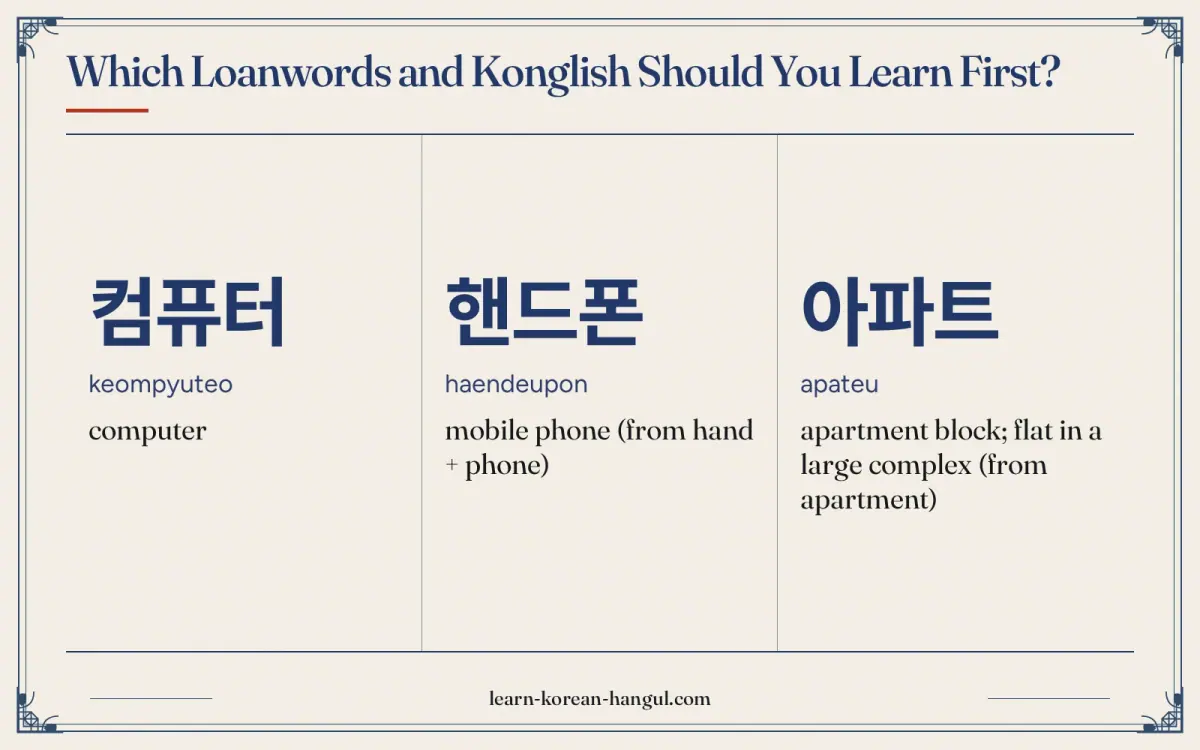
Start with the English loanwords, because you can guess them. Then learn the Konglish words, because they are everywhere and English speakers will not understand them. The false friends come last, because they make sense only when you already know the real English word.
- Day one. The ten English loanwords: 컴퓨터, 커피, 택시, 버스, 호텔, 인터넷, 카메라, 텔레비전, 아이스크림 and 샌드위치.
- Day two. The Konglish words: 핸드폰, 노트북, 에어컨, 리모컨, 파이팅 and the rest of that group.
- Day three. The sound-rule words: 스트라이크, 스트레스, 피자, 팬, 비타민 and the rest of that group.
- Day four. The Japanese-origin words and their replacements: 돈가스, 오뎅, 어묵, 다꽝, 단무지, 알바 and the rest.
- Day five. The false friends: 서비스, 샤프, 콘센트, 핸들, 아파트, 미팅 and the rest.
At 10 words a day, the list takes five days. The scene below puts eight of the words on one picture.
Word · 8
- 1
컴퓨터
keompyuteo
computer
- 2
핸드폰
haendeupon
mobile phone (from hand + phone)
- 3
아파트
apateu
apartment block; flat in a large complex (from apartment)
- 4
서비스
seobiseu
free extra; also service (from service)
- 5
샤프
syapeu
mechanical pencil (from Sharp, a brand)
- 6
콘센트
konsenteu
electrical outlet (from concentric plug)
- 7
에어컨
eeokeon
air conditioner (from air conditioner)
- 8
리모컨
rimokeon
remote control (from remote controller)
By origin label, the list has 23 English loanwords, 17 Konglish words, 7 Japanese-origin words and 3 replacement words (단무지 and 도시락 are native; 어묵 mixes a Sino-Korean and a native syllable). The origin column in each table marks them.
English Loanwords
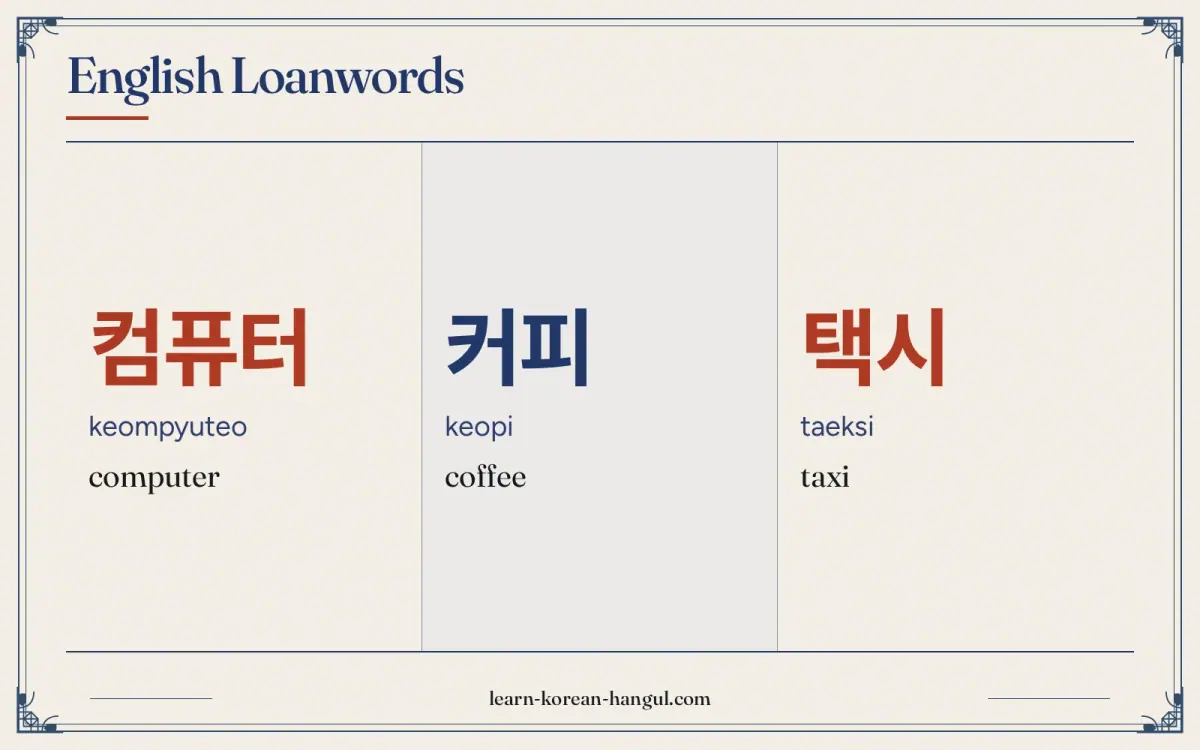
An English loanword is an English word that Korean has taken in and written in Hangul. The meaning is almost the same as in English, so these are the easiest words in the whole vocabulary. 컴퓨터, 커피 and 택시 are good examples. Spelling follows the sounds, not the English letters, so computer is 컴퓨터 and not a copy of the English spelling. The sound changes behind that are in How English Words Sound in Korean.
| No. | Hangul | Revised Romanization | Origin | Meaning | Example sentence | Audio assetId |
|---|---|---|---|---|---|---|
| 1 | 컴퓨터 | keompyuteo | English loanword | computer | 컴퓨터가 고장 났어요. (The computer is broken.) | au-pg-vocabulary-word-types-loanwords-1; example: au-pg-vocabulary-word-types-loanwords-51 |
| 2 | 커피 | keopi | English loanword | coffee | 커피 한 잔 주세요. (One cup of coffee, please.) | au-pg-vocabulary-word-types-loanwords-2; example: au-pg-vocabulary-word-types-loanwords-52 |
| 3 | 택시 | taeksi | English loanword | taxi | 택시를 탔어요. (I took a taxi.) | au-pg-vocabulary-word-types-loanwords-3; example: au-pg-vocabulary-word-types-loanwords-53 |
| 4 | 버스 | beoseu | English loanword | bus | 버스가 왔어요. (The bus has come.) | au-pg-vocabulary-word-types-loanwords-4; example: au-pg-vocabulary-word-types-loanwords-54 |
| 5 | 호텔 | hotel | English loanword | hotel | 호텔을 예약했어요. (I booked a hotel.) | au-pg-vocabulary-word-types-loanwords-5; example: au-pg-vocabulary-word-types-loanwords-55 |
| 6 | 인터넷 | inteonet | English loanword | internet | 인터넷이 느려요. (The internet is slow.) | au-pg-vocabulary-word-types-loanwords-6; example: au-pg-vocabulary-word-types-loanwords-56 |
| 7 | 카메라 | kamera | English loanword | camera | 카메라로 사진을 찍어요. (I take photos with a camera.) | au-pg-vocabulary-word-types-loanwords-7; example: au-pg-vocabulary-word-types-loanwords-57 |
| 8 | 텔레비전 | tellebijeon | English loanword | television | 텔레비전을 봐요. (I watch television.) | au-pg-vocabulary-word-types-loanwords-8; example: au-pg-vocabulary-word-types-loanwords-58 |
| 9 | 아이스크림 | aiseukeurim | English loanword | ice cream | 아이스크림을 먹어요. (I eat ice cream.) | au-pg-vocabulary-word-types-loanwords-9; example: au-pg-vocabulary-word-types-loanwords-59 |
| 10 | 샌드위치 | saendeuwichi | English loanword | sandwich | 샌드위치를 만들었어요. (I made a sandwich.) | au-pg-vocabulary-word-types-loanwords-10; example: au-pg-vocabulary-word-types-loanwords-60 |
Notice that Korean often adds a vowel. English "bus" ends with s, but Korean 버스 ends with 스, which has the vowel ㅡ. Each Korean syllable needs a vowel, so final consonants that Korean cannot say get one. This habit is the key to the whole topic.
Example Sentences
The examples use two simple patterns: noun + 을/를 + verb, as in 택시를 탔어요 (I took a taxi), and noun + 이/가 + verb or adjective, as in 인터넷이 느려요 (the internet is slow). Say each one aloud, then swap the noun for another word in the same table.
How Do You Say Konglish (Korean-made English) in Korean?
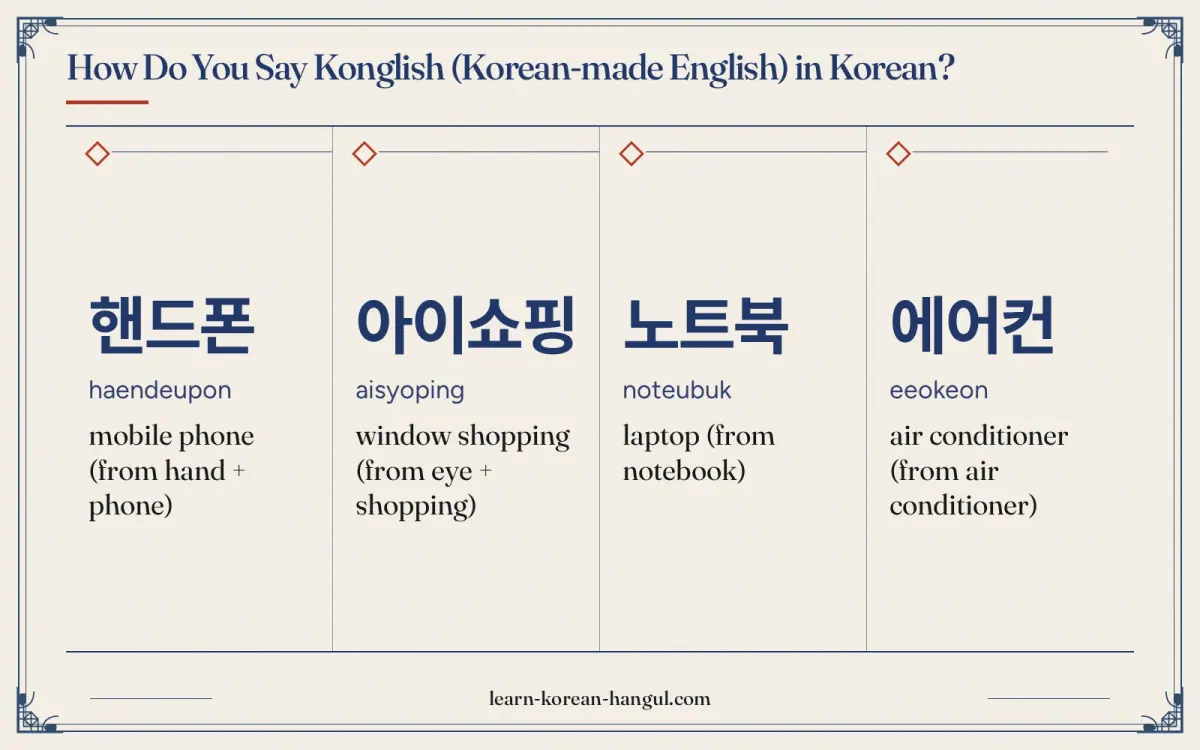
Konglish words are Korean inventions. The parts are English, but the word is not English. A 핸드폰 joins "hand" and "phone", and English speakers say "mobile phone" or "cell phone". A 노트북 is a laptop, not a paper notebook. An 아이쇼핑 is window shopping, from "eye" plus "shopping". Many Konglish words are shortened: 에어컨 is "air conditioner" and 리모컨 is "remote controller".
| No. | Hangul | Revised Romanization | Origin | Meaning | Example sentence | Audio assetId |
|---|---|---|---|---|---|---|
| 11 | 핸드폰 | haendeupon | Konglish | mobile phone (from hand + phone) | 핸드폰을 잃어버렸어요. (I lost my mobile phone.) | au-pg-vocabulary-word-types-loanwords-11; example: au-pg-vocabulary-word-types-loanwords-61 |
| 12 | 아이쇼핑 | aisyoping | Konglish | window shopping (from eye + shopping) | 주말에 아이쇼핑을 했어요. (I went window shopping at the weekend.) | au-pg-vocabulary-word-types-loanwords-12; example: au-pg-vocabulary-word-types-loanwords-62 |
| 13 | 노트북 | noteubuk | Konglish | laptop (from notebook) | 노트북을 가방에 넣었어요. (I put my laptop in my bag.) | au-pg-vocabulary-word-types-loanwords-13; example: au-pg-vocabulary-word-types-loanwords-63 |
| 14 | 에어컨 | eeokeon | Konglish | air conditioner (from air conditioner) | 에어컨을 켰어요. (I turned on the air conditioner.) | au-pg-vocabulary-word-types-loanwords-14; example: au-pg-vocabulary-word-types-loanwords-64 |
| 15 | 리모컨 | rimokeon | Konglish | remote control (from remote controller) | 리모컨이 어디 있어요? (Where is the remote control?) | au-pg-vocabulary-word-types-loanwords-15; example: au-pg-vocabulary-word-types-loanwords-65 |
| 16 | 파이팅 | paiting | Konglish | cheer: go for it; you can do it (from fighting) | 시험 파이팅! (Go for it on your exam!) | au-pg-vocabulary-word-types-loanwords-16; example: au-pg-vocabulary-word-types-loanwords-66 |
| 17 | 원룸 | wollum | Konglish | studio flat (from one room) | 원룸에서 혼자 살아요. (I live alone in a studio flat.) | au-pg-vocabulary-word-types-loanwords-17; example: au-pg-vocabulary-word-types-loanwords-67 |
| 18 | 오피스텔 | opiseutel | Konglish | officetel (office plus hotel; a small flat in a business building) | 그는 오피스텔에 살아요. (He lives in an officetel.) | au-pg-vocabulary-word-types-loanwords-18; example: au-pg-vocabulary-word-types-loanwords-68 |
| 19 | 스킨십 | seukinsip | Konglish | physical closeness; touch between people (from skin + -ship) | 아이에게는 스킨십이 중요해요. (Physical closeness is important for children.) | au-pg-vocabulary-word-types-loanwords-19; example: au-pg-vocabulary-word-types-loanwords-69 |
| 20 | 더치페이 | deochipei | Konglish | splitting the bill (from Dutch pay) | 오늘은 더치페이로 해요. (Let's split the bill today.) | au-pg-vocabulary-word-types-loanwords-20; example: au-pg-vocabulary-word-types-loanwords-70 |
One word in this group needs special care. 파이팅 comes from "fighting", but Koreans use it as a cheer that means "go for it" or "you can do it". It is not a call to fight. You will hear it at sports events, before exams and in K-pop. 화이팅 is a second spelling of the same word, and both appear on signs and in captions; 파이팅 is the standard spelling.
Japanese-Origin Words
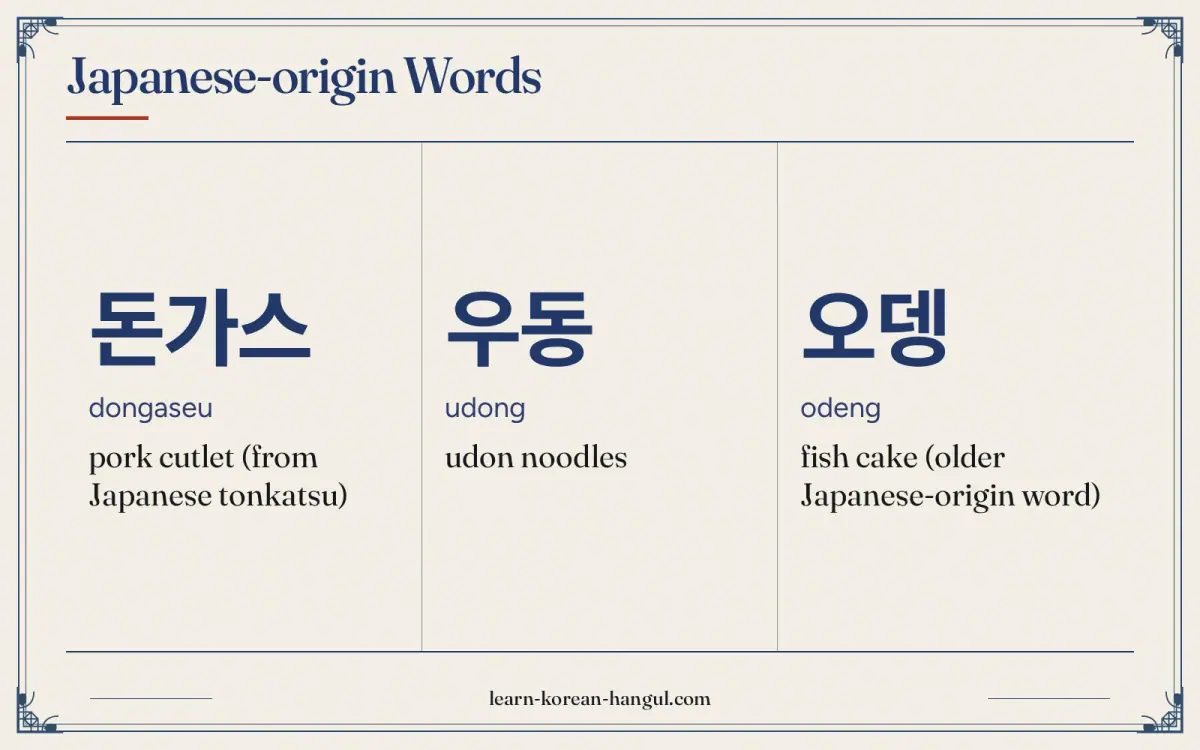
Some Korean words came from Japanese during the twentieth century. Many of them are food and everyday items. Because they are tied to history, the 국립국어원 has promoted replacements, and the replacements are now the standard. The table pairs each older word with its standard replacement.
| Older word | Standard replacement | Meaning |
|---|---|---|
| 오뎅 (odeng) | 어묵 (eomuk) | fish cake |
| 다꽝 (dakkwang) | 단무지 (danmuji) | pickled yellow radish |
| 벤또 (bento) | 도시락 (dosirak) | packed lunch; lunch box |
Not every Japanese-origin word has been replaced in practice. 돈가스 is the dictionary spelling of the word, and 우동 is used by almost everyone, even though 가락국수 was proposed in its place. Notice that 알바 and 아르바이트 are the same word: 아르바이트 comes from the German word Arbeit, through Japanese, and 알바 is its short form. People use 알바 in speech and 아르바이트 in writing.
| No. | Hangul | Revised Romanization | Origin | Meaning | Example sentence | Audio assetId |
|---|---|---|---|---|---|---|
| 21 | 돈가스 | dongaseu | Japanese-origin | pork cutlet (from Japanese tonkatsu) | 돈가스를 먹고 싶어요. (I want to eat a pork cutlet.) | au-pg-vocabulary-word-types-loanwords-21; example: au-pg-vocabulary-word-types-loanwords-71 |
| 22 | 우동 | udong | Japanese-origin | udon noodles | 우동 한 그릇 주세요. (One bowl of udon, please.) | au-pg-vocabulary-word-types-loanwords-22; example: au-pg-vocabulary-word-types-loanwords-72 |
| 23 | 오뎅 | odeng | Japanese-origin | fish cake (older Japanese-origin word) | 길에서 오뎅을 먹었어요. (I ate fish cake on the street.) | au-pg-vocabulary-word-types-loanwords-23; example: au-pg-vocabulary-word-types-loanwords-73 |
| 24 | 어묵 | eomuk | Sino-Korean + native | fish cake (the standard replacement for 오뎅) | 요즘은 어묵이라고 많이 불러요. (These days people often call it eomuk.) | au-pg-vocabulary-word-types-loanwords-24; example: au-pg-vocabulary-word-types-loanwords-74 |
| 25 | 다꽝 | dakkwang | Japanese-origin | pickled radish (older Japanese-origin word) | 다꽝은 옛날 말이에요. (다꽝 is an old word.) | au-pg-vocabulary-word-types-loanwords-25; example: au-pg-vocabulary-word-types-loanwords-75 |
| 26 | 단무지 | danmuji | native | pickled yellow radish (the standard replacement for 다꽝) | 김밥에 단무지가 들어가요. (Pickled radish goes into gimbap.) | au-pg-vocabulary-word-types-loanwords-26; example: au-pg-vocabulary-word-types-loanwords-76 |
| 27 | 아르바이트 | areubaiteu | Japanese-origin | part-time job (from German Arbeit, through Japanese) | 방학 때 아르바이트를 해요. (I work part-time during the vacation.) | au-pg-vocabulary-word-types-loanwords-27; example: au-pg-vocabulary-word-types-loanwords-77 |
| 28 | 알바 | alba | Japanese-origin | part-time job (short form of 아르바이트) | 저는 주말에 알바를 해요. (I work part-time at weekends.) | au-pg-vocabulary-word-types-loanwords-28; example: au-pg-vocabulary-word-types-loanwords-78 |
| 29 | 와이셔츠 | waisyeocheu | Japanese-origin | dress shirt (from white shirt, through Japanese) | 와이셔츠를 다렸어요. (I ironed my dress shirt.) | au-pg-vocabulary-word-types-loanwords-29; example: au-pg-vocabulary-word-types-loanwords-79 |
| 30 | 도시락 | dosirak | native | packed lunch; lunch box (the standard replacement for 벤또) | 점심에 도시락을 먹어요. (I eat a packed lunch at lunchtime.) | au-pg-vocabulary-word-types-loanwords-30; example: au-pg-vocabulary-word-types-loanwords-80 |
The origin of a few words in this group is debated, and the page gives only the commonly cited source. The 국립국어원 dictionary is the right place to check an origin. In everyday speech, you will hear both 오뎅 and 어묵. When you write for a Korean reader, 어묵 is the safer choice.
How Do You Say Loanword Sound Rules in Korean?
A loanword shows its rules in the way it is written. The ten words in this group are chosen because each one displays a rule. 스트라이크 shows how vowels are added to break up consonant groups. 피자 and 팬 show that English f and p both become ㅍ. 비타민 and 라이브 show that English v becomes ㅂ. 주스 shows j written as ㅈ, and 셔츠 shows sh written with ㅅ and a vowel.
| No. | Hangul | Revised Romanization | Origin | Meaning | Example sentence | Audio assetId |
|---|---|---|---|---|---|---|
| 31 | 스트라이크 | seuteuraikeu | English loanword | strike (baseball); a vowel is added to each consonant | 공이 스트라이크였어요. (The ball was a strike.) | au-pg-vocabulary-word-types-loanwords-31; example: au-pg-vocabulary-word-types-loanwords-81 |
| 32 | 스트레스 | seuteureseu | English loanword | stress (tension) | 스트레스를 받았어요. (I got stressed.) | au-pg-vocabulary-word-types-loanwords-32; example: au-pg-vocabulary-word-types-loanwords-82 |
| 33 | 피자 | pija | English loanword | pizza | 피자를 시켰어요. (I ordered pizza.) | au-pg-vocabulary-word-types-loanwords-33; example: au-pg-vocabulary-word-types-loanwords-83 |
| 34 | 팬 | paen | English loanword | fan (of a singer or team) | 저는 그 가수의 팬이에요. (I am a fan of that singer.) | au-pg-vocabulary-word-types-loanwords-34; example: au-pg-vocabulary-word-types-loanwords-84 |
| 35 | 비타민 | bitamin | English loanword | vitamin | 아침마다 비타민을 먹어요. (I take vitamins every morning.) | au-pg-vocabulary-word-types-loanwords-35; example: au-pg-vocabulary-word-types-loanwords-85 |
| 36 | 라이브 | raibeu | English loanword | live (performance) | 라이브 공연을 봤어요. (I watched a live show.) | au-pg-vocabulary-word-types-loanwords-36; example: au-pg-vocabulary-word-types-loanwords-86 |
| 37 | 주스 | juseu | English loanword | juice | 오렌지 주스 주세요. (Orange juice, please.) | au-pg-vocabulary-word-types-loanwords-37; example: au-pg-vocabulary-word-types-loanwords-87 |
| 38 | 셔츠 | syeocheu | English loanword | shirt | 흰 셔츠를 입었어요. (I wore a white shirt.) | au-pg-vocabulary-word-types-loanwords-38; example: au-pg-vocabulary-word-types-loanwords-88 |
| 39 | 클럽 | keulleop | English loanword | club (nightclub or social club) | 클럽에서 춤을 췄어요. (I danced at a club.) | au-pg-vocabulary-word-types-loanwords-39; example: au-pg-vocabulary-word-types-loanwords-89 |
| 40 | 텍스트 | tekseuteu | English loanword | text (written content) | 텍스트를 복사했어요. (I copied the text.) | au-pg-vocabulary-word-types-loanwords-40; example: au-pg-vocabulary-word-types-loanwords-90 |
The short table summarises the five rules behind these words. The lesson on how English words sound in Korean gives more examples of each.
| English sound | Korean letter | Word on this page |
|---|---|---|
| f | ㅍ | 팬 |
| v | ㅂ | 비타민, 라이브 |
| z or j | ㅈ | 주스 |
| sh | ㅅ plus a vowel (샤, 셔) | 셔츠 |
| final or clustered consonant | consonant plus ㅡ | 스트라이크, 스트레스 |
Words That Sound Like English but Are Not
A false friend is a word that looks English but means something else in Korean. These words cause the most confusion between Korean and English speakers. A 서비스 is a free extra at a restaurant, and the English "service" meaning also exists. A 샤프 is a mechanical pencil, after a brand called Sharp. A 콘센트 is a wall outlet, and a 핸들 is a steering wheel, from "handle". An 아파트 is a flat in a large block or a whole complex, and it is not an apartment in a small building.
| No. | Hangul | Revised Romanization | Origin | Meaning | Example sentence | Audio assetId |
|---|---|---|---|---|---|---|
| 41 | 서비스 | seobiseu | English loanword | free extra; also service (from service) | 서비스로 음료수를 줬어요. (They gave us a drink free.) | au-pg-vocabulary-word-types-loanwords-41; example: au-pg-vocabulary-word-types-loanwords-91 |
| 42 | 샤프 | syapeu | Konglish | mechanical pencil (from Sharp, a brand) | 샤프가 필요해요. (I need a mechanical pencil.) | au-pg-vocabulary-word-types-loanwords-42; example: au-pg-vocabulary-word-types-loanwords-92 |
| 43 | 콘센트 | konsenteu | Konglish | electrical outlet (from concentric plug) | 콘센트가 어디에 있어요? (Where is the outlet?) | au-pg-vocabulary-word-types-loanwords-43; example: au-pg-vocabulary-word-types-loanwords-93 |
| 44 | 핸들 | haendeul | English loanword | steering wheel (from handle) | 핸들을 돌렸어요. (I turned the steering wheel.) | au-pg-vocabulary-word-types-loanwords-44; example: au-pg-vocabulary-word-types-loanwords-94 |
| 45 | 아파트 | apateu | English loanword | apartment block; flat in a large complex (from apartment) | 아파트에 살아요. (I live in an apartment complex.) | au-pg-vocabulary-word-types-loanwords-45; example: au-pg-vocabulary-word-types-loanwords-95 |
| 46 | 비닐봉지 | binilbongji | Konglish | plastic bag (from vinyl + bag) | 비닐봉지가 필요해요. (I need a plastic bag.) | au-pg-vocabulary-word-types-loanwords-46; example: au-pg-vocabulary-word-types-loanwords-96 |
| 47 | 미팅 | miting | Konglish | group blind date (from meeting) | 대학교 때 미팅을 했어요. (I went on a group blind date in college.) | au-pg-vocabulary-word-types-loanwords-47; example: au-pg-vocabulary-word-types-loanwords-97 |
| 48 | 오토바이 | otobai | Konglish | motorbike (from auto + bike) | 오토바이를 타요. (I ride a motorbike.) | au-pg-vocabulary-word-types-loanwords-48; example: au-pg-vocabulary-word-types-loanwords-98 |
| 49 | 모닝콜 | moningkol | Konglish | wake-up call (from morning call) | 아침 일곱 시에 모닝콜을 부탁했어요. (I asked for a wake-up call at seven in the morning.) | au-pg-vocabulary-word-types-loanwords-49; example: au-pg-vocabulary-word-types-loanwords-99 |
| 50 | 백미러 | baengmireo | Konglish | rear-view mirror (from back mirror) | 백미러를 보세요. (Look in the rear-view mirror.) | au-pg-vocabulary-word-types-loanwords-50; example: au-pg-vocabulary-word-types-loanwords-100 |
Several words here are coined, not borrowed. A 미팅 is a group blind date between students, not a business meeting. A 모닝콜 is a wake-up call. A 백미러 is a rear-view mirror. If you want to say "meeting" in the business sense, the Korean word is 회의 (hoeui). If you speak to an English speaker, say "outlet", "mechanical pencil" or "steering wheel" and not the Korean word.
How Do You Pronounce These Words?
Loanwords follow their spelling, but a few sound changes appear. The table lists the ones that learners most often miss. Brackets show the spoken sound.
| Spelling | Pronunciation | What happens |
|---|---|---|
| 원룸 | [월룸] | The ㄴ before ㄹ becomes ㄹ, and Revised Romanization writes wollum |
| 텔레비전 | [텔레비전] | The two ㄹ letters make one long l sound, and Revised Romanization writes tellebijeon |
| 백미러 | [뱅미러] | The final ㄱ becomes ng before the nasal ㅁ, and Revised Romanization writes baengmireo |
| 클럽 | [클럽] | The final ㅂ is closed and not released, so there is no p burst |
| 컴퓨터 | [컴퓨터] | The ㅓ is relaxed and unrounded, not the rounded ㅗ |
| 돈가스 | [돈가스] | The spelling is 돈가스, and some speakers say [돈까스] |
| 스킨십 | [스킨십] | The final ㅂ is closed and not released, and ㅡ is spread, not rounded |
The rules come from the Standard Pronunciation rules (표준 발음법) of the 국립국어원. Revised Romanization is a learning aid. It writes the assimilation in wollum and baengmireo, but it does not show tensing such as [돈까스].
Audio and Slow Playback
Each word has a normal clip. Five words with tricky sounds also have a slow clip at 0.8 times the speed: 원룸, 백미러, 클럽, 스트라이크 and 파이팅. Nothing plays until you press a button. The audio is generated with text-to-speech and checked by a Korean teacher before publication.
Listen to 스트라이크 first. You should hear five clear syllables, seu-teu-ra-i-keu, with a light, unrounded ㅡ in the first, second and last syllable.
What Mistakes Do Learners Make with Loanwords and Konglish?
- Using Konglish with English speakers. Wrong: asking an English speaker for a 핸드폰 or a 콘센트 in English. Correct: say "mobile phone" or "cell phone" and "outlet", and keep the Korean words for Korean.
- Assuming 서비스 means a service charge. In a restaurant, 서비스 usually means something given free. Your host may say 서비스예요 as they put down a dish.
- Treating 미팅 as a business meeting. Wrong: 오늘 미팅이 있어요 for a work meeting, if you want to be clear. Correct: 회의가 있어요 for a work meeting. 미팅 is a group blind date.
- Reading 파이팅 as fighting. Wrong: taking it as an invitation to fight. Correct: it is a cheer, "you can do it".
- Using 오뎅 or 다꽝 in formal writing. The standard words are 어묵 and 단무지.
- Pronouncing the final consonant of 클럽 with a burst. Wrong: keul-lep with a puff of air. Correct: [클럽], with the lips closed and no puff.
- Dropping the extra vowel. Wrong: saying strike as one syllable. Correct: 스트라이크 has five syllables.
The first three change the meaning, and the rest change how natural you sound.
Practice: Flashcards and Worksheet
Drill these words with the vocabulary flashcard decks. A printable worksheet for these words (word list, matching, writing practice, fill-in-the-blank exercises and answer key) is available in A4 and US Letter from the download card on this page. Progress in the decks is saved only in your browser.
Loanwords and Konglish Vocabulary Worksheet
Try this five-question check, then say all 50 words aloud once more.
Practice · 5
What does 컴퓨터 mean?
Show answer
computer
컴퓨터 (keompyuteo) means computer.
What does 핸드폰 mean?
Show answer
mobile phone (from hand + phone)
핸드폰 (haendeupon) means mobile phone (from hand + phone).
What does 서비스 mean?
Show answer
free extra; also service (from service)
서비스 (seobiseu) means free extra; also service (from service).
What does 미팅 mean?
Show answer
group blind date (from meeting)
미팅 (miting) means group blind date (from meeting).
What does 어묵 mean?
Show answer
fish cake (the standard replacement for 오뎅)
어묵 (eomuk) means fish cake (the standard replacement for 오뎅).
Where to Go Next
This list sits inside Korean Word Types. After Konglish, many learners move on to the list of Sino-Korean words, which are the other large layer of borrowed vocabulary, or to Onomatopoeia and Mimetic Words.
Pages in This Section
Two deeper pages expand this list. Konglish Examples and False Friends goes further into words that look English but are not, and How English Words Sound in Korean explains the rules behind the spelling of English words in Hangul. Open the one that matches what you want to read next.
Frequently Asked Questions
How Do You Say Computer in Korean?
Computer is 컴퓨터 (keompyuteo). It is an English loanword written in Hangul, and it has four syllables. The ㅓ is a relaxed, unrounded vowel. To say your computer is broken, use 컴퓨터가 고장 났어요 (keompyuteoga gojang nasseoyo). Press the audio button to hear the word.
How Do You Pronounce 핸드폰 (haendeupon)?
핸드폰 is said [핸드폰], haen-deu-pon, in three beats. The first syllable has the ㅐ vowel, close to the e in bed. The ㅡ in the second syllable is unrounded, with the lips spread. The last syllable ends in the ㄴ sound. Use the word clip to match the rhythm. English speakers say mobile phone or cell phone instead.
How Many Loanwords and Konglish Should I Learn First?
Learn ten first: the English loanwords from the first table. They are the easiest, and that takes one day. Then add the Konglish words, the sound-rule words, the Japanese-origin words and the false friends. The whole list of 50 takes five days at 10 words a day, with review on the sixth day.
Where Can I Practise Loanwords and Konglish with Flashcards?
Use the vocabulary flashcard decks, which list every deck with audio. A deck for these words is planned. Progress stays in your browser. Until then, copy a table above onto cards: Hangul on one side, English on the other, and say each word aloud as you flip it.
Is the Romanization on This Page Official?
It follows the Revised Romanization of Korean, which South Korea officially adopted on 7 July 2000 and whose rules the National Institute of Korean Language (국립국어원) publishes. It is a learning aid that does not show tensing caused by a neighbouring sound, so learn the Hangul and use the audio to hear the real sound.
Is There a Printable Worksheet for Loanwords and Konglish?
A printable worksheet for these words (word list, matching, writing practice, fill-in-the-blank exercises and answer key) is available in A4 and US Letter from the download card on this page. For practice, write the Hangul from memory, cover the English column and check your answers against the tables above.