Key facts
- Konglish words are normal Korean. They only confuse English speakers, so use the English column when you speak English.
- 파이팅 is the loanword spelling and 화이팅 is the common spelling. Both mean 'you can do it'.
Konglish Examples at a Glance
Konglish, called 콩글리시 (konggeullisi) in Korean, means words that look like English but work differently in Korean. Some are shortened (에어컨 for 'air conditioner'), some change meaning (서비스 means a free extra), and some are invented from English parts (소개팅 for a blind date). Koreans use them every day, and they are not mistakes in Korean. They only become a problem when you carry them into English.
Standard loanwords, 외래어 (oeraeeo), are English words that Korean has borrowed with the same meaning, such as 커피 (coffee) and 택시 (taxi). The two groups overlap. 아파트 is a standard Korean word and it is also a clue to Konglish, because the Korean word means a tall residential block, not one flat. The rules for spelling borrowed words are published by the National Institute of Korean Language (국립국어원). For the sound rules behind the shapes, read How English words sound in Korean.
| Group | Words | What it covers |
|---|---|---|
| Shortened and reshaped English | 8 | 에어컨, 리모컨, 노트북, 헬스 |
| Words with a different meaning | 8 | 서비스, 핸드폰, 원피스, 아이쇼핑 |
| Made-in-Korea phrases and words | 8 | 파이팅, 화이팅, 모닝콜, 커닝 |
| Brand names that became nouns | 8 | 포스트잇, 호치키스, 샤프, 크리넥스 |
| Look-alikes with a local meaning | 8 | 미팅, 소개팅, 와이셔츠, 아르바이트 |
The page sits inside Konglish and Loanwords, part of Korean Word Types.
Which Konglish Words Should You Learn First?
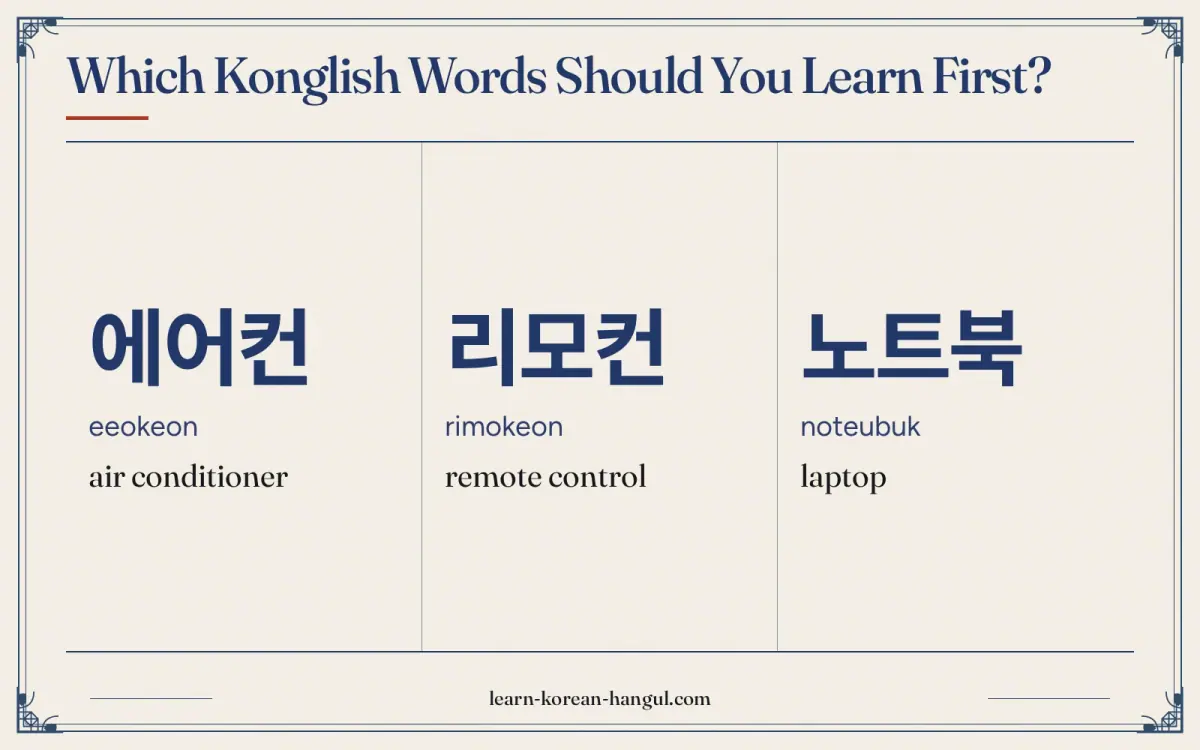
Learn the words you will hear on day one in Korea: 에어컨, 리모컨, 아파트, 핸드폰, 파이팅 and 서비스. Then learn the shop and office words, such as 콘센트, 호치키스 and 포스트잇. Leave the youth words, such as 맨투맨 and 소개팅, until you can follow casual talk.
- Say first. 파이팅, 서비스, 핸드폰, 에어컨, 리모컨, 아파트.
- Use often. 노트북, 콘센트, 셀카, 아르바이트, 와이셔츠.
- Recognise. 몰카, 에이에스, 모닝콜, 크리넥스, 포클레인.
The scene below is a living room with ten numbered objects from the first two groups. Tap a number to hear the word.
Word · 10
- 1
에어컨
eeokeon
air conditioner
- 2
리모컨
rimokeon
remote control
- 3
노트북
noteubuk
laptop
- 4
콘센트
konsenteu
power outlet
- 5
핸드폰
haendeupon
mobile phone
- 6
셀카
selka
selfie
- 7
믹서
mikseo
blender
- 8
오토바이
otobai
motorcycle
- 9
핸들
haendeul
steering wheel
- 10
스탠드
seutaendeu
desk lamp
Shortened and Reshaped English
The first group is the least confusing. These words come from real English words that were cut short or reshaped. 에어컨 and 리모컨 drop the second half of the English word. 노트북 and 믹서 keep the shape but name a different object from the English one. In each row, the column 'Say this in English' tells you what to say when you speak English.
| No. | Hangul | Revised Romanization | Meaning | English origin | Say this in English | Note | Example sentence | Audio assetId |
|---|---|---|---|---|---|---|---|---|
| 1 | 에어컨 | eeokeon | air conditioner | air conditioner, cut short | air conditioner; AC | A normal Korean word. The cut-short form is standard speech in Korea. | 에어컨을 켜요. (I turn on the air conditioner.) | au-pg-vocabulary-word-types-loanwords-konglish-1; example: au-pg-vocabulary-word-types-loanwords-konglish-41 |
| 2 | 리모컨 | rimokeon | remote control | remote control, cut short | remote | Shortened from two English words. Rarely said in full in Korea. | 리모컨이 어디에 있어요? (Where is the remote?) | au-pg-vocabulary-word-types-loanwords-konglish-2; example: au-pg-vocabulary-word-types-loanwords-konglish-42 |
| 3 | 아파트 | apateu | apartment block; condo | apartment | apartment building; condo | In Korea it means a tall residential block, not one flat. | 아파트에 살아요. (I live in an apartment block.) | au-pg-vocabulary-word-types-loanwords-konglish-3; example: au-pg-vocabulary-word-types-loanwords-konglish-43 |
| 4 | 헬스 | helseu | gym workout | health | gym; working out | Short for 헬스 클럽 (health club). Used with 하다: 헬스하다. | 저는 헬스를 해요. (I work out at the gym.) | au-pg-vocabulary-word-types-loanwords-konglish-4; example: au-pg-vocabulary-word-types-loanwords-konglish-44 |
| 5 | 노트북 | noteubuk | laptop | notebook (computer) | laptop | In English a notebook is paper, so say 'laptop'. | 노트북으로 공부해요. (I study on a laptop.) | au-pg-vocabulary-word-types-loanwords-konglish-5; example: au-pg-vocabulary-word-types-loanwords-konglish-45 |
| 6 | 콘센트 | konsenteu | power outlet | concentric (plug) | outlet; socket | From 'concentric plug'. Say 'outlet' in English. | 콘센트가 어디에 있어요? (Where is the outlet?) | au-pg-vocabulary-word-types-loanwords-konglish-6; example: au-pg-vocabulary-word-types-loanwords-konglish-46 |
| 7 | 믹서 | mikseo | blender | mixer | blender | Say [믹써] (tense ㅅ after ㄱ). | 믹서로 주스를 만들어요. (I make juice with a blender.) | au-pg-vocabulary-word-types-loanwords-konglish-7; example: au-pg-vocabulary-word-types-loanwords-konglish-47 |
| 8 | 오토바이 | otobai | motorcycle | auto + bi(cycle) | motorcycle | From 'auto-bicycle'. Everyone says 오토바이 for a motorbike. | 오토바이를 타요. (I ride a motorcycle.) | au-pg-vocabulary-word-types-loanwords-konglish-8; example: au-pg-vocabulary-word-types-loanwords-konglish-48 |
Example Sentences
The sentences use short frames: object + 을/를 + verb, or object + 이/가 + place. The particle is 을 after a consonant and 를 after a vowel (에어컨을, 오토바이를); 믹서로 uses 로, 'with'. Play the sentence, say it aloud, then swap in another object from the table.
Words with a Different Meaning
This group holds the real false friends. The English origin is easy to see, but the Korean meaning moved away from it. 서비스 sounds like 'service', yet in a restaurant it means a free extra. 원피스 sounds like 'one-piece', and in Korea it is a dress. If you say these in English, listeners will be puzzled.
| No. | Hangul | Revised Romanization | Meaning | English origin | Say this in English | Note | Example sentence | Audio assetId |
|---|---|---|---|---|---|---|---|---|
| 9 | 서비스 | seobiseu | free extra; on the house | service | a freebie; on the house | In a Korean restaurant 서비스 means a free gift from the house. | 음료수는 서비스예요. (The drink is on the house.) | au-pg-vocabulary-word-types-loanwords-konglish-9; example: au-pg-vocabulary-word-types-loanwords-konglish-49 |
| 10 | 핸드폰 | haendeupon | mobile phone | hand phone | cell phone; mobile | A very common word. Official forms often say 휴대폰. | 핸드폰이 없어요. (I do not have a phone.) | au-pg-vocabulary-word-types-loanwords-konglish-10; example: au-pg-vocabulary-word-types-loanwords-konglish-50 |
| 11 | 원피스 | wonpiseu | dress | one-piece | dress | 'One-piece' in English is a swimsuit or a jumpsuit. | 원피스를 입어요. (I wear a dress.) | au-pg-vocabulary-word-types-loanwords-konglish-11; example: au-pg-vocabulary-word-types-loanwords-konglish-51 |
| 12 | 아이쇼핑 | aisyoping | window-shopping | eye shopping | window shopping | A playful Korean-made word for looking without buying. | 아이쇼핑만 해요. (I only window-shop.) | au-pg-vocabulary-word-types-loanwords-konglish-12; example: au-pg-vocabulary-word-types-loanwords-konglish-52 |
| 13 | 스킨십 | seukinsip | physical affection | skinship | physical affection; touch | 'Skinship' is understood in Korea but not in English-speaking countries. | 엄마와 아기는 스킨십이 중요해요. (Skinship is important for a mother and baby.) | au-pg-vocabulary-word-types-loanwords-konglish-13; example: au-pg-vocabulary-word-types-loanwords-konglish-53 |
| 14 | 셀카 | selka | selfie | self + camera | selfie | A short form of 셀프 카메라. Say 'selfie' in English. | 셀카를 찍어요. (I take a selfie.) | au-pg-vocabulary-word-types-loanwords-konglish-14; example: au-pg-vocabulary-word-types-loanwords-konglish-54 |
| 15 | 파마 | pama | perm | permanent (wave) | perm | Short for a permanent wave. Used with 하다 for getting a perm. | 파마를 해요. (I get a perm.) | au-pg-vocabulary-word-types-loanwords-konglish-15; example: au-pg-vocabulary-word-types-loanwords-konglish-55 |
| 16 | 더치페이 | deochipei | splitting the bill | Dutch pay | go Dutch; split the bill | 'Dutch pay' is not English. The real phrase is 'go Dutch'. | 우리는 더치페이해요. (We split the bill.) | au-pg-vocabulary-word-types-loanwords-konglish-16; example: au-pg-vocabulary-word-types-loanwords-konglish-56 |
What Are the Made-in-Korea Phrases?
Some Konglish words were built in Korea and never existed in English. 파이팅, from 'fighting', is a cheer. 에이에스 is the two letters A and S, from 'after service'. 커닝 is from 'cunning', and in a classroom it means cheating on a test. English speakers do not say these, so they need a different phrase. For 파이팅, say 'Good luck!' or 'You've got this!'. In English, 'Fighting!' by itself may sound like a call to a physical fight.
파이팅 or 화이팅?
Both spellings are in use. The loanword spelling is 파이팅 (paiting), because the Korean rules for English words write the English 'f' as ㅍ. Many people write 화이팅 (hwaiting), and the pronunciation is close to it. Pick 파이팅 when you want the standard form and expect 화이팅 on signs, in messages and in songs.
| No. | Hangul | Revised Romanization | Meaning | English origin | Say this in English | Note | Example sentence | Audio assetId |
|---|---|---|---|---|---|---|---|---|
| 17 | 파이팅 | paiting | come on! you can do it! | fighting | Good luck! You've got this! | The loanword spelling is 파이팅. Used to cheer someone on. | 시험 파이팅! (Good luck on your exam!) | au-pg-vocabulary-word-types-loanwords-konglish-17; example: au-pg-vocabulary-word-types-loanwords-konglish-57 |
| 18 | 화이팅 | hwaiting | come on! you can do it! | fighting | Good luck! You've got this! | The everyday spelling of 파이팅. Same meaning, same use. | 화이팅! 힘내세요. (You can do it! Hang in there.) | au-pg-vocabulary-word-types-loanwords-konglish-18; example: au-pg-vocabulary-word-types-loanwords-konglish-58 |
| 19 | 모닝콜 | moningkol | wake-up call | morning call | wake-up call | The service a hotel offers. Say 'wake-up call'. | 호텔에서 모닝콜을 받아요. (I get a wake-up call at the hotel.) | au-pg-vocabulary-word-types-loanwords-konglish-19; example: au-pg-vocabulary-word-types-loanwords-konglish-59 |
| 20 | 몰카 | molka | hidden camera; secret filming | 몰래 (secretly) + camera | hidden camera; spy cam | Short for 몰래카메라. Today it often refers to illegal filming. | 몰카는 불법이에요. (Secret filming is illegal.) | au-pg-vocabulary-word-types-loanwords-konglish-20; example: au-pg-vocabulary-word-types-loanwords-konglish-60 |
| 21 | 커닝 | keoning | cheating on a test | cunning | cheating (on an exam) | 'Cunning' means clever, not cheating, in English. | 시험에서 커닝하면 안 돼요. (You must not cheat on an exam.) | au-pg-vocabulary-word-types-loanwords-konglish-21; example: au-pg-vocabulary-word-types-loanwords-konglish-61 |
| 22 | 에이에스 | eieseu | repair service; warranty service | A/S, after service | repair service; warranty service | Said as the two letters A and S. The service desk is an 에이에스 센터. | 에이에스 센터에 전화해요. (I call the service center.) | au-pg-vocabulary-word-types-loanwords-konglish-22; example: au-pg-vocabulary-word-types-loanwords-konglish-62 |
| 23 | 콘도 | kondo | resort condo | condominium | resort condo; vacation rental | A holiday apartment at a resort. Not an apartment in the city. | 방학에 콘도에서 쉬어요. (On vacation I rest at a resort condo.) | au-pg-vocabulary-word-types-loanwords-konglish-23; example: au-pg-vocabulary-word-types-loanwords-konglish-63 |
| 24 | 핫팩 | hatpaek | heat pack; hand warmer | hot pack | heat pack; hand warmer | A disposable pack for cold days. | 겨울에 핫팩을 써요. (In winter I use a hand warmer.) | au-pg-vocabulary-word-types-loanwords-konglish-24; example: au-pg-vocabulary-word-types-loanwords-konglish-64 |
Brand Names That Became Nouns
A brand can become a word for the whole product. English has 'Band-Aid' and 'Kleenex'. Korean has its own set: 포스트잇 for a sticky note, 호치키스 for a stapler and 크리넥스 for a tissue. These are plain nouns in speech. The brands behind them are old and mostly not Korean, which is why a learner does not guess the meaning from the sound alone.
| No. | Hangul | Revised Romanization | Meaning | English origin | Say this in English | Note | Example sentence | Audio assetId |
|---|---|---|---|---|---|---|---|---|
| 25 | 포스트잇 | poseuteuit | sticky note | Post-it (brand) | sticky note | A brand name used as a plain noun. | 포스트잇에 메모해요. (I write a note on a sticky note.) | au-pg-vocabulary-word-types-loanwords-konglish-25; example: au-pg-vocabulary-word-types-loanwords-konglish-65 |
| 26 | 호치키스 | hochikiseu | stapler | Hotchkiss (brand) | stapler | From a maker's name. The staples are 호치키스 심. | 호치키스로 종이를 찍어요. (I staple the papers.) | au-pg-vocabulary-word-types-loanwords-konglish-26; example: au-pg-vocabulary-word-types-loanwords-konglish-66 |
| 27 | 샤프 | syapeu | mechanical pencil | Sharp (brand) | mechanical pencil | From a pencil brand. A pen is 볼펜. | 샤프로 써요. (I write with a mechanical pencil.) | au-pg-vocabulary-word-types-loanwords-konglish-27; example: au-pg-vocabulary-word-types-loanwords-konglish-67 |
| 28 | 대일밴드 | daeilbaendeu | adhesive bandage | Daeil band (brand) | Band-Aid; adhesive bandage | From a Korean brand name, like 'Band-Aid' in English. | 손가락에 대일밴드를 붙여요. (I put a bandage on my finger.) | au-pg-vocabulary-word-types-loanwords-konglish-28; example: au-pg-vocabulary-word-types-loanwords-konglish-68 |
| 29 | 크리넥스 | keurinekseu | tissue | Kleenex (brand) | tissue | Many speakers use this brand name for any tissue. | 크리넥스 한 장 주세요. (Please give me a tissue.) | au-pg-vocabulary-word-types-loanwords-konglish-29; example: au-pg-vocabulary-word-types-loanwords-konglish-69 |
| 30 | 바바리 | babari | trench coat | Burberry (brand) | trench coat | The trench coat is called this after the brand. | 가을에 바바리를 입어요. (I wear a trench coat in autumn.) | au-pg-vocabulary-word-types-loanwords-konglish-30; example: au-pg-vocabulary-word-types-loanwords-konglish-70 |
| 31 | 포클레인 | pokeullein | excavator | Poclain (brand) | excavator; backhoe | A French maker's name became the word for any digger. | 포클레인이 땅을 파요. (The excavator digs the ground.) | au-pg-vocabulary-word-types-loanwords-konglish-31; example: au-pg-vocabulary-word-types-loanwords-konglish-71 |
| 32 | 스카치테이프 | seukachiteipeu | clear tape | Scotch tape (brand) | clear tape | A brand name used for any clear tape. | 스카치테이프가 필요해요. (I need clear tape.) | au-pg-vocabulary-word-types-loanwords-konglish-32; example: au-pg-vocabulary-word-types-loanwords-konglish-72 |
Look-Alikes with a Local Meaning
The last group is full of words you will hear in youth talk and in offices. 미팅 means a group blind date, not a work meeting, and 아르바이트 is a part-time job, not any job. Some words, such as 와이셔츠 and 맨투맨, name clothing with a shape that does not match the English words. The table lists what to say in English for each one.
| No. | Hangul | Revised Romanization | Meaning | English origin | Say this in English | Note | Example sentence | Audio assetId |
|---|---|---|---|---|---|---|---|---|
| 33 | 미팅 | miting | group blind date | meeting | group blind date; (a meeting is 회의) | University students use it for a date arranged in groups. | 대학교 때 미팅을 했어요. (I went on a group blind date in college.) | au-pg-vocabulary-word-types-loanwords-konglish-33; example: au-pg-vocabulary-word-types-loanwords-konglish-73 |
| 34 | 소개팅 | sogaeting | blind date | 소개 (introduction) + -ting | blind date | A date set up by a friend. Made from Korean and English parts. | 주말에 소개팅이 있어요. (I have a blind date this weekend.) | au-pg-vocabulary-word-types-loanwords-konglish-34; example: au-pg-vocabulary-word-types-loanwords-konglish-74 |
| 35 | 와이셔츠 | waisyeocheu | dress shirt | white shirt | dress shirt | From 'white shirt', and not only white ones. | 아버지는 와이셔츠를 입어요. (My father wears a dress shirt.) | au-pg-vocabulary-word-types-loanwords-konglish-35; example: au-pg-vocabulary-word-types-loanwords-konglish-75 |
| 36 | 맨투맨 | maentumaen | crewneck sweatshirt | man-to-man | sweatshirt | A sweatshirt with a round neck. | 맨투맨을 사요. (I buy a sweatshirt.) | au-pg-vocabulary-word-types-loanwords-konglish-36; example: au-pg-vocabulary-word-types-loanwords-konglish-76 |
| 37 | 아르바이트 | areubaiteu | part-time job | Arbeit (German) | part-time job | From German 'Arbeit'. Often shortened to 알바 (alba). | 주말에 아르바이트를 해요. (I work a part-time job on weekends.) | au-pg-vocabulary-word-types-loanwords-konglish-37; example: au-pg-vocabulary-word-types-loanwords-konglish-77 |
| 38 | 스탠드 | seutaendeu | desk lamp | stand (lamp) | desk lamp | A table lamp, not a stand. | 책상에 스탠드가 있어요. (There is a desk lamp on the desk.) | au-pg-vocabulary-word-types-loanwords-konglish-38; example: au-pg-vocabulary-word-types-loanwords-konglish-78 |
| 39 | 원샷 | wonsyat | bottoms up | one shot | bottoms up; down it in one go | Said when you finish a drink in one go. | 친구들과 원샷해요. (I down it in one go with my friends.) | au-pg-vocabulary-word-types-loanwords-konglish-39; example: au-pg-vocabulary-word-types-loanwords-konglish-79 |
| 40 | 핸들 | haendeul | steering wheel | handle | steering wheel | In English a 'handle' is a different part. | 핸들을 돌려요. (I turn the steering wheel.) | au-pg-vocabulary-word-types-loanwords-konglish-40; example: au-pg-vocabulary-word-types-loanwords-konglish-80 |
What Should You Say in English Instead?
Konglish is normal in Korean and unusual in English. Before you speak English, check the word. The list below gives the five most common slips.
| If you want to say | Do not say | Say instead |
|---|---|---|
| a mobile phone | hand phone | phone; cell phone; mobile |
| a free extra | service | it's on the house; a freebie |
| a dress | one-piece | dress |
| window shopping | eye shopping | window shopping |
| good luck, you can do it | fighting | good luck; you've got this |
How Do You Pronounce These Words?
English words are reshaped by the Korean sound system. Korean has no f or v, so 'f' is written ㅍ and 'v' is written ㅂ. A vowel is added to split clusters: 'blender' becomes 블렌더 and 'soft' becomes 소프트, with ㅡ added after a consonant. The Standard Pronunciation Rules (표준 발음법) of the National Institute of Korean Language (국립국어원) apply to these words, and the romanization follows the Revised Romanization of Korean.
- Tensing. A plain consonant after a final ㄱ is tense (Article 23), so 믹서 is said [믹써]. Romanization does not show tensing caused by a neighbouring sound.
- Final ㅅ. At the end of a syllable ㅅ sounds like ㄷ: 핫팩 is said [핟팩].
- Added vowels. A vowel ㅡ is added after a lone consonant, which makes an extra syllable: 'sharp' becomes 샤프 (sya-peu), with two syllables.
- Stress. Korean does not stress syllables the way English does. Give each syllable about the same length.
Audio and Slow Playback
Each word and sentence has its own clip. The clips below replay five longer words slowly. Play one, repeat it, then play it again and compare.
What Mistakes Do Learners Make with Konglish?
Five mistakes come up often.
- Using Konglish in English. Telling an English speaker 'I lost my hand phone' makes them stop and think. Say 'phone'.
- Expecting the English meaning. 서비스 is a free gift, 미팅 is a group date and 커닝 is cheating. The English word is not the Korean meaning.
- Mixing up 파이팅 and 화이팅. They are two spellings of the same cheer. Do not treat them as different words.
- Thinking Konglish is wrong in Korean. These words are the right Korean words. Using a 'proper' English word in a Korean sentence may sound odd.
- Guessing a brand noun from its sound. 호치키스 and 포클레인 come from brand names, so you must learn them as words.
The key idea is that Konglish is a Korean word that borrowed English sounds, not a broken form of English.
Practice: Flashcards and Worksheet
Run the deck in recognition mode until each word gives its meaning, then switch to listening mode and take the quiz. The deck holds all 40 words with audio, and your progress stays in your browser. The vocabulary flashcard decks page lists the other decks, and the Konglish words flashcards deck is a separate 28-card set that shares some of these words.
Practice · 85
- 01에어컨
Show answer
headword 1: air conditioner
- 02리모컨
Show answer
headword 2: remote control
- 03아파트
Show answer
headword 3: apartment block; condo
- 04헬스
Show answer
headword 4: gym workout
- 05노트북
Show answer
headword 5: laptop
- 06콘센트
Show answer
headword 6: power outlet
- 07믹서
Show answer
headword 7: blender
- 08오토바이
Show answer
headword 8: motorcycle
- 09서비스
Show answer
headword 9: free extra; on the house
- 10핸드폰
Show answer
headword 10: mobile phone
- 11원피스
Show answer
headword 11: dress
- 12아이쇼핑
Show answer
headword 12: window-shopping
- 13스킨십
Show answer
headword 13: physical affection
- 14셀카
Show answer
headword 14: selfie
- 15파마
Show answer
headword 15: perm
- 16더치페이
Show answer
headword 16: splitting the bill
- 17파이팅
Show answer
headword 17: come on! you can do it!
- 18화이팅
Show answer
headword 18: come on! you can do it!
- 19모닝콜
Show answer
headword 19: wake-up call
- 20몰카
Show answer
headword 20: hidden camera; secret filming
- 21커닝
Show answer
headword 21: cheating on a test
- 22에이에스
Show answer
headword 22: repair service; warranty service
- 23콘도
Show answer
headword 23: resort condo
- 24핫팩
Show answer
headword 24: heat pack; hand warmer
- 25포스트잇
Show answer
headword 25: sticky note
- 26호치키스
Show answer
headword 26: stapler
- 27샤프
Show answer
headword 27: mechanical pencil
- 28대일밴드
Show answer
headword 28: adhesive bandage
- 29크리넥스
Show answer
headword 29: tissue
- 30바바리
Show answer
headword 30: trench coat
- 31포클레인
Show answer
headword 31: excavator
- 32스카치테이프
Show answer
headword 32: clear tape
- 33미팅
Show answer
headword 33: group blind date
- 34소개팅
Show answer
headword 34: blind date
- 35와이셔츠
Show answer
headword 35: dress shirt
- 36맨투맨
Show answer
headword 36: crewneck sweatshirt
- 37아르바이트
Show answer
headword 37: part-time job
- 38스탠드
Show answer
headword 38: desk lamp
- 39원샷
Show answer
headword 39: bottoms up
- 40핸들
Show answer
headword 40: steering wheel
- 41에어컨을 켜요.
Show answer
example sentence for 에어컨
- 42리모컨이 어디에 있어요?
Show answer
example sentence for 리모컨
- 43아파트에 살아요.
Show answer
example sentence for 아파트
- 44저는 헬스를 해요.
Show answer
example sentence for 헬스
- 45노트북으로 공부해요.
Show answer
example sentence for 노트북
- 46콘센트가 어디에 있어요?
Show answer
example sentence for 콘센트
- 47믹서로 주스를 만들어요.
Show answer
example sentence for 믹서
- 48오토바이를 타요.
Show answer
example sentence for 오토바이
- 49음료수는 서비스예요.
Show answer
example sentence for 서비스
- 50핸드폰이 없어요.
Show answer
example sentence for 핸드폰
- 51원피스를 입어요.
Show answer
example sentence for 원피스
- 52아이쇼핑만 해요.
Show answer
example sentence for 아이쇼핑
- 53엄마와 아기는 스킨십이 중요해요.
Show answer
example sentence for 스킨십
- 54셀카를 찍어요.
Show answer
example sentence for 셀카
- 55파마를 해요.
Show answer
example sentence for 파마
- 56우리는 더치페이해요.
Show answer
example sentence for 더치페이
- 57시험 파이팅!
Show answer
example sentence for 파이팅
- 58화이팅! 힘내세요.
Show answer
example sentence for 화이팅
- 59호텔에서 모닝콜을 받아요.
Show answer
example sentence for 모닝콜
- 60몰카는 불법이에요.
Show answer
example sentence for 몰카
- 61시험에서 커닝하면 안 돼요.
Show answer
example sentence for 커닝
- 62에이에스 센터에 전화해요.
Show answer
example sentence for 에이에스
- 63방학에 콘도에서 쉬어요.
Show answer
example sentence for 콘도
- 64겨울에 핫팩을 써요.
Show answer
example sentence for 핫팩
- 65포스트잇에 메모해요.
Show answer
example sentence for 포스트잇
- 66호치키스로 종이를 찍어요.
Show answer
example sentence for 호치키스
- 67샤프로 써요.
Show answer
example sentence for 샤프
- 68손가락에 대일밴드를 붙여요.
Show answer
example sentence for 대일밴드
- 69크리넥스 한 장 주세요.
Show answer
example sentence for 크리넥스
- 70가을에 바바리를 입어요.
Show answer
example sentence for 바바리
- 71포클레인이 땅을 파요.
Show answer
example sentence for 포클레인
- 72스카치테이프가 필요해요.
Show answer
example sentence for 스카치테이프
- 73대학교 때 미팅을 했어요.
Show answer
example sentence for 미팅
- 74주말에 소개팅이 있어요.
Show answer
example sentence for 소개팅
- 75아버지는 와이셔츠를 입어요.
Show answer
example sentence for 와이셔츠
- 76맨투맨을 사요.
Show answer
example sentence for 맨투맨
- 77주말에 아르바이트를 해요.
Show answer
example sentence for 아르바이트
- 78책상에 스탠드가 있어요.
Show answer
example sentence for 스탠드
- 79친구들과 원샷해요.
Show answer
example sentence for 원샷
- 80핸들을 돌려요.
Show answer
example sentence for 핸들
- 81아르바이트
Show answer
slow playback: 아르바이트
- 82크리넥스
Show answer
slow playback: 크리넥스
- 83스카치테이프
Show answer
slow playback: 스카치테이프
- 84포클레인
Show answer
slow playback: 포클레인
- 85에이에스
Show answer
slow playback: 에이에스
Practice · 5
What does 서비스 (seobiseu) mean in a Korean restaurant?
Show answer
a free extra
서비스 means a free extra from the house. Example: 음료수는 서비스예요. (The drink is on the house.)
What is 원피스 (wonpiseu) in Korean?
Show answer
a dress
원피스 is a dress. In English, 'one-piece' is a swimsuit or jumpsuit.
What does 커닝 (keoning) mean?
Show answer
cheating on a test
커닝 means cheating on an exam. It comes from 'cunning', which means clever in English.
Which spelling is the standard loanword spelling of the cheer?
Show answer
파이팅
파이팅 is the loanword spelling. 화이팅 is the everyday spelling, and both are used.
What do you say in English for 핸드폰?
Show answer
phone
Say 'phone', 'cell phone' or 'mobile'. 'Hand phone' is not used in English.
Konglish Examples Worksheet (PDF)
A printable worksheet for these words (word list, matching, writing practice, fill-in-the-blank exercises and answer key) is available in A4 and US Letter from the download card on this page. For practice, list five Konglish words you use and write the English phrase next to each.
Where to Go Next
Read How English words sound in Korean for the sound rules behind these shapes, then practise reading with Reading English loanwords in Hangul. Return to Konglish and Loanwords for the wider list. Continue to Sino-Korean words for the other large layer of Korean vocabulary.
Frequently Asked Questions
What Is Konglish?
Konglish, called 콩글리시 (konggeullisi), means Korean words made from English parts that do not match English. Examples are 서비스 (a free extra), 원피스 (a dress) and 핸드폰 (a mobile phone). They are normal Korean, and they only confuse people when used in English.
What Does 파이팅 Mean in Korean?
파이팅 (paiting) is a cheer that means 'You can do it!' or 'Good luck!'. It comes from the English word 'fighting'. The loanword spelling is 파이팅, and many people write 화이팅 (hwaiting). Both are used to encourage someone.
What Does 서비스 Mean in Korean?
In a shop or restaurant, 서비스 (seobiseu) means a free extra or a gift from the house, such as a free drink. It does not usually mean customer service, which is 고객 서비스 or 서비스 센터.
Is Konglish the Same as a Loanword?
No. A loanword, 외래어, is an English word that Korean borrowed with the same meaning, such as 커피 (coffee). Konglish words have changed meaning or were made in Korea, such as 아이쇼핑 (window shopping). The two groups overlap, so some words fit both.
Should I Use Konglish When I Speak English?
No. English speakers will not understand most of it. Use the English column in the tables and say 'phone', 'dress' or 'good luck' instead. In Korean, use the Konglish word, because it is the right Korean word.
Is the Romanization on This Page Official?
It follows the Revised Romanization of Korean, which South Korea adopted on 7 July 2000 and whose rules the National Institute of Korean Language (국립국어원) publishes. It is a learning aid and does not mark every sound change, so rely on the Hangul and the audio.