
What you will be able to do (about 45 minutes, spread over three sittings)
- Write each of the 10 basic vowels in the standard stroke order.
- Tell vertical vowels from horizontal vowels, and place each correctly in a block.
- Write ten common words that use these vowels, and give the sound of each.
- Check your own work against a stroke-order answer key.
Download the Korean Vowels Writing Practice

The download gives you both paper sizes, with the same pages in each. Choose the file that matches your printer. The sheet needs no account and no email address.
Korean Vowels Writing Practice Sheet
Download PDF (A4) PDF (US Letter)
Preview
Write Each Vowel Five Times inside a Silent ㅇ Block
The next section describes each page, so you can check that the sheet matches your level before you print it.
What Is on Each Page?
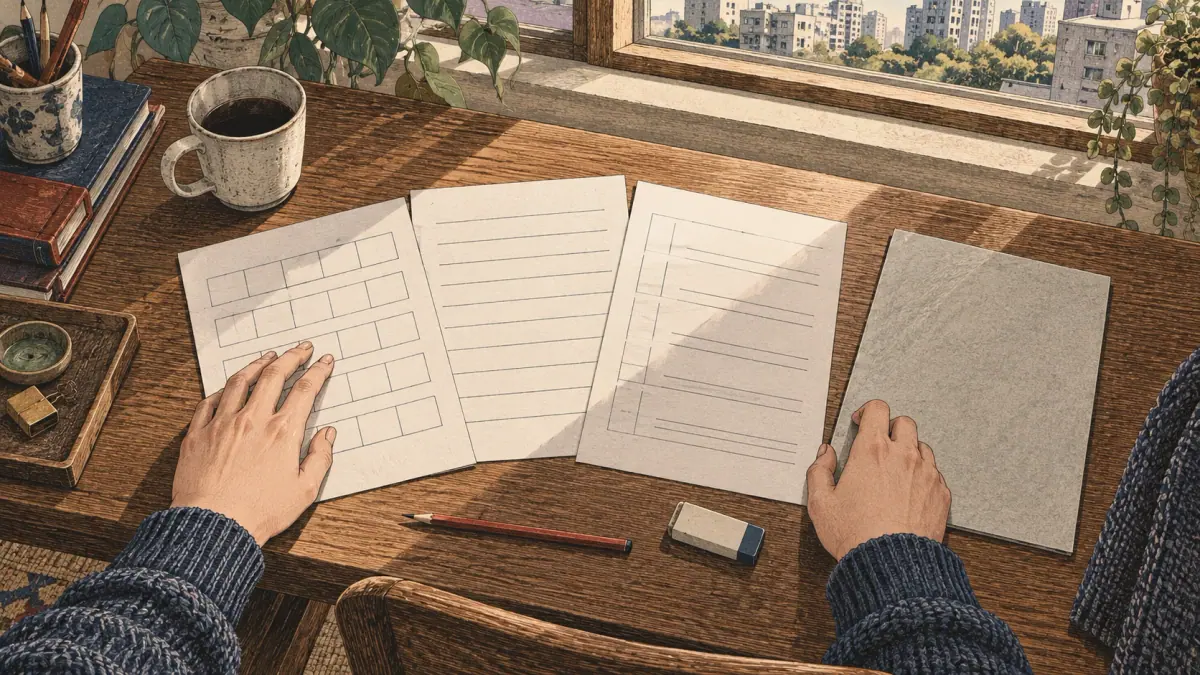
The sheet has three practice pages and an answer key. Page 1 builds the habit of writing a vowel inside a block, page 2 teaches the direction of every stroke, and page 3 puts the vowels into real words.
Page 1: write each vowel five times. The ten rows hold 아 야 어 여 오 요 우 유 으 이. Each row begins with a dotted model and then gives you five empty squares. Every vowel is written with a silent ㅇ in front, because in Hangul a vowel never stands alone inside a block. ㅇ marks the empty consonant slot: it has no sound at the start of a syllable.
Page 2: stroke direction. The page has two bands. The first band holds the vertical vowels ㅏ ㅑ ㅓ ㅕ ㅣ, which have a long line that runs top to bottom. The second holds the horizontal vowels ㅗ ㅛ ㅜ ㅠ ㅡ, which have a long line that runs left to right. Each model has numbered arrows, with the long stroke printed darker than the short ticks.
Page 3: trace ten words. Each row has a word to trace, three empty boxes to copy it into, and a line for the sound. These are the ten words:
| Word | Sound (Revised Romanization) | Meaning |
|---|---|---|
| 아이 | ai | child |
| 오이 | oi | cucumber |
| 우유 | uyu | milk |
| 이유 | iyu | reason |
| 여유 | yeoyu | spare time or room to spare |
| 야구 | yagu | baseball |
| 요리 | yori | cooking |
| 유리 | yuri | glass |
| 어머니 | eomeoni | mother |
| 아버지 | abeoji | father |
Page 4: the answer key. It shows a stroke-order diagram for each vowel, the stroke count, and the sound of each word on page 3.
The table below lists the strokes of every vowel in the order the sheet teaches them.
| Vowel | Syllable (romanization) | Group | Strokes | Order of strokes |
|---|---|---|---|---|
| ㅏ | 아 (a) | vertical | 2 | long vertical, then a short tick to the right |
| ㅑ | 야 (ya) | vertical | 3 | long vertical, then two short ticks to the right, top first |
| ㅓ | 어 (eo) | vertical | 2 | short tick on the left, then the long vertical |
| ㅕ | 여 (yeo) | vertical | 3 | two short ticks on the left, top first, then the long vertical |
| ㅗ | 오 (o) | horizontal | 2 | short vertical on top, then the long horizontal |
| ㅛ | 요 (yo) | horizontal | 3 | two short verticals on top, left first, then the long horizontal |
| ㅜ | 우 (u) | horizontal | 2 | long horizontal, then the short vertical below |
| ㅠ | 유 (yu) | horizontal | 3 | long horizontal, then two short verticals below, left first |
| ㅡ | 으 (eu) | horizontal | 1 | one horizontal line, left to right |
| ㅣ | 이 (i) | vertical | 1 | one vertical line, top to bottom |
With the contents clear, the next section explains how to work through the pages.
How Do I Use This Sheet?

Write the circle first and then the vowel stroke, and say the vowel aloud every time your pencil finishes a block. Saying the sound while writing links the shape to the sound, which is the point of the sheet. Work through it in this order:
- Read the row's syllable aloud, for example "아, a".
- Trace the model with a finger to feel the stroke direction.
- Write the ㅇ first, as a round circle, and then add the vowel stroke beside it or under it.
- Fill the five squares, keeping the circle and the vowel the same size each time.
- On page 3, trace the word, copy it, and write the sound on the line before checking.
You will know a row went well when the vowel line touches the circle in the same way in all five squares. Do one page per day, and keep the pencil light so that you can erase.
For the sounds behind each vowel, read the lesson on basic korean vowels. It explains, for example, how ㅓ and ㅗ differ in sound: ㅓ is said with open, unrounded lips and ㅗ with rounded lips.
What Is the Answer Key For?
The answer key is for checking after you finish, not while you write. Compare the position of the vowel stroke, not only its shape. A correct ㅓ has its short tick on the left of the long line, and a correct ㅗ has its short stroke on top. The key is a separate final sheet, so you can keep it face down until you have completed a page.
Print Settings
The vowel sheet prints cleanly in black and white. The recommended settings are:
- Paper: A4 (210 by 297 mm) or US Letter (8.5 by 11 inches), using the matching file.
- Scale: 100 percent, with "fit to page" turned off, so the 22 mm squares keep their size.
- Margins: 12 mm on every side, enough for a hole punch.
- Colour: black and white is enough. Models are mid-gray and dotted outlines are light gray.
A soft pencil gives the best result for tracing, because a hard pencil leaves a thin line that is hard to see against the dots.
Mistakes to Watch For
Most mistakes on this sheet come from where the short strokes go. Check these four points:
- Moving ㅓ to the left of ㅇ. The short tick of ㅓ sits on the left of the long line, and the whole vowel sits to the right of the consonant slot. Learners sometimes move the entire vowel to the left of ㅇ. The circle always comes first, and the vowel comes after it.
- Making the y-strokes too long. In ㅑ ㅕ ㅛ ㅠ the two short strokes are the same short length. If one tick grows long, ㅑ starts to look like a ㅏ with an extra bar.
- Skipping the ㅇ. A vowel written alone in a block, with no circle, is not a normal syllable. On this sheet the circle is part of every answer.
- Mixing ㅗ and ㅜ. Check where the short stroke is. On top is ㅗ, and below is ㅜ.
What Should I Practice Next?

After this sheet, practise the same ten vowels on screen. The basic korean vowels flashcards use the same ten items, and the hangul vowels quiz tests whether you can tell them apart by ear. When the ten basic vowels feel steady, continue with the korean compound vowels worksheet.
This sheet covers only the ten basic vowels. It does not cover the compound vowels such as ㅐ or ㅘ, consonants, or final consonants. Those live in other sheets in the hangul worksheets collection. Used in three sittings, the korean vowels writing practice sheet teaches you the shape, the position and the sound of every basic vowel.
Frequently Asked Questions
Why add ㅇ?
In Hangul every syllable block starts with a consonant slot. When a syllable begins with a vowel sound, the slot is filled with a silent ㅇ. So the vowel ㅏ is written as 아 inside a block. Writing the circle on every row also shows you where the vowel sits.
What is the order of strokes?
Strokes run top to bottom, then left to right. For vertical vowels the long vertical comes first in ㅏ, and the short tick comes first in ㅓ because it is on the left. For horizontal vowels the top stroke comes first. The answer key shows every vowel with numbered arrows.
Do I need to print in colour?
No. The sheet is designed for black-and-white printing. The model letters are mid-gray and the dotted outlines are light gray, so they stay visible on a draft setting. Use a pencil for the first pass, and ink only after you can write each vowel in the right order.
Is there an audio link?
The PDF itself has no sound, because paper cannot play audio. This page has audio buttons for the vowel syllables and for the ten words, so you can listen before you write. The flashcards deck linked from this page also plays the same vowels, which helps when you practise away from the printer.
Is the worksheet free to print?
Free for personal and classroom use. Teachers may print copies for their students. No reselling or republishing online.
May I use these worksheets in class?
Free for personal and classroom use. Teachers may print copies for their students. No reselling or republishing online.
Free for personal and classroom use. Teachers may print copies for their students. No reselling or republishing online.