
| Korean | Name | Romanization | Family | Sound |
|---|---|---|---|---|
| ㅏ | 아 | a | basic | a in "father" |
| ㅑ | 야 | ya | basic | ya in "yacht" |
| ㅓ | 어 | eo | basic | between u in "cup" and aw in "law" |
| ㅕ | 여 | yeo | basic | y + ㅓ |
| ㅗ | 오 | o | basic | o in "go", shorter and pure |
| ㅛ | 요 | yo | basic | yo in "yoga" |
| ㅜ | 우 | u | basic | oo in "moon" |
| ㅠ | 유 | yu | basic | "you" |
| ㅡ | 으 | eu | basic | oo in "moon" with lips spread |
| ㅣ | 이 | i | basic | ee in "see" |
| ㅐ | 애 | ae | compound | e in "bed" |
| ㅒ | 얘 | yae | compound | ye in "yes" |
| ㅔ | 에 | e | compound | e in "bed" |
| ㅖ | 예 | ye | compound | ye in "yes" |
| ㅘ | 와 | wa | compound | "wah" |
| ㅙ | 왜 | wae | compound | we in "wet" |
| ㅚ | 외 | oe | compound | we in "wet" |
| ㅝ | 워 | wo | compound | "wuh" |
| ㅞ | 웨 | we | compound | we in "wet" |
| ㅟ | 위 | wi | compound | "wee" |
| ㅢ | 의 | ui | compound | ㅡ gliding into ㅣ |
What Are the Basic Korean Vowels?
The basic Korean vowels are the ten vowel letters that the Hangul Orthography lists as the core set; every other vowel is a combination of them. The ten are ㅏ, ㅑ, ㅓ, ㅕ, ㅗ, ㅛ, ㅜ, ㅠ, ㅡ and ㅣ. They belong to the larger set of Korean vowels, which has 21 letters.
Each basic vowel is a vertical or horizontal line with one or two short ticks. Written alone, a vowel takes the silent consonant ㅇ, as in 아, 어, 오, 우, 으 and 이. In dictionary order the ten are ㅏ ㅑ ㅓ ㅕ ㅗ ㅛ ㅜ ㅠ ㅡ ㅣ. The teaching order on this site is different: ㅏ, ㅓ, ㅗ, ㅜ, ㅡ, ㅣ, because it puts the most useful contrasts side by side.
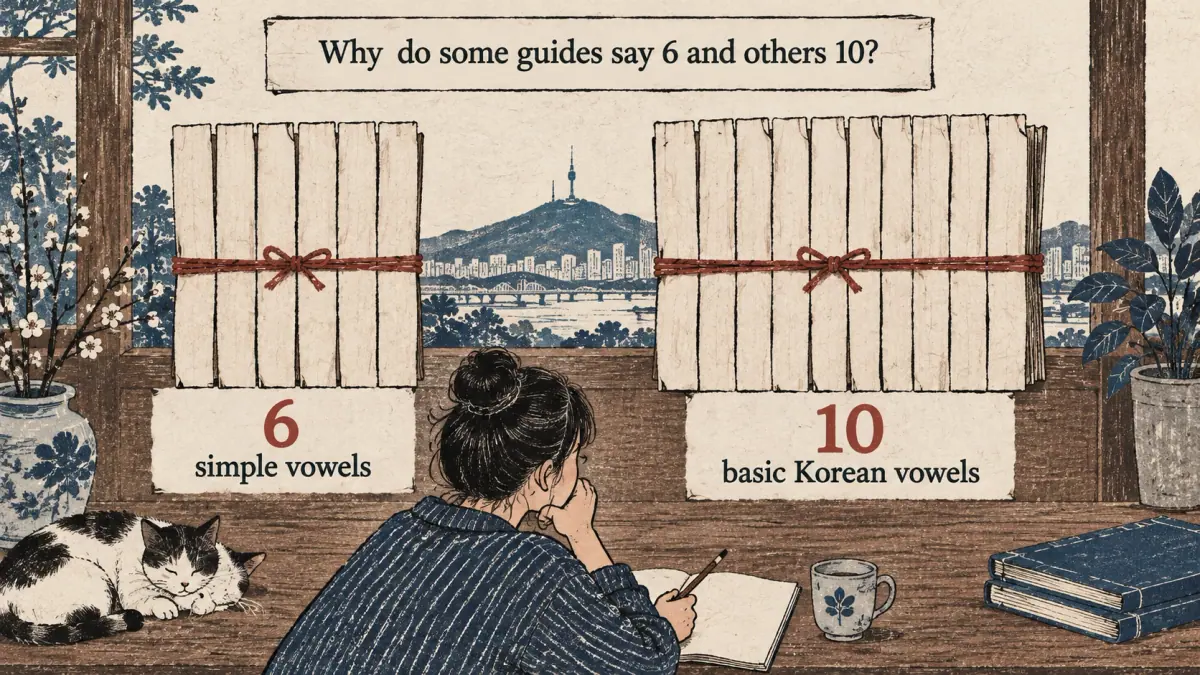
Why Do Some Guides Say 6 and Others 10?
Some guides say 6 because they count only the simple vowels, and others say 10 because they include the four y-vowels ㅑ ㅕ ㅛ ㅠ. Both counts are correct. The y-vowels are a simple vowel plus an extra tick that adds a "y" glide: ㅏ [a] becomes ㅑ [ya].
This course teaches the six simple vowels first because the y-vowels are a pattern, not new shapes. The four y-vowels follow on the Korean y-vowels page.
The Six Basic Vowel Lessons

Take the six lessons in the order below. Each lesson takes about twenty minutes and ends with practice and an answer key. These lessons are also day 1 of Learn Hangul in a week.
ㅏ (a): the Open Vowel
ㅏ is an open "ah" like the "a" in "father", made with a wide jaw and relaxed lips. It combines with every consonant in the 가나다 row and is the easiest vowel to hear. Begin with the vowel ㅏ, the open "ah".
ㅓ (eo): the One Most Often Confused with ㅗ
ㅓ is a relaxed "uh", like the "u" in "cup" but with a slightly wider mouth. Revised Romanization writes it "eo", which confuses English readers because there is no separate "e" and "o". The pair 거기 "there" and 고기 "meat" shows its contrast with ㅗ. The vowel ㅓ is the one most often confused with ㅗ, and the vowel ㅓ trains your ear.
ㅗ (o): the First Horizontal Vowel
ㅗ is a pure, rounded "o" with no glide, written under its consonant, as in 고. It is the first of the horizontal vowels and the base of ㅘ, ㅙ and ㅚ. The vowel ㅗ is the first horizontal vowel you will write.
ㅜ (u): the Rounded Oo
ㅜ is a rounded "oo" as in "food", with the lips pushed forward, written under its consonant. It differs from ㅡ only in lip shape: 굴 "oyster" against 글 "writing". The vowel ㅜ is the rounded "oo", and it is the base of ㅝ, ㅞ and ㅟ.
ㅡ (eu): the Vowel with No English Twin
ㅡ is a "oo" made with spread lips and a nearly closed jaw, a sound English does not use. Revised Romanization writes it "eu". Say ㅜ, then flatten the lips into a smile without changing the tongue, and you are close. The vowel ㅡ has no English twin and needs the most listening.
ㅣ (i): the Building Block
ㅣ is a clear, short "ee" written with one vertical stroke, and it appears inside many other vowels. The syllable 시 sounds like "shi", although the official spelling is "si". The vowel ㅣ builds many other vowels.
Which Basic Vowels Go beside or below a Consonant?
Vertical vowels (ㅏ ㅓ ㅣ) go to the right of the consonant, and horizontal vowels (ㅗ ㅜ ㅡ) go under it. The direction of the longest stroke decides.
| Group | Vowels | Consonant position | Example block |
|---|---|---|---|
| Vertical | ㅏ ㅓ ㅣ | left | 가, 거, 기 |
| Horizontal | ㅗ ㅜ ㅡ | top | 고, 구, 그 |
This one rule predicts the layout of all ten basic vowels. The y-vowels follow their simple versions: ㅑ and ㅕ are vertical, ㅛ and ㅠ are horizontal.
Which Pairs of Basic Vowels Are Easy to Confuse?
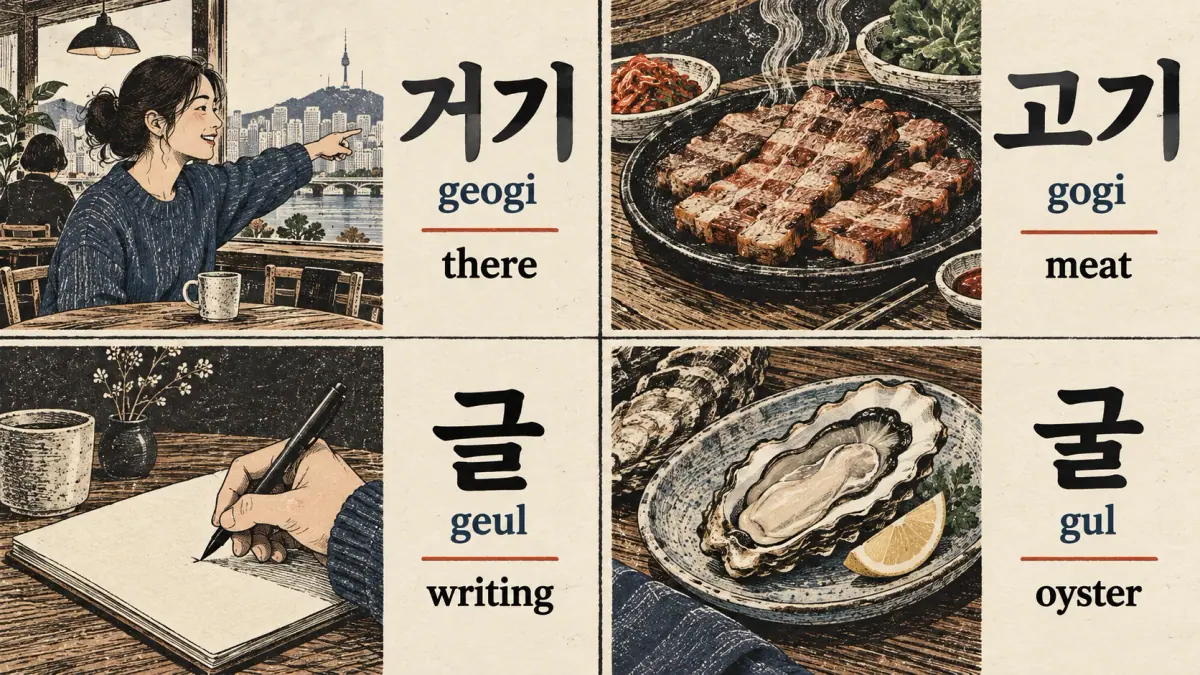
Three pairs of basic vowels are easy to confuse: ㅏ and ㅓ, ㅓ and ㅗ, and ㅡ and ㅜ. Each pair differs in one physical feature, so you can learn the difference by feel.
| Pair | Feature that differs | Word pair |
|---|---|---|
| ㅏ / ㅓ | jaw opening | 사다 "to buy" / 서다 "to stand" |
| ㅓ / ㅗ | lip rounding | 거기 "there" / 고기 "meat" |
| ㅡ / ㅜ | lip rounding | 글 "writing" / 굴 "oyster" |
ㅓ: Lips Relaxed. ㅗ: Lips Rounded.
| Korean | Romanization | Meaning | Sound |
|---|---|---|---|
| 거기 | geogi | there | |
| 고기 | gogi | meat |
ㅡ: Lips Spread. ㅜ: Lips Rounded.
| Korean | Romanization | Meaning | Sound |
|---|---|---|---|
| 글 | geul | writing | |
| 굴 | gul | oyster |
The ㅓ and ㅗ trap catches most English speakers, because both have a half-open jaw and English uses lip rounding differently. Say 거기 and 고기 in a mirror and watch your lips.
What Words Can You Read with Vowels Only?

You can read your first Korean words using only the silent ㅇ and the basic vowels. Each block is ㅇ plus a vowel, so the word is just a string of vowel sounds.
| Word | Revised Romanization | Meaning |
|---|---|---|
| 아이 | ai | child |
| 오이 | oi | cucumber |
| 우유 | uyu | milk |
| 여우 | yeou | fox |
Two of these (우유 and 여우) already use y-vowels, which shows how quickly the set grows. The one-syllable words 이 "two" and 오 "five" are also complete number words in the Sino-Korean system.
Basic Vowels Compared in One Table
This table lines up all six simple vowels with the features you need for reading and listening. Keep the Korean vowels chart nearby while you study.
| Letter | Name | Revised Romanization | Long stroke | Consonant position | Harmony class | First word |
|---|---|---|---|---|---|---|
| ㅏ | 아 | a | vertical | left | bright | 아이 "child" |
| ㅓ | 어 | eo | vertical | left | dark | 어머니 "mother" |
| ㅗ | 오 | o | horizontal | top | bright | 오이 "cucumber" |
| ㅜ | 우 | u | horizontal | top | dark | 우유 "milk" |
| ㅡ | 으 | eu | horizontal | top | dark | 음악 "music" |
| ㅣ | 이 | i | vertical | left | neutral | 이름 "name" |
Harmony class (모음조화, moeumjohwa) is the bright, dark or neutral label that later decides verb endings such as 아요 and 어요. This page only previews the idea.
Review with the Hangul flashcard decks, or practise this step with the hangul syllable builder, which gives instant feedback on the six simple vowels.
Frequently Asked Questions

Which basic vowel is hardest for English speakers? Most English speakers find ㅡ and ㅓ hardest, because English has no exact match. ㅡ is a nearly closed vowel with spread lips, and ㅓ is a relaxed "uh" with a slightly wider mouth. Listening to the pairs ㅡ and ㅜ, and ㅓ and ㅗ, with a mirror in front of you, usually helps most.
Should I learn vowels or consonants first? Either order works, but most courses start with a few vowels, because every syllable needs one. Learn ㅏ first, then add consonants so you can read real syllables, such as 가 and 나. This site's lessons start with ㅏ, then ㅓ, ㅗ, ㅜ, ㅡ and ㅣ, and the consonant lessons reuse them.
Do basic vowels have names? Yes. Each basic vowel is named by its sound plus the silent ㅇ: 아, 야, 어, 여, 오, 요, 우, 유, 으 and 이. Hangul Orthography, the National Institute of Korean Language rules, lists these names. Learners say them when reading a chart aloud or spelling a word out loud.
How long does it take to learn the basic vowels? Recognising the six shapes takes one short session. Hearing ㅓ against ㅗ and ㅡ against ㅜ reliably usually takes several days of brief daily listening. This is a typical pattern, not a guarantee, and it varies with your first language and how often you practise.
Is ㅡ ever silent? No. ㅡ is a full vowel and is pronounced. The silent letter is ㅇ at the start of a block. Learners sometimes think ㅡ is silent because it appears as a light helper vowel in loanwords, such as 스키 (seuki, "ski"), where it is short and weak but still present.