What you will learn
- Write speech in double quotes and thoughts in single quotes.
- Attach 라고 to a closing quote with the right spacing and period.
- Mark a book, a poem and a film title with the right brackets.
- Turn a quoted sentence into reported speech without quote marks.
Before you start: read the lesson on Korean punctuation marks first. Time: about 25 minutes.
What Are Korean Quotation Marks?
Korean quotation marks are called 따옴표 (ttaompyo). There are two kinds: 큰따옴표 (keunttaompyo, "big quotation mark"), written “ ”, and 작은따옴표 (jageunttaompyo, "small quotation mark"), written ‘ ’. The official name for the whole group of marks that are not letters is 문장 부호 (munjang buho, "sentence marks"). The rules were revised in 2014 and have applied since 2015.
Korean divides the work between the marks clearly:
| Mark | Korean name (RR) | What it holds | Example |
|---|---|---|---|
| “ ” | 큰따옴표 (keunttaompyo) | spoken words, a direct quotation | “안녕하세요.” |
| ‘ ’ | 작은따옴표 (jageunttaompyo) | thoughts, a quotation inside a quotation, emphasis | ‘좋아’ |
| 『 』 | 겹낫표 (gyeomnatpyo) | titles of books and newspapers | 『어린 왕자』 |
| 「 」 | 홑낫표 (honnatpyo) | titles of poems, articles and short works | 「봄」 |
| 《 》 | 겹화살괄호 (gyeophwasalgwalho) | titles of books and newspapers | 《한겨레》 |
| 〈 〉 | 홑화살괄호 (hothwasalgwalho) | titles of films, songs and artworks | 〈기생충〉 |
| ( ) | 소괄호 (sogwalho) | extra information | 한글(Hangul) |
| [ ] | 대괄호 (daegwalho) | a bracket inside a bracket, a differing sound | 나이[年歲] |
The brackets are more than decoration: they tell the reader what kind of work a title is. The table shows the traditional pairs, and the sections below explain each pair.
First, here is why quoting causes trouble for learners.
Why Do English Speakers Struggle with Korean Quotation Marks?
Learners struggle because Korean builds a quotation into the grammar of the sentence, while English leaves the quotation almost free. Three differences matter.
- Particles after the closing mark. In English the quote simply ends. In Korean the particle 라고 (or the verb 하다) follows the closing mark and joins the quote to the verb of speaking.
- Reported speech is a different sentence shape. English changes pronouns and tense (She said she would go). Korean changes the verb ending and drops the marks: 가겠다고 말했어요.
- Titles have their own brackets. English uses italics or quotes for titles. Korean text has a set of traditional brackets, and a typed text often uses simpler marks instead.
The next section starts with the two quotation marks, speech and thoughts.
Which Marks Show Speech and Thoughts?
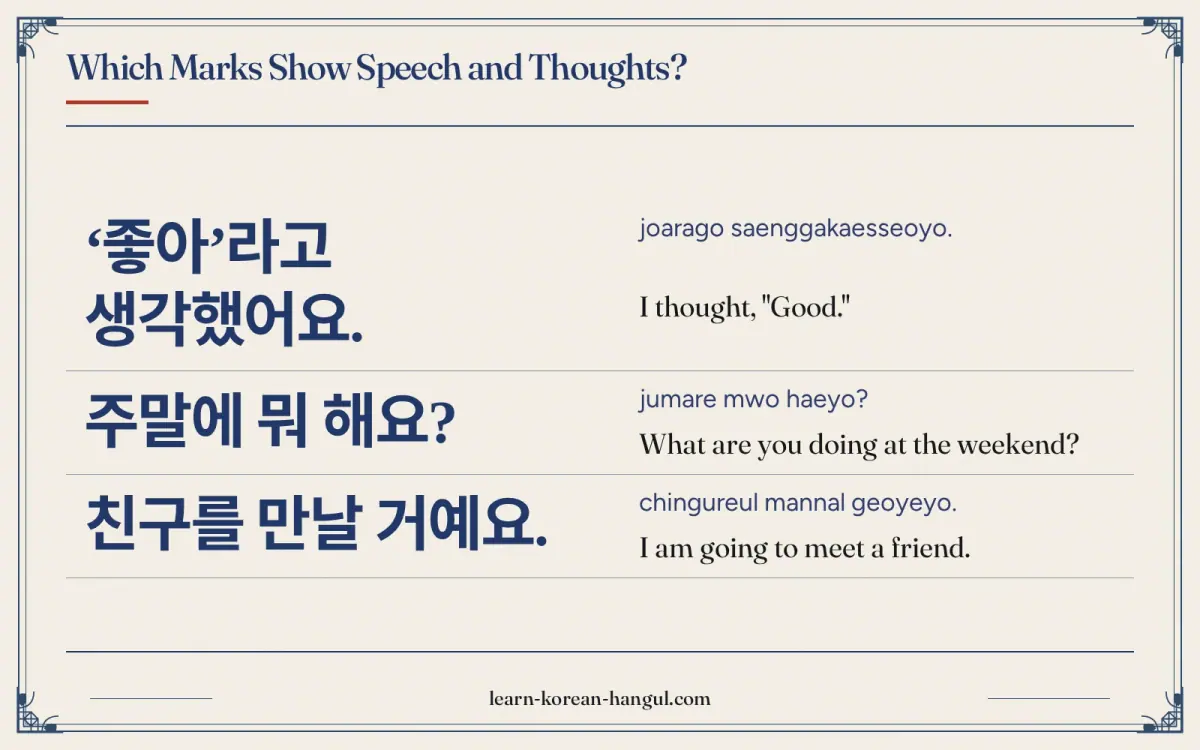
Double quotes show speech, and single quotes show thoughts. A speaker's words go in “ ”, and what a person thinks to themselves goes in ‘ ’. Both marks open before the first word and close after the last word or the sentence mark, with no space inside.
“안녕하세요.”라고 말했어요.
annyeonghaseyorago malhaesseoyo.
(He) said, "Hello."
‘좋아’라고 생각했어요.
joarago saenggakaesseoyo.
I thought, "Good."
Revised Romanization (RR, the official Latin spelling) shows the ㅎ sound in verbs: 생각했어요 is saenggakaesseoyo, and it is said [생가캐써요].
Single quotes have two more jobs. They hold a quotation inside a double quotation, and they mark a word to stress or to call "so-called". A learner can think of the single mark as the "quiet" mark: it is for words that nobody says out loud, or for a term that the writer holds at a distance.
Here is a short exchange written the way a story would print it. The speaker tags are in plain text, and the words are in the marks.
지민이 물었어요. “주말에 뭐 해요?” 수아가 대답했어요. “친구를 만날 거예요.” ‘어디서 만날까?’ 수아는 생각했어요.
주말에 뭐 해요?
jumare mwo haeyo?
What are you doing at the weekend?
친구를 만날 거예요.
chingureul mannal geoyeyo.
I am going to meet a friend.
The first question has a question word, 뭐 ("what"), so its stress falls on 뭐 and the sentence does not end with a sharp rise. The pronunciation of 만날 거예요 is [만날꺼예요], with a tense ㄲ after the ending -ㄹ. The spelling keeps ㄱ in 거, even though it is said tense.
On a computer, many people type the straight marks " and ', which look different from “ ” and ‘ ’. Straight marks are understood, but curved marks are the careful form for essays, exam answers and print.
Next, we look at how the quotation joins the verb.
How Does 라고 Attach to a Quotation?
The particle 라고 attaches to the closing quotation mark with no space, and it tells the reader that the words are quoted exactly as spoken. The verb of speaking comes after it, after a space.
| Part | Form | Note |
|---|---|---|
| The quotation | “안녕하세요.” | the period stays inside the mark |
| The particle | 라고 | no space before it |
| The verb | 말했어요 | after a space |
| All together | “안녕하세요.”라고 말했어요. | the sentence ends with its own period |
The particle stays 라고 whatever sound the quote ends with, so there is no choice to make.
There is one more form. The verb 하다 can join a quotation too, and then it is a separate word with a space before it: “안녕하세요.” 하고 말했어요. Use 라고 when you are unsure, because it is the one that attaches.
Reported speech is the opposite case. It keeps the meaning but drops the marks, and it changes the ending of the quoted verb to -다고, -냐고, -자고 or -라고, depending on the sentence type. A direct quote “가겠어요.”라고 말했어요 becomes the reported 가겠다고 말했어요.
가겠다고 말했어요.
gagetdago malhaesseoyo.
(He) said that he would go.
The endings of reported speech are a grammar topic of their own. For this lesson, one rule is enough: no marks around reported speech.
How Are Titles Marked?
Titles are marked with brackets whose shape depends on the kind of work. The rule of thumb under the 2014 rules is two sizes: double marks for large works and single marks for small ones.
| Kind of work | Traditional mark | Example | Meaning |
|---|---|---|---|
| Book | 『 』 or 《 》 | 『어린 왕자』 | The Little Prince |
| Newspaper | 『 』 or 《 》 | 《한겨레》 | Hankyoreh (a newspaper) |
| Poem or article | 「 」 or 〈 〉 | 「봄」 | "Spring" (a poem title) |
| Film, song or artwork | 〈 〉 or 「 」 | 〈기생충〉 | Parasite (a film) |
The corner brackets 「 」 and 『 』 come from vertical writing. The angle brackets 《 》 and 〈 〉 are the same idea in a form that fits horizontal text. Publishers differ in which they choose, and many put an album in 《 》 and its songs in 〈 〉. Be consistent inside one text.
In everyday typing, single quotes ‘ ’ are common for titles, especially in news headlines, because the brackets are harder to enter. Plain writing with no marks is also seen on signs and in chat. The 2014 rules also allow quotation marks in place of the brackets: double quotes for the 『 』 and 《 》 group, and single quotes for the 「 」 and 〈 〉 group, so ‘기생충’ is acceptable.
『어린 왕자』를 읽었어요.
eorin wangjareul ilgeosseoyo.
I read The Little Prince.
영화 〈기생충〉을 봤어요.
yeonghwa gisaengchungeul bwasseoyo.
I watched the film Parasite.
「봄」이라는 시를 좋아해요.
bomiraneun sireul joahaeyo.
I like a poem called "Spring".
A title takes the particle straight after the closing bracket, as 『어린 왕자』를 shows. For reading practice with real titles, see Korean short stories for beginners. The brackets also help you tell a title from an ordinary phrase.
Now we turn to the round and square brackets, which have a different job.
What Do Brackets Do in Korean?
Round brackets hold extra information, and square brackets hold a second level. These brackets are close to the English ones, but their uses are more regular.
| Bracket | Name | Use | Example |
|---|---|---|---|
| ( ) | 소괄호 (sogwalho) | an explanation, a foreign word, a year range | 한글(Hangul), 김정희(1786~1856) |
| [ ] | 대괄호 (daegwalho) | a bracket inside a bracket; a form whose sound differs | 나이[年歲] |
| { } | 중괄호 (junggwalho) | a group of choices (rare) | {이/가} |
Round brackets are the common one. After a Korean word they give the English or Hanja form, as in 한글(Hangul). They do not take a space before them. A year range inside round brackets uses the tilde: 김정희(1786~1856).
Square brackets in this site's lessons carry a second meaning: they show how a word is said, as in 학생 [학쌩]. This is the dictionary habit. In a regular Korean text, a square bracket mostly holds a sound-difference form or a note inside another bracket. Do not mistake the pronunciation bracket for the punctuation mark.
The next section covers where the sentence marks sit when a quotation ends.
Where Do Periods and Question Marks Go?
The period, question mark or exclamation mark of the quoted sentence goes inside the closing quotation mark. The mark of the whole sentence then follows the verb at the very end. A quoted sentence therefore carries its own mark, and the larger sentence carries another.
| Sentence | Marks | Note |
|---|---|---|
| “안녕하세요.”라고 말했어요. | period inside, period at the end | the quote and the whole sentence each have a period |
| “뭐 해요?”라고 물었어요. | question mark inside, period at the end | the quote asks; the whole sentence reports it |
| “조심하세요!”라고 말했어요. | exclamation mark inside | the feeling belongs to the quote |
| ‘좋아’라고 생각했어요. | no mark inside | short thoughts often omit it |
A short quotation or a single word often drops the inside mark, as in ‘좋아’라고. A full sentence keeps it. If your quotation is a title, there is no sentence mark at all inside the brackets.
Never put a space between the closing mark and 라고: “안녕하세요.” 라고 is wrong. The verb of speaking, after 라고, is a separate word.
Worked Example: “안녕하세요.”
You will write the sentence "Minsu said, 'Hello.'" in Korean, using all the rules above.
- Write the words that are spoken. 안녕하세요.
- Add the double marks and keep the period inside. “안녕하세요.”
- Attach 라고 with no space. “안녕하세요.”라고
- Add the speaker and the verb. 민수가 “안녕하세요.”라고 말했어요.
- Say it. The particle goes straight on to the verb, and the quote is read as part of the sentence.
Checkpoint: you have it right if there is no space before 라고, the period sits inside the mark, and there is a space before 말했어요.
The same pattern works for thoughts: 민수는 ‘좋아’라고 생각했어요. Only the marks and the verb change.
What Mistakes Do Learners Make with Quotation Marks?
Learners often assume that Korean quotes work like English quotes. Five habits cause errors.
- A comma before the quote. English writers put a comma before a quote: He said, "Hello." Korean needs none before “안녕하세요.”라고.
- A space before 라고. The particle attaches to the mark: “…”라고, not “…” 라고.
- Double quotes for thoughts. A thought uses ‘ ’. Double marks show speech that someone says aloud.
- Quotes around reported speech. 가겠다고 말했어요 already reports the words. “가겠다”고 is not needed.
- Italics for titles. Handwriting rarely has italics, and many fonts lack them. Use the brackets 『 』 or 〈 〉 instead.
Practice and Answer Key
Add the right marks to the five items. Each answer uses the forms you have learned.
| Item | Your task |
|---|---|
| 1. 미나가 안녕하세요라고 말했어요 | Mark Mina's spoken words, with the period inside. |
| 2. 좋아라고 생각했어요 | Mark the thought. |
| 3. 어린 왕자를 읽었어요 | Mark the book title. |
| 4. 기생충을 봤어요 | Mark the film title. |
| 5. 가겠어요라고 말했어요 | Add double quotes, and say what changes if you make it reported speech. |
Answers.
- 미나가 “안녕하세요.”라고 말했어요.
- ‘좋아’라고 생각했어요. A short thought often needs no mark inside.
- 『어린 왕자』를 읽었어요. The book takes the double corner brackets.
- 〈기생충〉을 봤어요. The film takes the single angle brackets.
- “가겠어요.”라고 말했어요. As reported speech it becomes 가겠다고 말했어요, with no marks.
Practice · 5
Which mark shows what a person thinks to themselves?
Show answer
Single quotes ‘ ’
Thoughts go in single quotes: ‘좋아’라고 생각했어요.
Where does the period of a quoted sentence go?
Show answer
Inside the closing mark
The period stays inside: “안녕하세요.”라고 말했어요.
Which sentence is spaced correctly?
Show answer
“안녕하세요.”라고 말했어요.
라고 attaches to the closing mark, and the verb of speaking is a separate word.
Which brackets mark a book title?
Show answer
『 』
『 』 (or 《 》) marks the title of a book.
How do you report 가겠어요 as indirect speech?
Show answer
가겠다고 말했어요.
Reported speech drops the marks and changes the ending to -다고.
Where to Go Next
You can now mark speech, thoughts and titles in Korean writing. The next lesson, Korean internet punctuation, covers the chat marks that these formal rules do not allow in school or work writing. If you want to see the marks in context, read some Korean short stories for beginners. To review the basics, go back to Korean punctuation marks or to the Korean punctuation overview.
What this lesson does not cover. It does not cover vertical writing, script and subtitle formats, or every bracket in the official set. The lesson follows the 문장 부호 rules of the National Institute of Korean Language (국립국어원).
In short, Korean quotation marks put speech in “ ”, thoughts in ‘ ’ and titles in brackets, and they join a quotation to its verb with 라고 directly after the closing mark.
Frequently Asked Questions
Can I Use English Straight Quotes in Korean?
Yes, in typing. Straight marks (" and ') are common in chat, forms and web pages, and readers understand them. The rules show curved marks (“ ” and ‘ ’) for double and single quotes, so use those in careful writing such as essays, exam answers and published text.
Why Does 라고 Come Right after the Closing Quote?
Because 라고 is a particle that marks a direct quotation, and Korean particles attach to the word before them. So it follows the closing mark with no space: “안녕하세요.”라고 말했어요. If you use the verb 하다 instead, a space is written: “안녕하세요.” 하고 말했어요.
Do I Need Quotation Marks for Reported Speech?
No. Reported speech changes the verb ending and drops the marks: 가겠다고 말했어요 means that someone said they will go. Direct speech keeps the speaker's own words and needs marks: “가겠어요.”라고 말했어요. Learn the ending patterns in the reported speech section.
Which Brackets Mark a Movie Title?
Under the 2014 rules, the single angle brackets 〈 〉 or single corner brackets 「 」 mark a film, song or other work: 영화 〈기생충〉. Double marks, 《 》 or 『 』, are for books and newspapers. News sites often use single quotes ‘ ’ for titles because they are easier to type.
What Is the Difference between ( ) and [ ] in Korean?
Parentheses ( ) hold extra information, such as 한글(Hangul) or a year range. Square brackets [ ] appear inside parentheses, or when the content inside differs in sound from the word before it, as in 나이[年歲]. Dictionaries and this site also put pronunciations in square brackets, like [안녕하세요].