Key facts
- The tilde (
) is the usual mark for a range, written with no spaces, as in 1020 or 9월 15일~9월 25일.
What you will learn
- Name ten marks in Korean, such as 마침표 (period) and 쉼표 (comma).
- Place each mark correctly, with the right spacing, in a short sentence.
- Write a date, a time and a range in the Korean way.
- Proofread four lines that contain typical English-speaker slips.
Before you start: you should be able to read Hangul. Time: about 25 minutes.
What Are Korean Punctuation Marks?
Korean punctuation marks are called 문장 부호 (munjang buho), which means "sentence marks". A mark is a small sign that is not a letter. It tells the reader where a sentence stops, where a pause falls, or what kind of sentence it is. Most of the marks you already know from English look the same in Korean. A few have a different use, and some have Korean names that are worth learning because textbooks, spell checkers and teachers use them.
Here are the four names to learn first. Listen once, then say them aloud.
The table lists ten marks. Revised Romanization (RR, the official Latin spelling) is only a reading aid under each Korean name.
| Mark | Korean name (RR) | Main use | Example |
|---|---|---|---|
| . | 마침표 (machimpyo), also 온점 (onjeom) | ends a statement | 저는 학생이에요. |
| , | 쉼표 (swimpyo), also 반점 (banjeom) | lists, clause breaks, a call or an answer | 사과, 배, 귤 |
| ? | 물음표 (mureumpyo) | ends a question | 이름이 뭐예요? |
| ! | 느낌표 (neukkimpyo) | strong feeling, a command | 조심하세요! |
| · | 가운뎃점 (gaundetjeom) [가운데쩜] | short equal items | 여름·가을 |
| ~ | 물결표 (mulgyeolpyo) | a range, "from … to …" | 10~20 |
| …… or … | 줄임표 (jurimpyo) | words left out, a trailing off | 글쎄요…… |
| : | 쌍점 (ssangjeom) [쌍쩜] | a list introduction, a time, a ratio | 오전 10:30 |
| / | 빗금 (bitgeum) [빋끔] | "or", a fraction, a line break in a poem | 이/가 |
| ( ) | 소괄호 (sogwalho) | extra information | 한글(Hangul) |
RR writes the tense consonant in 느낌표 (neukkimpyo) because it is part of the spelling. The brackets for 가운뎃점, 쌍점 and 빗금 show tensing caused by a neighbouring sound, and RR does not write that. Names such as 온점 and 반점 are older terms that the rules still accept for the period and the comma.
The next section explains why these marks cause trouble for English speakers, even though most look familiar.
Why Do English Speakers Struggle with Korean Punctuation?
English speakers trust their punctuation habits, so the errors in Korean are small and easy to miss. There are three typical causes.
- Comma habits. English puts a comma after an opening word ("Yesterday, I went…") and before "and" in a list. Korean does neither as a rule. It joins items with the particles 와/과 or 하고, and short opening words need no comma.
- Spacing around marks. Some English-language styles put a space before a question mark. Korean never does.
- Chat habits. Messages use marks as feelings, such as ~ for a soft tone or many exclamation marks. Those habits are fine with friends but not in school, exam or work writing. The lesson on Korean internet punctuation covers chat style in full.
The rest of this page works from the safe marks to the ones that need care.
Which Marks Does Korean Share with English?
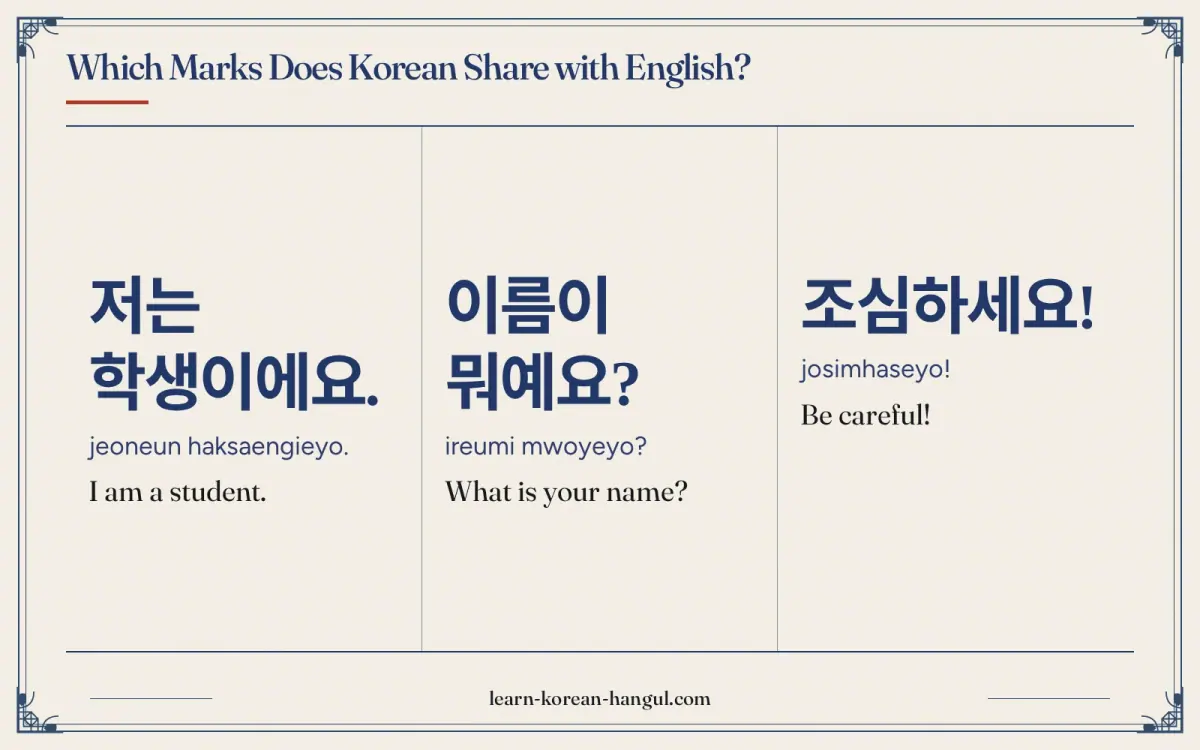
Korean shares four marks with English: the period, the comma, the question mark and the exclamation mark. They are written with the same shapes (. , ? !), and they attach directly to the last word of the sentence. A space comes after the mark only when more text follows.
The period (마침표). It ends a statement or a polite request. Titles and headings usually take no period.
저는 학생이에요.
jeoneun haksaengieyo.
I am a student.
The question mark (물음표). It ends a question. The sentence 이름이 뭐예요? has a question word (뭐, "what"), and the mark is a spelling convention, not an instruction to raise your voice. In speech, a question word carries the stress, and the sentence often ends with a fall or a rise-fall, not a sharp final rise. A yes/no question, such as 정말요? ("Really?", jeongmaryo), usually rises at the end. In everyday speech it is commonly said [정말료].
이름이 뭐예요?
ireumi mwoyeyo?
What is your name?
The exclamation mark (느낌표). It marks strong feeling, a warning or a firm command. Careful writing uses it sparingly.
조심하세요!
josimhaseyo!
Be careful!
The comma (쉼표). The comma is the mark that differs most in practice, because Korean grammar already does a lot of the work. These are the common uses.
| Use of the comma | Example | RR | Meaning |
|---|---|---|---|
| Listing equal items | 사과, 배, 귤을 샀어요. | sagwa, bae, gyureul sasseoyo. | I bought apples, pears and tangerines. |
| After a call or an answer | 지영아, 이리 와. | jiyeonga, iri wa. | Jiyeong, come here. |
| Between two clauses | 비가 오고, 바람이 불어요. | biga ogo, barami bureoyo. | It rains, and the wind blows. |
| After a lead-in word | 첫째, 몸이 튼튼해야 해요. | cheotjjae, momi teunteunhaeya haeyo. | First, you must be healthy. |
| Inside numbers | 5,000원 | ocheon won | 5,000 won |
In the list example the commas do the work of the word "and", and the particle 을 sits on the last item, 귤을. There is no comma before a final "and", as English writers sometimes add. Korean writers use fewer commas than English writers. If a short clause reads clearly without a pause, leave the comma out.
사과, 배, 귤을 샀어요.
sagwa, bae, gyureul sasseoyo.
I bought apples, pears and tangerines.
Next come the marks that English speakers know less well, beginning with the middle dot.
What Is the Middle Dot Used For?
The middle dot (가운뎃점, gaundetjeom) joins short items that have equal weight. It sits in the middle of the line, not at the bottom like a period, and it is written without spaces on either side. It saves space and avoids a string of commas, so it is common in headlines, textbooks and notices.
여름·가을에는 날씨가 좋아요.
yeoreum·gaeureneun nalssiga joayo.
The weather is good in summer and autumn.
In 여름·가을, the dot is not spoken. You read two words with a very small pause, as in "summer, autumn", or you say the particle 과: 여름과 가을 (yeoreumgwa gaeul). Both are the same list.
| With the middle dot | Reading | Meaning |
|---|---|---|
| 상·중·하 | sang, jung, ha | high, middle, low |
| 한·일 양국 | han, il yangguk | the two countries Korea and Japan |
| 봄·여름·가을·겨울 | bom, yeoreum, gaeul, gyeoul | spring, summer, autumn, winter |
The middle dot suits short items of the same kind. Do not use it between long phrases; use a comma instead. A comma is a common substitute when a middle dot is hard to type.
The next section covers the two marks that show a stretch of values and a missing part.
How Do Ranges and Ellipses Work?
A range is written with the tilde (물결표), and an ellipsis is written with dots. Both have an official use and an informal use, and the informal use is where learners go wrong.
The tilde as a range. The official rules use the tilde for 내지 (naeji), which means "from … to …". It is written with no space on either side, and it reads aloud as 에서 … 까지 or 부터 … 까지.
| Written | Read aloud | Meaning |
|---|---|---|
| 10~20 | 십에서 이십 | ten to twenty |
| 9월 15일~9월 25일 | 구월 십오 일부터 구월 이십오 일까지 | 15 September to 25 September |
| 김정희(1786~1856) | the years are read as a pair | Kim Jeong-hui, 1786 to 1856 |
The tilde as a soft tone. In chat, 고마워요~ ends in a tilde to sound warm. That is not the official use. The following table compares the two.
| Range tilde | Chat tilde | |
|---|---|---|
| Position | between two values | after the last word |
| Example | 10~20 | 고마워요~ |
| Where it fits | notices, forms, schedules | messages to friends |
| Read aloud? | yes, as 에서/부터 and 까지 | no, it only changes the tone |
The ellipsis (줄임표). An ellipsis shows words left out or a trailing silence. The 2014 rules accept six dots (……) and three dots (…). Six is the older and fuller form; three is the common form on screens. Choose one and keep it in a text.
글쎄요……
geulsseyo……
Well… (I am not sure.)
Dates, times and numbers use marks too, and the next section shows the Korean versions.
How Are Dates, Times and Numbers Marked?
Korean uses periods, colons and commas in numbers, and the spacing rules are strict. Three patterns cover most cases.
| Item | Korean way | Note |
|---|---|---|
| Short date | 2026. 10. 9. | a period after the year, the month and the day, with a space after each |
| Written date | 2026년 10월 9일 | the counters 년, 월 and 일 replace the periods |
| Time | 오전 10:30 | a colon, with no space on either side of it |
| Large number | 5,000원 | a comma between groups of three digits |
| Ratio | 3:2 | a colon, with no spaces |
The final period after the day in 2026. 10. 9. is part of the pattern; it is not a sentence ending. Spacing between a number and a counter has its own rules, which you can read in Korean counter spacing. Opening hours on a shop sign, such as 9시~6시, combine a counter and a range; see store hours signs for real examples.
You now have all ten marks. The worked example below puts several of them into one sentence.
Worked Example: 여름·가을
Take the line "The weather is good in summer and autumn." and write it with the right marks. You will practise four decisions.
- Write the two items. 여름 (summer) and 가을 (autumn).
- Choose the mark between them. The items are short and equal, so use the middle dot: 여름·가을. No spaces.
- Add the particle after the pair. 에는 attaches to the last item with no space: 여름·가을에는 ("in summer and autumn").
- Finish the sentence and add a period. 날씨가 좋아요 ends the statement, so close it with a period: 여름·가을에는 날씨가 좋아요.
Checkpoint: a correct line has no space around the dot, one period at the end, and no space before the period. If you wrote 여름 · 가을 or 좋아요 . the marks are floating, and they need to attach.
What Mistakes Do Learners Make with Punctuation Marks?
Learners often assume that Korean punctuation is the same as English punctuation. For the four shared marks it is, but five habits cause errors.
- A space before the mark. Learners often write 이름이 뭐예요 ? with a space. The mark attaches: 이름이 뭐예요?
- A comma after every short phrase. Learners often assume a comma is needed after 어제 ("yesterday"). It is not: 어제 학교에 갔어요.
- Spaces around a range mark. Learners often write 10 - 20 or 10 ~ 20. The range mark takes no spaces, and the tilde is the usual choice: 10~20.
- Missing spaces after commas. 사과,배,귤 is hard to read. The comma attaches to the word before it, and a space follows.
- Chat marks in formal work. A string such as 감사합니다!!! or 알겠어요~ is fine in a message to a friend. In an exam answer, a school paper or a work email, use one period.
A note on tone: whether a mark sounds friendly or cold depends on the situation, and no rule says so. Treat tone advice as a tendency, not a law.
Practice and Answer Key
Try the four proofreading lines first, then the quiz. Each line has one punctuation slip.
| Line | Your task |
|---|---|
| 1. 이름이 뭐예요 ? | Fix the spacing of the question mark. |
| 2. 사과,배,귤을 샀어요. | Fix the commas in the list. |
| 3. 가게는 9시 - 6시예요. | Fix the range mark. |
| 4. 2026.10.9 | Write this short date the Korean way. |
Answers.
- 이름이 뭐예요? The question mark attaches to the last word.
- 사과, 배, 귤을 샀어요. Each comma attaches to the word before it, and a space follows.
- 가게는 9시~6시예요. Use the tilde, the usual range mark, with no spaces. It stands for "from … to …".
- A period and a space follow the year and the month, and the day takes a final period. If this looks awkward, write 2026년 10월 9일 instead.
Practice · 5
What is the Korean name of the question mark?
Show answer
물음표
물음표 (mureumpyo) is the question mark. 쉼표 is the comma, 마침표 the period and 느낌표 the exclamation mark.
Which line uses the middle dot correctly?
Show answer
여름·가을
The middle dot sits between short equal items with no spaces: 여름·가을.
Which range is written the usual way?
Show answer
10~20
The tilde (물결표) is the usual range mark, and it takes no spaces: 10~20.
Which ellipsis forms are accepted?
Show answer
Six dots or three dots
The 2014 rules accept six dots (……) and three dots (…).
Where does the question mark go in 이름이 뭐예요?
Show answer
Attached to the last word
Korean attaches the question mark to the last word, with no space before it.
Where to Go Next
You can now name and place the main Korean punctuation marks. The next lesson, Korean quotation marks, covers the marks for speech, thoughts and titles. For the section overview, go back to Korean punctuation. When you are ready to use these marks in your own writing, try Korean writing prompts.
What this lesson does not cover. It leaves out quotation marks, brackets and chat marks, which have their own lessons, and it does not list every mark in the official set. The rules named here come from the 문장 부호 rules, as published and explained by the National Institute of Korean Language (국립국어원).
In short, Korean punctuation marks look like English ones for the period, comma, question mark and exclamation mark, and they add the middle dot, the range tilde and a flexible ellipsis.
Frequently Asked Questions
Does Korean Use Periods and Commas?
Yes. Korean ends statements with a period and uses commas to list items, to mark a clause break and after a call or an answer such as 예, 알겠습니다. Korean writers use fewer commas than English writers, so short opening words and phrases usually take none.
How Do I Write a Range in Korean?
Use the tilde (물결표), joined to the numbers with no space: 1020, 9월 15일9월 25일. The tilde stands for 내지, which means from one point to another. It reads aloud as 에서 and 까지 (십에서 이십), or as 부터 and 까지 with dates.
Are There Korean-Only Punctuation Marks?
Few marks are unique to Korean. The middle dot, the tilde as a range mark and the angle or corner brackets for titles are used more often than in English. The old circle point (。) and the point 、 appear only in vertical writing, which is now rare.
When Were the Korean Punctuation Rules Revised?
The Ministry of Culture, Sports and Tourism revised the rules for 문장 부호 (sentence marks) in 2014, and the new rules applied from 2015. The National Institute of Korean Language (국립국어원) explains them online. Check there for the exact wording of any rule.
Is There a Space before a Question Mark in Korean?
No. The question mark, exclamation mark, period and comma attach directly to the last word: 이름이 뭐예요? A space follows the mark only when more text comes after it. English writers who add a space before a question mark, as in French, are making an error.