What you will learn
- Say what an auxiliary (helper) verb is and name six of them.
- Write eight main-plus-helper pairs correctly, with a space or without.
- Tell which pairs allow both forms and which must be spaced.
- Choose one style and keep it consistent in a text.
Before you start: you should know the connective ending -아/어 (as in 먹어) and the spacing rule for dependent nouns. Time: about 25 minutes.
What Is Korean Auxiliary Verb Spacing?
Korean auxiliary verb spacing is the set of rules for the space between a main verb and the helper verb that follows it. The rule is Article 47 of the 한글 맞춤법, published by the National Institute of Korean Language (국립국어원). The article says helper verbs are written apart from the main verb as a principle, and that attaching them is also permitted in certain patterns.
The key terms are these. A main verb (본용언, bonyongeon) carries the core meaning, such as 먹다 ("eat"). An auxiliary verb (보조 용언, bojo yongeon) is a verb or adjective that follows it to add a meaning, such as "try" (보다) or "do for someone" (주다). The pair is joined by an ending, usually -아/어 or -고.
Here is the pair 먹어 보다 ("eat and see", meaning "try eating") in a sentence. Both 먹어 보세요 and 먹어보세요 are correct.
비빔밥을 먹어 봤어요.
bibimbabeul meogeo bwasseoyo.
I tried bibimbap.
The spoken form is [비빔빠블 머거 봐써요]: inside the compound 비빔밥 the ㅂ of 밥 is said tense ([비빔빱]). RR writes bibimbabeul and does not show the tensing. The spaces do not affect the sound at all.
Why does the space matter at all? Because readers see the structure: a two-word form shows that 먹다 is the main verb. The next section explains why English speakers find the choice confusing.
Why Do English Speakers Struggle with Auxiliary Verb Spacing?
English speakers struggle because English has no matching pair and because Korean allows two spellings. Three habits cause trouble.
- No space is fine in some pairs and not in others. Learners see 먹어보다 in a text and think all pairs may attach, then write 먹고싶다.
- The helper looks like an ordinary verb. 보다 means "see" on its own, so learners are unsure whether 먹어 보다 is one idea or two.
- Corrections disagree. A spell checker may accept both 먹어 보다 and 먹어보다, so learners think the choice does not matter. It does matter for the pairs that are not covered by the allowance.
The next section defines the helper verbs so you can recognise them.
What Is an Auxiliary Verb?
An auxiliary verb adds a shade of meaning to the main verb and cannot do the main job by itself. The helper keeps its dictionary form and takes the final endings (tense and politeness), while the main verb takes the connecting ending.
| Helper | Meaning | Pattern | Example | RR |
|---|---|---|---|---|
| 보다 | try | -아/어 보다 | 먹어 보다 | meogeo boda |
| 주다 | do for someone | -아/어 주다 | 읽어 주다 | ilgeo juda |
| 드리다 | do for a superior | -아/어 드리다 | 도와 드리다 | dowa deurida |
| 버리다 | finish, regret | -아/어 버리다 | 먹어 버리다 | meogeo beorida |
| 놓다 | do in advance | -아/어 놓다 | 열어 놓다 | yeoreo nota |
| 있다 | be doing | -고 있다 | 먹고 있다 | meokgo itda |
| 싶다 | want | -고 싶다 | 가고 싶다 | gago sipda |
| 말다 | do not | -지 말다 | 가지 말다 | gaji malda |
| 하다 / 싶다 | seem, be worth | -ㄹ + 듯 / 만 + 하다 | 올 듯하다, 볼 만하다 | ol deutada, bol manhada |
The grammar of each pattern has its own lesson, such as Korean auxiliary verbs, -아/어 보다 and -아/어 주다. Here the focus is only on spacing.
Notice that the table groups helpers by the ending that joins them. That ending decides the spacing, as the next sections show.
Which Combinations Allow Both Forms?
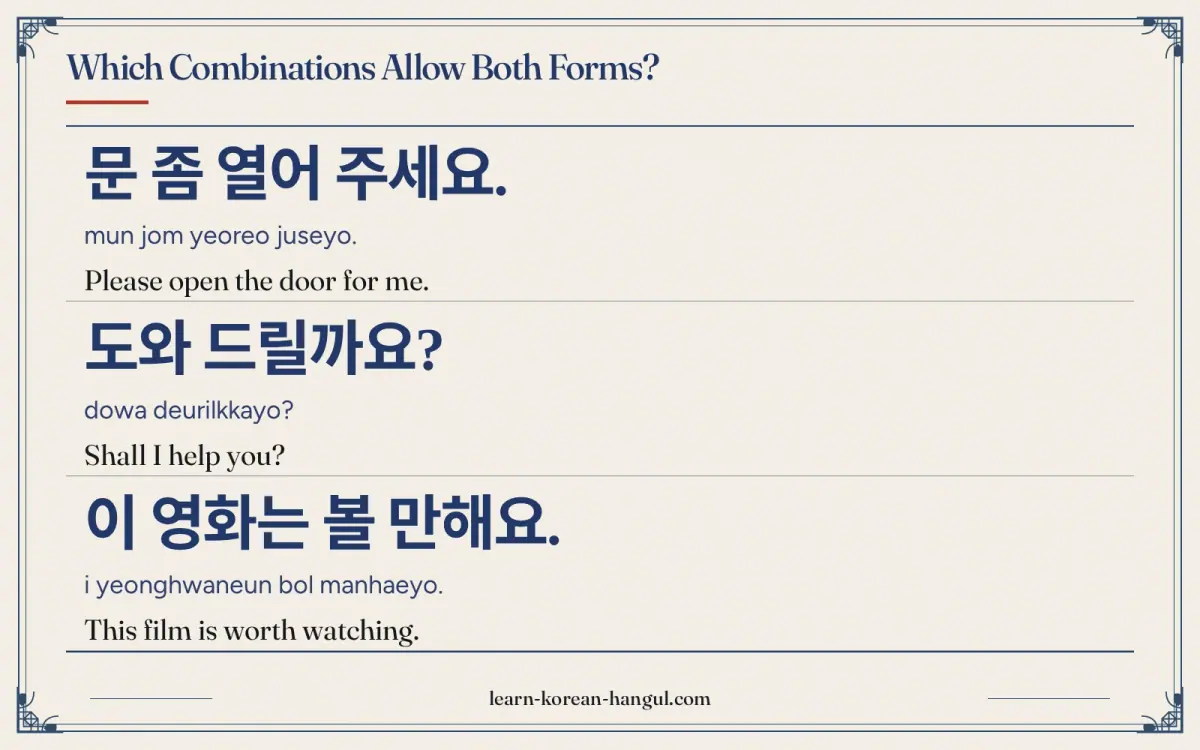
After the connective -아/어, the attached form is allowed. The article gives examples such as 도와 드린다 / 도와드린다, 막아 낸다 / 막아낸다 and 깨뜨려 버렸다 / 깨뜨려버렸다. The same permission covers a second pattern: a modifier, then a dependent noun such as 듯 or 만, then 하다 or 싶다.
| Pair | Spaced | Attached | Both allowed? |
|---|---|---|---|
| try | 먹어 보다 | 먹어보다 | yes |
| do for someone | 읽어 주다 | 읽어주다 | yes |
| do for a superior | 도와 드리다 | 도와드리다 | yes |
| finish, regret | 먹어 버리다 | 먹어버리다 | yes |
| do in advance | 열어 놓다 | 열어놓다 | yes |
| seem | 올 듯하다 | 올듯하다 | yes |
| be worth | 볼 만하다 | 볼만하다 | yes |
| be doing | 먹고 있다 | 먹고있다 | no: space only |
| want | 가고 싶다 | 가고싶다 | no: space only |
| do not | 가지 말다 | 가지말다 | no: space only |
The spaced form is the standard default, and it is correct in every row. The attached form is the permitted alternative in the first seven rows. The last three rows show the pairs where a mistake is possible.
문 좀 열어 주세요.
mun jom yeoreo juseyo.
Please open the door for me.
도와 드릴까요?
dowa deurilkkayo?
Shall I help you?
이 영화는 볼 만해요.
i yeonghwaneun bol manhaeyo.
This film is worth watching.
The question 도와 드릴까요? is a yes/no question, so the voice rises at the end. The verb 돕다 is a ㅂ-irregular verb, so its connective form is 도와, not 돕아.
Which Combinations Must Be Spaced?
Three kinds of pair must be spaced, whatever style you choose. The reason is that the attached-form allowance covers only the patterns named in the rule.
- Pairs joined by -고, -지 or -게. 먹고 있다, 가고 싶다, 가지 마세요, 가지 못하다 and 크게 하다 are always spaced. The attached forms 먹고있다 and 가고싶다 are errors.
- A particle sits in between. If a particle comes after the main verb, the helper stands alone: 읽어도 보고, 믿어는 주겠니, 놀아만 나는구나. The particle splits the pair, so write both words separately.
- The main verb is a compound verb. When the main verb is itself made of two verbs, the helper is spaced: 들어가 보다, 떠내려가 버렸다. The compound is already joined; adding a helper to it would make a chain. The official commentary on the rule makes one small exception: when the compound's connective form has only two syllables, as in 나가 버렸다, the attached 나가버렸다 is also allowed.
A related error is a chain of three. Each allowance covers one pair at a time, so the string 읽어보고싶다 is wrong. Write 읽어 보고 싶다 or, with the first pair attached, 읽어보고 싶다. The last helper is spaced because -고 싶다 never attaches.
한국어를 배우고 싶어요.
hangugeoreul baeugo sipeoyo.
I want to learn Korean.
지금 밥을 먹고 있어요.
jigeum babeul meokgo isseoyo.
I am eating now.
Said aloud, 배우고 싶어요 is [배우고 시퍼요], and 먹고 있어요 is [먹꼬 이써요]. The sound changes follow the spelling, not the spacing, so you cannot tell the pair from a recording.
The ending -고 싶다 is covered in the lesson on Korean want to grammar, and the let's form in Korean let's grammar.
How Do You Choose One Style?
Choose the spaced form unless you have a reason to attach, and use the same style throughout a text. Four decisions give the answer in order.
- Is the second verb a helper? If it adds a shade to the first verb (try, do for, want, be doing), continue. If it has its own meaning and its own object, it is an ordinary verb and gets a space.
- What joins the two verbs? If it is -아/어, or modifier + 듯/만/법/성/척 + 하다/싶다, both styles are allowed. If it is -고, -지 or -게, write a space.
- Does anything block the pair? A particle between the verbs, or a compound main verb, forces a space.
- Pick one style. Use the spaced form, or the attached form for the allowed pairs only, and do not mix them on one page.
Consistency matters because readers notice it. A page that writes 먹어 보다 in the first line and 먹어보다 in the third looks unedited. Spell checkers accept both, so they will not warn you. For learner writing, the spaced form is the easiest to defend.
Worked Example: 먹어 보세요
You will build "Please try eating it" and write it both ways. It takes four steps.
- Find the main verb and its connective form. 먹다 plus -어 gives 먹어.
- Find the helper. 보다 ("try") joins with -아/어. The pattern is 먹어 보다.
- Make the request. 보다 becomes 보세요 in the polite request form, so the phrase is 먹어 보세요.
- Decide the spacing. The pair is joined by -어, so both 먹어 보세요 and 먹어보세요 are allowed. Choose one.
Checkpoint: you have it right when you can say why 먹고 보세요 would need a space (-고, not -아/어) and why the sound is the same for both spellings: [머거 보세요].
Now repeat the steps with 읽다 and 주다. The phrase is 읽어 주세요 or 읽어주세요 ("Please read it for me").
What Mistakes Do Learners Make with Auxiliary Verb Spacing?
Learners often assume that if one helper can attach, all helpers can. Five habits cause errors.
- Attaching -고 helpers. 먹고있어요 should be 먹고 있어요, and 가고싶어요 should be 가고 싶어요.
- Chaining three elements. 읽어보고싶다 attaches too much. Use 읽어 보고 싶다.
- Mixing styles. 먹어 보고 and 먹어보고 in one text look inconsistent.
- Ignoring the particle. 읽어도보다 should be 읽어도 보다.
- Spacing inside a 하다 word. 사랑하다 stays one word, but 사랑해 주다 or 사랑해주다 follows the usual helper rule.
Practice and Answer Key
Space each combination correctly. Then say whether both the spaced and attached forms are allowed.
| Item | Combination |
|---|---|
| 1 | 먹어보다 |
| 2 | 가고싶다 |
| 3 | 도와드리다 |
| 4 | 먹고있다 |
| 5 | 열어놓다 |
| 6 | 가지마세요 |
| 7 | 볼만하다 |
| 8 | 해주세요 |
Answers.
- 먹어 보다. Both forms are allowed.
- 가고 싶다. Spaced only.
- 도와 드리다. Both forms are allowed.
- 먹고 있다. Spaced only.
- 열어 놓다. Both forms are allowed.
- 가지 마세요. Spaced only.
- 볼 만하다. Both forms are allowed.
- 해 주세요. Both forms are allowed, so 해주세요 is also correct.
Practice · 5
Which spelling is wrong?
Show answer
먹고싶다
-고 싶다 is always spaced, so 먹고싶다 is a spelling error.
Which pair allows both a spaced and an attached form?
Show answer
도와 드리다
After -아/어 the attached form is allowed: 도와 드리다 / 도와드리다.
How should 읽어도보다 be written?
Show answer
읽어도 보다
A particle sits between the verbs, so the helper stands alone.
What is the safe default style?
Show answer
Space the helper from the main verb
The spaced form is the standard default and is correct in every pair.
Does attaching the helper change the sound of 먹어 보세요?
Show answer
No, it sounds the same
Spacing is a writing choice. Both forms sound like [머거 보세요].
Where to Go Next
You can now space the common helper verbs and avoid the errors. The next lesson, Korean name spacing, covers family names, given names, titles and 씨. For the grammar behind these helpers, read about Korean auxiliary verbs. To see all the rules together, return to Korean spacing rules, and for spelling questions see Korean spelling rules.
What this lesson does not cover. It does not list every helper verb, and it does not explain the meaning of each pattern. It also does not decide style questions that the rule leaves open. The rule comes from Article 47 of the 한글 맞춤법 of the National Institute of Korean Language (국립국어원).
In short, Korean auxiliary verb spacing writes the helper as a separate word by default, allows the attached form after -아/어, and always spaces helpers that follow -고, -지 or -게.
Frequently Asked Questions
Is It 먹어 보다 or 먹어보다?
Both are accepted. Article 47 of 한글 맞춤법 says helper verbs are normally spaced but allows the attached form after -아/어, so 먹어 보다 and 먹어보다 are both correct. Choose one style and keep it throughout your text. The spaced form is the standard default and the safest choice.
Which Style Should I Use in an Exam or Essay?
Use the spaced form as your default, since it is always correct under the main rule and shows the two verbs clearly. Use the attached form only if you know the pair is allowed and you keep it consistent. Never attach forms that the rule does not cover, such as 먹고싶다.
What about 하고 싶다 and 가고 싶다?
Write them with a space: 하고 싶다, 가고 싶다, 먹고 싶어요. The helper 싶다 follows the ending -고, and the attached-form allowance covers -아/어 patterns, not -고. So 가고싶다 is a spelling error. This rule is easy to apply because -고 싶다 is always written in two words.
How Do I Write -아/어 주다?
Write 읽어 주다 with a space, or 읽어주다 attached. Both are allowed. Requests follow the same choice: 읽어 주세요 or 읽어주세요. For 하다 verbs, the connective is 해, so write 해 주세요 or 해주세요. The meaning is the same as the spaced form.
Does the Pronunciation Change If I Attach the Helper?
No. The spoken form is the same either way, so 먹어 보세요 and 먹어보세요 both sound like [머거 보세요]. Spacing is a writing choice. It does not change the sound, the stress or the meaning, but it can affect how easily a reader sees the two verbs.