What you will learn
- Say what a dependent noun is and name the ten most common ones.
- Space 것, 수, 줄, 번 and 지 correctly after a modifier.
- Tell a dependent noun from an ending or a particle that attaches.
- Space ten sentences correctly and explain each choice.
Before you start: you should know the basic particle rule from Korean particles spacing. Time: about 25 minutes.
What Is Korean Dependent Nouns Spacing?
Korean dependent nouns spacing is the rule that a dependent noun is written apart from the word in front of it. The rule is Article 42 of the 한글 맞춤법 (Hangeul Orthography), the official spelling rules published by the National Institute of Korean Language (국립국어원). The rule's own examples are 아는 것이 힘이다 ("Knowledge is power") and 나도 할 수 있다 ("I can do it too").
Two terms need a definition. An eojeol (어절) is a group of letters written between spaces. A modifier (관형어) is a word or word ending that describes a noun that follows. The endings -는, -(으)ㄴ and -(으)ㄹ turn a verb into a modifier: 먹는, 먹은 and 먹을 all describe a noun, as in 먹을 것 ("something to eat").
A dependent noun is the noun that follows such a modifier. It is a real noun, but it is "bound" to its modifier: you cannot say 것 alone as a sentence. The space between them is where the spelling rule shows the grammar. Here is the first example, with audio.
먹을 것이 없어요.
meogeul geosi eopseoyo.
There is nothing to eat.
The spoken form is [머글꺼시 업써요]. After the ending -ㄹ, the ㄱ of 것 is said tense (as ㄲ), and the spelling does not show it. Revised Romanization (RR, the official Latin spelling) writes geosi, not kkeosi. Words that you read as one sound unit can still be two words on the page.
Why Do English Speakers Struggle with Dependent Nouns Spacing?
English speakers struggle because English has no matching class of words, and because Korean shows the difference only by a space. Three reasons come up again and again.
- The words look short and light. 수 and 지 look like syllables in a longer word, so learners attach them: 할수, 온지.
- Spoken Korean runs the words together. In speech there is no pause before 수 or 것, so the ear gives no cue.
- Look-alike endings attach. Some of the same sounds are endings, and these are written without a space. Learners over-apply the space rule and write 먹을 수록 (wrong) instead of 먹을수록.
The sections below give a test that removes the guesswork. First, we need the exact definition.
What Is a Dependent Noun?
A dependent noun (의존 명사, uijon myeongsa) is a noun that has little meaning by itself and always follows a modifier. It has three marks that you can test.
| Test | Dependent noun | Ordinary noun |
|---|---|---|
| Can it start a sentence alone? | no | yes |
| What comes before it? | a modifier ending (-는, -(으)ㄴ, -(으)ㄹ) or 이, 그, 저, 어떤 | anything |
| Can it take a particle? | yes (것이, 수가, 줄을) | yes |
Compare 책 ("book"), an ordinary noun, with 것 ("thing"). 책이 있어요 is a full sentence, but 것이 있어요 is not clear until you say which thing: 먹을 것이 있어요. In each sentence, the dependent noun carries a particle, such as 이 or 을, and the particle attaches to it with no space.
The pattern is always: modifier, space, dependent noun, particle (attached), then the next word after a space.
- 아는 것이 많아요. (I know many things.)
- 한국어를 할 수 있어요. (I can speak Korean.)
저는 한국어를 할 수 있어요.
jeoneun hangugeoreul hal su isseoyo.
I can speak Korean.
Said aloud, 할 수 있어요 is [할쑤 이써요]: the ㅅ of 수 is tense after the ending -ㄹ. In a bracket the tense consonant is written attached to the syllable before it, as in [할쑤]. For the grammar behind this pattern, see Korean can grammar and the dependent nouns lesson in the grammar section.
Which Dependent Nouns Are Most Common?
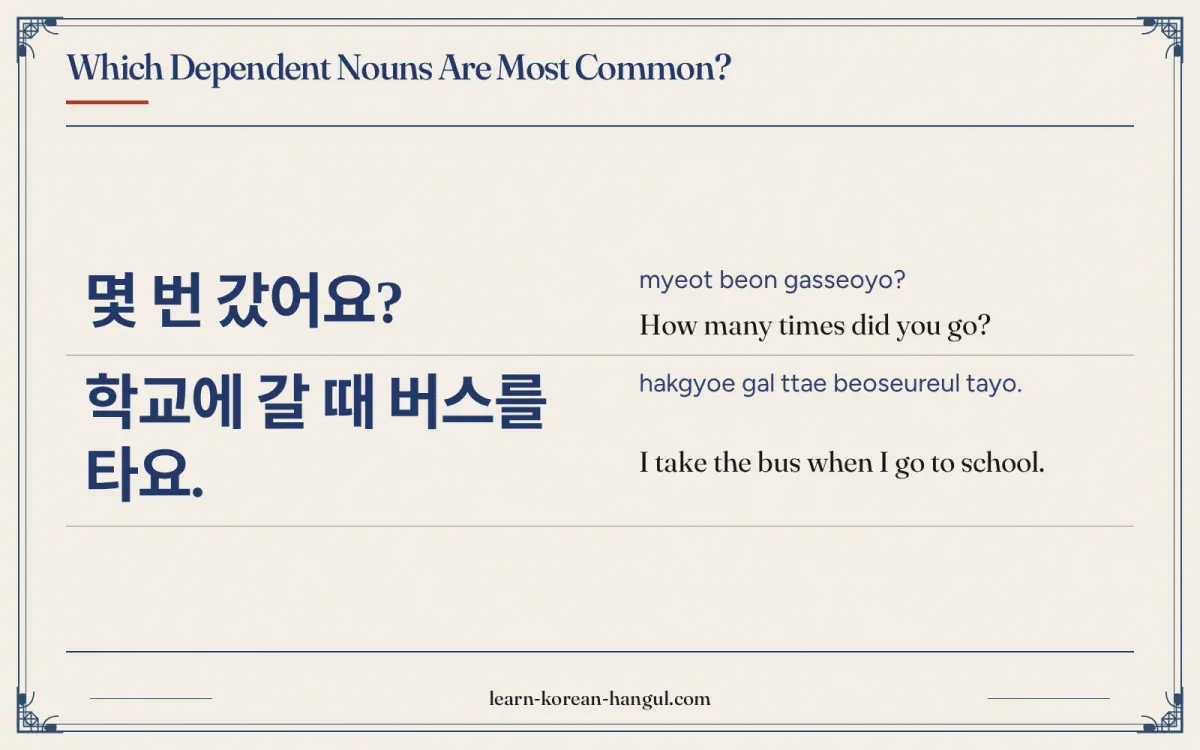
The most common dependent nouns are 것, 수, 줄, 번, 지, 뿐, 만, 데, 바 and 대로. The table gives eight to learn first, each with a sentence and its Revised Romanization.
| Dependent noun | Meaning | Example | RR |
|---|---|---|---|
| 것 | thing, fact | 먹을 것 | meogeul geot |
| 수 | way, possibility | 할 수 있다 | hal su itda |
| 줄 | know-how, belief | 운전할 줄 알아요 | unjeonhal jul arayo |
| 번 | time (count) | 한 번 | han beon |
| 지 | time since | 온 지 오 년 | on ji o nyeon |
| 뿐 | only, merely | 웃을 뿐이에요 | useul ppunieyo |
| 만 | lapse of time | 삼 년 만에 | sam nyeon mane |
| 데 | place, situation | 읽는 데 두 시간 | ingneun de du sigan |
The sounds to learn are [머글껃] for 먹을 것, [할쑤 읻따] for 할 수 있다 and [운전할쭐 아라요] for 운전할 줄 알아요. In 읽는 데, the final ㄺ is said as ㄱ and becomes ㅇ before ㄴ: [잉는 데]. RR does not write the tensing in the first three. Only tense letters that are part of the spelling, such as the ㅃ of 뿐 (ppun), appear.
Three more examples show the nouns in a real sentence.
한국에 온 지 오 년이 됐어요.
hanguge on ji o nyeoni dwaesseoyo.
It has been five years since I came to Korea.
책을 읽는 데 두 시간이 걸렸어요.
chaegeul ingneun de du sigani geollyeosseoyo.
It took two hours to read the book.
몇 번 갔어요?
myeot beon gasseoyo?
How many times did you go?
The question 몇 번 갔어요? has the question word 몇, so the stress falls on it and the sentence does not end with a sharp rise. The sound across the space is [멷뻔 가써요]. RR keeps the words apart (myeot beon) and does not show the tensing.
A note on 때. In the standard dictionary, 때 ("time, when") is an ordinary noun and can stand alone. Still, it follows a modifier in the same pattern, so it is spaced like the nouns above: 갈 때, 어릴 때, 밥을 먹을 때. It is easiest to learn it in the same group.
학교에 갈 때 버스를 타요.
hakgyoe gal ttae beoseureul tayo.
I take the bus when I go to school.
The next section handles the case that causes most errors.
How Do You Tell a Dependent Noun from an Ending?
Use a three-step test. Look at the word before the sound in question, ask whether it keeps its noun meaning, and try replacing it with 것.
- What is before it? If it is a modifier (-는, -(으)ㄴ, -(으)ㄹ), it may be a dependent noun. If it is a noun, a pronoun or a number, it may be a particle.
- Does it keep its noun meaning? 먹을 것 means "a thing to eat", so 것 is a noun. 먹을수록 means "the more one eats", and 수록 has no noun meaning. It is an ending.
- Ask a noun question. Can it answer "what thing?", "which time?" or "what place?" If yes, write a space. If it only links two clauses or adds a shade such as "the more" or "whether", it is an ending, so attach it.
The table shows the pairs where the sounds match but the writing does not.
| Space (noun) | Meaning | No space | Type |
|---|---|---|---|
| 간 지 오래됐어요 | It has been long since (I) went. | 어디 갔는지 몰라요 | -는지 ending: whether |
| 읽는 데 두 시간 | two hours to read | 읽는데 졸려요 | -는데 ending: and / but |
| 웃을 뿐이에요 | I only smile. | 너뿐이에요 | 뿐 particle after a noun |
| 삼 년 만에 | after three years | 너만 | 만 particle: only |
| 아는 대로 | as much as (I) know | 법대로 | 대로 particle: according to |
| 노력한 만큼 | as much as (I) tried | 나만큼 | 만큼 particle: as much as |
| 먹을 수 있다 | can eat | 먹을수록 | -(으)ㄹ수록 ending: the more |
Notice the pattern. Where a noun or a pronoun comes before 뿐, 만, 대로 and 만큼, these are particles, and a particle attaches to its noun. After a modifier, the same sounds are dependent nouns and take a space.
Two words that look like this pair are single words and are never spaced. 오랜만에 ("after a long time") is one word, but 삼 년 만에 is a noun phrase with a number. 이것, 그것, 저것 and 아무것 are single words as well, and the casual 이거, 그거 and 저거 are written the same way. A spaced 이 것 is an error.
What about the Contracted Forms 거, 게, 건 and 걸?
The short forms of 것 are still dependent nouns, and they keep the space after the modifier. In speech 것 is shortened: 것이 becomes 게, 것은 becomes 건, 것을 becomes 걸, and 것이다 becomes 거다. After a modifier you still write the space.
| Full form | Short form | Example | Meaning |
|---|---|---|---|
| 먹을 것이 | 먹을 게 | 먹을 게 없어요. | There is nothing to eat. |
| 좋은 것은 | 좋은 건 | 좋은 건 뭐예요? | What is the good thing? |
| 사는 것을 | 사는 걸 | 사는 걸 봤어요. | I saw (him) buying it. |
| 할 것이에요 | 할 거예요 | 내일 할 거예요. | I will do it tomorrow. |
The last example is the future "will": 할 거예요 is said [할꺼예요]. The spelling keeps ㄱ and the space, and the bracket shows the tense sound. The full lesson is Korean geot contractions.
Worked Example: 먹을 것
You will space a sentence from scratch. The sentence means "There is nothing to eat at home", and it is first written with no spaces: 집에먹을것이없어요.
- Find the particle and split it off. 집에 is 집 plus the particle 에, which attaches. Keep 집에 together.
- Find the modifier. 먹을 is the verb 먹다 with the modifier ending -을. It describes a noun.
- Find the dependent noun. 것 follows the modifier and means "thing". Put a space before it: 먹을 것.
- Attach the particle to the noun. 이 attaches to 것: 것이.
- Space the predicate. 없어요 is a separate word: 집에 먹을 것이 없어요.
Checkpoint: you have it right if your answer has four words: 집에, 먹을, 것이 and 없어요, and no space between 것 and 이. If you wrote 먹을것이, the space before the noun is missing.
Now compare it with the look-alike 먹을수록. There the sentence is 먹을수록 배가 불러요 ("the more I eat, the fuller I get"), and 수록 is part of the ending, so the whole word attaches.
What Mistakes Do Learners Make with Dependent Nouns Spacing?
Learners often assume that a short word needs no space. Five mistakes are the most common.
- Attaching a short noun. 할수 있다 should be 할 수 있다. The noun 수 is a separate word.
- Spacing an ending. 먹을 수록 should be 먹을수록. The ending -ㄹ수록 is one piece.
- Mixing the two meanings of 지. 간 지 ("since I went") has a space, but 갔는지 ("whether I went") is attached.
- Spacing a particle after a noun. 너 뿐이에요 should be 너뿐이에요, because 뿐 follows a noun.
- Spacing a pronoun. 이 것 should be 이것.
A habit that helps is reading aloud. Say the phrase and listen for a modifier ending: if you hear -ㄹ, -ㄴ or -는 right before the word, the next word is probably a noun.
Practice Sentences and Answer Key
Space each sentence correctly. One item needs no new space.
| Item | Sentence |
|---|---|
| 1 | 먹을것이 없어요. |
| 2 | 저는 할수 있어요. |
| 3 | 운전할줄 알아요. |
| 4 | 한번 더 해요. |
| 5 | 서울에 온지 오 년이 됐어요. |
| 6 | 웃을뿐이에요. |
| 7 | 삼 년만에 만났어요. |
| 8 | 책을 읽는데 두 시간이 걸렸어요. |
| 9 | 아는대로 말해 주세요. |
| 10 | 공부할 수록 재미있어요. |
Answers.
- 먹을 것이 없어요.
- 저는 할 수 있어요.
- 운전할 줄 알아요.
- 한 번 더 해요. (한 is the number "one", and 번 is the counter noun.)
- 서울에 온 지 오 년이 됐어요.
- 웃을 뿐이에요.
- 삼 년 만에 만났어요.
- 책을 읽는 데 두 시간이 걸렸어요. (The reading means "it took two hours to read", so 데 is a noun.)
- 아는 대로 말해 주세요.
- 공부할수록 재미있어요. The ending -ㄹ수록 attaches, so the space in the question must be removed.
Practice · 5
Which spelling is correct?
Show answer
할 수 있다
수 is a dependent noun after the modifier 할, so it is a separate word.
Which sentence uses 지 as a noun meaning 'time since'?
Show answer
한국에 온 지 오 년이 됐어요.
온 지 오 년 means 'five years since I came', so 지 is a noun with a space.
Which is written as one word?
Show answer
먹을수록
-(으)ㄹ수록 is an ending, so it attaches to the stem.
Which is correct?
Show answer
너뿐이에요
After a noun or pronoun, 뿐 is a particle and attaches.
Is the casual form 거 spaced after the modifier?
Show answer
Yes: 먹을 거예요
거 is the short form of 것, still a dependent noun, so it keeps the space.
Where to Go Next
You can now space the most common dependent nouns and avoid the look-alike endings. The next lesson, Korean counter spacing, applies a similar idea to numbers and counters such as 한 개. To see the particle side of the rule, go back to Korean particles spacing. For the whole set of rules, return to Korean spacing rules, and for related spelling questions see Korean spelling rules. If the modifier forms are new, read about the Korean noun modifier.
What this lesson does not cover. It does not list every dependent noun, and it does not explain the grammar of each one. Counters such as 개 and 명 follow Article 43 and have their own lesson.
In short, Korean dependent nouns spacing means writing 것, 수, 줄, 번, 지 and the other bound nouns as separate words after a modifier, while the look-alike endings and particles attach.
Frequently Asked Questions
Why Is It 할 수 있다 with a Space?
Because 수 is a dependent noun that follows the modifier 할. The modifier is a separate word, and so is the noun, and the verb 있다 is a third. Writing 할수 있다 is a spelling error. The same rule gives 갈 수 없다, 먹을 수 있어요 and 읽을 수 있습니다.
What Is a Dependent Noun in Korean?
A dependent noun (의존 명사, uijon myeongsa) is a noun that has little meaning of its own and always needs a modifying word in front of it. 것 (thing), 수 (way, ability), 줄 (know-how) and 번 (time) are examples. Normal nouns such as 책 can stand alone, but these cannot.
Do 것 and 거 Follow the Same Rule?
Yes. 거 is the spoken short form of 것, and it is still a dependent noun, so it is spaced from the modifier: 먹을 거예요, 맛있는 거. The contracted forms 게, 건 and 걸 also follow a modifier with a space. Only the demonstrative forms 이거, 그거 and 저거 are written as one word.
How Do I Know If It Is an Ending Instead?
Look at the word before it. A dependent noun follows a modifier ending such as -는, -(으)ㄴ or -(으)ㄹ and keeps its meaning (thing, time since, place). An ending joins straight onto a verb stem and adds a meaning like whether, as, or more and more. Ask whether it still names a thing, a time or a place: if so, space it.
Is 때 a Dependent Noun?
In the standard dictionary 때 is an ordinary noun that can stand alone, but it follows a modifier in the same pattern, so it is also written with a space: 갈 때, 어릴 때. Learners can treat it with the dependent nouns for spacing. The rule is the same, and the sound is [갈때].