What you will learn
- Space a Hangul number and its counter in twelve everyday phrases.
- Write the same phrases with digits and read them aloud with the right numbers.
- Write a date, a time and a price in both Hangul and digits.
- Explain when standard writing attaches a counter and when it does not.
Before you start: you should know the native numbers up to 99 and the Sino-Korean numbers. Review them in Korean counters. Time: about 25 minutes.
What Is Korean Counter Spacing?
Korean counter spacing is the set of rules for the space between a number and the counter that follows it. A counter (단위 명사, a unit noun) is a word like 개, 명, 살, 잔 or 원 that you must add after a number when you count or measure something. Counters are nouns that need a number before them, so they work like the dependent nouns of the previous lesson.
The main rule of Article 43 is simple: write the counter as a separate word. The article then makes an exception: when the counter follows an order number, or when it sits with digits, it may attach. The exception is why you see both 한 개 and 1개 in print.
Here is the pair in action. The words are the same, and only the number's form changes.
사과 한 개 주세요.
sagwa han gae juseyo.
One apple, please.
With a digit, the same request is written 사과 1개 주세요 and is read aloud exactly the same way: 한 개. You will learn the read-aloud rule below. First, let's see why English speakers find this difficult.
Why Do English Speakers Struggle with Counter Spacing?
English speakers struggle because English puts a space between a number and a unit, and Korean sometimes does not. They also have to pick the number system for each counter. Three things go wrong most often.
- Digits plus a space. English writes "3 items" with a space. Korean usually writes 3개 without one.
- Hangul numbers without a space. Learners write 한개 or 두명 as one word. The standard writes 한 개 and 두 명.
- Wrong number form. Before a counter, native numbers shorten: 하나 becomes 한, 둘 becomes 두, 셋 becomes 세, 넷 becomes 네, and 스물 becomes 스무. Learners write 하나 개 or 일 개.
The worked example later in the lesson fixes all three at once. Now we look at the rule for Hangul numbers.
Do Numbers and Counters Take a Space?
Yes. When the number is in Hangul, the number and its counter are two words. The space goes between them, and any particle attaches to the counter. This applies to native numbers (한, 두, 세) and Sino-Korean numbers (일, 이, 삼) alike.
The table gives twelve common phrases with their digit forms. The right column shows the attached digit form that standard writing allows.
| Meaning | Hangul (spaced) | RR | Digit form |
|---|---|---|---|
| one item | 한 개 | han gae | 1개 |
| two people | 두 명 | du myeong | 2명 |
| three cups | 세 잔 | se jan | 3잔 |
| four bottles | 네 병 | ne byeong | 4병 |
| five animals | 다섯 마리 | daseot mari | 5마리 |
| ten years old | 열 살 | yeol sal | 10살 |
| twenty years old | 스무 살 | seumu sal | 20살 |
| three books | 세 권 | se gwon | 3권 |
| two hours | 두 시간 | du sigan | 2시간 |
| three months | 세 달 | se dal | 3달 |
| the third time | 세 번째 | se beonjjae | 3번째 |
| 5,000 won | 오천 원 | ocheon won | 5,000원 |
Two items need a comment. 열 살 and 스무 살 show the native-number counter pattern for age. Twenty is 스물 on its own, but it becomes 스무 before a counter, so 20살 is read 스무 살. And 번째 (the "-th" counter) always keeps a space after Hangul: 첫 번째, 두 번째, 세 번째, 열한 번째. The first one is 첫, never 한.
Particles attach to the counter, not to the number. Look at these two sentences.
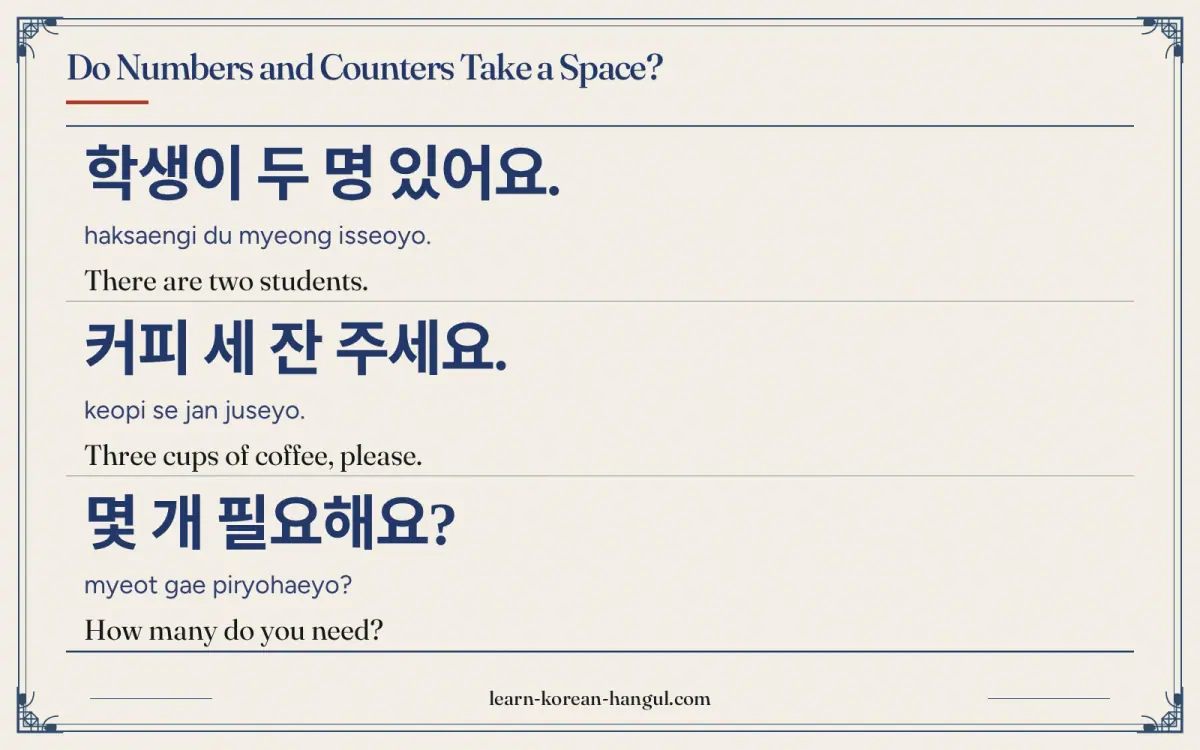
학생이 두 명 있어요.
haksaengi du myeong isseoyo.
There are two students.
커피 세 잔 주세요.
keopi se jan juseyo.
Three cups of coffee, please.
A question that asks for a number uses the question word 몇 ("how many"), which is spaced from the counter in the same way: 몇 개, 몇 명, 몇 살.
몇 개 필요해요?
myeot gae piryohaeyo?
How many do you need?
The stress falls on 몇 and the sentence does not end with a sharp rise. The sound across the space is [멷깨 피료해요]: the final stop of 몇 makes the ㄱ of 개 tense. RR writes the spaced words apart (myeot gae) and does not show the tensing.
The next section shows the other side of the rule: digits.
Do Digits Attach to Counters?
Yes, in standard writing a counter may attach to a digit. The exception in Article 43 lists forms such as 10개, 80원 and 7미터, and in practice the attached form is the one you will see on signs, receipts and menus. Writing a space after a digit is not a mistake under the main rule, but it is rare in print.
| Writing | Example | Status |
|---|---|---|
| Hangul number + counter | 한 개 | main rule: spaced |
| Digit + counter | 1개 | exception: attached, the usual form |
| Digit with a space | 1 개 | allowed, but rarely seen |
| Hangul number attached | 한개 | not accepted for amounts |
The mixed form 한개 is the most common error for learners. It breaks the main rule, and the digit exception does not apply because there is no digit.
When a digit is read aloud, you pick the number system that the counter needs. Most counters for things and people take native numbers up to 99, and counters for money, minutes and many measurements take Sino-Korean numbers.
| Written | Read aloud | Number system |
|---|---|---|
| 3개 | 세 개 | native |
| 10살 | 열 살 | native |
| 2명 | 두 명 | native |
| 30분 | 삼십 분 | Sino-Korean |
| 5,000원 | 오천 원 | Sino-Korean |
A counter that follows an order or a grade can attach even in Hangul. The rule's own examples include 제일과 ("lesson one") and 삼학년 ("third grade"), and with digits, 3학년 and 16동 502호 are normal. This is the "order" exception: ordinal forms attach.
Now let's turn to the forms that mix several numbers: dates, times and prices.
How Are Dates, Times and Money Written?
Dates, times and money combine several number-counter pairs, and each has a fixed pattern. With digits, every counter attaches and the pairs are separated by spaces. With Hangul, each pair is spaced as in the main rule.
| Item | Digits | Hangul |
|---|---|---|
| Date | 2026년 10월 9일 | 이천이십육 년 시월 구 일 |
| Time | 2시 30분 | 두 시 삼십 분 |
| Price | 5,000원 | 오천 원 |
| Large price | 35,000원 | 삼만 오천 원 |
The Hangul time may also be written attached: 두시 삼십분. Article 43 lists 두시 삼십분 오초 as an allowed form, and it lists the date 1446년 10월 9일 as an attached form. Both styles are correct, and the spaced form is easier to read for beginners. Keep to one style inside a text.
Three details help. First, the months 6 and 10 are 유월 and 시월 in Hangul, not 육월 and 십월. Second, big numbers are spaced at each 만 unit: 삼만 오천 원, and 삼억 오천만 원 for 350,000,000 won. This is Article 44. Third, the unit noun after 만 is spaced as well: 만 원 ("ten thousand won"). In a spoken price the forms 일천 and 일만 are never used. They appear only in formal written documents.
지금 두 시 삼십 분이에요.
jigeum du si samsip bunieyo.
It is two thirty now.
The sound of the minutes is [삼십뿌니에요]. The counter 분 is tense after a stop, so 삼십 분 is [삼십뿐], and RR does not write the tensing. For more, see the lessons on dates in Korean and Korean money numbers.
이 책은 오천 원이에요.
i chaegeun ocheon wonieyo.
This book is 5,000 won.
한글날은 시월 구 일이에요.
hangeullareun siwol gu irieyo.
Hangul Day is on 9 October.
What about 두세 개 and Other Number Words?
Some number words are made of two numbers and are written as one word before the counter. These words mean an approximate quantity: 두세 ("two or three"), 서너 ("three or four"), 네댓 ("four or five"), 대여섯 ("five or six") and 예닐곱 ("six or seven"). The counter is spaced after them: 두세 개, 서너 명, 대여섯 시간.
| Word | Meaning | Example |
|---|---|---|
| 두세 | two or three | 두세 개 |
| 서너 | three or four | 서너 명 |
| 네댓 | four or five | 네댓 마리 |
| 대여섯 | five or six | 대여섯 시간 |
| 여러 | several | 여러 번 |
| 몇 | how many; a few | 몇 개 |
The first word is one piece. 두세개 and 두 세 개 are both wrong. A common phrase is 두세 개만 주세요 ("Please give me just two or three"), in which 만 attaches to the counter.
두세 개만 주세요.
duse gaeman juseyo.
Please give me just two or three.
Note a related word: 오랜만 ("a long time") is a noun, but 삼 년 만에 ("after three years") is a number plus a noun, spaced. That pattern belongs to the lesson on dependent nouns spacing.
Worked Example: 한 개
You will write "I would like three apples and two bottles of water" in the correct form. It takes five steps.
- List the things and the counters. Apples take 개, and bottles take 병.
- Choose the numbers. Native numbers go with 개 and 병: three is 세, two is 두.
- Space each pair. 세 개 and 두 병. Do not write 세개 or 두병.
- Attach the particles to the counters. The particle 랑 ("and") joins the first pair, and it attaches to the counter, not the number: 세 개랑.
- Write the whole sentence. 사과 세 개랑 물 두 병 주세요. Or, with digits, 사과 3개랑 물 2병 주세요.
Checkpoint: you have it right if every Hangul number is separated from its counter, every digit is attached to its counter, and 세 and 두 are the short forms. If you wrote 셋 개 or 둘 병, you used the plain count words, which cannot stand before a counter.
What Mistakes Do Learners Make with Counter Spacing?
Learners often assume that a counter works like a suffix. It does not, because it is a separate noun in the Hangul form. Five habits cause errors.
- Attaching a Hangul number. 한개, 두명 and 세잔 should be 한 개, 두 명 and 세 잔.
- Spacing a digit in a hurry. 3 개 is allowed but rare. Prefer 3개.
- Using the plain count word. 하나 개 and 둘 명 are wrong. Use 한 개 and 두 명.
- Reading a digit with the wrong numbers. 3개 is 세 개, not 삼 개. 30분 is 삼십 분, not 서른 분.
- Forgetting the order exception. The first item is 첫 번째, and 3학년 and 제1과 attach.
Practice and Answer Key
Write each phrase in both forms: the Hangul form with the right spacing, and the digit form. Use the meaning in brackets.
| Item | Meaning | Your task |
|---|---|---|
| 1 | one apple | Hangul and digit |
| 2 | two students | Hangul and digit |
| 3 | three cups | Hangul and digit |
| 4 | four bottles | Hangul and digit |
| 5 | five animals | Hangul and digit |
| 6 | ten years old | Hangul and digit |
| 7 | twenty years old | Hangul and digit |
| 8 | two hours | Hangul and digit |
| 9 | 5,000 won | Hangul and digit |
| 10 | 35,000 won | Hangul and digit |
| 11 | half past two | Hangul and digit |
| 12 | the third time | Hangul and digit |
Answers.
- 한 개 / 1개
- 두 명 / 2명
- 세 잔 / 3잔
- 네 병 / 4병
- 다섯 마리 / 5마리
- 열 살 / 10살
- 스무 살 / 20살
- 두 시간 / 2시간
- 오천 원 / 5,000원
- 삼만 오천 원 / 35,000원
- 두 시 삼십 분 / 2시 30분
- 세 번째 / 3번째
Practice · 5
Which is the standard Hangul form for 'two people'?
Show answer
두 명
A Hangul number and its counter are two words, and two shortens to 두 before a counter.
Which digit form is the usual attached form?
Show answer
3개
With digits, the counter usually attaches: 3개.
How is 20살 read aloud?
Show answer
스무 살
Twenty becomes 스무 before a counter, so 20살 is read 스무 살.
Which is correct for 35,000 won in Hangul?
Show answer
삼만 오천 원
Space at each 만 unit and before 원: 삼만 오천 원.
Which is the correct first-place form?
Show answer
첫 번째
The first one is 첫 번째, with 번째 spaced from the number.
Where to Go Next
You can now space a number and its counter in Hangul and in digits. The next lesson, Korean auxiliary verb spacing, covers helper verbs such as 먹어 보다. For more on the numbers themselves, read about Korean counters and Korean money numbers, and go back to Korean spacing rules or the dependent nouns lesson if the noun idea is unclear. For spelling questions, see Korean spelling rules.
What this lesson does not cover. It does not list every counter or the grammar of each one, and it does not cover units written with Latin letters, such as 5kg. The rules come from the 한글 맞춤법 of the National Institute of Korean Language (국립국어원), Articles 43 and 44.
In short, Korean counter spacing writes a Hangul number and its counter as two words, lets a counter attach to a digit or to an order number, and spaces large amounts at each 만 unit.
Frequently Asked Questions
How Do I Write Three Items in Korean?
Write 세 개 with a space when the number is in Hangul, or 3개 with no space when you use a digit. Both are accepted. Note that three before a counter is 세, not 삼, and that you read the digit form as 세 개 as well. Use one style throughout a text.
Where Does the Particle Go after a Counter?
A particle attaches to the counter with no space, and the number stays separate: 두 명이, 한 개를, 세 시에, 3개를. If a counter has a particle, count that as one word. The space always sits between the number and the counter, not before the particle.
Is It 첫 번째 or 한 번째?
Write 첫 번째 for the first one. 한 번째 does not exist, because 첫 is the special form of one in an order. After that the pattern is regular: 두 번째, 세 번째, 열한 번째, with 번째 spaced from the number.
How Do I Space Big Money Amounts?
In Hangul, put a space at each 만 unit and before 원: 삼만 오천 원. In digits, attach 원: 35,000원. A bare 만 is spaced from 원: 만 원. The forms 일천 and 일만 do not appear in spoken prices, only in formal written documents.
Which Form Is Safest in an Exam?
The Hangul form with a space (한 개, 두 명) is always correct under the main rule, and the digit form without a space (3개) is the accepted exception. Pick one and keep it consistent through the answer. Mixed styles inside one line, such as 세개 or 3 개, look careless.