What Is Sai Siot Spelling?
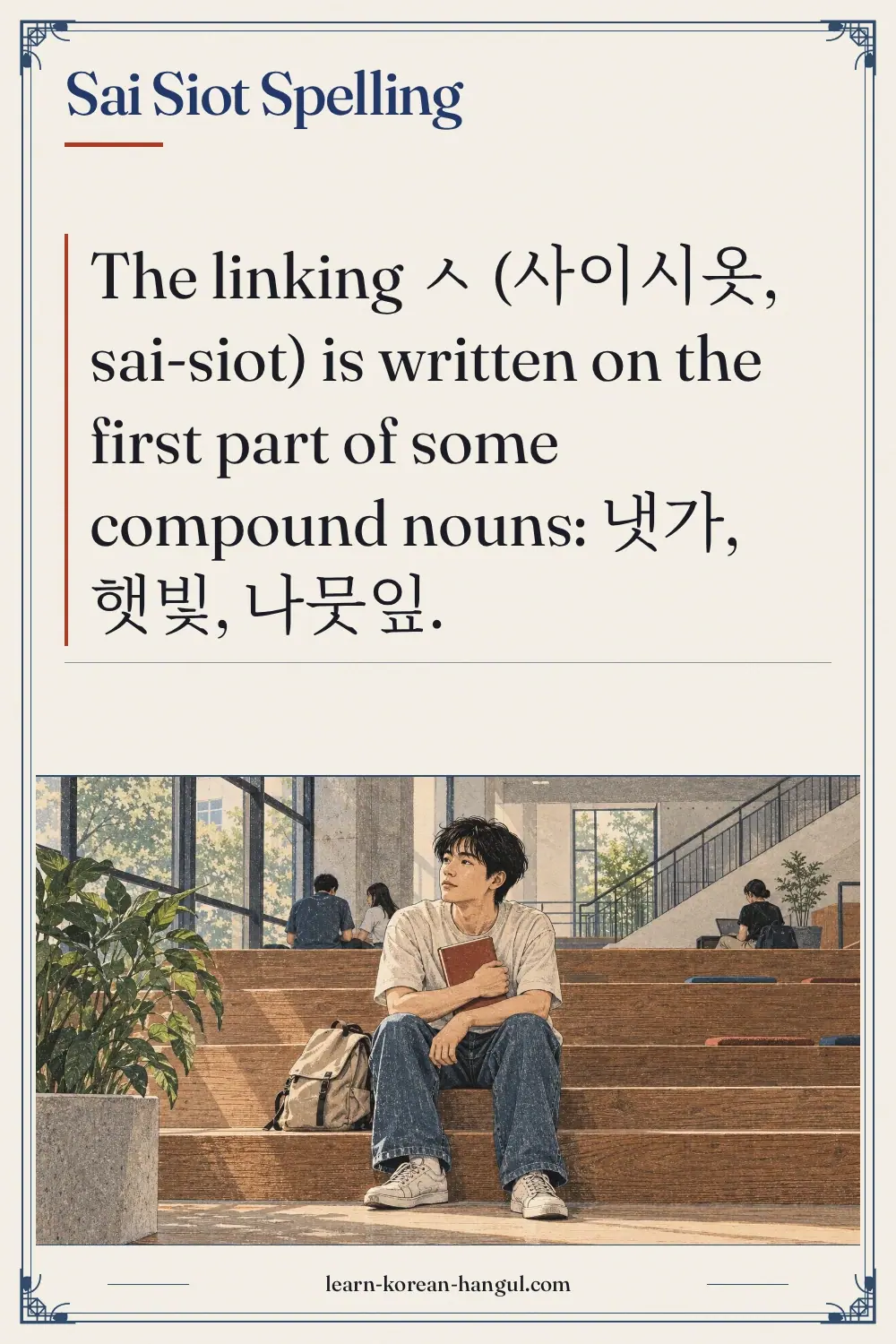
Sai siot (사이시옷, "the ㅅ in between") is the letter ㅅ written between two parts of a compound word, attached to the first part. It is not a word or a particle. It is a spelling mark that points to a sound change.
Three words show the pattern.
| Parts | Compound | RR | Said |
|---|---|---|---|
| 내 (stream) + 가 (edge) | 냇가 | naetga | [내까] |
| 해 (sun) + 빛 (light) | 햇빛 | haetbit | [해삗] |
| 코 (nose) + 날 (blade, ridge) | 콧날 | konnal | [콘날] |
In each word the first part ends in a vowel (내, 해, 코). Without the ㅅ you would see 내가, 해빛 and 코날, which do not look like the compound at all. The ㅅ keeps the compound visible and shows that something happens at the joint when you say it.
Listen to a sentence with the first word.
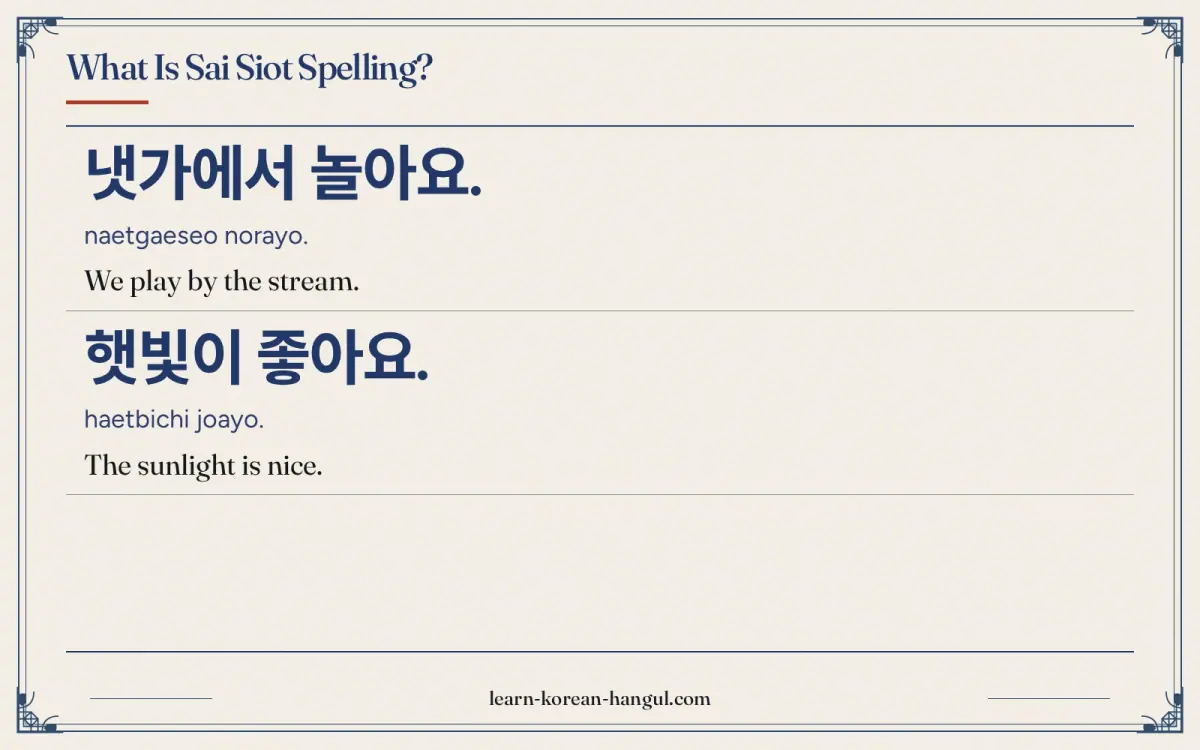
냇가에서 놀아요.
naetgaeseo norayo.
We play by the stream.
It is said [내까에서 노라요]. The ㅅ is not heard as a separate sound, but the ㄱ after it becomes tense.
햇빛이 좋아요.
haetbichi joayo.
The sunlight is nice.
It is said [해삐치 조아요]. The ㅂ of 빛 is tense in the compound, and the final ㅊ of 빛 moves on to 이.
Why English Speakers Struggle Here
English speakers struggle because English spelling does not mark anything like this. A compound such as "sunlight" is just two words joined, with no mark at the joint. In Korean the mark sits inside the word, and it stands for a sound rather than a letter you can hear.
Three things make the problem worse.
- You cannot hear the ㅅ. Syllable-final ㅅ is said as ㄷ or dropped, so a speaker says [해삗] and hears no clear ㅅ at the end of 해.
- The parts hide. If you do not know that 햇빛 is 해 + 빛, the ㅅ looks like part of a strange word.
- The rule has exceptions in both directions. Some compounds that sound similar have no ㅅ at all, and six Sino-Korean ones keep it.
The result is that learners guess. A better method is to check four conditions in order. The method is simple and works for most nouns.
What Is the Linking ㅅ?
The linking ㅅ is a mark of a sound change that happens when two nouns join. The orthography (한글 맞춤법, Article 30, from the National Institute of Korean Language, 국립국어원) writes it when speech shows one of three signals at the joint. The Standard Pronunciation Rules (표준 발음법, Article 30) describe the same three signals.
| Signal in speech | Example | Said | What you hear |
|---|---|---|---|
| The first consonant of the second part becomes tense | 냇가, 햇빛 | [내까], [해삗] | ㄱ → ㄲ, ㅂ → ㅃ |
| An extra ㄴ before ㄴ or ㅁ | 콧날, 아랫니 | [콘날], [아랜니] | the ㅅ is heard as ㄴ |
| An extra ㄴㄴ before a vowel | 나뭇잎, 깻잎 | [나문닙], [깬닙] | two ㄴ sounds appear |
The third signal is the one learners find strangest. In 나뭇잎 (tree leaf), the second part 잎 starts with a vowel. In speech you hear [나문닙], with a new ㄴ that is not written anywhere else. The ㅅ in 나뭇 stands for that ㄴㄴ. The rule that adds the ㄴ is covered in Korean n insertion.
The sentence 나뭇잎이 떨어져요 ("The leaves fall") is said [나문니피 떠러저요]. The sound change behind the first signal is explained in Korean tensification, and the sound-change side of this spelling mark is in Korean sai siot.
When Does a Compound Take It?
A compound takes the linking ㅅ only when all four conditions are true. Ask the questions in order, and stop at the first "no".
- Is it a compound noun? Two nouns joined into one word. Verbs, adjectives and particles do not take it.
- Is at least one part native Korean, with no loanword part? Native plus native (냇가), native plus Sino-Korean (귓병, "ear disease") and Sino-Korean plus native (전셋집) can take it. Two Sino-Korean parts cannot, except the six exceptions below, and a compound with a loanword part never does.
- Does the first part end in a vowel? If it ends in a consonant, there is no place for the ㅅ: 꽃잎 [꼰닙] and 눈사람 have no linking ㅅ.
- Does speech show a signal? A tense consonant, an extra ㄴ or an extra ㄴㄴ at the joint. If the second part is already tense or aspirated, there is nothing to mark.
If all four answers are "yes", write the ㅅ on the first part.
| Compound | 1 Noun? | 2 Native part? | 3 Vowel ending? | 4 Signal? | Spelling |
|---|---|---|---|---|---|
| 내 + 가 | yes | yes | yes | tense [까] | 냇가 |
| 해 + 돋이 | yes | yes | yes | no, [해도지] | 해돋이 |
| 위 + 쪽 | yes | yes | yes | no, 쪽 already tense | 위쪽 |
| 꽃 + 잎 | yes | yes | no | not applicable | 꽃잎 |
| 개 + 수 (個數) | yes | no, both Sino | yes | not applicable | 개수 |
| 핑크 + 빛 | yes | no, 핑크 is a loanword | not applicable | not applicable | 핑크빛 |
The last row needs a note. 핑크 is a loanword, and the compounds of loanwords take no ㅅ, so the usual spelling is 핑크빛 and not 핑큿빛. Because the loanword part is outside the rule, only a native or Sino-Korean first part can carry the mark.
Two contrasts give the limit of the rule. 햇빛 has a tense sound at the joint [해삗]. 해돋이 ("sunrise") does not, so it is written without ㅅ. In the same way, 위쪽 and 위층 have no ㅅ because 쪽 and 층 already begin with a strong consonant. The spellings 윗쪽 and 윗층 are errors.
What Are the Six Sino-Korean Exceptions?
Six compounds are made of Sino-Korean parts, and the orthography still writes the linking ㅅ in them. They are fixed words, so you learn them as a list.
| Word | RR | Said | Meaning |
|---|---|---|---|
| 곳간 | gotgan | [고깐] | storehouse |
| 셋방 | setbang | [세빵] | rented room |
| 숫자 | sutja | [수짜] | number, digit |
| 찻간 | chatgan | [차깐] | train compartment |
| 툇간 | toetgan | [퇴깐] | covered space at the side of a traditional house |
| 횟수 | hoetsu | [회쑤] | number of times |
Of the six, 숫자 (number, figure) and 횟수 (number of times) are the common ones. The other four are rare, and you will meet them mostly in reading. Compare these with ordinary Sino-Korean compounds that have no ㅅ: 개수 (number of items), 대가 (price paid), 초점 (focus) and 치과 (dentistry). They sound tense in places, but they take no ㅅ.
A useful memory aid is the word 숫자. People who spell it 수자 do so because they hear no ㅅ. Remember that 숫자 and 횟수 are the two everyday exceptions, and the rest of the Sino-Korean compounds follow the general rule.
How Is It Pronounced?
The written ㅅ is not said as a sound of its own. Its job is to mark a change in the next syllable, so the pronunciation depends on the signal.
| Written | Signal | Said | RR |
|---|---|---|---|
| 냇가 | tense ㄱ | [내까] | naetga |
| 바닷가 | tense ㄱ | [바다까] | badatga |
| 햇빛 | tense ㅂ | [해삗] | haetbit |
| 촛불 | tense ㅂ | [초뿔] | chotbul |
| 콧날 | extra ㄴ | [콘날] | konnal |
| 시냇물 | ㅅ → ㄴ before ㅁ | [시낸물] | sinaenmul |
| 빗물 | ㅅ → ㄴ before ㅁ | [빈물] | binmul |
| 나뭇잎 | extra ㄴㄴ | [나문닙] | namunnip |
For words with a tense signal, Article 30 of the pronunciation rules makes the reading without ㄷ the main one and also allows a final ㄷ, such as [낻까] for 냇가 or [핻삗] for 햇빛. The first reading is the one to learn. Revised Romanization writes the ㅅ at the end of a syllable as t, which is why 냇가 is naetga. It does not show the tense sound of [내까], because tensing caused by a sound change is not written in RR.
Worked Example: 냇가
This is the decision for one word, step by step.
- Hear the word. You hear [내까] and want to write it.
- Split it. The parts are 내 ("stream") and 가 ("edge, side"). Both are native Korean nouns.
- Check the first part. 내 ends in a vowel, so the ㅅ can attach.
- Check the signal. The ㄱ of 가 is tense in speech ([까]), so there is a signal.
- Write. 내 + ㅅ + 가 = 냇가.
The word 시냇물 ("stream water") follows the same method. 시내 + 물 has a vowel-final first part, and the speech has the signal [낸]. So the spelling is 시냇물.
The two words 냇가 and 시냇물 show that the ㅅ sits on the first part and then the second part follows in its normal spelling. They also show that the extra ㅅ is invisible in the sound: you do not say a separate ㅅ.
Common Learner Mistakes
Five mistakes cover most errors. Each follows the pattern "learners often assume X, but actually Y, because Z".
- Leaving it out. Learners often write 내가 for 냇가, or 나무잎 for 나뭇잎. Actually a vowel-final first part plus a signal needs the ㅅ.
- Adding it everywhere. Learners often write 윗쪽 or 핑큿빛. Actually the second part may already be tense, or the word may be a loanword.
- Adding it after a consonant. Learners sometimes try to add the mark to 꽃잎 or 눈사람. Actually the ㅅ needs a vowel-final first part, so these two stay plain.
- Forgetting the six exceptions. Learners often write 수자 or 회수 for 숫자 and 횟수. Actually these two keep the ㅅ even though they are Sino-Korean.
- Reading the ㅅ as a separate sound. Learners often say 냇가 with a clear s before the ㄲ. Actually the ㅅ only marks the change in the next syllable.
Honest limit of this lesson: the rule is not completely mechanical. A few compounds follow tradition more than logic, and the dictionary spells them as it does. The conditions here cover the common words. For any compound that is not on this page, check the Standard Korean Language Dictionary (표준국어대사전) and the current 한글 맞춤법.
Practice and Answer Key
Join the two parts into one compound. Decide whether the ㅅ is needed, and write the result. Do all ten before you check the answers.
- 해 + 빛
- 나무 + 잎
- 코 + 날
- 바다 + 가
- 비 + 물
- 수 + 자 (Sino-Korean 數字)
- 위 + 쪽
- 해 + 돋이
- 개 + 수 (Sino-Korean 個數)
- 전세 + 집
Practice · 5
Which is the standard spelling of "tree leaf"?
Show answer
나뭇잎
나무 ends in a vowel, both parts are native Korean, and speech has an extra ㄴㄴ, so the linking ㅅ is written.
Which is the standard spelling of "upper side"?
Show answer
위쪽
쪽 already begins with a tense consonant, so there is no linking ㅅ.
Which Sino-Korean compound keeps the ㅅ?
Show answer
횟수
횟수 is one of the six exceptions: 곳간, 셋방, 숫자, 찻간, 툇간, 횟수.
Which is the standard spelling of "sunrise"?
Show answer
해돋이
해돋이 has no tense sound or extra ㄴ at the joint ([해도지]), so there is no linking ㅅ.
Which is the standard spelling of "number, digit"?
Show answer
숫자
숫자 is one of the six Sino-Korean compounds that keep the linking ㅅ.
Answer Key
- 햇빛 (haetbit) [해삗]. Vowel-final 해, tense ㅂ, so ㅅ.
- 나뭇잎 (namunnip) [나문닙]. Extra ㄴㄴ, so ㅅ.
- 콧날 (konnal) [콘날]. Extra ㄴ, so ㅅ.
- 바닷가 (badatga) [바다까]. Tense ㄱ, so ㅅ.
- 빗물 (binmul) [빈물]. ㅅ is heard as ㄴ before ㅁ, so ㅅ.
- 숫자 (sutja) [수짜]. One of the six Sino-Korean exceptions.
- 위쪽 (wijjok). 쪽 is already tense, so no ㅅ. Do not write 윗쪽.
- 해돋이 (haedoji) [해도지]. No signal, so no ㅅ.
- 개수 (gaesu) [개쑤]. Both parts are Sino-Korean and 개수 is not one of the six, so no ㅅ.
- 전셋집 (jeonsetjip) [전세찝]. Sino-Korean 전세 plus native 집, vowel-final first part, tense ㅈ, so ㅅ.
If you made an error, go back to the four-question checklist and mark where the answer was "no". Items 7 to 9 are the ones that test whether you over-apply the rule.
Where to Go Next
The next lesson, the Korean spell checker guide, shows how a spelling checker can flag these words and where it can still miss an error. The previous lesson, ㄹ게 vs ㄹ께, is another case where a tense sound is heard and not written in the usual way. This page belongs to the Korean spelling rules section, and spaces between words are taught in Korean spacing rules.
In short, the sai siot rule is a checklist: a compound noun, a native part, a vowel-final first part and a sound signal, and then the ㅅ.
Frequently Asked Questions
What Is Sai-Siot?
Sai-siot (사이시옷) means "the ㅅ in between". It is a ㅅ written at the end of the first part of a compound noun, as in 냇가 (streamside) and 햇빛 (sunlight). It marks a sound change in speech, a tense sound or an extra ㄴ, that happens at the joint of the two parts.
Why Is It 나뭇잎 and Not 나무잎?
Because the compound meets all the conditions. 나무 (tree) ends in a vowel, both parts are native Korean, and speech has an extra ㄴㄴ sound: 나뭇잎 is said [나문닙]. The ㅅ shows that a sound is added at the joint. 나무잎 would not show this, so the standard spelling is 나뭇잎.
Which Sino-Korean Words Use It?
Six: 곳간 (storehouse), 셋방 (rented room), 숫자 (number, digit), 찻간 (train compartment), 툇간 (a covered space at the side of a traditional house) and 횟수 (number of times). All other Sino-Korean compounds, such as 개수, 대가 and 초점, are written without the ㅅ.
How Is 햇빛 Pronounced?
햇빛 is said [해삗] or [핻삗]. The ㅅ at the end of 햇 is said as ㄷ, or it is not said at all, and the next consonant ㅂ becomes tense (ㅃ). So the written ㅅ is the clue that the ㅂ is tense. Revised Romanization writes it as haetbit.
Is It 윗층 or 위층?
It is 위층. When the second part already begins with a tense or aspirated consonant, as in 층, 쪽 and 뜰, no ㅅ is added. So the standard spellings are 위층, 위쪽, 아래층 and 뒤뜰, and 윗층, 윗쪽 and 뒷뜰 are errors.