What Is ㄹ게 vs ㄹ께?
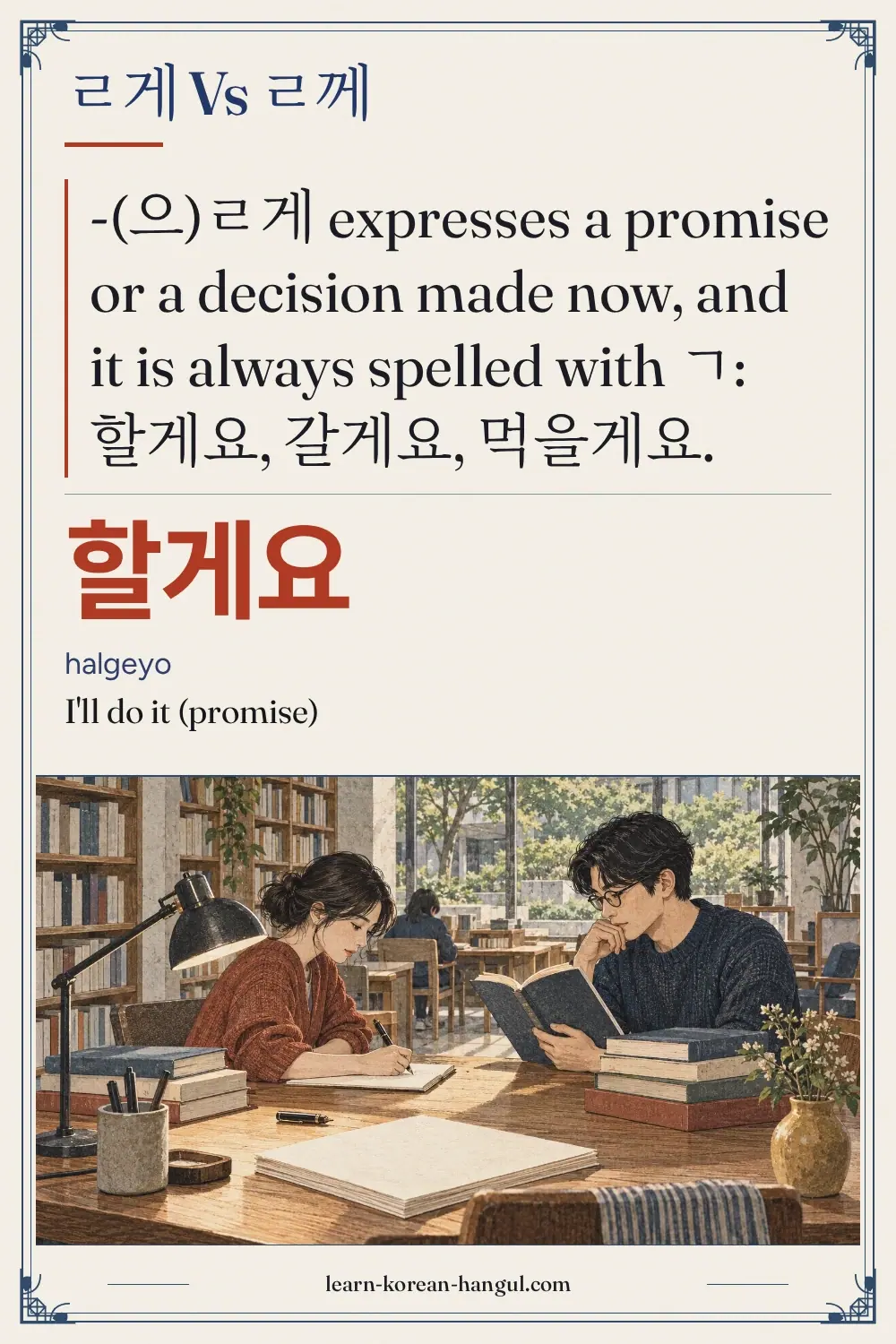
The pair ㄹ게 vs ㄹ께 is the choice between a correct spelling and its common error. The ending -(으)ㄹ게 attaches to a verb stem and says "I will do it". The tense consonant is heard, but only ㄱ is written.
| Written | RR | Said | Meaning |
|---|---|---|---|
| 할게요 | halgeyo | [할께요] | I'll do it |
| 갈게요 | galgeyo | [갈께요] | I'll go |
| 먹을게요 | meogeulgeyo | [머글께요] | I'll eat it |
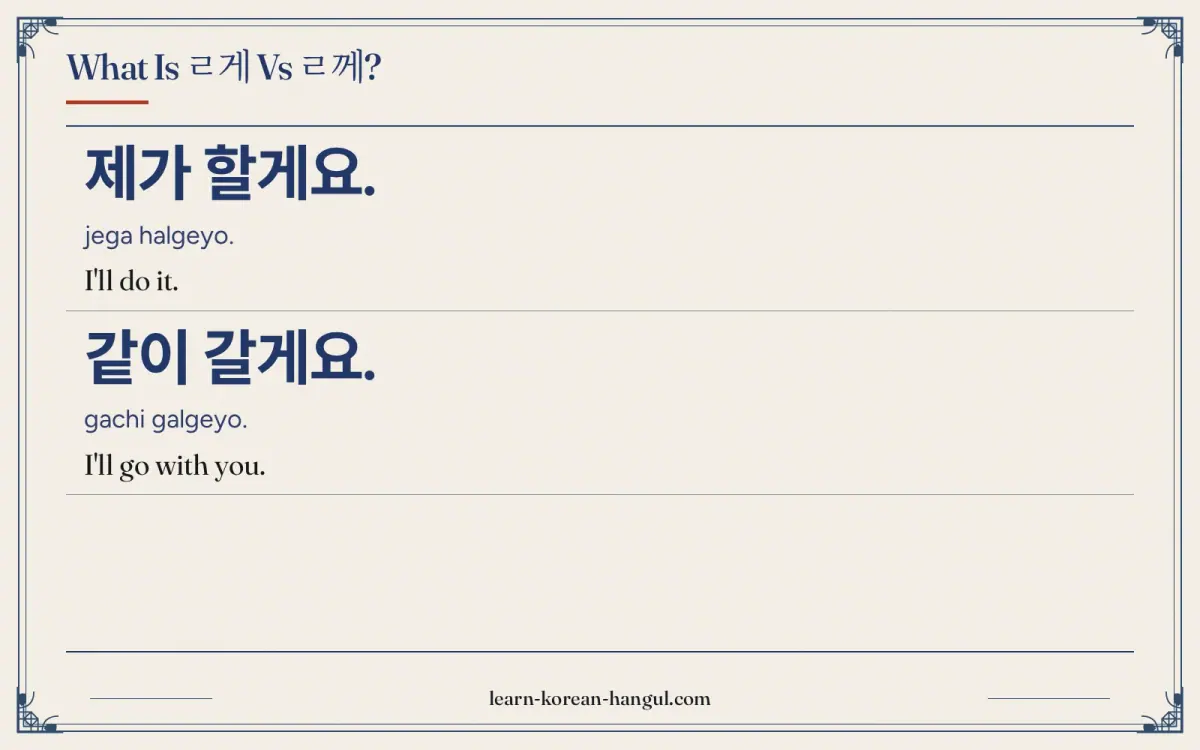
Listen to the first example. The speaker offers to do something.
제가 할게요.
jega halgeyo.
I'll do it.
The sentence is said [제가 할께요]. In the second example the speaker promises to join someone.
같이 갈게요.
gachi galgeyo.
I'll go with you.
It is said [가치 갈께요]. Note that 같이 is said [가치], because ㅌ before 이 becomes ㅊ. This is a separate sound change, and 같이 is always written 같이.
Revised Romanization writes ㄱ as g in halgeyo. It does not show the tense sound of [할께요], because the tensing comes from a neighbouring sound and not from a letter.
Why English Speakers Struggle Here
English speakers struggle because a tense consonant sounds like a different letter. English has no tense/plain contrast, so [께] seems the same as ㄲ, and learners type what they hear. In chat, 할께요 and 갈께요 are very common, even among Koreans, so a learner sees the wrong spelling more often than the right one.
Three further facts add to the confusion.
- Hangul has a letter for the sound. ㄲ exists, and it is used in other words such as 까치 ("magpie"). A learner thinks "this sound, this letter".
- The question ending uses ㄲ. 할까요? is spelled with ㄲ. So both spellings look familiar.
- Tensing is invisible in the dictionary. The ending is listed as -(으)ㄹ게 with ㄱ, and the pronunciation is not marked.
The aim of this lesson is to give you a rule and a reason, so that the correct spelling feels natural. Start with what the ending means.
What Does -ㄹ게 Mean?
-(으)ㄹ게 expresses a promise, an offer or a decision that the speaker makes at the moment of speaking, for the listener's sake. It is the ending for "OK, I'll do it" or "I'll be right back".
| Sentence | Meaning |
|---|---|
| 제가 할게요. | I'll do it. |
| 같이 갈게요. | I'll go with you. |
| 내일 전화할게요. | I'll call you tomorrow. |
| 이건 제가 먹을게요. | I'll eat this one. |
Three limits shape how you use it.
- The subject is the speaker. -(으)ㄹ게 is for "I" or "we". You cannot say a sentence like 친구가 갈게요 for "my friend will go".
- It is not a question. To ask what the listener wants, use -(으)ㄹ까요 or -(으)ㄹ래요. The lesson on -(으)ㄹ게요 explains the meaning in full.
- It is not the plain future. 갈 거예요 states a plan. 갈게요 offers or promises. The differences between plans and promises are covered in the Korean future tense section.
The ending attaches to the stem. After a vowel or ㄹ, the form is -ㄹ게요 (가 + ㄹ게요 → 갈게요). After another consonant, the form is -을게요 (먹 + 을게요 → 먹을게요). The casual form drops 요: 갈게, 먹을게.
The Casual Form without 요
Friends and family drop 요 and say the casual form. The spelling rule stays exactly the same.
| Polite | Casual | Said (casual) | Meaning |
|---|---|---|---|
| 할게요 | 할게 | [할께] | I'll do it |
| 갈게요 | 갈게 | [갈께] | I'll go |
| 먹을게요 | 먹을게 | [머글께] | I'll eat it |
A casual sentence is 내가 할게 (naega halge), said [내가 할께]. Chat messages are where 할께 appears most, because people type what they hear. In a message to a friend, nobody will mind. In an email, an essay or a test, write 할게.
Why Is It Spelled ㄱ, Not ㄲ?
It is spelled ㄱ because the tense sound is predictable. After the ending -(으)ㄹ, a plain ㄱ, ㄷ, ㅂ, ㅅ or ㅈ is said as a tense sound. This is a sound rule from the Standard Pronunciation Rules (표준 발음법, Article 27). Because every speaker applies it automatically, the orthography does not write it. A reader who knows the rule restores the tense sound alone.
You can see the rule at work in the whole family of endings that start with -(으)ㄹ.
| Ending | Meaning | Written | Said | Example |
|---|---|---|---|---|
| -(으)ㄹ게 | I will (promise) | ㄱ | [ㄹ께] | 할게요 [할께요] |
| -(으)ㄹ걸 | probably; I should have | ㄱ | [ㄹ껄] | 올걸요 [올껄요] |
| -(으)ㄹ수록 | the more | ㅅ | [ㄹ쑤록] | 할수록 [할쑤록] |
| -(으)ㄹ지 | whether | ㅈ | [ㄹ찌] | 갈지 [갈찌] |
| -(으)ㄹ까 | shall I? shall we? | ㄲ | [ㄹ까] | 할까요 [할까요] |
The first four are written with a plain consonant and said with a tense one. The last row is the exception, and the next section explains it. The wider rule for tensification is explained in Korean tensification, and the principle behind unwritten sound changes is in Korean spelling principles.
Here is a sound comparison of three endings, all on the same verb. Listen to the clips in order.
All Three Have a Tense Consonant after ㄹ. Only the Question Ending Is Also Written with ㄲ.
| Korean | Romanization | Meaning | Sound |
|---|---|---|---|
| 할게요 | halgeyo | I'll do it (promise) | |
| 할까요 | halkkayo | Shall I do it? (question) | |
| 올걸요 | olgeoryo | It will probably come (guess) |
What Is the -ㄹ까 Exception?
The exception is that the question ending -(으)ㄹ까 is written with ㄲ. Article 53 of the Hangul Orthography lists -(으)ㄹ게 and -(으)ㄹ걸 among the endings written with a plain consonant, and then names the question endings (-(으)ㄹ까, -(으)ㄹ꼬 and a few others) as the ones written with a tense consonant. So the two endings that sound alike are spelled differently.
| Ending | Meaning | Spelling | Example | Tone at the end |
|---|---|---|---|---|
| -(으)ㄹ게 | promise: I will | ㄱ | 제가 할게요. | falls |
| -(으)ㄹ까 | question: shall I? | ㄲ | 제가 할까요? | rises (yes/no) |
You can hear the difference in what the speaker is doing. A promise falls and closes the topic. A question rises and passes the turn to the listener.
도와 드릴까요?
dowa deurilkkayo?
Shall I help you?
The verb phrase 도와 드리다 ("to help, humble") comes from 돕다 plus 드리다. The ending is -(으)ㄹ까요. It is a yes/no question, so the voice rises at the end. A question word changes that: 뭐 먹을까요? ("What shall we eat?") does not end with a sharp rise. The full lesson on this ending is -(으)ㄹ까요, and the closely related suggestion pattern is in Korean let's grammar.
A memory aid: ㄲ for questions, ㄱ for promises. If the sentence asks the listener something, use ㄲ. If the speaker is making a promise, use ㄱ.
The third ending in the table, -(으)ㄹ걸, is a guess or a regret. 비가 올걸요 means "It will probably rain". A regret uses the pattern -(으)ㄹ걸 그랬다, as in 갈걸 그랬어요 ("I should have gone"). The lesson on -(으)ㄹ걸요 covers both. Its spelling follows the same rule as 할게요: plain ㄱ, tense in speech.
How to Test Any -(으)ㄹ Ending
The test for any ending in this family has three steps.
- Find the ending. Look for -(으)ㄹ at the end of the verb stem.
- Check the meaning. Is it a question to the listener? Then -(으)ㄹ까, written with ㄲ.
- Otherwise use plain letters. A promise is -ㄹ게. A guess or regret is -ㄹ걸. The tense sound is not written.
Apply it to a few new sentences.
| Sentence | Meaning | Ending |
|---|---|---|
| 먼저 갈게요. | I'll go first. | -ㄹ게 |
| 먼저 갈까요? | Shall I go first? | -ㄹ까 |
| 먼저 갔을걸요. | They probably went first. | -ㄹ걸 |
The third sentence uses -(으)ㄹ걸 after a past marker, 갔을걸요. The past marker changes nothing in the spelling rule.
Worked Example: 제가 할게요.
This is the decision for one sentence, step by step.
- Hear the sentence. You hear [제가 할께요]. The word you need to write is the last one.
- Find the stem. The verb is 하다 ("to do"), and the stem is 하.
- Add the ending. After a vowel, the ending is -ㄹ게요, giving 할게요.
- Check the meaning. The speaker offers to do something, so it is a promise: ㄱ.
- Write. 제가 할게요.
The same steps with a question give a different result. If the speaker asks "Shall I do it?", the meaning is a question, so the spelling is 제가 할까요?, with ㄲ.
The pronunciation of 제가 is [제가], with no change. Only the ending has the tense sound.
What Mistakes Do Learners Make Here?
Five mistakes cover most errors. Each follows the pattern "learners often assume X, but actually Y, because Z".
- Writing 할께요. Learners often write what they hear. Actually the tense sound is predictable, so the spelling uses plain ㄱ.
- Writing 할가요 for a question. Learners sometimes overcorrect after learning the ㄱ rule. Actually the question ending is the exception and takes ㄲ: 할까요.
- Using -ㄹ게 for other people. Learners often write 친구가 할게요. Actually this ending is for the speaker's own promise.
- Writing 올껄요 or 갈껄. Learners often copy chat spellings. Actually the standard spelling is -(으)ㄹ걸 with ㄱ.
- Confusing -ㄹ게 with -ㄹ 거예요. Learners often use them as the same. Actually 갈 거예요 states a plan, and 갈게요 makes an offer or promise. Even in -ㄹ 거예요, the 거 is said tense ([갈꺼예요]) but written with ㄱ.
Honest limit of this lesson: it covers the common endings. The full list of endings that take tense consonants in writing includes literary forms that learners rarely meet, such as -(으)ㄹ꼬. Check an unfamiliar ending in the Standard Korean Language Dictionary (표준국어대사전).
Practice and Answer Key
Fill each blank with the correct syllable (게/께, 까/가, 걸/껄). Do all eight before you check the answers.
- 제가 먼저 갈___요.
- 같이 갈___요? (Shall we go together?)
- 내일 전화할___요.
- 비가 올___요. (It will probably rain.)
- 뭐 먹을___요? (What shall we eat?)
- 도와 드릴___요?
- 이건 제가 먹을___요.
- 그냥 갈___ 그랬어요. (I should have just gone.)
Practice · 3
Which is the standard spelling of "I'll do it"?
Show answer
제가 할게요.
The promise ending is spelled with plain ㄱ, and the tense sound is not written.
Which is correct for "Shall I help you?"
Show answer
도와 드릴까요?
The question ending -(으)ㄹ까 is the exception and is written with ㄲ.
Which is correct for "It will probably rain"?
Show answer
비가 올걸요.
-(으)ㄹ걸 is written with plain ㄱ, although it is said [올껄요].
Answer Key
- 제가 먼저 갈게요. (jega meonjeo galgeyo) [제가 먼저 갈께요]. A promise, so ㄱ.
- 같이 갈까요? (gachi galkkayo) [가치 갈까요]. A question to the listener, so ㄲ.
- 내일 전화할게요. (naeil jeonhwahalgeyo) [내일 전화할께요]. A promise, so ㄱ.
- 비가 올걸요. (biga olgeoryo) [비가 올껄요]. A guess, so plain ㄱ.
- 뭐 먹을까요? (mwo meogeulkkayo) [뭐 머글까요]. A question, so ㄲ. This is a question with a question word, so the voice does not rise sharply at the end.
- 도와 드릴까요? (dowa deurilkkayo). A yes/no question, so ㄲ, and the voice rises.
- 이건 제가 먹을게요. (igeon jega meogeulgeyo) [이건 제가 머글께요]. A promise, so ㄱ.
- 그냥 갈걸 그랬어요. (geunyang galgeol geuraesseoyo) [그냥 갈껄 그래써요]. A regret, so plain ㄱ.
If you made an error, apply the three-step test again, starting with the meaning. Most errors are on item 2, 5 or 6, where learners overcorrect after learning the ㄱ rule.
Where to Go Next
The next spelling lesson is Sai siot spelling, another case where a sound is heard and not written in the same way. This page belongs to the Korean spelling rules section, and spacing is covered in Korean spacing rules. For the grammar of the ending, go to -(으)ㄹ게요.
To keep the ㄹ게 vs ㄹ께 rule in one line: write ㄱ for a promise, ㄲ for a question, and let the tense sound take care of itself.
Frequently Asked Questions
Is It 할게 or 할께?
It is 할게. The standard spelling uses ㄱ, as in 할게요, 갈게요 and 먹을게요. The spelling 할께 is a very common mistake, because the ending is said with a tense sound, [할께]. The tensing follows a regular rule after -(으)ㄹ, so the spelling does not mark it.
Why Is 할까 Spelled with ㄲ?
The question ending -(으)ㄹ까 is a written exception. The orthography lists the question endings -(으)ㄹ까 and -(으)ㄹ꼬 as spelled with a tense consonant, even though the sound is the same kind as in 할게. So you write 할까요? with ㄲ and 할게요 with ㄱ. Memorise this contrast as one pair.
What Does -ㄹ게 Mean?
-(으)ㄹ게 means "I will", said as a promise or as a decision made at the moment of speaking, usually for the listener. 제가 할게요 means "I will do it". The subject is normally the speaker, and the ending is not used for questions or for other people.
Is 갈께요 Wrong?
Yes, in standard writing. The correct spelling is 갈게요, said [갈께요]. You will see 갈께요 often in chat messages because it matches the sound, but in an essay, an email to a teacher or a test it counts as a spelling error.
How Is -ㄹ걸 Spelled?
-(으)ㄹ걸 is spelled with ㄱ, as in 올걸요 ("It will probably come"), and it is said [올껄요]. Like -(으)ㄹ게, its tense sound is predictable. Do not write 올껄요, although you will see it in messages.