Name endings are small, but they carry a lot of information. The same name can be said as 민준아, 민준 씨 or 김민준 님, and each one tells the listener how the speaker sees the relationship. The lesson sits inside the topic of names, so for the question of who to use which form with, see Korean names how to address. For the grammar side, see Korean particles, and for every name topic, see the Korean names hub.
Korean Name Endings Meaning: the Essentials
Korean name endings are short words or particles added after a name to show how you speak to or about a person. There are four you need now.
| Ending | What it is | Level | Example with 민준 |
|---|---|---|---|
| -아 / -야 | Vocative particle, used to call someone | Casual, close | 민준아, 이리 와 |
| -씨 | Dependent noun after a name | Polite, neutral | 민준 씨 |
| -님 | Respectful suffix | Respectful | 김민준 님 |
| (none) | Bare name | Close, or neutral in writing | 민준 |
The vocative particle -아/야 is a form of address. You use it when you are speaking to the person, not about them. It makes the name a call: 민준아! means "Minjun!" or "Hey, Minjun". It cannot be used about a person who is not in the conversation. The endings 씨 and 님 can be used both to the person and about the person, and they work in writing as well.
How Does -아/야 Work?
The rule has one test: does the name end in a consonant or in a vowel? Look at the last block of the name. If it has a final consonant (a 받침), add -아. If it ends in a vowel, add -야. The table shows ten names, plus two with a final ㄹ.
| Name | Last block | Ends in | Call form | Spoken |
|---|---|---|---|---|
| 민준 | 준 | consonant ㄴ | 민준아 | [민주나] |
| 서연 | 연 | consonant ㄴ | 서연아 | [서여나] |
| 수빈 | 빈 | consonant ㄴ | 수빈아 | [수비나] |
| 하윤 | 윤 | consonant ㄴ | 하윤아 | [하유나] |
| 도현 | 현 | consonant ㄴ | 도현아 | [도혀나] |
| 채원 | 원 | consonant ㄴ | 채원아 | [채워나] |
| 은서 | 서 | vowel | 은서야 | [은서야] |
| 지아 | 아 | vowel | 지아야 | [지아야] |
| 지우 | 우 | vowel | 지우야 | [지우야] |
| 재우 | 우 | vowel | 재우야 | [재우야] |
| 하늘 | 늘 | consonant ㄹ | 하늘아 | [하느라] |
| 보람 | 람 | consonant ㅁ | 보람아 | [보라마] |
Two sound facts matter here. First, a final consonant links to the 아 that follows it, so 민준아 is said [민주나], with the ㄴ moving onto the empty ㅇ. This is liaison. The written name keeps its final consonant, but the ear hears it on the next syllable. Second, after a vowel the sound is simple: 은서야 is [은서야] and 지우야 is [지우야], with nothing moved. The difference between 은서야 and 지우야 is only which vowel comes before 야.
Why Is the Rule about the Last Sound?
The reason is the sound itself. The vocative has two forms for the same reason that Korean has 은/는 and 이/가: a consonant-final name needs a vowel to start the next syllable, and a vowel-final name does not. After a consonant, 아 supplies a vowel. After a vowel, the extra y sound of 야 keeps the two vowels apart. If you say 지아아, the two ㅏ sounds run together. Say 지아야 and the 야 gives a clean beat.
What about the Extra 이 on Names?
In casual talk about a friend or a child, a name that ends in a consonant often gets an extra 이: 민준이가 왔어요 ("Minjun came") and 민준이는 어디 갔어요? ("Where did Minjun go?"). This -이 is not the vocative. It is a friendly add-on in speech about someone, and it does not appear on names that end in a vowel, so 지아가 왔어요 stays 지아가. When you call the person directly, use 아 or 야: 민준아, 지아야.
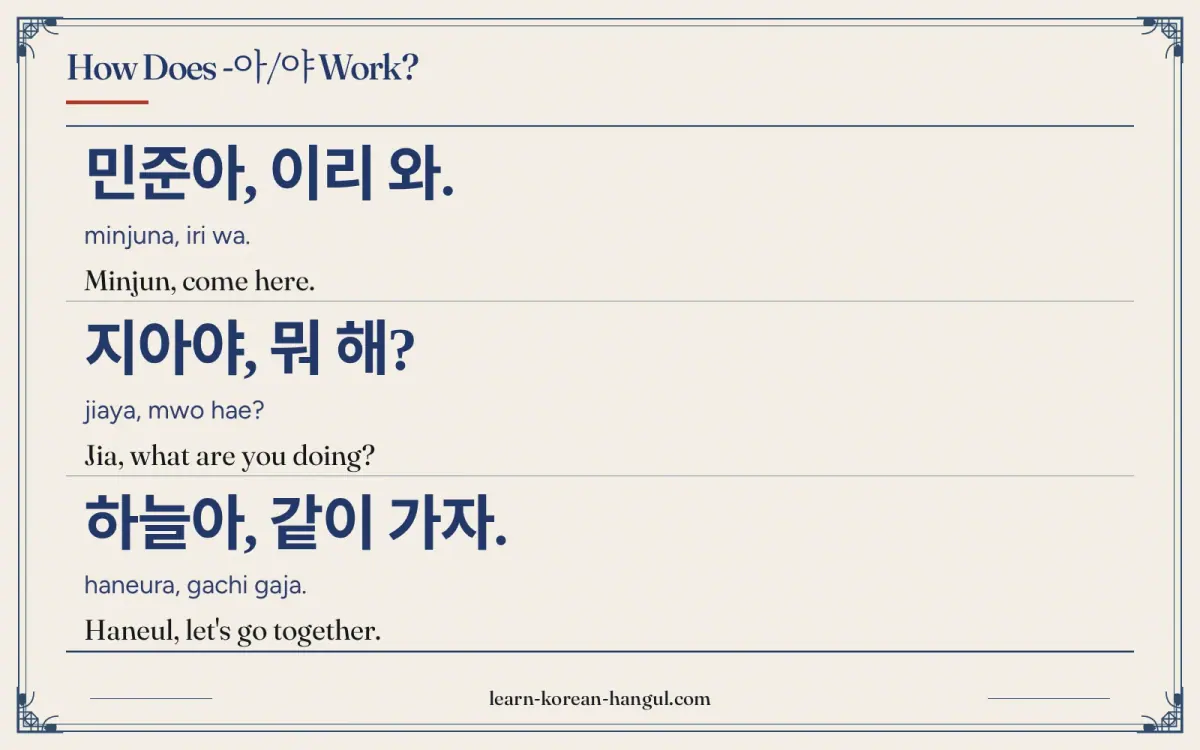
민준아, 이리 와.
minjuna, iri wa.
Minjun, come here.
지아야, 뭐 해?
jiaya, mwo hae?
Jia, what are you doing?
하늘아, 같이 가자.
haneura, gachi gaja.
Haneul, let's go together.
The first is said [민주나, 이리 와], the second is said [지아야, 뭐 해], and the third is said [하느라, 가치 가자], where 같이 changes to [가치]. All three are casual sentences, which fits a call to a friend.
How Do 씨 and 님 Differ?
씨 is polite and neutral, and 님 is respectful. The difference is the direction of the respect. 씨 is used for peers and for people below you, and 님 is used for people above you and for customers. A good way to remember is that 씨 follows a name and 님 follows a title.
| Ending | Attaches to | Use | Example | Note |
|---|---|---|---|---|
| -아/야 | A given name | Casual call | 민준아 | Friends and younger people only |
| 씨 | A name | Polite | 민준 씨, 김민준 씨 | Not for a boss or an elder |
| 님 | A title or role | Respectful | 사장님, 선생님, 고객님 | The usual form upward |
| 님 | A full name in writing | Formal | 김민준 님 | Messages, service text, notices |
Spacing follows the same logic. 씨 is written as a separate word after a name: 민준 씨. 님 is written attached to a title: 사장님, 선생님. After a full name in service writing, 님 is written as a separate word: 김민준 님.
민준 씨, 이쪽으로 오세요.
minjun ssi, ijjogeuro oseyo.
Minjun, please come this way.
사장님, 안녕하세요?
sajangnim, annyeonghaseyo?
President, hello.
The first is said [민준 씨, 이쪼그로 오세요], and the second is said [사장님, 안녕하세요]. Notice that the first sentence uses the honorific -세요 with 씨. Polite speech and 씨 fit together, and so do the respectful forms and 님. For the full comparison, see Korean honorifics ssi vs nim.
Does the Final Sound Change How -아 Is Said?
Yes, and the change depends on the final consonant. Most final consonants move onto the empty ㅇ of 아, but the final ㅇ does not move, because ㅇ at the end of a block is the sound "ng" and it stays where it is. The table shows six final sounds, each with a call form.
| Final sound | Name | Call form | Spoken | What happens |
|---|---|---|---|---|
| ㄴ | 민준 | 민준아 | [민주나] | ㄴ moves to the next syllable |
| ㄹ | 하늘 | 하늘아 | [하느라] | ㄹ moves to the next syllable |
| ㅁ | 보람 | 보람아 | [보라마] | ㅁ moves to the next syllable |
| ㅇ (ng) | 지영 | 지영아 | [지영아] | ㅇ stays; the 아 is a separate beat |
| ㄱ | 민혁 | 민혁아 | [민혀가] | ㄱ moves and is said as a plain ㄱ |
| ㅂ | 지섭 | 지섭아 | [지서바] | ㅂ moves and is said as a plain ㅂ |
Listen to the difference between 민준아 and 지영아. In the first, you hear 주 + 나. In the second, you hear 영 and then 아 as two clear beats. Write the name as it is spelled and let the ear do the linking. If you write 민주나 for 민준아, you have spelled the sound instead of the name, and the reader will not recognise the name.
What Is a Quick Method for Choosing an Ending?
Follow four steps, in this order, every time you need to address someone by name.
- Decide the relationship. Is the person close, polite-distance or above you?
- Choose the ending family. Close and equal or younger: -아/야. Polite and level: 씨. Above you or a customer: 님 with a title or role.
- Look at the last sound if you chose -아/야. A consonant takes 아 and a vowel takes 야.
- Match the sentence. A casual call takes a casual sentence, 씨 takes the polite style, and 님 takes the honorific style.
Run the steps on 김민준 and a friend. The friend is close, so use -아/야. The name ends in the consonant ㄴ, so use 아: 민준아. The sentence is casual: 민준아, 밥 먹었어? Now run them on a customer named 김민준. The customer is above you in a service setting, so use 님. A title fits better than a name, so 고객님, and the sentence is honorific: 고객님, 잠시만 기다려 주세요.
Who Calls Whom?
The direction of the call matters as much as the ending. The table shows who may use which form.
| Speaker | Listener | Common form | Why |
|---|---|---|---|
| Older or senior | Younger or junior | 민준아, 민준 씨 | The senior may be casual or polite |
| Younger or junior | Older or senior | 선생님, 과장님, 형, 언니 | The junior uses titles or kin terms |
| Close friends of the same age | Each other | 민준아 | Both have agreed to casual speech |
| Adults who just met | Each other | 민준 씨 | Polite and neutral |
| Staff | Customer | 고객님 | Respect, by role |
The senior holds the choice. A younger person should not start with 아/야 to an older one, and an older person may offer casual speech by asking 말 편하게 할까요? ("Shall we speak casually?"). Until the offer comes, keep to 씨 and 님.
When Is -아/야 Inappropriate?
Use -아/야 only when the relationship allows it. It is not a polite ending, and it does not mean "please". These are the cases where you should not use it.
- With strangers. Calling someone you have just met by 아/야 is too familiar, even if they are younger than you.
- With older people. A bare name with 아/야 to someone older than you sounds disrespectful, even if you know them well.
- In professional settings. At work, use 씨 or a title, unless a colleague has asked you to be casual.
- With customers. Use 고객님 or a name plus 님.
- With people who have not agreed to it. Casual speech (반말) is usually offered by the older or higher person. Wait for that offer. See 나 너 banmal pronouns and 아/야 for how the offer works.
Notice what the safe cases have in common: the two people are close, they are about the same age or the listener is younger, and they have already moved to casual speech. If any of those is missing, use 씨 or 님.
What Are Common Mistakes and Fixes?
These errors come up most often.
- Using 야 after a consonant. 민준야 is wrong. A name that ends in a consonant takes 아: 민준아.
- Using 아 after a vowel. 지아아 is wrong. A name that ends in a vowel takes 야: 지아야.
- Attaching 씨 to a title. 사장씨 is wrong. A title takes 님: 사장님.
- Using 아/야 with a title. 김 과장아 is wrong and rude. A title takes 님: 김 과장님.
- Using 씨 for your boss. 민준 씨 is polite, but it is not respectful enough for a superior.
- Stacking endings. 민준 씨야 is wrong. Use one ending only.
A better habit is to find the last sound of the name, choose the ending by the relationship, and check the sentence ending. If the call is casual, the sentence is casual too.
Practice Set
Answer the six questions. Each one tests a rule from this lesson.
Practice · 6
You want to call a close friend named 민준. Which form is correct?
Show answer
민준아
민준 ends in a consonant (ㄴ), so it takes 아: 민준아. 야 follows a vowel.
You want to call a close friend named 지아. Which form is correct?
Show answer
지아야
지아 ends in a vowel, so it takes 야: 지아야.
Which form suits your boss, section chief 김?
Show answer
김 과장님
A title takes 님 for respect. 아 is casual and 씨 attaches to names, not to titles.
Why is 사장씨 wrong?
Show answer
씨 cannot attach to a title; titles take 님
씨 follows a name. A title takes 님, as in 사장님.
How is 하늘아 said aloud?
Show answer
[하느라]
The final ㄹ of 하늘 moves onto the empty ㅇ of 아, so you hear 하-느-라.
Who can you call with 아/야?
Show answer
A close friend of your own age or younger
아/야 is a casual call for close friends and younger people. It is too familiar for a senior or a stranger.
Frequently Asked Questions
Why Do Names End in 아 or 야?
They end in 아 or 야 because those are the vocative particle, which Korean speakers add to a given name when they call someone. 아 follows a consonant and 야 follows a vowel, so 민준아 and 지아야 are both calls. The ending is casual and is used for close friends and younger people.
Can I Use 아/야 with a Stranger?
No. Calling a stranger by 아/야 is too familiar and can sound rude, even if the person is younger than you. Use the name with 씨, or a title with 님, until you know the person well and they invite you to be casual.
Is 아/야 Used for Adults?
Yes, between adult friends of similar age who are close, and by an older person to a younger one. It is not used to an adult who is older or senior, or in work settings with people you do not know well. In those cases, use 씨 or a title.
How Do I Call My Teacher?
Call a teacher 선생님, with or without the name: 선생님 or 김 선생님. Never use 아/야 with a teacher, and do not use 씨. Use the honorific sentence ending -세요 too, as in 선생님, 안녕하세요?