
Korean names are written with the family name first, as in 김민준 (Kim Min-jun), followed by a given name that is usually two syllables. Each syllable is one Hangul block, so most full names are three blocks long. This section explains surnames, given names, romanization and how to address people by name.
How Do Korean Names Work?

Korean names work in a fixed order: family name, then given name, with no middle name. In 김민준, 김 is the family name and 민준 is the given name. Korean always uses this order. In English-language settings, some Koreans reverse it to fit Western forms, so the same person may appear as Kim Min-jun or Min-jun Kim.
The table compares the Korean order with the English one.
| Korean order | Western order | |
|---|---|---|
| In Hangul | 김민준 | not used |
| In English letters | Kim Min-jun | Min-jun Kim |
| Family name | first: 김 | last: Kim |
| Given name | second: 민준 | first: Min-jun |
Five features shape most Korean names:
- One-syllable surnames. Almost all family names are one syllable, such as 김, 이, 박, 최 and 정. A few are two syllables, such as 남궁 (Namgung), 선우 (Seonu), 제갈 (Jegal) and 황보 (Hwangbo).
- Two-syllable given names. Most given names have two syllables, such as 민준 or 서연. One-syllable and three-syllable given names exist but are much less common.
- Hanja meanings. Many given names are chosen for the meaning of the Chinese characters (hanja) behind each syllable. Others use native Korean words, such as 하늘 (sky) or 한별, built from 한 (great) and 별 (star).
- Generation syllables. Some families give siblings or cousins of one generation a shared syllable, called 돌림자 (dollimja, pronounced [돌림짜]). Brothers named 민준 and 민호 may share 민.
- Surnames after marriage. Korean women keep their own family name when they marry. A married couple therefore usually has two different surnames.
The most common surnames are 김, 이 and 박. In the 2015 Population and Housing Census, Statistics Korea counted about one in five Koreans as a 김, about one in seven as a 이 and about one in twelve as a 박, so the three together cover close to half the population. These are rounded 2015 figures, and shares shift slightly between censuses.
The next question for most learners is how these names look in English letters.
Why Are Korean Names Spelled in so Many Ways?
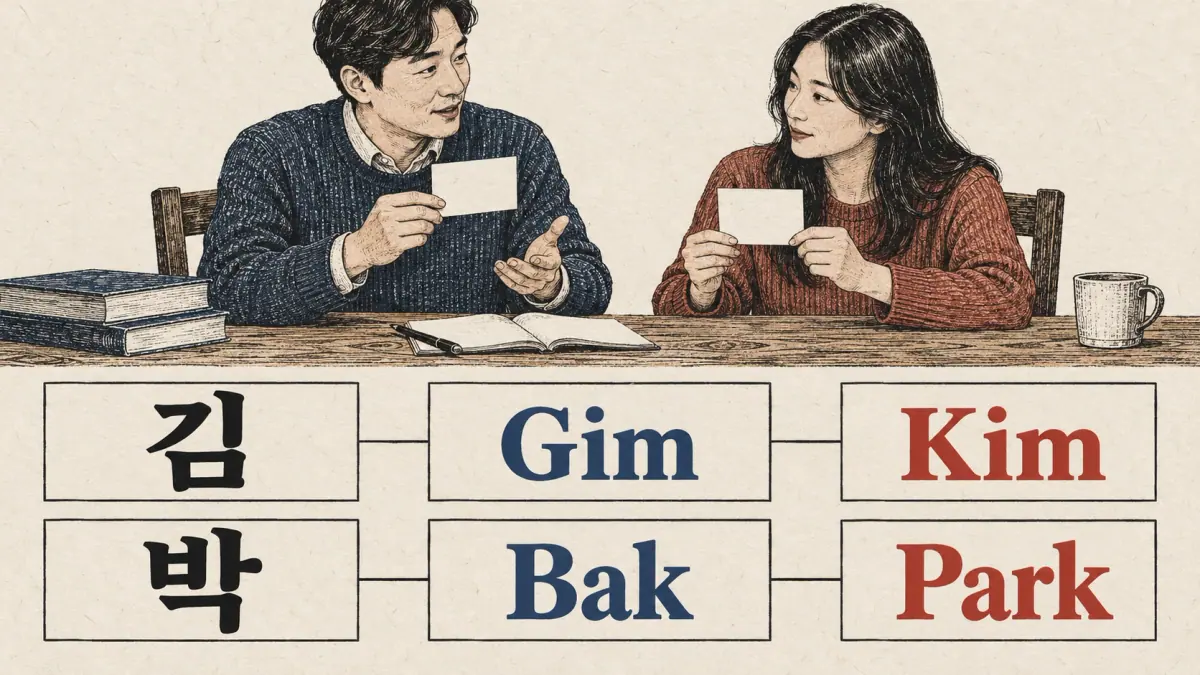
Korean names have several English spellings because families chose spellings long before today's romanization rules existed. The official system, Revised Romanization of Korean (2000), writes the surname first, then a space, then the given name as one word or with a hyphen: 김민준 is Gim Minjun or Gim Min-jun. In practice almost every 김 writes Kim.
| Surname | Strict Revised Romanization | Usual spelling |
|---|---|---|
| 김 | Gim | Kim |
| 이 | I | Lee, Yi, Rhee |
| 박 | Bak | Park |
| 최 | Choe | Choi |
| 정 | Jeong | Jung, Chung |
A second rule surprises learners. Revised Romanization does not show sound changes between the syllables of a given name. The official example is 한복남, pronounced [한봉남] but written Han Boknam or Han Bok-nam. The full story, including why 이 became Lee, is on the romanization of Korean names page.
What Pages Are in This Subhub?
This subhub groups the name pages into four sets: surnames and meaning, popular names, pronunciation and romanization, and how to address people. Two Hangul pages on writing names are linked here too.








Surnames and Meaning
Korean last names lists the ten most common surnames from the 2015 census with their hanja and usual English spellings, and explains the clan origin, 본관 (bon-gwan), that tells two Kim families apart. Korean name meaning shows how given names are built from hanja or native words, why one Hangul sound can stand for many hanja, and how 돌림자 works in the families that use it.
Popular Names
Korean girl names and Korean boy names list popular given names with their meanings and pronunciation. They also explain how name fashions change over time, so a name can hint at a person's age.
Pronunciation and Romanization
Korean names pronunciation shows how to say a full name as three even beats and how sound rules apply inside a name, for example why 박민준 sounds like [방민준]. Two Hangul pages cover the other direction. Your name in Korean shows how to write your own name in Hangul, and English names in Korean shows how common English names are spelled.
Address and Endings
How to address people by name explains when to use the full name, the given name or a title. Korean name endings covers -아 and -야 after a given name, and 씨 and 님 after a name or title. The grammar of 씨 and 님 is also taught in ssi vs nim in Korean.
How Do You Address Someone by Name?

You address someone by name with a suffix that matches the relationship, never with a surname alone. The table shows four common forms.
| Form | Example | Use it for |
|---|---|---|
| Full name + 씨 | 김민준 씨 | polite address at work or in formal settings |
| Given name + 씨 | 민준 씨 | colleagues and acquaintances of similar rank |
| Surname + title + 님 | 김 부장님 | managers and seniors at work |
| Given name + 아/야 | 민준아, 지수야 | close friends and people younger than you |
The ending 아 follows a name that ends in a consonant (민준아), and 야 follows a vowel (지수야). In the middle of a sentence, a consonant-final name often takes 이: 민준이가 왔어요 (Minjun came). A surname with 씨 alone, as in 김 씨, is not a polite way to address someone, because it sounds flat or even dismissive. The Korean etiquette section shows how these choices fit with speech levels.
What Can a Korean Name Tell You?

A Korean name often hints at a person's generation, though rarely at their gender with certainty. Popular given names change from decade to decade. 철수 and 영희 are the classic names in older Korean school textbooks, much like "John and Mary" in English, while 민준 and 서연 were very popular for babies born in the 2000s and 2010s. Hearing a name can therefore suggest an approximate age, which matters in a culture where age shapes speech.
Gender is less predictable. Many given names lean male or female, but some, such as 지민 or 유진, are used for both. Do not guess a person's gender from a romanized name; check how they introduce themselves. The girl names page shows which names are clearly gendered and which are shared.
What Is Not Covered Here?
This section covers how Korean names are built, spelled and used. Writing your own non-Korean name in Hangul is taught in the Hangul section, starting at your name in Korean. The hanja side of names, such as the characters behind common given names, belongs to the hanja section. Family titles such as 오빠 and 언니 are covered in older sibling titles.
Frequently Asked Questions

Which comes first in a Korean name, the family or given name?
The family name always comes first in Korean. In 김민준, 김 is the family name and 민준 is the given name, so in English he is Mr. Kim. In English-language documents some Koreans reverse the order to Min-jun Kim, so check which part is the surname before you address someone.
How many Korean surnames are there?
The 2015 Population and Housing Census recorded several thousand surnames, but most of them are very rare, and many recent ones belong to naturalised citizens. A much smaller set of traditional surnames covers almost everyone, and 김, 이 and 박 alone cover close to half of the population.
How do I write my name in Korean?
Write it the way it sounds, not letter by letter. Split your name into syllables, match each sound to the nearest Korean sound and build one Hangul block per syllable, so Emma becomes 엠마. The step-by-step method and tricky sounds such as F and V are on the your name in Korean page.
Do Korean children take the father's surname?
Usually, yes. By default a child takes the father's surname. The Civil Act also allows the mother's surname if both parents agree when they register their marriage. Because women keep their own surname after marriage, a mother and her children often have different family names.
Why are some Korean names written with a hyphen?
Revised Romanization lets the given name be written as one word or with a hyphen between its syllables, as in Minjun or Min-jun. The hyphen helps English readers see the two syllables and avoids misreadings. Passports and official records follow whatever spelling the person registered, so both forms are correct.
Where to Go Next with Korean Names
Start with romanization of Korean names if you want to read names in news or K-pop credits, or with ssi vs nim in Korean if you need to address people today. Korean names are one of four culture sections; the others are listed on the Korean language and culture hub.