
Korean address works differently from English. In English you can say "Hi, Alex" to almost anyone. In Korean, a bare name is a close-friend form, and it can sound rude if the other person is older or senior. The fix is simple once you know the tools, and the rest of this page shows each tool with the same example name, 김민준 (Gim Minjun). For the name itself, see Korean names pronunciation. For the suffix grammar, see Korean honorifics ssi vs nim. Every name topic is on the Korean names hub.
Korean Names How to Address: the Essentials
Koreans call people in four ways, and each way fits a different relationship. The table uses 김민준 to show all four.
| Way of addressing | Form | Fits | Feeling |
|---|---|---|---|
| Title alone | 과장님 | A boss, a teacher, a shop owner | Respectful, the safest choice upward |
| Surname + title + 님 | 김 과장님 | A boss or senior whose rank you know | Respectful, specific |
| Full name or given name + 씨 | 김민준 씨, 민준 씨 | A peer or someone younger, in polite speech | Polite and neutral |
| Given name + 아/야 | 민준아 | A close friend or someone younger | Warm, casual, close |
The pattern behind the table is that respect goes into the title, and closeness goes into the bare name. A bare name is a gift of closeness. You use it when the other person invites it, not before. The suffix is not decoration. 씨 and 님 show how you stand to the person, and the wrong one can change the meaning of a polite sentence.
Step 1: Identify the Relationship
Start with who the person is to you, because that decides everything else. Ask yourself two questions: Is this person older or higher in rank than I am? How well do I know them? The answer to the first question tells you whether to use a title. The answer to the second tells you whether a name is allowed yet.
The chooser covers five people you will often meet. The example name is 김민준 in each row.
| Person | Relationship | What to say | Example |
|---|---|---|---|
| Boss | Higher in rank | Surname + title + 님 | 김 과장님 |
| Elder | Older, not family | A respectful title such as 선생님, or 어르신 for an elderly person | 선생님 |
| Peer | Same age, newly met | Full or given name + 씨 | 민준 씨 |
| Younger colleague | Lower in rank or younger | Given name + 씨 at work, given name + 아/야 if close | 민준 씨, 민준아 |
| Customer | Receives your service | Title + 님, or name + 님 in writing | 고객님, 김민준 님 |
Age counts as much as rank. In Korean culture a person who is a few years older than you expects a more careful form even outside work, and the page on age etiquette explains why. When two people are close in age and have just met, they often ask each other's age so that each can pick the right form.
Checkpoint: for each of the five people above, say the form aloud. If you hesitate on the elder or the boss, repeat the title with 님.
Step 2: Choose a Title or Name
Choose a title if the person is higher than you, and a name if the person is equal or lower. A title is a job or role word: 과장 (section chief), 부장 (department head), 사장 (company head, also a shop owner), 교수 (professor), 선생 (teacher), 선배 (senior at school or work). It sounds respectful because it places the person by rank, not by personal name.
There are three ways to use a title:
- Title alone. 과장님. This is the usual way to call out to someone and the safest form when you are unsure.
- Surname and title. 김 과장님. Use it when several people share the role, or when you are introducing the person.
- Full name and title. 김민준 과장님. Use it in formal writing and announcements, not in everyday speech.
For a peer or someone younger, use the name. Given name plus 씨 is the common polite form: 민준 씨. Full name plus 씨 (김민준 씨) is slightly more formal and is common on forms and in first meetings. Surname alone plus 씨 (김 씨) can sound curt, and sometimes rude, when you are speaking to the person directly. Use the given name when you can.
What If I Do Not Know Someone's Title?
Use a general respectful word. 선생님 is the safe choice for a teacher or a respected adult in a professional setting. In shops and restaurants 사장님 is a polite way to call the owner, and 손님 is how staff address customers. To get someone's attention, 저기요 ("excuse me") works for almost anyone. Avoid 아저씨 and 아줌마 as address forms for strangers, because some people find them blunt. If the person tells you their title, repeat it with 님.
Step 3: Add the Suffix
Add 님 to a title for respect, and 씨 to a name for politeness. These two suffixes are not interchangeable.
| Suffix | Attaches to | Level | Example |
|---|---|---|---|
| 님 | Titles and roles | Respectful, upward | 과장님, 사장님, 고객님 |
| 님 | A full name in service text and messages | Formal, written | 김민준 님 |
| 씨 | A name | Polite, level or downward | 민준 씨, 김민준 씨 |
| 아/야 | A name | Casual, to friends and younger people | 민준아, 지아야 |
Three rules prevent most mistakes.
- 님 goes on titles, 씨 goes on names. 사장님 is right. 사장씨 is wrong.
- Never use 씨 for a boss or an elder. 민준 씨 is polite, but it is not respectful enough for someone above you. Use 김 과장님 instead.
- Do not stack suffixes. 김 과장님 씨 is wrong. One suffix is enough.
The casual forms 아 and 야 work like this: a name that ends in a consonant takes 아 (민준아), and a name that ends in a vowel takes 야 (지아야). They are warm between friends and sound rude to a stranger or a senior. The page on Korean name endings explains the rule step by step, and the page on 나 너 banmal pronouns and 아/야 shows how these endings sit inside casual speech.
Step 4: Check the Speech Level
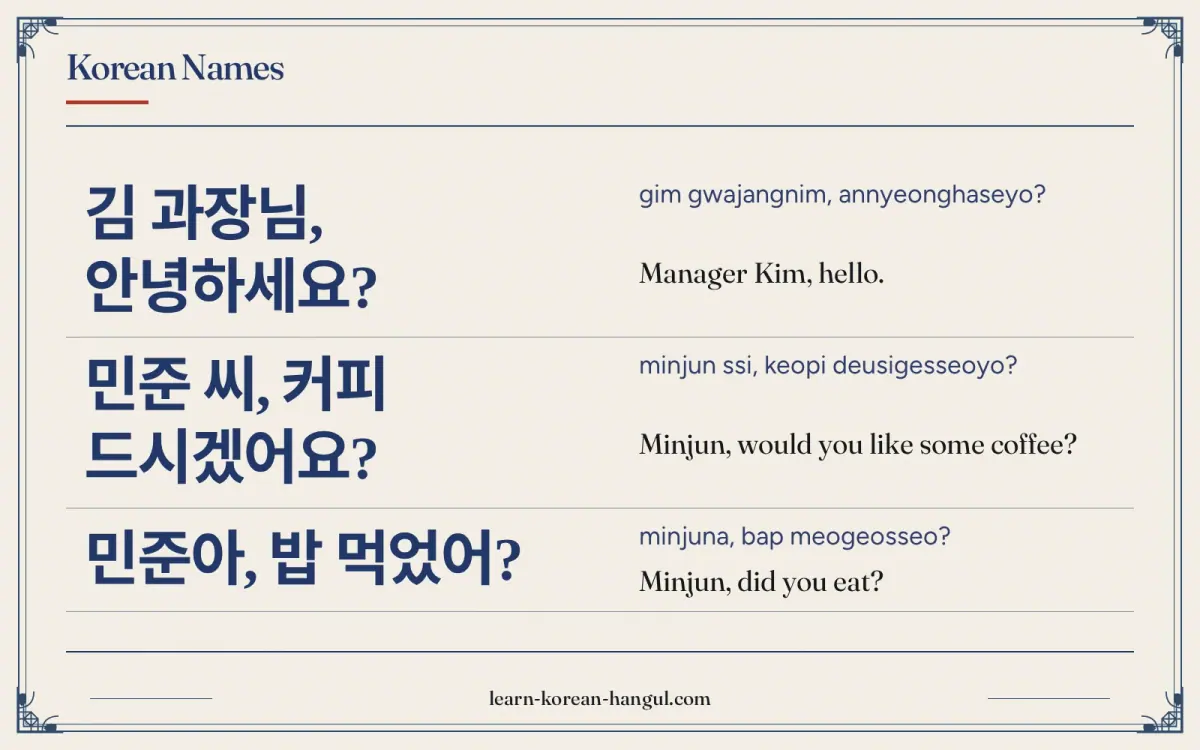
Match the verb ending to the address form. A respectful title needs a respectful sentence, and a casual name goes with a casual sentence. If the two do not match, the sentence sounds odd. The three levels below cover most situations. For the full system, see Korean speech levels.
| Address | Sentence ending | Example |
|---|---|---|
| Title + 님 | Honorific polite (-(으)세요) | 김 과장님, 식사하셨어요? |
| Name + 씨 | Polite (해요체) | 민준 씨, 커피 드시겠어요? |
| Name + 아/야 | Casual (반말) | 민준아, 밥 먹었어? |
김 과장님, 안녕하세요?
gim gwajangnim, annyeonghaseyo?
Manager Kim, hello.
민준 씨, 커피 드시겠어요?
minjun ssi, keopi deusigesseoyo?
Minjun, would you like some coffee?
민준아, 밥 먹었어?
minjuna, bap meogeosseo?
Minjun, did you eat?
고객님, 잠시만 기다려 주세요.
gogaengnim, jamsiman gidaryeo juseyo.
Dear customer, please wait a moment.
The second sentence is said [커피 드시게써요], the third is said [밥 머거써], and in the fourth the title is said [고갱님], because the ㄱ of 객 turns into ㅇ before ㄴ. In a casual sentence you drop the 요, as in 먹었어. Use the casual form only when the other person has said it is fine to speak casually.
Checkpoint: take the names 김 과장, 민준 and 지아 and give each a matching sentence ending. 김 과장님 needs -세요, 민준 씨 needs -어요, and 지아야 can take a casual ending.
How Do I Address a Korean Friend's Parents?
Call a friend's mother 어머님 and a friend's father 아버님. These are respectful forms, and they are the standard way to speak to your friend's parents directly. You can add 안녕하세요 to greet them: 어머님, 안녕하세요? When you talk about them to someone else, 친구 어머니 and 친구 아버지 are fine. Do not call them by their names, and do not use 아줌마 or 아저씨 to their faces.
How Do Koreans Address Foreigners?
Koreans often use a polite form, built from your name. If you give a Korean name, they will use it with 씨. If you give an English first name, they may say it with 씨, as in "Alex 씨", or they may use your full name. If you teach, you may be called 선생님. If you are unsure which form to use for yourself, ask what the other person prefers. When you introduce yourself, give a name that is easy to say, and say 편하게 불러 주세요 ("please call me whatever is comfortable").
What about 오빠, 언니, 형 and 누나?
These four words are family terms for an older brother or sister, and Koreans also use them for close friends and acquaintances who are a little older. Which one you say depends on your own gender and on the gender of the older person.
| You are | Older man | Older woman |
|---|---|---|
| A man | 형 | 누나 |
| A woman | 오빠 | 언니 |
You can attach them to a name, as in 민준 형 or 지아 언니, and you can add 님 for extra respect, as in 형님. Use them only with people you know well and who have accepted a close tie. At work, with a stranger or in a service setting, use a title or 씨 instead. Foreign learners often hear these words in dramas and copy them too early, so wait until the other person uses the word about themselves or invites you to.
How Do I Ask What to Call Someone?
Ask directly. Koreans are used to the question, because the right form depends on a tie that the speaker cannot always see. A short, polite sentence does the job.
뭐라고 부르면 될까요?
mworago bureumyeon doelkkayo?
What should I call you?
The sentence is said [뭐라고 부르면 될까요]. Use it when you meet someone and do not know the title, or when a person has told you to speak casually and you want to be sure which name they prefer. If the person says 편하게 부르세요 ("call me whatever is comfortable"), choose the 씨 form first and move closer only when they do.
What Mistakes Do Learners Make When They Address Koreans?
These errors come up most.
- Calling an older person or a boss by a bare name. Use a title and 님. A bare name tells the other person that you are on the same level.
- Using 씨 for a superior. 민준 씨 is polite, but it is not respectful. Use 김 과장님.
- Attaching 씨 to a title. 사장씨 and 과장씨 are wrong. Titles take 님.
- Putting 씨 on a surname when speaking to the person. 김 씨 can sound dismissive. Use the given name or the full name.
- Using 아/야 with adults you do not know well. It sounds too close. Use 씨 or a title.
- Calling a person "you". 당신 and 너 sound rude or intimate in most settings. Use the name or title instead.
A better habit is to listen for how others address the person and copy that form. If you hear 부장님, say 부장님.
Quick Practice
Pick the right form for each person, using the name 김민준.
- Your company's section chief: 김 과장님.
- A classmate of your own age, just met: 민준 씨.
- A younger cousin: 민준아.
- A customer at a counter: 고객님.
- Your friend's father: 아버님.
If any of these felt strange, go back to Step 2 and read the table of titles again.
Frequently Asked Questions
Can I Call My Boss by Name?
Not directly, in most workplaces. Call your boss by title with 님, such as 김 과장님, or just 과장님. Some companies, often young ones, use 님 for everyone or use nicknames, so listen to what colleagues do and follow it. If your boss invites you to use a name, you can, but wait for the invitation.
What Do I Say If I Do Not Know the Title?
Use 선생님 for a respected adult in a professional setting, 사장님 for a shop owner, and 저기요 to get someone's attention. If you learn the real title later, switch to it and add 님.
How Do Koreans Address Foreigners?
Often by name plus 씨, or by the full name. Some people use a title such as 선생님 for a teacher. If you want a different form, you can say 편하게 불러 주세요, which means "please call me whatever is comfortable".
Is 아/야 Rude?
Not between friends or when an older person speaks to a younger one. It is rude to use it with strangers, with people older than you and in professional settings. If you are unsure, use 씨 or a title.