
This page applies the sound rules to names. The full set of rules lives on the Korean pronunciation hub, so here we use only the rules that matter for names. If you want to write your own name in Hangul, see your name in Korean, and for the spelling side, see the romanization of Korean names.
Korean Names Pronunciation: the Essentials
A Korean name is a one-syllable surname followed by a two-syllable given name, written together with no space. You say it as three even beats. The table shows the ten names used on this page, with the Revised Romanization (RR), the spelling you often see, and the spoken form.
| Hangul | RR | Common English spelling | Spoken |
|---|---|---|---|
| 김민준 | Gim Minjun | Kim Minjun | [김민준] |
| 이서연 | I Seoyeon | Lee Seoyeon | [이서연] |
| 박지훈 | Bak Jihun | Park Jihoon | [박찌훈] |
| 최유진 | Choe Yujin | Choi Yujin | [최유진] |
| 정하윤 | Jeong Hayun | Jung Hayun | [정하윤] |
| 강도윤 | Gang Doyun | Kang Doyun | [강도윤] |
| 조은서 | Jo Eunseo | Cho Eunseo | [조은서] |
| 윤재우 | Yun Jaeu | Yoon Jaewoo | [윤재우] |
| 장하은 | Jang Haeun | Jang Haeun | [장하은] |
| 임수빈 | Im Subin | Lim Subin | [임수빈] |
These ten names are illustrations. They are chosen to show different sounds and they do not stand for any real person.
Step 1: Read the Name in Hangul
Read the name from the Hangul and ignore the Roman letters. Split it into syllable blocks: 김 | 민 | 준. Each block is one beat. The first block is almost always the surname, and the next two are the given name. The English spelling can hide this, because "Lee Seoyeon" looks like two words and "Seoyeon" looks like it has two syllables, but the Hangul 이서연 shows three clear blocks.
Do these checks before you speak:
- Count the blocks. Three blocks is the usual length. Four blocks means a two-syllable surname (see below) or a three-syllable given name.
- Find the surname. It is the first block, unless it is a two-syllable family name such as 남궁.
- Read each block with its own vowel. Every block has one vowel, so every block is one syllable.
Checkpoint: cover the Roman letters in the table above and read the Hangul aloud, block by block. You should be able to say 김, 민, 준 as three separate sounds before you join them.
Step 2: Say Each Syllable Evenly
Say each syllable with about the same length and the same weight. English stresses one syllable in a word and shortens the others, so "Minjun" often becomes MIN-jun. Korean gives all the syllables nearly equal time, so the name sounds like min-jun with two light beats of the same size. Think of a steady drum with no accent.
A simple drill uses taps. Tap your finger once for each block while you say the name, and keep the taps at the same distance:
| Name | Beats | Tap pattern |
|---|---|---|
| 김민준 | 3 | gim · min · jun |
| 이서연 | 3 | i · seo · yeon |
| 임수빈 | 3 | im · su · bin |
| 윤재우 | 3 | yun · jae · u |
Notice that 이 is a whole beat even though it is a single vowel. A Korean speaker gives the surname 이 the same time as 서 or 연. Many English speakers shorten it, which makes the name sound rushed.
Checkpoint: say 이서연 with three even taps. If the middle block sounds louder than the first and last, slow down and flatten it.
Step 3: Check the Vowels
Korean vowels are pure: they do not glide into a second sound the way English "o" and "a" often do. Two vowels cause most of the trouble in names, ㅓ and ㅡ, and two others, ㅜ and ㅕ, need care.
| Vowel | Where you meet it | How to say it | Common slip |
|---|---|---|---|
| ㅓ | 정, 서, 연 | Relaxed mouth, lips unrounded, like "uh" held longer | Rounding the lips so 정 sounds like 종 |
| ㅗ | 조, 도 | Lips rounded, a pure "o" | Gliding to "ow" |
| ㅡ | 은, 승 | Lips flat, tongue pulled back, like "oo" said without rounding the lips | Saying "oo" or "uh" |
| ㅜ | 우, 준, 수 | Lips rounded, a pure "oo" | Adding a "w" glide |
| ㅕ | 연, 현 | A quick "y" plus ㅓ | Saying "yo" |
The most famous pair is 정 and 종. Jeong (정) uses ㅓ, with an unrounded mouth. Jong (종) uses ㅗ, with rounded lips. The spelling "Jung" is a common attempt to show ㅓ in English, and it hints at an unrounded sound. Try saying "uh" with a relaxed jaw: that is the vowel in 정.
The vowel ㅡ appears in 은 and in names such as 은서 and 승현. There is no English twin. Say "oo", then spread your lips flat without moving your tongue. If you say "oo" or "uh", the name changes.
Checkpoint: say 정, then 종, then 조, three times each. Your lips should be flat for 정, and rounded for 종 and 조.
Step 4: Check Consonants and Sound Changes
Korean has three kinds of stop consonants: plain, tense and aspirated. Names mostly use the plain kind, which has little air. The most common slip for English speakers is to add a puff of air.
- ㄱ in 김 and 강: a plain sound between English "k" and "g". Say it with no puff of air.
- ㅈ in 지 and 장: a plain "j" with little air. Do not say "ch".
- ㅂ in 박 and 빈: a plain sound between "p" and "b".
- ㅊ in 채 and 최: aspirated, with a clear puff. This is the only one that has a strong puff.
The aspirated letters ㅊ, ㅋ, ㅌ and ㅍ are different letters from the plain ones. ㅈ and ㅊ are two letters, and 지 and 치 are different syllables.
A final consonant in the surname is held, not released: 박 ends with a stopped ㄱ, so the mouth closes on the sound and no extra vowel follows. English speakers often add a vowel and say "ba-keu". Keep it clipped: bak.
Sounds also change where one syllable meets the next. These are the changes you meet most often in names.
| Change | Rule | Example |
|---|---|---|
| Liaison | A final consonant moves onto an empty ㅇ in the next syllable | 현우 is [혀누]; 준우 is [주누]; 선우 is [서누] |
| Nasalisation | ㄱ before ㅁ or ㄴ becomes ㅇ | 박민준 is [방민준] |
| Aspiration | ㄱ + ㅎ merge into ㅋ | 박하은 is [바카은] |
| Tensing | A plain ㄱ, ㄷ, ㅂ, ㅅ or ㅈ after a final ㄱ is said tense | 박지훈 is said [박찌훈] |
Most surnames cause no change. 김, 이, 최, 정, 강, 조, 윤, 장 and 임 sit next to the given name without altering it, so 김민준 is just [김민준]. Liaison is the change you hear most, because many given names end in ㄴ and start with a vowel, as in 현우. It follows a rule from the National Institute of Korean Language's standard pronunciation: a final consonant moves to the next syllable when that syllable starts with a vowel.
How Do I Say Two-Syllable Surnames Such as 남궁?
Say each syllable as its own beat, so 남궁 is two beats: nam-gung. The rare two-syllable surnames follow the same even rhythm. 황보 is hwang-bo, 선우 is [서누] with a liaison, and 제갈 is je-gal.
| Surname | RR | Spoken |
|---|---|---|
| 남궁 | Namgung | [남궁] |
| 황보 | Hwangbo | [황보] |
| 선우 | Seonu | [서누] |
| 제갈 | Jegal | [제갈] |
A person with a two-syllable surname has a four-block name, such as 남궁민 or 선우진, so count the blocks first. Do not assume that a long name is a three-syllable given name.
이름이 어떻게 되세요?
ireumi eotteoke doeseyo?
What is your name, please?
The sentence is said [이르미 어떠케 되세요], where the ㅎ of 어떻게 merges with the ㄱ to make a single aspirated ㅋ. It is a polite way to ask for a name, and the person will often give you the full name.
Step 5: Compare with Audio
Compare your own voice with the audio. Press a play button above, say the name yourself, and listen for three things: the rhythm of the beats, the shape of the vowels and the lack of air on the plain consonants. The audio on this site is generated with text-to-speech and a Korean teacher approves each clip before it goes live. It is a model to copy, not a final judge.
A quick routine works well:
- Listen once with your eyes on the Hangul.
- Say it aloud right after the clip, as an echo.
- Record yourself on your phone and play it back next to the clip.
- Fix one thing at a time. Pick the most obvious difference, such as the ㅓ in 정, and repeat only that.
Checkpoint: record 최유진, play it back and listen for a puff of air on the ㅈ. If you hear one, say the name again with a flatter, quieter ㅈ.
How Do I Check a Name's Pronunciation with a Native Speaker?
Ask the person, a teacher or a Korean friend to say it, and then say it back. Asking is polite, and most people are glad to help. A short request does the job.
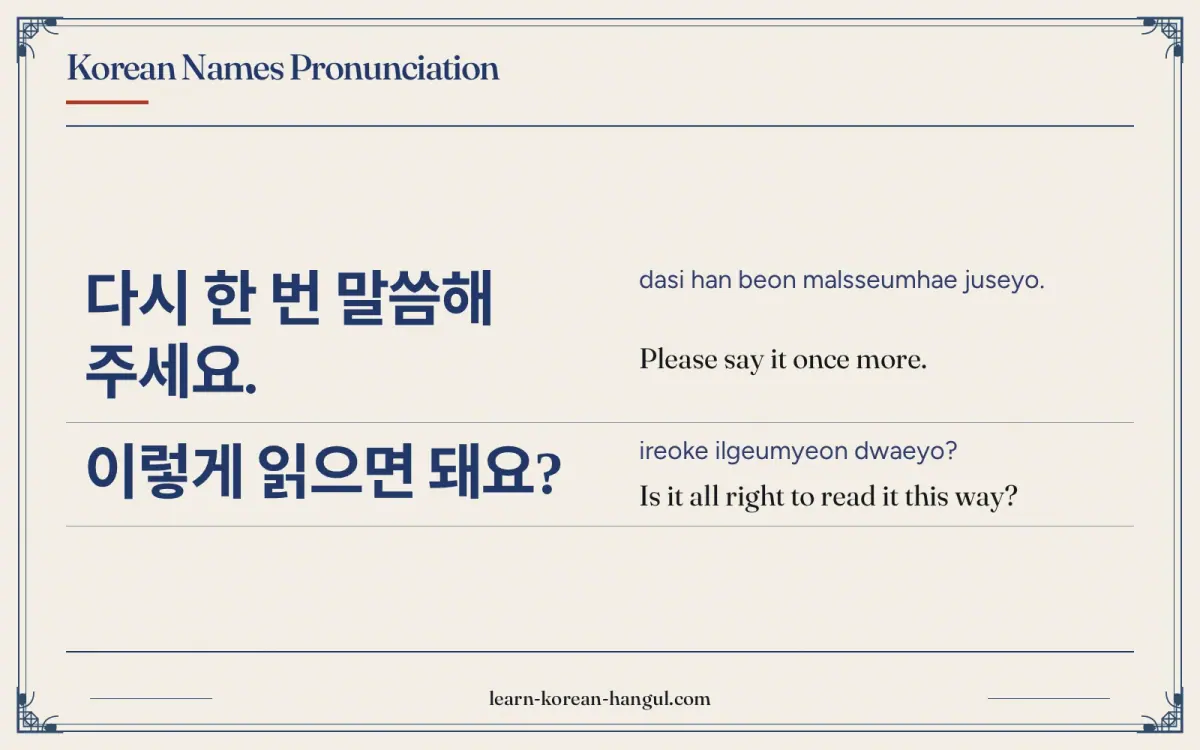
다시 한 번 말씀해 주세요.
dasi han beon malsseumhae juseyo.
Please say it once more.
이렇게 읽으면 돼요?
ireoke ilgeumyeon dwaeyo?
Is it all right to read it this way?
The first is said [다시 한 번 말씀해 주세요]; in fast speech the ㅎ often weakens, so 말씀해 sounds close to [말쓰매]. The second is said [이러케 일그면 돼요]. Use the first when you did not catch the name, and the second when you want a check. If the person is older than you, add 죄송하지만 ("I am sorry, but") before the request. Once you can say the name, the pages on how to address people and Korean name endings show which title or suffix to add, and the Korean names hub lists every name topic.
How Does a Name Sound inside a Sentence?
A name sounds different once a particle follows it, because a final consonant links to the particle. After a name that ends in a consonant, the subject particle is 이 and the topic particle is 은. After a name that ends in a vowel, they are 가 and 는. The link between the name and the particle is the same liaison you heard in 현우.
| Name | Subject | Topic | Spoken |
|---|---|---|---|
| 민준 | 민준이 | 민준은 | [민주니], [민주는] |
| 서연 | 서연이 | 서연은 | [서여니], [서여는] |
| 수빈 | 수빈이 | 수빈은 | [수비니], [수비는] |
| 지아 | 지아가 | 지아는 | [지아가], [지아는] |
민준이 왔어요.
minjuni wasseoyo.
Minjun has come.
The sentence is said [민주니 와써요]. Notice that the final ㄴ of 민준 moves onto 이, so the name seems to change its last syllable. A learner who writes the name as 민주 and then adds 이 will make a mistake, because the written name is still 민준.
What Mistakes Do Learners Make with Korean Names?
These five errors come up most often among English speakers.
- Stressing one syllable. MIN-jun is an English habit. Give each block the same weight.
- Rounding ㅓ. 정 turns into 종 and 서 turns into 소. Keep the lips unrounded.
- Adding air to plain consonants. 지 is not "chi", and 박 is not "pak" with a hard puff. Say little air.
- Reading the English spelling as English. "Lee" is not pronounced like the English word "lee"; the Hangul 이 is a short "ee". "Park" is not said with an English "r"; the Hangul 박 is bak. "Choi" is not said "choy": the Hangul 최 has its own vowel, close to "chweh".
- Skipping the sound changes at the joints. If you say 현우 as hyeon-u with a gap, it sounds stiff. Link the ㄴ and say [혀누].
A better habit is to read the Hangul first, check the English spelling second, and trust the audio over the English letters.
Quick Practice
Say each item aloud, then check the answer.
- 박하은: where does the ㄱ go? It merges with ㅎ into ㅋ, so it is [바카은].
- 선우진: how many beats? Four, and the first two link as [서누진].
- 정 and 종: which has the unrounded vowel? 정 does, with ㅓ.
- 임수빈: how does it end? A clean ㄴ, with no extra vowel after it.
- 이서연: how long is 이? One full beat, the same as 서 and 연.
If you get three of these right, you have the skills for most Korean names. The rest is repetition with the audio.
Frequently Asked Questions
How Do I Say Kim Correctly?
Say 김 as one short syllable, "gim", with a plain ㄱ that has no puff of air. It sits between "k" and "g", and the vowel is a short "ee". The final ㅁ closes the lips, so end with a clean "m". The spelling Kim is the common English form.
Why Is Lee Pronounced "Ee"?
The Hangul 이 is the vowel ㅣ on its own, with a silent ㅇ in front, so it is said "ee". Lee is one of several English spellings of 이, and others are Yi and Rhee. The Revised Romanization is I. All of them stand for the same short "ee" sound.
Is Park Pronounced "Park" or "Bak"?
It is said bak, with a plain ㅂ, the vowel ㅏ and a stopped final ㄱ. "Park" is the common English spelling, and it does not tell you to say an English "r". The Revised Romanization is Bak.
Can I Ask Someone to Say Their Name?
Yes. Asking is polite and expected, and most Koreans are glad that you want to get it right. Say 다시 한 번 말씀해 주세요, listen, and repeat the name back.