
Korean Syllable Flashcards: Study the 41 Cards
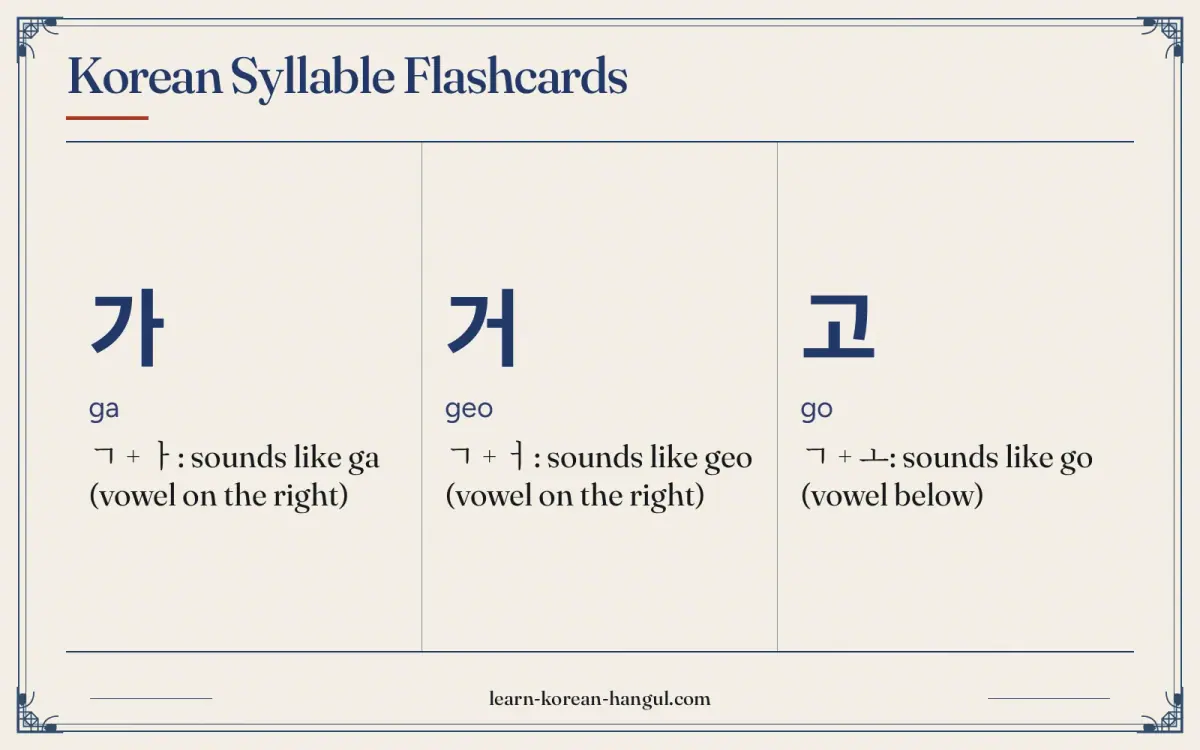
Each card shows one block with no final consonant. The Meaning column shows which letters build the block and where the vowel sits. Blocks with a final consonant are in the Korean batchim flashcards. The lesson behind the deck is Korean syllable blocks.
How Do I Use These Flashcards?
Use the deck above in four steps. It works with tap, click or keyboard, and nothing plays until you press an audio button.
- Choose a mode. Start with recognition (Hangul to meaning). Switch to recall (meaning to Hangul) or listening (audio to meaning) once recognition feels easy.
- Show the answer. Think of the answer first, then press Show answer (or Space). Turn on the romanization toggle only if you need it; the 41-card table below always shows it.
- Grade yourself. Press Got it if you answered correctly without help, or Not yet if you hesitated or guessed.
- Finish the session. A session holds up to 20 cards (you can set 10, 20 or 40). With 41 cards, spread the deck over five days at the default of 10 new cards a day, and do not rush the blocks with ㅓ.
What Do the Three Modes Do?
Recognition shows the Hangul and asks for the meaning, which trains reading. Recall shows the meaning and asks for the Hangul, which trains remembering; you may type the answer with your Hangul keyboard or just recall it in your head. Listening plays a clip and hides the letters, which trains the ear. Listening mode only uses a card once its audio is approved, and cards without approved audio are skipped in that mode with a note.
What Do Got It and Not yet Do?
Got it moves the card up one Leitner box, so it returns later. Not yet sends the card back to box 1, so it returns in the same session or within 10 minutes. The grades are your own judgement; the deck does not score you or claim fluency.
Deck Scope: What Is and Is Not Covered
The deck covers 41 open syllable blocks, meaning blocks with no final consonant: ten consonants (ㄱ ㄴ ㄷ ㄹ ㅁ ㅂ ㅅ ㅇ ㅈ ㅎ) each joined with ㅏ ㅓ ㅗ ㅜ, plus 시. The ㅡ and ㅣ rows are not drilled in full, since the vowels are the same ones the vowel decks teach; 시 is included because ㅅ changes sound before ㅣ.
What Is Left out of This Deck?
Blocks with a final consonant are in the batchim deck. Aspirated and tense consonants in blocks, such as 카 and 까, are in the consonant decks and the minimal pairs deck. The letter names are in the Korean letter names flashcards.
All 41 Cards in One Table
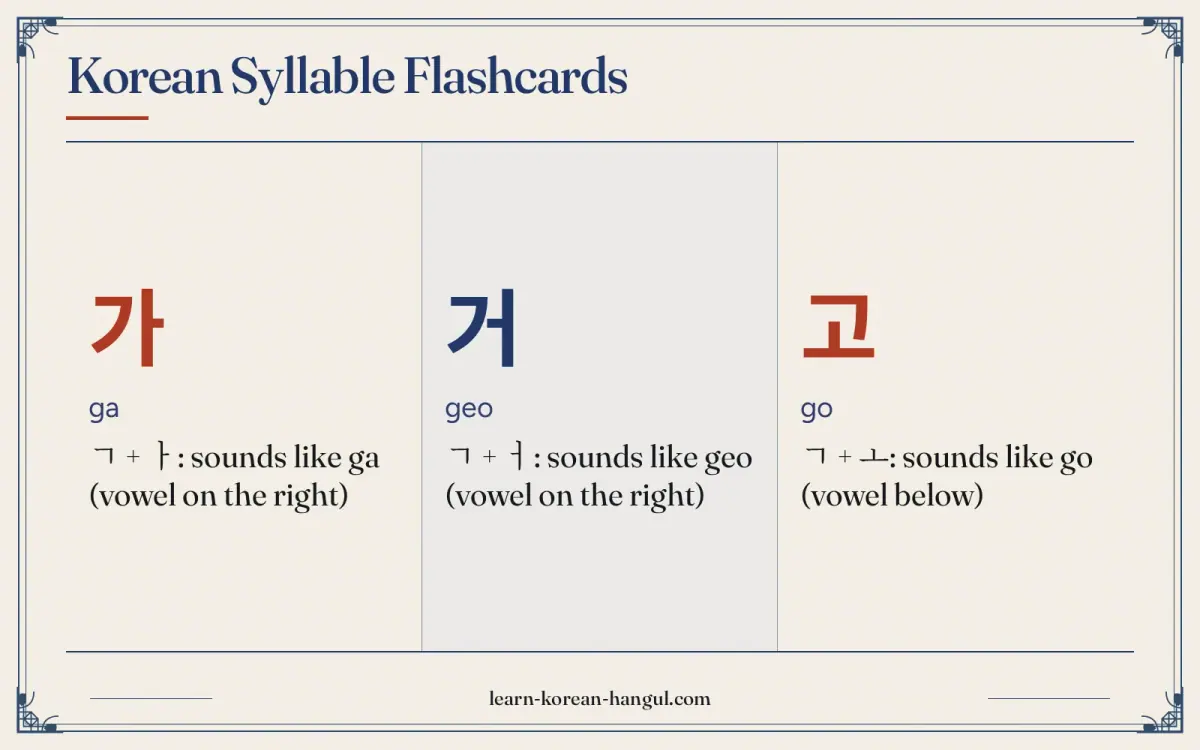
All 41 cards appear below in deck order, grouped by initial consonant. The table is plain HTML, so you can read, search or print it without the deck.
| # | Hangul | Revised Romanization | Meaning | Note | Audio assetId |
|---|---|---|---|---|---|
| 1 | 가 | ga | ㄱ + ㅏ: sounds like ga (vowel on the right) | Example: 가수 (gasu, singer). | au-pg-flashcards-syllables-1 |
| 2 | 거 | geo | ㄱ + ㅓ: sounds like geo (vowel on the right) | Example: 거미 (geomi, spider). | au-pg-flashcards-syllables-2; slow: au-pg-flashcards-syllables-42 |
| 3 | 고 | go | ㄱ + ㅗ: sounds like go (vowel below) | Example: 고기 (gogi, meat). | au-pg-flashcards-syllables-3 |
| 4 | 구 | gu | ㄱ + ㅜ: sounds like gu (vowel below) | Example: 구두 (gudu, shoes). | au-pg-flashcards-syllables-4 |
| 5 | 나 | na | ㄴ + ㅏ: sounds like na (vowel on the right) | Example: 나무 (namu, tree). | au-pg-flashcards-syllables-5 |
| 6 | 너 | neo | ㄴ + ㅓ: sounds like neo (vowel on the right) | Example: 너무 (neomu, too, very). | au-pg-flashcards-syllables-6 |
| 7 | 노 | no | ㄴ + ㅗ: sounds like no (vowel below) | Example: 노래 (norae, song). | au-pg-flashcards-syllables-7 |
| 8 | 누 | nu | ㄴ + ㅜ: sounds like nu (vowel below) | Example: 누나 (nuna, older sister, said by a male). | au-pg-flashcards-syllables-8 |
| 9 | 다 | da | ㄷ + ㅏ: sounds like da (vowel on the right) | Example: 다리 (dari, leg or bridge). | au-pg-flashcards-syllables-9 |
| 10 | 더 | deo | ㄷ + ㅓ: sounds like deo (vowel on the right) | Example: 더 (deo, more). | au-pg-flashcards-syllables-10 |
| 11 | 도 | do | ㄷ + ㅗ: sounds like do (vowel below) | Example: 도시 (dosi, city). | au-pg-flashcards-syllables-11 |
| 12 | 두 | du | ㄷ + ㅜ: sounds like du (vowel below) | Example: 두부 (dubu, tofu). | au-pg-flashcards-syllables-12 |
| 13 | 라 | ra | ㄹ + ㅏ: sounds like ra (vowel on the right) | Example: 라디오 (radio, radio). | au-pg-flashcards-syllables-13 |
| 14 | 러 | reo | ㄹ + ㅓ: sounds like reo (vowel on the right) | Example: 러시아 (reosia, Russia). | au-pg-flashcards-syllables-14 |
| 15 | 로 | ro | ㄹ + ㅗ: sounds like ro (vowel below) | Example: 로봇 (robot, robot). | au-pg-flashcards-syllables-15 |
| 16 | 루 | ru | ㄹ + ㅜ: sounds like ru (vowel below) | Example: 루비 (rubi, ruby). | au-pg-flashcards-syllables-16 |
| 17 | 마 | ma | ㅁ + ㅏ: sounds like ma (vowel on the right) | Example: 마늘 (maneul, garlic). | au-pg-flashcards-syllables-17 |
| 18 | 머 | meo | ㅁ + ㅓ: sounds like meo (vowel on the right) | Example: 머리 (meori, head or hair). | au-pg-flashcards-syllables-18 |
| 19 | 모 | mo | ㅁ + ㅗ: sounds like mo (vowel below) | Example: 모자 (moja, hat). | au-pg-flashcards-syllables-19 |
| 20 | 무 | mu | ㅁ + ㅜ: sounds like mu (vowel below) | Example: 무지개 (mujigae, rainbow). | au-pg-flashcards-syllables-20 |
| 21 | 바 | ba | ㅂ + ㅏ: sounds like ba (vowel on the right) | Example: 바다 (bada, sea). | au-pg-flashcards-syllables-21 |
| 22 | 버 | beo | ㅂ + ㅓ: sounds like beo (vowel on the right) | Example: 버스 (beoseu, bus). | au-pg-flashcards-syllables-22 |
| 23 | 보 | bo | ㅂ + ㅗ: sounds like bo (vowel below) | Example: 보다 (boda, to see). | au-pg-flashcards-syllables-23 |
| 24 | 부 | bu | ㅂ + ㅜ: sounds like bu (vowel below) | Example: 부모 (bumo, parents). | au-pg-flashcards-syllables-24 |
| 25 | 사 | sa | ㅅ + ㅏ: sounds like sa (vowel on the right) | Example: 사과 (sagwa, apple). | au-pg-flashcards-syllables-25 |
| 26 | 서 | seo | ㅅ + ㅓ: sounds like seo (vowel on the right) | Example: 서울 (seoul, Seoul). | au-pg-flashcards-syllables-26 |
| 27 | 소 | so | ㅅ + ㅗ: sounds like so (vowel below) | Example: 소 (so, cow). | au-pg-flashcards-syllables-27 |
| 28 | 수 | su | ㅅ + ㅜ: sounds like su (vowel below) | Example: 수박 (subak, watermelon). | au-pg-flashcards-syllables-28 |
| 29 | 아 | a | silent ㅇ + ㅏ: sounds like a (vowel on the right) | Example: 아이 (ai, child). | au-pg-flashcards-syllables-29 |
| 30 | 어 | eo | silent ㅇ + ㅓ: sounds like eo (vowel on the right) | Example: 어머니 (eomeoni, mother). | au-pg-flashcards-syllables-30; slow: au-pg-flashcards-syllables-43 |
| 31 | 오 | o | silent ㅇ + ㅗ: sounds like o (vowel below) | Example: 오이 (oi, cucumber). | au-pg-flashcards-syllables-31 |
| 32 | 우 | u | silent ㅇ + ㅜ: sounds like u (vowel below) | Example: 우유 (uyu, milk). | au-pg-flashcards-syllables-32 |
| 33 | 자 | ja | ㅈ + ㅏ: sounds like ja (vowel on the right) | Example: 자전거 (jajeongeo, bicycle). | au-pg-flashcards-syllables-33 |
| 34 | 저 | jeo | ㅈ + ㅓ: sounds like jeo (vowel on the right) | Example: 저기 (jeogi, over there). | au-pg-flashcards-syllables-34; slow: au-pg-flashcards-syllables-44 |
| 35 | 조 | jo | ㅈ + ㅗ: sounds like jo (vowel below) | Example: 조개 (jogae, shellfish). | au-pg-flashcards-syllables-35 |
| 36 | 주 | ju | ㅈ + ㅜ: sounds like ju (vowel below) | Example: 주스 (juseu, juice). | au-pg-flashcards-syllables-36 |
| 37 | 하 | ha | ㅎ + ㅏ: sounds like ha (vowel on the right) | Example: 하나 (hana, one). | au-pg-flashcards-syllables-37 |
| 38 | 허 | heo | ㅎ + ㅓ: sounds like heo (vowel on the right) | Example: 허리 (heori, waist). | au-pg-flashcards-syllables-38 |
| 39 | 호 | ho | ㅎ + ㅗ: sounds like ho (vowel below) | Example: 호수 (hosu, lake). | au-pg-flashcards-syllables-39 |
| 40 | 후 | hu | ㅎ + ㅜ: sounds like hu (vowel below) | Example: 후추 (huchu, pepper). | au-pg-flashcards-syllables-40 |
| 41 | 시 | si | ㅅ + ㅣ: closer to shi, with the vowel on the right | Example: 시계 (sigye, clock or watch). Special case: ㅅ turns toward sh before ㅣ. | au-pg-flashcards-syllables-41; slow: au-pg-flashcards-syllables-45 |
How Do I Read the Table?
Hangul is the syllable block. Revised Romanization (RR) is a learning aid and is regular for these open blocks. The Meaning column shows the letters that build the block and where the vowel sits. The Note column gives an example word that contains the block, and the last column lists the audio assetId. A second ID marks a slow clip.
Usage Notes for These Cards
A Korean syllable block is built as an initial consonant, then a vowel, then an optional final consonant. 가 is ㄱ plus ㅏ, and 감 is ㄱ plus ㅏ plus ㅁ. All cards in this deck stop after the vowel.
Vertical vowels (ㅏ ㅓ ㅣ) sit to the right of the consonant, as in 가 and 거. Horizontal vowels (ㅗ ㅜ ㅡ) sit below it, as in 고 and 구. Seeing the layout makes it easier to know which letter you read first: always the consonant, then the vowel.
A block that starts with a vowel sound takes a silent ㅇ in front: 아, 어, 오, 우. The ㅇ rows are in the deck so you remember that a circle at the top left or top is a placeholder.
The Unicode standard holds 11,172 modern Hangul syllable blocks, but a beginner needs only these simple ones first. Practising them out of order builds reading speed, and thousands of words are made from them.
Which Sounds Do Not Match the Spelling?
Initial ㅅ stays s before ㅓ ㅗ ㅜ, as in 서 (seo), 소 (so) and 수 (su), but it is closer to sh before ㅣ, so 시 sounds nearer to "shi". Revised Romanization writes si for it.
The blocks 저 and 처 are close for English speakers, so tell them apart by the puff of air: 처 has a puff and 저 does not.
ㄱ ㄷ ㅂ ㅈ sound softer between vowels. In 구두 (gudu, shoes) the second block sounds close to "du", with a soft d.
What Mistakes Do Learners Make with Korean Syllable Blocks?
- Reading 거 as "go" because the romanization geo contains an o. The vowel is ㅓ, not ㅗ.
- Reading horizontal-vowel blocks from the bottom. Read the consonant first and then the vowel below it.
- Skipping the silent ㅇ, so 아 and 오 are not seen as blocks.
- Mixing up 고 and 거, or 구 and 그. The short vowel stroke is the only difference: up in ㅗ, left in ㅓ, down in ㅜ and absent in ㅡ.
Mixing up similar blocks is normal, and the schedule returns them more often until they stay.
How Does the Review Schedule Work?
The deck uses a simplified Leitner system with five boxes. A new card starts in box 1. Each Got it moves it up one box, and each Not yet returns it to box 1. The box sets how long the card waits before it is due again.
| Box | Wait until the next review |
|---|---|
| 1 | same session or 10 minutes |
| 2 | 1 day |
| 3 | 3 days |
| 4 | 7 days |
| 5 | 21 days |
Each session shows due cards first, oldest due first, and then up to 10 new cards a day by default. A deck of 41 cards is introduced over five days at the default of 10 new cards a day, and the later boxes bring each card back at longer gaps. Progress is saved only in this browser, so clearing site data deletes it. Use the export button to save a small JSON file with card IDs, boxes and due dates, and import it on another device. No account is needed.
Cultural and Practical Context
Hangul blocks look like Chinese characters, but every block is spelled with letters, so Hangul is an alphabet and not a syllabary. This is why 40 letters (19 consonants and 21 vowels) are enough to build thousands of blocks. Shop signs and menus are a good reading drill outside the deck: try to sound out 다 or 마 on a sign before you read the whole name.
Limits of This Deck
The deck teaches 41 simple open blocks, not the 11,172 possible blocks, and it leaves out the ㅡ and ㅣ rows and blocks with aspirated or tense initials. The example words are chosen for common, simple vocabulary and were reviewed by Min-ji Park. All Korean text is generated, and Min-ji Park reviewed and signed off the text and audio on 15 October 2026.
Next Steps after the Korean Syllable Flashcards
After this deck, continue with the Korean batchim flashcards to add final consonants. Revisit the Korean letter names flashcards if you want the names for spelling. Write blocks with the Hangul syllable chart worksheet, test yourself with the Korean syllable blocks quiz, explore blocks in the interactive hangul alphabet, and see every deck in the Hangul flashcards list or the Korean flashcards hub.
Frequently Asked Questions
How Many Syllable Blocks Does Korean Have?
The Unicode standard encodes 11,172 modern Hangul syllable blocks, but Korean uses only a fraction of them. A beginner can start with the simple blocks of consonant plus vowel, such as the 41 on this deck. Adding final consonants and the remaining vowels extends those few shapes to thousands of words.
How Do I Read a Syllable Block?
Read the consonant first, then the vowel, then any consonant at the bottom. A vowel on the right, as in 가, is read after the consonant, and a vowel below, as in 고, is also read after the consonant. Blocks read left to right and top to bottom, like English.
Why Does 아 Have a Circle?
Every Hangul block needs a consonant slot, so a block that starts with a vowel sound puts the silent letter ㅇ there. Only the vowel is pronounced, so 아 is a and 오 is o. At the end of a block the same circle is the sound ng.
What Is the Difference between 거 and 고?
The vowel differs. 거 is ㄱ plus ㅓ, with the vowel stroke on the right, and it sounds like "guh". 고 is ㄱ plus ㅗ, with the vowel below, and it sounds like "go". Watch the stroke direction and listen for the open mouth in 거 and the round lips in 고.
Is My Progress Saved If I Close the Page?
Yes, in the same browser on the same device. Card boxes and due dates are stored locally and nothing is sent to a server. Clearing site data, using a private window or switching browsers removes them, so use the export button to keep a backup file that you can import later. No account is needed.