
Which Hangul Flashcards Should I Start With?
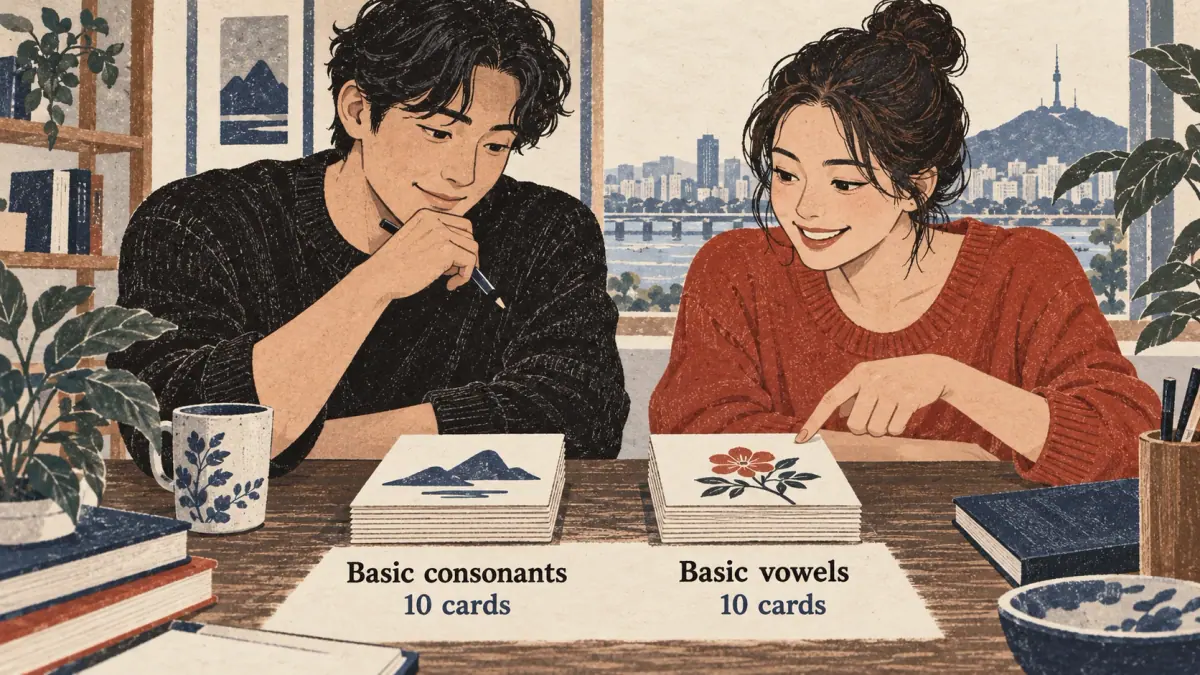
Start with the basic consonants and basic vowels decks if you cannot read Hangul yet, because they have only 10 cards each. The choice depends on what you can already do.
- You know no letters. Start with basic Korean consonants flashcards, then basic Korean vowels flashcards.
- You know the letters but read slowly. Use Korean syllable flashcards and Hangul reading flashcards.
- You mix up similar sounds. Use Korean aspirated consonants flashcards, Korean double consonants flashcards and Korean minimal pairs flashcards with the audio.
- You want one review of everything. Use the Korean alphabet flashcards, which hold all 40 letters.
The list below shows every deck in learning order, with card counts.
All Hangul Flashcards on This Site
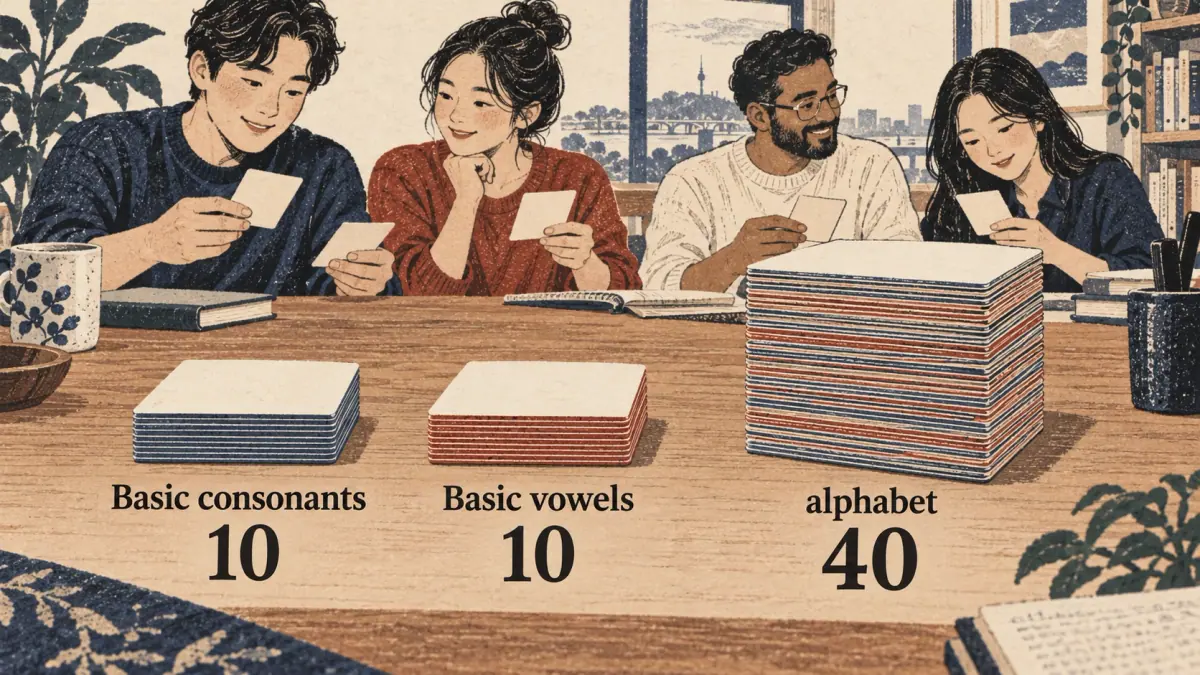













Korean Consonants Flashcards: 19 Cards
This deck has 19 cards and covers all 19 consonants in one mixed set: 10 basic, 4 aspirated and 5 tense letters, each with a sound hint and an example word. Open the Korean consonants flashcards.
Basic Korean Consonants Flashcards: 10 Cards
This deck has 10 cards and covers the 10 plain consonants ㄱ ㄴ ㄷ ㄹ ㅁ ㅂ ㅅ ㅇ ㅈ ㅎ, in dictionary order, with names, sounds and example words. Open the basic Korean consonants flashcards.
Korean Aspirated Consonants Flashcards: 8 Cards
This deck has 8 cards and covers the four puffed letters ㅋ ㅌ ㅍ ㅊ plus their plain partners ㄱ ㄷ ㅂ ㅈ, so you can hear the puff of air against the plain sound. Open the Korean aspirated consonants flashcards.
Korean Double Consonants Flashcards: 9 Cards
This deck has 9 cards and covers the five tense letters ㄲ ㄸ ㅃ ㅆ ㅉ plus four words, 아빠, 토끼, 빵 and 싸다, for the tight, airless sound. Open the Korean double consonants flashcards.
Hangul Vowels Flashcards: 21 Cards
This deck has 21 cards and covers all 21 vowels, 10 basic and 11 compound, from ㅏ to ㅢ, each with a sound hint and an example word. Open the Hangul vowels flashcards.
Basic Korean Vowels Flashcards: 10 Cards
This deck has 10 cards and covers the 10 basic vowels ㅏ ㅑ ㅓ ㅕ ㅗ ㅛ ㅜ ㅠ ㅡ ㅣ: six simple vowels and four y-vowels. Open the basic Korean vowels flashcards.
Korean Compound Vowels Flashcards: 11 Cards
This deck has 11 cards and covers the 11 vowels built from combinations, such as ㅐ ㅔ ㅘ ㅢ, with notes on which ones sound alike today. Open the Korean compound vowels flashcards.
Korean Alphabet Flashcards: 40 Cards
This deck has 40 cards and covers the whole 40-letter alphabet, 19 consonants and 21 vowels, as a mixed review set. Open the Korean alphabet flashcards.
Korean Letter Names Flashcards: 19 Cards
This deck has 19 cards and covers the names of the 19 consonants, from 기역 to 쌍지읒, used when spelling words aloud. Open the Korean letter names flashcards.
Korean Syllable Flashcards: 41 Cards
This deck has 41 cards and covers 41 open syllable blocks, ten consonants joined with ㅏ ㅓ ㅗ ㅜ, plus 시, to practise reading whole blocks. Open the Korean syllable flashcards.
Korean Batchim Flashcards: 19 Cards
This deck has 19 cards and covers 19 words that show the seven final sounds k, n, t, l, m, p and ng, plus two double finals. Open the Korean batchim flashcards.
Hangul Reading Flashcards: 26 Cards
This deck has 26 cards and covers 26 simple words with no final consonants, such as 나무 and 아이, to sound out from the letters alone. Open the Hangul reading flashcards.
Korean Minimal Pairs Flashcards: 17 Cards
This deck has 17 cards and covers 17 words in seven sets, such as 달, 딸 and 탈, that train your ear on plain, tense and aspirated sounds. Open the Korean minimal pairs flashcards.
Together the 13 decks hold 250 cards. The full alphabet deck repeats the letters taught in the group decks, so the totals overlap by design.
Each deck page also links back to the Korean flashcards hub and across to the matching lesson, quiz and worksheet.
| Deck | Cards | Covers | Best for |
|---|---|---|---|
| Basic consonants | 10 | ㄱ ㄴ ㄷ ㄹ ㅁ ㅂ ㅅ ㅇ ㅈ ㅎ | first session |
| Basic vowels | 10 | ㅏ ㅑ ㅓ ㅕ ㅗ ㅛ ㅜ ㅠ ㅡ ㅣ | first session |
| Aspirated consonants | 8 | ㅋ ㅌ ㅍ ㅊ with plain partners | hearing the puff of air |
| Double consonants | 9 | ㄲ ㄸ ㅃ ㅆ ㅉ and four words | hearing tense sounds |
| Compound vowels | 11 | ㅐ ㅒ ㅔ ㅖ ㅘ ㅙ ㅚ ㅝ ㅞ ㅟ ㅢ | vowel combinations |
| Syllables | 41 | open blocks with ㅏ ㅓ ㅗ ㅜ | reading blocks |
| Batchim | 19 | final sounds k n t l m p ng | final consonants |
| Reading words | 26 | simple open-syllable words | reading fluency |
| Minimal pairs | 17 | seven sets of near-identical words | listening |
In What Order Should I Study the Hangul Decks?
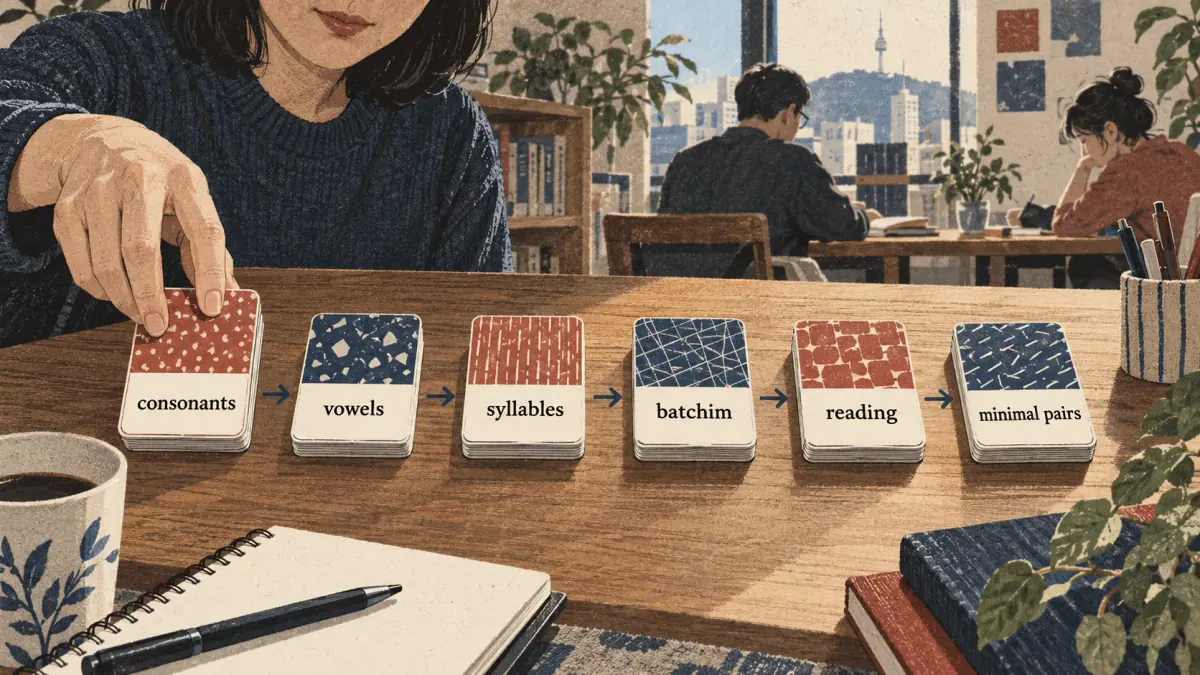
Study the decks in this order: consonants, vowels, syllables, batchim, reading, then minimal pairs. The order follows how Hangul builds up, so each deck uses letters from the earlier ones.
- Basic consonants (10 cards).
- Basic vowels (10 cards).
- Aspirated consonants (8 cards) and double consonants (9 cards).
- Compound vowels (11 cards).
- Syllables (41 cards) and batchim (19 cards).
- Reading words (26 cards) and minimal pairs (17 cards).
- Letter names (19 cards), once you know the sounds.
The mixed set decks (consonants, vowels and alphabet) work best as reviews at the end of steps 3, 4 and 6.
The first-pass decks hold 151 cards (10, 10, 8, 9, 11, 41, 19, 26 and 17). At the default pace of 10 new cards a day, that takes about 16 days, and the review boxes bring older cards back in between. The pace is a default, so set your own limit if you want a slower or faster plan.
Learn letter names after sounds because names are used mostly when spelling words aloud. The aspirated and double consonant decks work best with the listening mode with the approved audio, because the contrast is a puff of air that the eye cannot see.
How Do the Decks Pair with Worksheets and Quizzes?
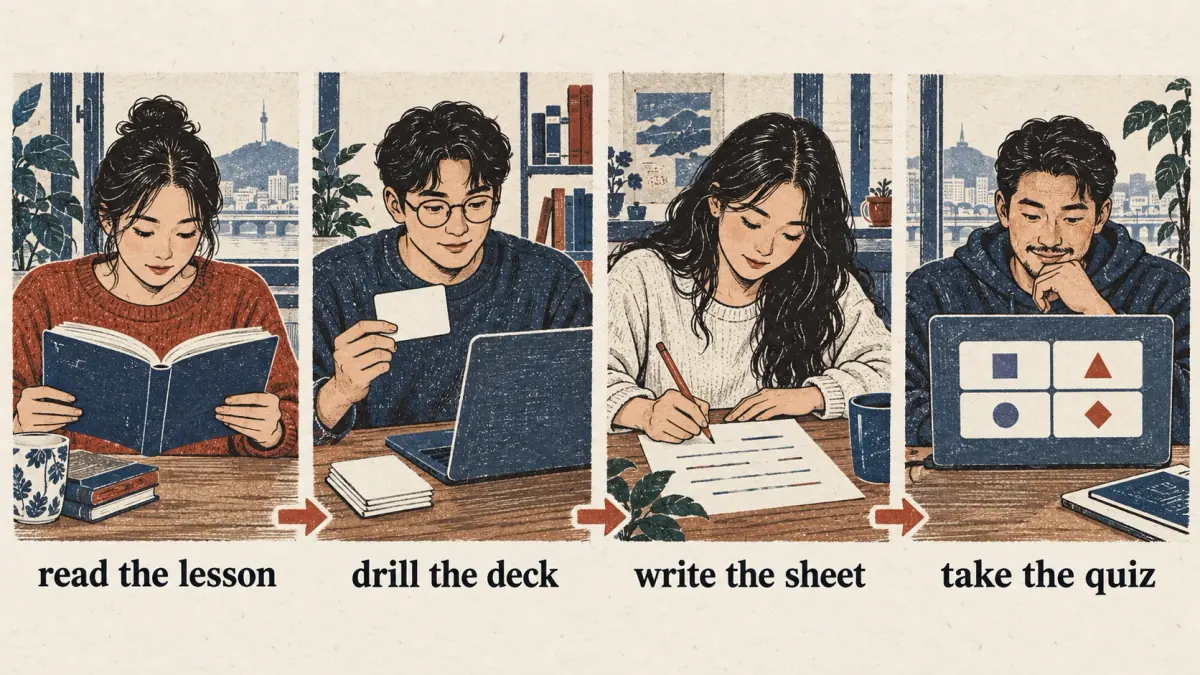
Each deck pairs with a writing sheet and a quiz, so you can combine screen review with handwriting. The matching free printable sheets are the Korean consonants writing practice, the aspirated consonants worksheet, the double consonants worksheet, the Korean vowels writing practice, the compound vowels worksheet, the Hangul syllable chart worksheet, the Korean batchim worksheet and the Hangul reading worksheet. The Hangul practice sheets cover the whole alphabet.
For scored questions, use the Hangul quizzes. To explore letters beyond a fixed deck, use the interactive hangul alphabet. A good loop is: read the lesson, drill the deck, write the sheet, then take the quiz.
Limits of the Hangul Decks

The decks teach recognition and a first sound, not full pronunciation. Revised Romanization cannot show every sound, especially the plain, tense and aspirated contrast. All Korean text and audio are generated and were reviewed and signed off by Min-ji Park on 15 October 2026. The aspirated and double consonant decks need the listening mode with the approved audio, so use them with the audio on.
Where to Go Next after the Hangul Flashcards
When the Hangul decks feel easy, move to the Korean vocabulary flashcards and the Korean flashcards hub for other families. These hangul flashcards are meant for short daily sessions, so a few minutes a day is enough to keep each deck moving through the review boxes.
Frequently Asked Questions
Which Hangul Deck Should I Start With?
Start with the basic Korean consonants flashcards, then the basic Korean vowels flashcards. They have only 10 cards each and match the first lessons. After those two, move to syllables and batchim. Use the larger set decks, such as the whole alphabet, as reviews once the smaller groups feel familiar.
Are Letter Names Needed?
Not at first. Reading needs sounds, and the names such as 기역 are mostly used when spelling a word aloud or following a textbook. Learn the letter sounds first, then study the letter names deck once you can read short words, as the order section suggests.
How Many Decks Cover the Whole Alphabet?
One deck holds the whole alphabet: the Korean alphabet flashcards with 40 letters, 19 consonants and 21 vowels. The other decks split the same letters into groups, such as basic consonants or compound vowels, so sessions stay short. Both routes cover the same letters.
Can I Print Hangul Decks?
Yes. Every deck page shows all cards in a plain table, so your browser print command gives a printable list. For handwriting, use the matching writing sheets from the worksheets section. Printing helps reading and writing practice, but the review schedule works only on screen.
Do the Decks Have Audio?
Every card has an audio button, and audio never plays by itself. The clips are generated and were approved by Min-ji Park on 15 October 2026. Decks that depend on sound, such as aspirated consonants, double consonants and minimal pairs, need the listening mode, which uses a card only once its audio is approved.