Korean Airport Phrases Flashcards: Study the 24 Cards
Airport Korean follows the order of your trip: check in, find the gate, pass immigration, collect your bag and leave. The lesson behind this deck is korean airport phrases, so read it first if a card is new, and use the cards to rehearse each step before you travel.
How Do I Use These Flashcards?
Use the deck above in four steps. It works with tap, click or keyboard, and nothing plays until you press an audio button.
- Choose a mode. Start with recognition (Hangul to meaning). Switch to recall (meaning to Hangul) or listening (audio to meaning) once recognition feels easy.
- Show the answer. Think of the meaning and the step of the trip first, then press Show answer (or Space). Say the sentence aloud before you reveal it, as if you stood at the counter. Turn on the romanization toggle only if you need it; the 24-card table below always shows it.
- Grade yourself. Press Got it if you answered correctly without help, or Not yet if you hesitated or guessed.
- Finish the session. A session holds up to 20 cards (you can set 10, 20 or 40). With 24 cards, a first-time learner can split the deck over 3 days, using the default limit of 10 new cards a day.
The Three Study Modes
Recognition shows the Hangul and asks for the meaning, which trains reading. Recall shows the meaning and asks for the Hangul, which trains remembering; you may type the answer with your Hangul keyboard or just recall it in your head. Listening plays a clip and hides the letters, which trains the ear. The pronunciation audio is generated with text-to-speech and a Korean teacher approves it before it is switched on. Listening mode only uses cards whose audio is approved, and cards without approved audio are skipped in that mode with a note.
Got It and Not Yet
Got it moves the card up one Leitner box, so it comes back later. Not yet sends the card back to box 1, so it returns in the same session or within 10 minutes. The grades are your own judgement; the deck does not score you or claim fluency.
Deck Scope: What Is and Is Not Covered
The deck covers check-in, passport control, customs, baggage claim and getting out of the airport as polite sentences. It has seat requests, questions about gates and departure times, the answers to the immigration officer, a customs line, three baggage problems, money exchange, the airport bus, and two thank-you and show-your-document lines.
What Is Left out of This Deck?
The deck does not cover getting to your hotel by taxi or asking for street directions. For those use the Korean taxi phrases flashcards and the Korean directions phrases flashcards. Announcements in the terminal use a very formal style that is not drilled here, and body-state words for feeling unwell are left to the Korean feelings phrases flashcards.
All 24 Cards in One Table
All 24 cards appear below in deck order. The table is plain HTML, so you can use it as a drill without the deck: cover the Meaning column, say each sentence aloud, then uncover it.
| # | Hangul | Revised Romanization | Meaning | Note | Audio assetId |
|---|---|---|---|---|---|
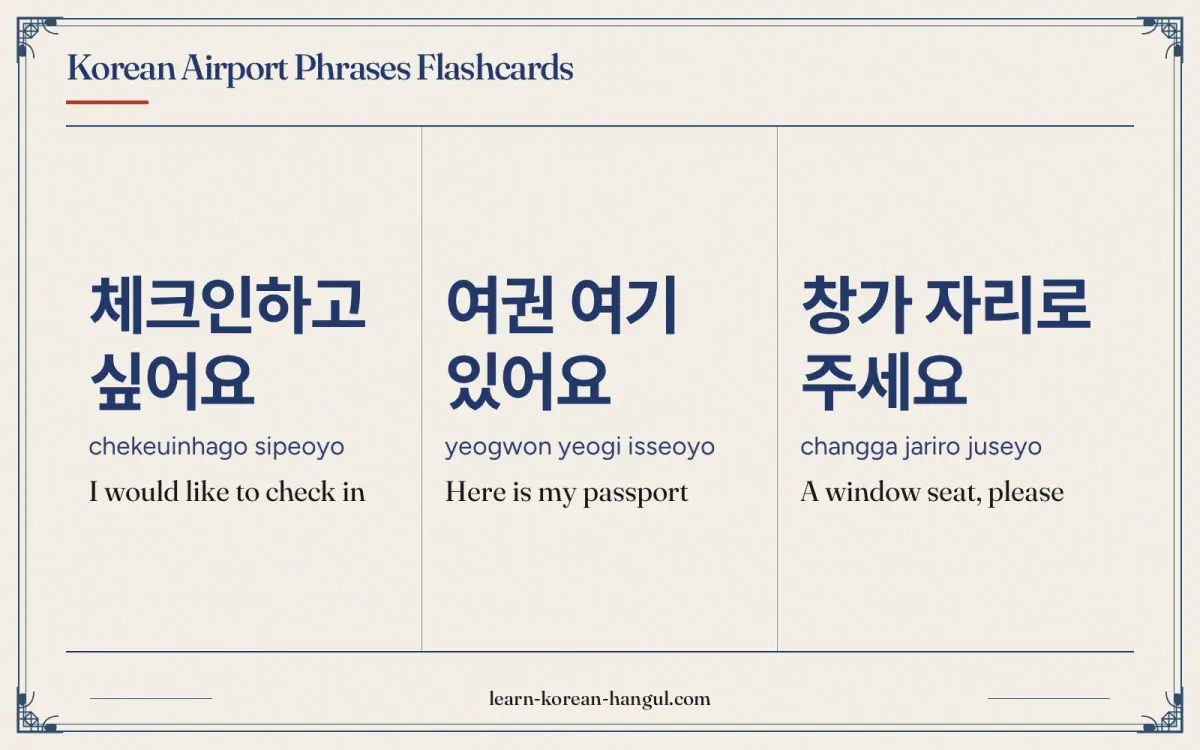
| 1 | 체크인하고 싶어요 | chekeuinhago sipeoyo | I would like to check in | -고 싶어요 states a wish politely; say it at the counter. | au-pg-flashcards-airport-phrases-flashcards-1 |
| 2 | 여권 여기 있어요 | yeogwon yeogi isseoyo | Here is my passport | Hand the passport over as you say it. | au-pg-flashcards-airport-phrases-flashcards-2 |
| 3 | 창가 자리로 주세요 | changga jariro juseyo | A window seat, please | (으)로 marks the thing you choose. | au-pg-flashcards-airport-phrases-flashcards-3 |
| 4 | 복도 자리로 주세요 | bokdo jariro juseyo | An aisle seat, please | Same pattern as the window seat. | au-pg-flashcards-airport-phrases-flashcards-4 |
| 5 | 짐이 두 개예요 | jimi du gaeyeyo | I have two bags | 개 is the counter for things; 두 is the counter form of 둘. | au-pg-flashcards-airport-phrases-flashcards-5 |
| 6 | 이 가방은 기내에 들고 탈게요 | i gabangeun ginaee deulgo talgeyo | I will carry this bag on board | 기내 means inside the plane; -ㄹ게요 promises an action. | au-pg-flashcards-airport-phrases-flashcards-6 |
| 7 | 탑승구가 어디예요? | tapseungguga eodiyeyo | Where is the boarding gate? | Pattern: place + 이/가 + 어디예요? | au-pg-flashcards-airport-phrases-flashcards-7 |
| 8 | 출구가 어디예요? | chulguga eodiyeyo | Where is the exit? | Recognise the sign 출구 (exit). | au-pg-flashcards-airport-phrases-flashcards-8 |
| 9 | 몇 번 게이트예요? | myeot beon geiteuyeyo | Which gate is it? | 몇 번 is said [멷뻔]; 번 counts numbered things. | au-pg-flashcards-airport-phrases-flashcards-9 |
| 10 | 비행기는 몇 시에 출발해요? | bihaenggineun myeot sie chulbalhaeyo | What time does the flight leave? | 출발 means departure; the sign for leaving is 출국. | au-pg-flashcards-airport-phrases-flashcards-10 |
| 11 | 입국 목적이 뭐예요? | ipguk mokjeogi mwoyeyo | What is the purpose of your visit? | What the officer asks; 입국 is said [입꾹]. | au-pg-flashcards-airport-phrases-flashcards-11; slow: au-pg-flashcards-airport-phrases-flashcards-25 |
| 12 | 관광이에요 | gwangwangieyo | It is sightseeing | One noun plus 이에요 is a full answer. | au-pg-flashcards-airport-phrases-flashcards-12 |
| 13 | 출장이에요 | chuljangieyo | It is a business trip | Another one-noun answer. | au-pg-flashcards-airport-phrases-flashcards-13 |
| 14 | 일주일 있을 거예요 | iljuil isseul geoyeyo | I will stay for one week | -(으)ㄹ 거예요 states a plan. | au-pg-flashcards-airport-phrases-flashcards-14 |
| 15 | 호텔에서 묵을 거예요 | hotereseo mugeul geoyeyo | I will stay at a hotel | 묵다 means to stay overnight; said [호테레서]. | au-pg-flashcards-airport-phrases-flashcards-15 |
| 16 | 신고할 것이 없어요 | singohal geosi eopseoyo | I have nothing to declare | Said at customs; 신고 means a declaration. | au-pg-flashcards-airport-phrases-flashcards-16 |
| 17 | 수하물 찾는 곳이 어디예요? | suhamul channeun gosi eodiyeyo | Where is baggage claim? | Said [수하물 찬는 고시]; 곳 means place. | au-pg-flashcards-airport-phrases-flashcards-17; slow: au-pg-flashcards-airport-phrases-flashcards-26 |
| 18 | 제 가방이 안 나왔어요 | je gabangi an nawasseoyo | My bag has not come out | Use for a missing bag at the carousel. | au-pg-flashcards-airport-phrases-flashcards-18 |
| 19 | 짐이 없어졌어요 | jimi eopseojyeosseoyo | My luggage has gone missing | Said [지미 업써저써요]; 없어지다 means to go missing. | au-pg-flashcards-airport-phrases-flashcards-19; slow: au-pg-flashcards-airport-phrases-flashcards-27 |
| 20 | 환전하는 곳이 어디예요? | hwanjeonhaneun gosi eodiyeyo | Where can I exchange money? | 환전 means currency exchange. | au-pg-flashcards-airport-phrases-flashcards-20 |
| 21 | 공항버스는 어디에서 타요? | gonghangbeoseuneun eodieseo tayo | Where do I take the airport bus? | 어디에서 asks where an action happens. | au-pg-flashcards-airport-phrases-flashcards-21 |
| 22 | 와이파이 비밀번호가 뭐예요? | waipai bimilbeonhoga mwoyeyo | What is the Wi-Fi password? | Useful in lounges and cafés. | au-pg-flashcards-airport-phrases-flashcards-22 |
| 23 | 탑승권 여기 있어요 | tapseunggwon yeogi isseoyo | Here is my boarding pass | Same pattern as the passport card. | au-pg-flashcards-airport-phrases-flashcards-23 |
| 24 | 도와주셔서 감사합니다 | dowajusyeoseo gamsahamnida | Thank you for helping me | Formal thanks; -아/어 주시다 is the honorific form of doing something for someone. | au-pg-flashcards-airport-phrases-flashcards-24 |
Reading the Table
Hangul is the sentence. Revised Romanization (RR) is a learning aid, so try to read the Hangul before you look at it. RR follows the sound, which is why 입국 is written ipguk. The Meaning column gives the English gloss, and the Note column gives a use or sound hint. The last column lists the audio assetId; a second ID marks a slow clip (0.8x) for the cards where the sound changes most.
Usage Notes for These Cards
You can answer in the polite 해요 style. Most airport staff use polite formal speech, so you can answer in -아요/어요 and be fully understood. There is no need to use the formal 합쇼체 yourself, though you may hear it in announcements.
Ask where something is with place + 이/가 어디예요? The pattern is a place word plus 이/가 plus 어디예요, as in 탑승구가 어디예요?. Swap the first word for 출구, 환전하는 곳 or any other place you need.
One noun is a full answer. At immigration the officer asks 입국 목적이 뭐예요?. Replying with a single noun like 관광이에요 or 출장이에요 (business trip) is enough.
Count bags with 개. 짐 두 개 means two bags, and 하나 or 한 개 is how you say one. The counter 개 works for most objects.
Learn the signs. Signs usually show Korean and English together, so the Korean words to recognise are 출구 (exit), 입국 (arrival), 출국 (departure) and 탑승구 (gate).
Which Sounds Do Not Match the Spelling?
수하물 찾는 곳 is said [수하물 찬는 곧]. The ㅈ in 찾 neutralizes to ㄷ, and then nasalizes to ㄴ before the ㄴ of 는. On its own, 곳 is said [곧]; before the particle 이 it links as [고시]. This is neutralization plus nasalization, and the RR is suhamul channeun gosi.
입국 is said [입꾹]. The ㄱ turns tense after the final ㅂ (tensification). RR does not mark this.
없어졌어요 is said [업써저써요]. The cluster ㅄ reads as ㅂ, and the ㅅ that follows turns tense. Together this is cluster simplification plus tensification. In 졌 the ㅕ is said [ㅓ] after ㅈ, so 졌어요 sounds like [저써요].
What Mistakes Do Learners Make with Airport Korean?
- Saying 짐이 없어요 for lost luggage. That means I have no luggage. Say 짐이 안 나왔어요 or 짐이 없어졌어요.
- Using 어디 with no ending, as in 화장실 어디?. Add 예요 to be polite: 화장실이 어디예요?.
- Using 가요 when you ask when a flight leaves. People will understand, but 출발해요 is the clearer word for a flight departing.
- Saying 여권 있어요 when you hand over the passport. Add 여기: 여권 여기 있어요 means here it is.
The luggage lines cause the most confusion, so give cards 18 and 19 extra passes in recall mode.
How Does the Review Schedule Work?
The deck uses a simplified Leitner system with five boxes. A new card starts in box 1. Each Got it moves it up one box, and each Not yet returns it to box 1. The box sets how long the card waits before it is due again.
| Box | Wait until the next review |
|---|---|
| 1 | same session or 10 minutes |
| 2 | 1 day |
| 3 | 3 days |
| 4 | 7 days |
| 5 | 21 days |
Each session shows due cards first, oldest due first, and then up to 10 new cards a day by default. A deck of 24 cards is introduced over 3 days at the default of 10 new cards a day, and the later boxes bring each card back at longer gaps. Progress is saved only in this browser, so clearing site data deletes it. Use the export button to save a small JSON file with card IDs, boxes and due dates, and import it on another device. No account is needed.
Cultural and Practical Context
Incheon airport is known for signage in several languages and for staff who commonly speak at least some English, so Korean here is often a courtesy rather than a necessity. Even so, a short 감사합니다 to staff is warmly received. Learners often find that a few correct sentences at the counter lead staff to answer slowly and kindly.
Limits of This Deck
The deck holds 24 cards and covers a standard international arrival and departure, not every airport situation. Official terms for immigration and customs wording should be checked against current forms, and the remark about Incheon signage is general. All Korean text is generated and was reviewed and signed off by Min-ji Park on 15 October 2026, and each audio clip is checked by a Korean teacher before publication.
Next Steps after This Deck
After these korean airport phrases flashcards, move on to the korean directions phrases flashcards to keep the same routine. If you need words for feeling tired or unwell after the flight, use the korean feelings phrases flashcards. The Korean phrases flashcards page lists every phrase deck, and the Korean flashcards hub lists all topics.
Frequently Asked Questions
How Do I Say My Seat Preference in Korean?
Say 창가 자리로 주세요 for a window seat or 복도 자리로 주세요 for an aisle seat. The pattern is the seat word plus 자리로 plus 주세요, which means please give me. It is polite and works at check-in or on the plane.
What Does the Immigration Officer Ask Me?
The usual question is 입국 목적이 뭐예요?, which means What is the purpose of your visit? Answer with one noun, such as 관광이에요 for sightseeing or 출장이에요 for a business trip. The officer may also ask how long you will stay.
What Should I Say If My Bag Does Not Arrive?
Say 제 가방이 안 나왔어요 if it has not come out at the carousel, or 짐이 없어졌어요 if it has gone missing. Do not say 짐이 없어요, which means I have no luggage. Then ask staff where the baggage desk is.
Do I Need to Speak Formally at the Airport?
No. Polite -아요/어요 speech is fully understood and welcome. Staff often use the formal 합쇼체 to you, but you do not need to match it. Add 감사합니다 when staff help you.
Is My Progress Saved If I Close the Page?
Yes, in the same browser on the same device. Card boxes and due dates are stored locally and nothing is sent to a server. Clearing site data, using a private window or switching browsers removes them, so use the export button to keep a backup file. No account is needed.