Korean Directions Phrases Flashcards: Study the 23 Cards
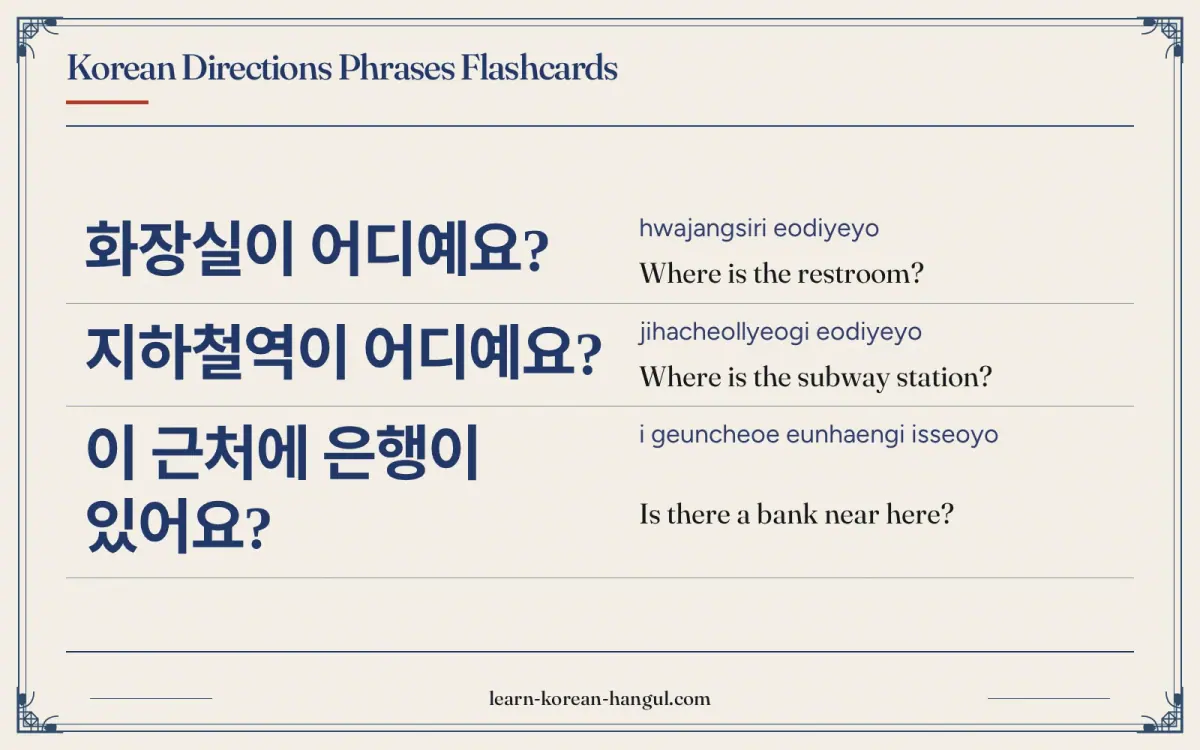
Asking directions has two halves: the question you ask and the reply you must understand. The lesson behind this deck is korean directions phrases, so read it first if a card is new, and use the cards to practise both halves.
How Do I Use These Flashcards?
Use the deck above in four steps. It works with tap, click or keyboard, and nothing plays until you press an audio button.
- Choose a mode. Start with recognition (Hangul to meaning). Switch to recall (meaning to Hangul) or listening (audio to meaning) once recognition feels easy.
- Show the answer. Think of the meaning and picture the street first, then press Show answer (or Space). Say the sentence aloud before you reveal it, and point left or right as you say the direction cards. Turn on the romanization toggle only if you need it; the 23-card table below always shows it.
- Grade yourself. Press Got it if you answered correctly without help, or Not yet if you hesitated or guessed.
- Finish the session. A session holds up to 20 cards (you can set 10, 20 or 40). With 23 cards, a first-time learner can split the deck over 3 days, using the default limit of 10 new cards a day.
The Three Study Modes
Recognition shows the Hangul and asks for the meaning, which trains reading. Recall shows the meaning and asks for the Hangul, which trains remembering; you may type the answer with your Hangul keyboard or just recall it in your head. Listening plays a clip and hides the letters, which trains the ear. The pronunciation audio is generated with text-to-speech and a Korean teacher approves it before it is switched on. Listening mode only uses cards whose audio is approved, and cards without approved audio are skipped in that mode with a note.
Got It and Not Yet
Got it moves the card up one Leitner box, so it comes back later. Not yet sends the card back to box 1, so it returns in the same session or within 10 minutes. The grades are your own judgement; the deck does not score you or claim fluency.
Deck Scope: What Is and Is Not Covered
The deck covers asking where places are, how to get there, and understanding the main replies. It has the question pattern 어디예요 and 어디에 있어요, being lost, the direction commands (straight, right, left, forward, cross), location words (next to, in front of), exit numbers, near and far, walking time, and two lines for showing a map.
What Is Left out of This Deck?
The deck does not cover riding a taxi or buying transit tickets. For those use the Korean taxi phrases flashcards. Arrival and customs lines are in the Korean airport phrases flashcards, and emergency help is in the Korean emergency phrases flashcards.
All 23 Cards in One Table
All 23 cards appear below in deck order. The table is plain HTML, so you can use it as a drill without the deck: cover the Meaning column, say each sentence aloud, then uncover it.
| # | Hangul | Revised Romanization | Meaning | Note | Audio assetId |
|---|---|---|---|---|---|
| 1 | 화장실이 어디예요? | hwajangsiri eodiyeyo | Where is the restroom? | Pattern: place + 이/가 + 어디예요? | au-pg-flashcards-directions-phrases-flashcards-1 |
| 2 | 지하철역이 어디예요? | jihacheollyeogi eodiyeyo | Where is the subway station? | Said [지하철려기]; a ㄴ sound is inserted before 역. | au-pg-flashcards-directions-phrases-flashcards-2; slow: au-pg-flashcards-directions-phrases-flashcards-24 |
| 3 | 이 근처에 은행이 있어요? | i geuncheoe eunhaengi isseoyo | Is there a bank near here? | Asks whether something exists nearby. | au-pg-flashcards-directions-phrases-flashcards-3 |
| 4 | 여기가 어디예요? | yeogiga eodiyeyo | Where is this place? | Say it while pointing at a map. | au-pg-flashcards-directions-phrases-flashcards-4 |
| 5 | 편의점이 어디에 있어요? | pyeonuijeomi eodie isseoyo | Where is the convenience store? | Use 어디에 있어요 for the location of something known. | au-pg-flashcards-directions-phrases-flashcards-5 |
| 6 | 길을 잃었어요 | gireul ireosseoyo | I am lost | Said [기를 이러써요]; 길을 잃다 means to lose the way. | au-pg-flashcards-directions-phrases-flashcards-6; slow: au-pg-flashcards-directions-phrases-flashcards-25 |
| 7 | 이 길로 가면 돼요? | i gillo gamyeon dwaeyo | Do I go this way? | (으)로 marks the route; 길로 has a double ㄹ sound. | au-pg-flashcards-directions-phrases-flashcards-7 |
| 8 | 쭉 가세요 | jjuk gaseyo | Go straight on | Polite command; the normal helpful tone. | au-pg-flashcards-directions-phrases-flashcards-8 |
| 9 | 똑바로 가세요 | ttokbaro gaseyo | Go straight ahead | Said [똑빠로]; ㅂ is tense after ㄱ. | au-pg-flashcards-directions-phrases-flashcards-9; slow: au-pg-flashcards-directions-phrases-flashcards-26 |
| 10 | 오른쪽으로 가세요 | oreunjjogeuro gaseyo | Go to the right | Direction needs (으)로, not 에. | au-pg-flashcards-directions-phrases-flashcards-10 |
| 11 | 왼쪽으로 가세요 | oenjjogeuro gaseyo | Go to the left | Same pattern as the right turn. | au-pg-flashcards-directions-phrases-flashcards-11 |
| 12 | 앞으로 가세요 | apeuro gaseyo | Go forward | 앞 is front; 뒤 is back. | au-pg-flashcards-directions-phrases-flashcards-12 |
| 13 | 길을 건너세요 | gireul geonneoseyo | Cross the street | 건너다 means to cross; 길을 marks the thing crossed. | au-pg-flashcards-directions-phrases-flashcards-13 |
| 14 | 사거리에서 왼쪽으로 가세요 | sageorieseo oenjjogeuro gaseyo | At the intersection, go left | 사거리 means a four-way crossing. | au-pg-flashcards-directions-phrases-flashcards-14 |
| 15 | 은행 옆에 있어요 | eunhaeng yeope isseoyo | It is next to the bank | 에 marks location; 옆 means beside. | au-pg-flashcards-directions-phrases-flashcards-15 |
| 16 | 편의점 앞에 있어요 | pyeonuijeom ape isseoyo | It is in front of the convenience store | Landmarks beat street names in Korea. | au-pg-flashcards-directions-phrases-flashcards-16 |
| 17 | 2번 출구로 나가세요 | ibeon chulguro nagaseyo | Go out of exit 2 | Subway exit numbers are the best landmarks. | au-pg-flashcards-directions-phrases-flashcards-17 |
| 18 | 가까워요 | gakkawoyo | It is near | Adjective in the polite form; the stem is 가깝다. | au-pg-flashcards-directions-phrases-flashcards-18 |
| 19 | 멀어요 | meoreoyo | It is far | Adjective in the polite form; the stem is 멀다. | au-pg-flashcards-directions-phrases-flashcards-19 |
| 20 | 걸어서 얼마나 걸려요? | georeoseo eolmana geollyeoyo | How long does it take on foot? | 걸어서 means by walking. | au-pg-flashcards-directions-phrases-flashcards-20 |
| 21 | 걸어서 오 분이에요 | georeoseo o bunieyo | It is five minutes on foot | Minutes use Sino numbers: 오 분. | au-pg-flashcards-directions-phrases-flashcards-21 |
| 22 | 여기 가고 싶어요 | yeogi gago sipeoyo | I want to go here | Point at a map or phone and say it. | au-pg-flashcards-directions-phrases-flashcards-22 |
| 23 | 지도로 보여 주세요 | jidoro boyeo juseyo | Please show me on the map | (으)로 marks the means: by map. | au-pg-flashcards-directions-phrases-flashcards-23 |
Reading the Table
Hangul is the sentence. Revised Romanization (RR) is a learning aid, so try to read the Hangul before you look at it. RR follows the sound, which is why 오른쪽으로 is written oreunjjogeuro. The Meaning column gives the English gloss, and the Note column gives a use or sound hint. The last column lists the audio assetId; a second ID marks a slow clip (0.8x) for the cards where the sound changes most.
Usage Notes for These Cards
Ask for a place with place + 이/가 어디예요? To ask where something is, use the pattern in 화장실이 어디예요?. For existence, use place + 이/가 어디에 있어요?, as in 편의점이 어디에 있어요?.
Directions come in the polite command -(으)세요. 오른쪽으로 가세요 is not rude; it is the normal helpful tone. Learn the endings together with the five direction words: 쭉, 오른쪽, 왼쪽, 앞 and 건너다.
(으)로 marks direction; 에 marks location. Say 오른쪽으로 (toward the right) and 왼쪽으로 (toward the left), but 은행 옆에 있어요 (it is next to the bank). Mixing them up is the most common error in this topic.
Landmarks beat street names. In Korea people say 편의점 앞 (in front of the convenience store) or 2번 출구 (exit 2) rather than a street number. Ask about the landmark, and your helper will do the same.
Show a map. Show your phone and say 여기 가고 싶어요 (I want to go here). Pointing plus 여기 is often the fastest way to be understood.
Which Sounds Do Not Match the Spelling?
지하철역이 is said [지하철려기]. A ㄴ sound is inserted before 역, and it turns into ㄹ after the final ㄹ of 철 (ㄴ-insertion plus liquidization). The final ㄱ of 역 then links to 이. The RR is jihacheollyeogi.
똑바로 is said [똑빠로]. The ㅂ turns tense after the final ㄱ (tensification). RR does not mark this, so the RR stays ttokbaro.
길을 잃었어요 is said [기를 이러써요]. The ㄹ of 길 links to 을, and the ㅎ in the cluster ㅀ of 잃 is silent, so the ㄹ links as well (liaison).
What Mistakes Do Learners Make with Asking Directions?
- Saying 오른쪽에 가세요 for turn right. Direction needs (으)로: 오른쪽으로 가세요.
- Asking with the bare place name, as in 지하철역?. Add 어디예요? so the question is complete and polite.
- Asking 어디 있어요? with no noun. Add the place: 화장실이 어디 있어요?.
- Using minutes with the native number. Say 오 분 (Sino number), not 다섯 분.
The 에 versus (으)로 pair causes most slips, so give cards 10 and 15 extra passes in recall mode.
How Does the Review Schedule Work?
The deck uses a simplified Leitner system with five boxes. A new card starts in box 1. Each Got it moves it up one box, and each Not yet returns it to box 1. The box sets how long the card waits before it is due again.
| Box | Wait until the next review |
|---|---|
| 1 | same session or 10 minutes |
| 2 | 1 day |
| 3 | 3 days |
| 4 | 7 days |
| 5 | 21 days |
Each session shows due cards first, oldest due first, and then up to 10 new cards a day by default. A deck of 23 cards is introduced over 3 days at the default of 10 new cards a day, and the later boxes bring each card back at longer gaps. Progress is saved only in this browser, so clearing site data deletes it. Use the export button to save a small JSON file with card IDs, boxes and due dates, and import it on another device. No account is needed.
Cultural and Practical Context
Addresses in Korea were moved to a street-name system, but in daily life people still direct each other by landmarks, subway exits and shop names, so asking for the exit number is very practical. Passers-by will often walk with you part of the way, or point and repeat the key word slowly. A thank-you at the end is always welcome.
Limits of This Deck
The deck holds 23 cards and teaches the questions and replies a visitor needs most, not full route descriptions. The remark about the address system is general. All Korean text is generated and was reviewed and signed off by Min-ji Park on 15 October 2026, and each audio clip is checked by a Korean teacher before publication.
Next Steps after This Deck
After these korean directions phrases flashcards, move on to the korean taxi phrases flashcards to keep the same routine. The korean airport phrases flashcards cover the step before this one, from check-in to the airport bus. The Korean phrases flashcards page lists every phrase deck, and the Korean flashcards hub lists all topics.
Frequently Asked Questions
How Do I Say 'Turn Left' and 'Turn Right' Correctly?
Say 왼쪽으로 가세요 for left and 오른쪽으로 가세요 for right. The particle (으)로 marks direction, so do not use 에. If you need to turn at a corner, add the place first: 사거리에서 왼쪽으로 가세요.
What Is the Difference between 어디예요 and 어디에 있어요?
어디예요 asks what a place is or where it is in general, as in 여기가 어디예요?. 어디에 있어요 asks where something is located, as in 편의점이 어디에 있어요?. In daily speech people often shorten the second to 어디 있어요?.
How Do I Ask If Something Is Walking Distance?
Ask 걸어서 얼마나 걸려요?, which means How long does it take on foot? The answer is a number of minutes, such as 걸어서 오 분이에요. You can also ask 가까워요?, which means Is it near?.
Which Landmark Words Are Best to Learn First?
Learn 편의점 (convenience store), 은행 (bank), 지하철역 (subway station) and 출구 (exit). Add the place words 앞 (front), 옆 (beside) and 뒤 (behind), because Koreans describe places by landmarks.
Is My Progress Saved If I Close the Page?
Yes, in the same browser on the same device. Card boxes and due dates are stored locally and nothing is sent to a server. Clearing site data, using a private window or switching browsers removes them, so use the export button to keep a backup file. No account is needed.