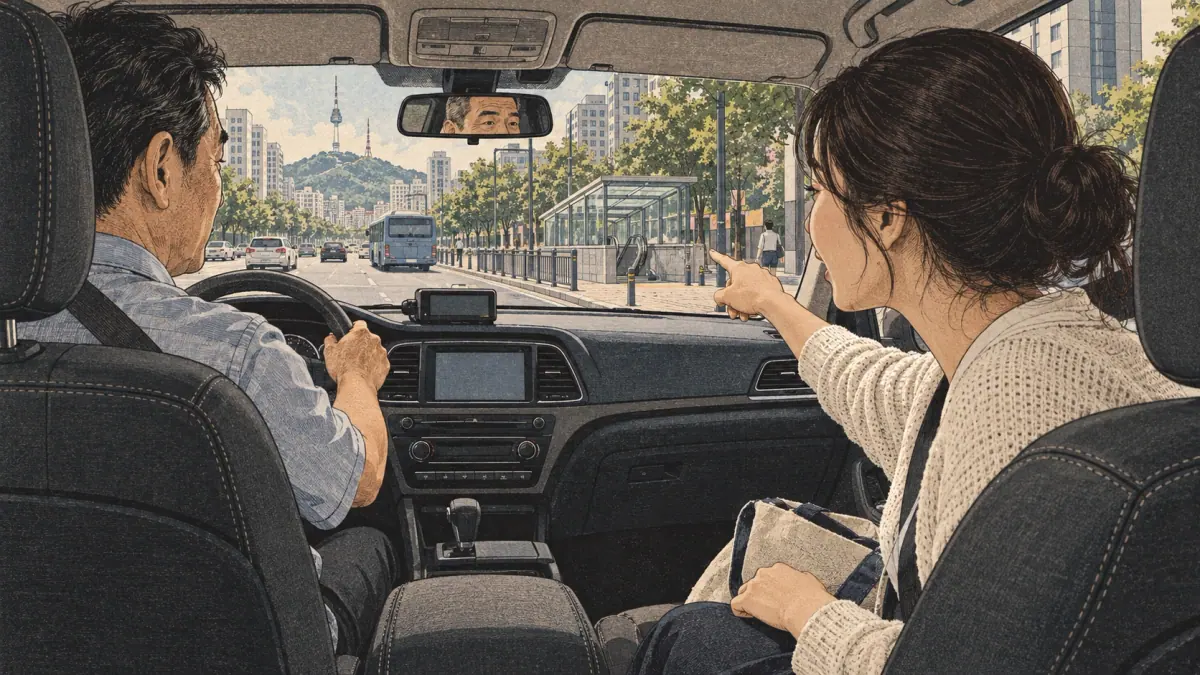
What Are the Most Useful Korean Taxi Phrases to Learn First?
The most useful Korean taxi phrases follow the order of a ride, so learn them in that order. Taxi apps, such as Kakao T, handle most destinations, so your phrases are for the ride itself: boarding, stopping and paying.
| Step | Situation | Korean | Revised Romanization | Guide |
|---|---|---|---|---|
| 1 | Find a taxi | 택시 승강장이 어디예요? | taeksi seunggangjangi eodiyeyo | where is the taxi stand |
| 2 | Stop the ride | 여기서 세워 주세요 | yeogiseo sewo juseyo | stop here please |
| 3 | Ask the fare | 요금이 얼마예요? | yogeumi eolmayeyo | how much is the fare |
| 4 | Change subway lines | 어디서 갈아타요? | eodiseo garatayo | where do I transfer |
Revised Romanization (the South Korean government standard of 2000) is shown only as a reading aid. Learn the Hangul first.
Three taxi lines cover most rides. Say the destination plus 가 주세요, stop with 여기서 세워 주세요, and check payment with 카드 돼요?. The destination line has one small rule: use 로 after a vowel or ㄹ, and 으로 after any other consonant, so 명동으로 가 주세요 (myeongdongeuro ga juseyo) and 시청으로 가 주세요 both use 으로.
- 명동으로 가 주세요. (myeongdongeuro ga juseyo): "Please go to Myeongdong."
- 여기서 세워 주세요. (yeogiseo sewo juseyo): "Please stop here."
- 카드 돼요? (kadeu dwaeyo): "Does a card work?"
Tipping is not expected in Korean taxis, so you do not need a phrase for it. On the subway and bus, the same polite pattern works. Ask about a line with 몇 호선 (myeot hoseon, "which line?"), and ask about an exit with 몇 번 출구 (myeot beon chulgu). The Sino-Korean numbers page teaches the numbers behind them. With the order clear, the next question is which style to use.
How Do You Choose between Formal, Polite and Casual Korean Taxi Phrases?
Use the polite style (해요체) with 주세요 for every driver, clerk and passenger. The page on Korean speech levels explains the three styles in depth. Drivers and station staff are strangers, so politeness comes first, and casual 반말 is never right.
| Task | You say (polite) | You may hear |
|---|---|---|
| Destination | 명동으로 가 주세요 | 네, 알겠습니다 (yes, understood) |
| Stop | 여기서 세워 주세요 | 여기요? (here?) |
| Payment | 카드 돼요? | 네, 카드 돼요 (yes, cards work) |
| Transfer | 어디서 갈아타요? | 시청역에서 갈아타세요 (transfer at City Hall) |
The same two endings do most of the work. -(아/어) 주세요 means "please do it for me," and -아요/-어요 is the standard polite ending. Drivers may answer with honorific sentences, such as 어디로 모실까요? (where shall I take you?), and a short 네 or the place name is a complete reply. With the style chosen, the cards below list every guide.
All Korean Taxi Phrases Guides
The list below has all four guides, each with its lead phrase and a short audio clip. The Korean travel phrases hub holds the other travel clusters, and the Korean phrases hub holds every situation.
Start Here
Where Is the Taxi Stand
The key phrase is 택시 승강장이 어디예요? (taeksi seunggangjangi eodiyeyo), which means "where is the taxi stand?" It is the question for a station or airport.
Stop Here Please
The key phrase is 여기서 세워 주세요 (yeogiseo sewo juseyo), which means "please stop here." It is the line that ends a ride.
How Much Is the Fare
The key phrase is 요금이 얼마예요? (yogeumi eolmayeyo), which means "how much is the fare?" It asks the price of the ride.
Where Do I Transfer
The key phrase is 어디서 갈아타요? (eodiseo garatayo), which means "where do I transfer?" It is the question for a subway or bus change.
How Do You Practise Korean Taxi Phrases?
Practise Korean taxi phrases as a short role play. Play each lead clip, repeat it aloud, and then act out a ride from the taxi stand to the drop-off.
- Ask 택시 승강장이 어디예요? to find the stand.
- Say your destination with 로 or 으로 plus 가 주세요.
- Say 여기서 세워 주세요 a little early.
- Ask 요금이 얼마예요?, then 카드 돼요?.
The phrase flashcards drill the lines with audio. For the single word, see taxi in Korean. If you have not yet learned the basics, start with Korean greetings. Always keep the destination written in Hangul on your phone, so you can show it if the driver does not understand your pronunciation.
What Mistakes Do Learners Make with Korean Taxi Phrases?
Most mistakes with Korean taxi phrases come from the destination ending, the stop and the payment.
| Mistake | Why it is a problem | Fix |
|---|---|---|
| Saying a bare place name, such as 명동 | It sounds abrupt to a stranger | Say 명동이요 or add 가 주세요 |
| Choosing 으로 after a vowel | The particle form is wrong | Use 로 after a vowel or ㄹ |
| Calling the stop late | The car cannot pull over in time | Say 여기서 세워 주세요 early |
| Leaving a tip | Tipping is not expected | Pay the fare shown |
| Mixing 타요 and 갈아타요 | 타요 means "ride," 갈아타요 means "change" | Say 갈아타요 for transfers |
An expert tip: in a long ride, repeat the place name after the driver confirms it. If the driver says 네 and starts the meter, you are on the right route. Keep the lines short, stay polite, and the Korean taxi phrases in this hub will cover the ride from the stand to the drop-off.
Frequently Asked Questions
How do I tell a taxi driver where to go?
Say the place, then 으로 가 주세요 or 로 가 주세요. Use 로 after a vowel or ㄹ, and 으로 after other consonants. For example, 명동으로 가 주세요 (myeongdongeuro ga juseyo) means "please go to Myeongdong." Show the address in Hangul on your phone as well, because many places share similar names.
How do I ask the driver to stop in Korean?
Say 여기서 세워 주세요 (yeogiseo sewo juseyo), "please stop here." Say it a little early, because the car needs time to pull over. You can point to the spot and add 저기 (jeogi, "over there") or 앞에서 (apeseo, "in front"). Then ask 얼마예요? (eolmayeyo) to hear the fare.
Do Korean taxis take cards?
Most taxis in big cities take credit cards and transit cards, but it is polite to check by asking 카드 돼요? (kadeu dwaeyo), "does a card work?" before the ride or at the end. If the driver says no, you can pay in cash with 현금으로 낼게요 (hyeongeumeuro naelgeyo). Tipping is not expected in Korean taxis.
How do I ask where to transfer in Korean?
Ask 어디서 갈아타요? (eodiseo garatayo), "where do I transfer?" Add the line or station if you know it, such as 2호선은 어디서 갈아타요? (i hoseoneun eodiseo garatayo). Station staff and other riders usually answer with a station name and an exit number, and they will often point to the signs.