
What Are the Most Useful Polite Korean Phrases to Learn First?
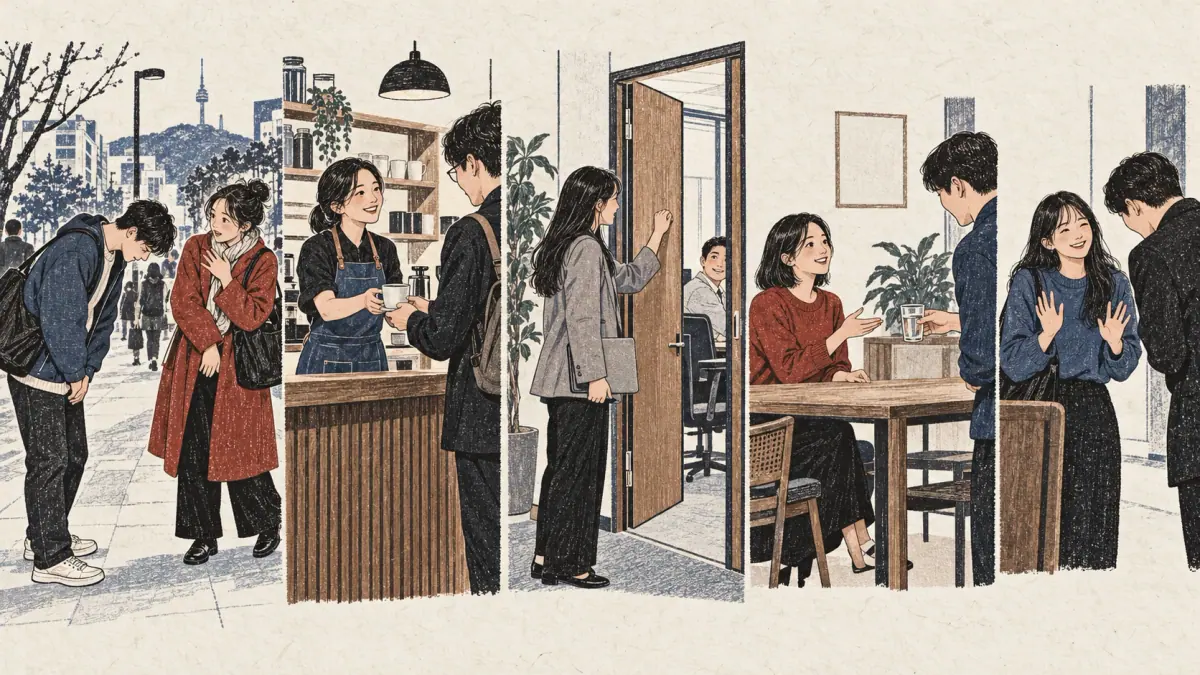
Learn five polite Korean phrases first: 죄송합니다 (joesonghamnida, sorry), 감사합니다 (gamsahamnida, thank you), 실례합니다 (sillyehamnida, excuse me), 주세요 (juseyo, please give me) and 천만에요 (cheonmaneyo, you're welcome). Together they cover most shops, trains, offices and homes.
| Order | Job | Korean | Revised Romanization | Page |
|---|---|---|---|---|
| 1 | Apologise | 죄송합니다 | joesonghamnida | sorry in Korean |
| 2 | Thank | 감사합니다 | gamsahamnida | thank you in Korean |
| 3 | Interrupt or ask | 실례합니다 | sillyehamnida | excuse me in Korean |
| 4 | Request | 주세요 | juseyo | please in Korean |
| 5 | Reply to thanks | 천만에요 | cheonmaneyo | you're welcome in Korean |
Revised Romanization (the South Korean government standard of 2000) is shown only as a reading aid. Learn the Hangul first. The next section explains how to adjust these phrases for the listener.
How Do You Choose between Formal, Polite and Casual Forms?

Choose the form by the listener: 감사합니다 and 죄송합니다 are the safe formal pair for strangers, teachers and bosses, while 고마워요 and 미안해요 suit people you know. Korean marks the listener with three speech styles, explained in the guide to Korean speech levels. The polite style (해요체) is the everyday default, the casual style (해체) is for close friends, and the formal style (합쇼체) is for service, work and speeches.
| Job | Formal | Polite | Casual |
|---|---|---|---|
| Thank you | 감사합니다 | 고마워요 | 고마워 |
| Sorry | 죄송합니다 | 미안해요 | 미안해 |
| Excuse me | 실례합니다 | 저기요 | 저기 |
| Please give me | 주십시오 | 주세요 | 줘 |
| Reply to thanks | 천만에요 | 아니에요 | 아니야 |
Choosing the style is only half the work. The vocabulary underneath also changes the tone, as the next section shows.
What Is the Difference between 감사 and 고맙, 죄송 and 미안?
Korean has two roots for thanks and two for sorry, and the root changes the tone. 감사 (感謝) and 죄송 (罪悚) are Sino-Korean, meaning they come from Chinese-character roots, and they sound formal and respectful. 고맙 is a native Korean root and sounds warmer and closer. 미안 (未安) is also Sino-Korean by origin, but in everyday use it is the lighter, closer sorry, so the tone difference comes from usage, not from origin.
- Thanks: 감사합니다 is formal; 고마워요 is warm and polite; 고마워 is casual.
- Sorry: 죄송합니다 admits fault to a listener you respect; 미안해요 is a friendlier sorry between equals; 미안해 is casual.
- Rule of thumb: use 감사 and 죄송 with strangers and seniors, and 고맙 and 미안 with friends and younger people.
Two more groups of phrases need their own explanation, because English has one word where Korean has several.
Four Meanings of Excuse Me in Korean

English uses excuse me for four jobs, and Korean uses four phrases. 실례합니다 (sillyehamnida) comes before you enter or interrupt. 저기요 (jeogiyo) gets a stranger's attention. 여기요 (yeogiyo) calls staff to your table. 잠시만요 (jamsimanyo) asks people to let you pass. The page on excuse me in Korean gives an example and audio for each.
Korean Has No Stand-Alone Word for Please

Korean builds please into the verb. 주세요 (juseyo) means "please give me", as in 물 주세요 (water, please). Add -아/어 주세요 to another verb to ask for an action, as in 도와주세요 (please help me). The guide to please in Korean explains the pattern, and the guide cards below list every phrase in this cluster.
All Polite Korean Phrases Guides
The list below has all 19 guides, each with its lead phrase and a short audio clip. Start with the five main pages, then use the alphabetical list for the rest. Every guide follows the same layout: a quick answer, a register table, pronunciation with audio, usage scenes, short dialogues and common mistakes. The Korean phrases hub holds the other situation clusters.
Start Here
Sorry in Korean
The lead phrase is 죄송합니다 (joesonghamnida), which means "I'm sorry." The standard formal apology for strangers, customers and seniors, with the casual 미안해 for friends. The page covers the sound change [죄송함니다] and the replies.
Thank You in Korean
The lead phrase is 감사합니다 (gamsahamnida), which means "thank you." The all-purpose formal thanks, with 고마워요 and 고마워 for people you know. The page covers its pronunciation and common replies.
Excuse Me in Korean
The lead phrase is 실례합니다 (sillyehamnida), which means "excuse me" before entering, interrupting or asking a stranger. The page separates it from 저기요, 여기요 and 잠시만요 and gives dialogues for a restaurant, a subway and an office.
Please in Korean
The lead phrase is 주세요 (juseyo), which means "please give me." Korean has no stand-alone please, so the request is built into the verb. The page shows how to order, ask for help and soften a request.
You're Welcome in Korean
The lead phrase is 천만에요 (cheonmaneyo), which means "you're welcome" or "not at all." It is the formal reply to thanks, and the page compares it with the modest 아니에요 that many Koreans prefer.
More Phrases
The remaining 14 guides are listed in alphabetical order.
Forgive Me in Korean
The lead phrase is 용서해 주세요 (yongseohae juseyo), which means "please forgive me." A serious apology that asks the listener to forgive a real mistake. The page gives polite and casual versions and explains how it differs from 죄송합니다.
I Apologize in Korean
The lead phrase is 사과드립니다 (sagwadeurimnida), which means "I apologise." A formal apology for workplace and public statements, using the humble verb 드리다. It sits at the top of the apology ladder, above 죄송합니다.
I'm Sorry to Hear That in Korean
The lead phrase is 안타깝네요 (antakkamneyo), which means "that's a pity" or "I'm sorry to hear that." A sympathy phrase for bad news, said as [안타깜네요]. It does not apologise, so it fits when you did nothing wrong.
I'm Very Sorry in Korean
The lead phrase is 정말 죄송합니다 (jeongmal joesonghamnida), which means "I'm really sorry." Adding 정말 (really) raises the apology one step. The page shows when the extra weight is needed.
It's Okay in Korean
The lead phrase is 괜찮아요 (gwaenchanayo), which means "it's okay." It answers an apology, says you are fine, and can even mean "no thanks." The page explains how tone decides the meaning.
No Problem in Korean
The lead phrase is 문제없어요 (munje eopseoyo), which means "no problem." It agrees to a plan or request, while 괜찮아요 and 아니에요 handle apologies and thanks. The page sets out the three jobs.
No Thank You in Korean
The lead phrase is 괜찮습니다 (gwaenchanseumnida), which means "no thank you, I'm fine." The formal way to decline an offer politely. The page shows how to refuse without sounding cold.
Sorry for Bothering You in Korean
The lead phrase is 불편을 드려 죄송합니다 (bulpyeoneul deuryeo joesonghamnida), which means "sorry for the inconvenience." It is standard in customer service. The page separates inconvenience, interruption and small favours.
Sorry for Your Loss in Korean
The lead phrase is 삼가 조의를 표합니다 (samga jouireul pyohamnida), which means "my deepest condolences." The formal phrase for a funeral or a condolence card. The page explains why 죄송합니다 alone is the wrong choice.
Sorry I'm Late in Korean
The lead phrase is 늦어서 죄송합니다 (neujeoseo joesonghamnida), which means "sorry I'm late." It names the reason for the apology with 늦다 (to be late). The page gives polite, formal and casual versions.
Thank You for the Gift in Korean
The lead phrase is 선물 감사합니다 (seonmul gamsahamnida), which means "thank you for the gift." It pairs the word for gift with the standard thanks. The page gives formal, polite and casual forms.
Thank You for the Meal in Korean
The lead phrase is 잘 먹겠습니다 (jal meokgetseumnida), which means "I will eat well." Koreans say it before eating to thank the host or cook. The matching phrase after the meal is 잘 먹었습니다 (jal meogeotseumnida, "I ate well").
Thank You for Your Help in Korean
The lead phrase is 도와주셔서 감사합니다 (dowajusyeoseo gamsahamnida), which means "thank you for helping me." It names the help with 도와주다 (to help) and respects the helper with -시-. The page gives polite and casual versions.
Thank You Very Much in Korean
The lead phrase is 정말 감사합니다 (jeongmal gamsahamnida), which means "thank you very much." Adding 정말 (really) strengthens the thanks. The page shows when plain 감사합니다 is enough.
How Do You Practise Polite Korean Phrases?

Practise polite Korean phrases in three steps: listen, repeat, then choose. Play the clip on a guide once, say the phrase aloud twice, and then decide who you would say it to. The phrase flashcards drill this cluster with audio, and each guide ends with a short practice set with answers. Speak the phrase to a real or imagined listener, because the ending changes with the person. After this cluster, continue with introduce yourself in Korean, where the polite style meets self-introductions.
Common Mistakes with Polite Korean Phrases
Most mistakes come from using one English word for several Korean jobs, or from picking a casual form for a stranger.
| Mistake | Why it is a problem | Fix |
|---|---|---|
| 미안해요 to a customer or senior | Friendlier than respectful | Say 죄송합니다 |
| 실례합니다 to call a waiter | Sounds stiff | Say 여기요 or 저기요 |
| Looking for a word for please | Korean builds it into the verb | Say 주세요 |
| 죄송합니다 as the only condolence | It reads as an apology | Say 삼가 조의를 표합니다 |
| 괜찮아요 to accept an offer | Often heard as "no thanks" | Say 네, 좋아요 |
Learners often assume the polite phrases are interchangeable across thanks and apologies. Actually, each pair has its own tone, so the guide to no problem in Korean is a good place to see how one English phrase splits into three Korean ones. Use this cluster of polite Korean phrases as a reference, and return to a guide whenever a situation is unfamiliar.
Frequently Asked Questions
What is the safest way to say thank you in Korean?
Say 감사합니다 (gamsahamnida). It is formal and polite, and it works with strangers, shop staff, teachers and bosses. With friends and younger people, 고마워 is more natural, and 고마워요 is a warm polite middle. When you are unsure, choose 감사합니다, because no listener will find it rude.
Is 미안해요 polite enough for a stranger?
Not quite. 미안해요 is polite in form, but it is a softer, friendlier sorry used between people on equal terms. For a stranger, a customer or a senior, use 죄송합니다 or 죄송해요. They sound more respectful and are the standard apology in shops, offices and public places.
How do I get a waiter's attention politely?
Say 여기요 (yeogiyo, over here) or 저기요 (jeogiyo, over there). Both are normal in Korean restaurants and are not rude. Many tables also have a call button, which you press instead of calling out. Avoid 실례합니다 for waiters, because it sounds stiff and is meant for entering or interrupting.
Is there a Korean word for please?
Korean has no stand-alone please. The polite request is built into the verb: 주세요 (juseyo) means please give me, as in 물 주세요 (water, please). For other actions, add 주세요 to the -아/어 form of the verb, as in 도와주세요 (please help me). Say it with a gentle tone and a nod.
What do Koreans say after thank you?
The formal reply is 천만에요 (cheonmaneyo, not at all). Many people prefer the modest 아니에요 (it's nothing) or 별거 아니에요 (it's no big deal). With friends, 아니야 or 뭘 (it's nothing) is enough. In shops, staff often reply with a nod and a smile instead.