
TOPIK Vocabulary at a Glance
TOPIK vocabulary is the set of words that Korean learners study to prepare for TOPIK, the Test of Proficiency in Korean. The exam has two parts, TOPIK I for levels 1 and 2 and TOPIK II for levels 3 to 6. This page gives you a core list of 100 words, grouped into the starter words that suit TOPIK I, abstract words that suit TOPIK II, and workplace words for the separate EPS-TOPIK. Each word has Hangul, Revised Romanization, audio and one example sentence. The groups are editorial selections and not official word lists. For the exam itself, the official source is topik.go.kr.
| Group | Words | Use |
|---|---|---|
| TOPIK I word list (levels 1-2) | 40 | Exam words, daily life and basic verbs |
| TOPIK II word list (levels 3-6) | 35 | Abstract words for reading and writing |
| EPS-TOPIK words | 25 | Workplace words for the employment test |
The list belongs to Korean Vocabulary. The full TOPIK sections of this site have the exam guide, the level pages and the longer word lists by topic: TOPIK exam guide, TOPIK 1 vocabulary list and TOPIK 2 vocabulary list. This page is the short, core set you can learn first.
Which TOPIK Words Should You Learn First?
Learn the exam words first: 시험, 문제, 답, 읽기, 듣기 and 쓰기. They are the words in the instructions and in the names of the sections. Then learn the daily life words, because TOPIK I questions are built on school, shopping, work and family. The abstract words of TOPIK II come after that.
- Day one. The exam words: 시험, 문제, 답, 읽기, 듣기, 쓰기, 점수 and 합격.
- Days two to four. The TOPIK I daily life words: 학교, 친구, 가족, 집, 음식, 시간 and the rest of the first table.
- Day five. The nine basic verbs and adjectives: 가다, 오다, 먹다, 마시다, 보다, 하다, 좋다, 크다 and 많다.
- Days six to eight. The TOPIK II words: 경제, 사회, 환경, 정보 and the rest of the second table.
- Days nine and ten. The EPS-TOPIK words, if you plan to take that test.
At 10 to 12 words a day, the list takes about nine or ten days plus review. Use this as a starter: it is a small core, not the full vocabulary of any level.
TOPIK I Word List (levels 1-2)
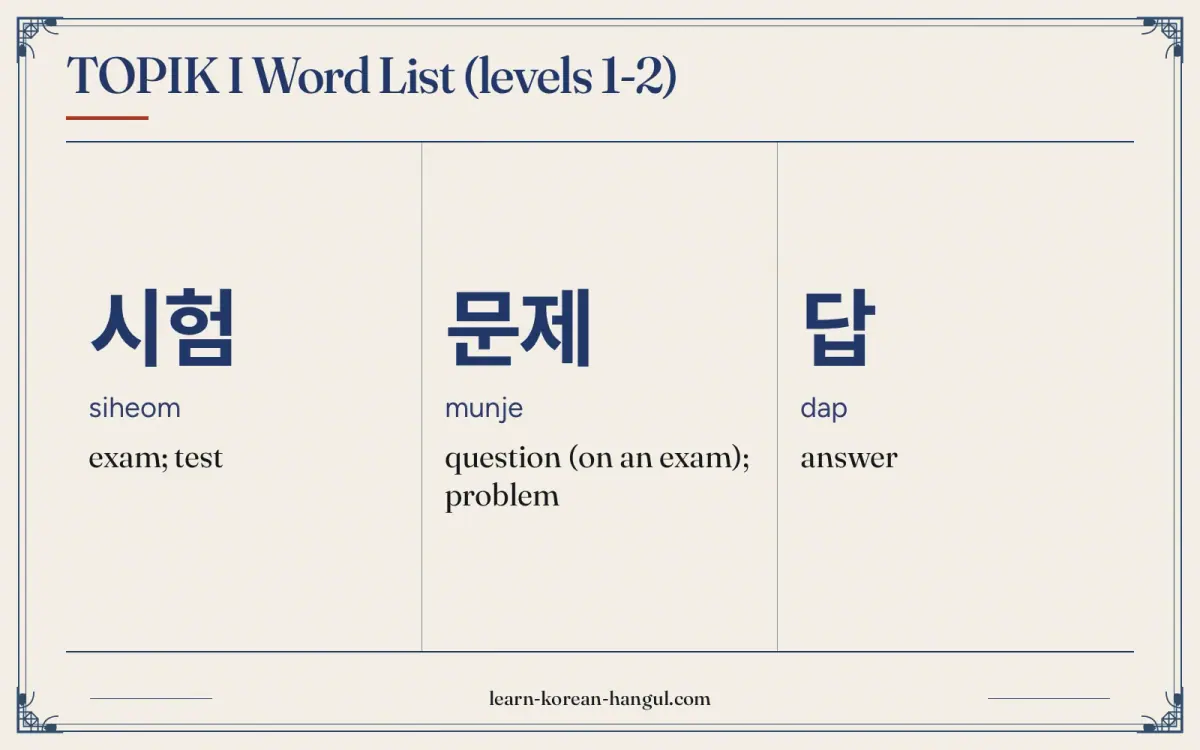
TOPIK I is the test for levels 1 and 2. It tests listening (듣기) and reading (읽기). Its questions use everyday topics, so the words below are about school, family, food, time and basic actions. The first eight are exam words: you will read them in instructions and in the name of the sections.
| No. | Hangul | Revised Romanization | Origin | Meaning | Example sentence | Audio assetId |
|---|---|---|---|---|---|---|
| 1 | 시험 | siheom | Sino-Korean | exam; test | 내일 시험이 있어요. (I have an exam tomorrow.) | au-pg-vocabulary-topik-vocabulary-1; example: au-pg-vocabulary-topik-vocabulary-101 |
| 2 | 문제 | munje | Sino-Korean | question (on an exam); problem | 문제가 어려워요. (The question is difficult.) | au-pg-vocabulary-topik-vocabulary-2; example: au-pg-vocabulary-topik-vocabulary-102 |
| 3 | 답 | dap | Sino-Korean | answer | 답을 몰라요. (I do not know the answer.) | au-pg-vocabulary-topik-vocabulary-3; example: au-pg-vocabulary-topik-vocabulary-103 |
| 4 | 읽기 | ilgi | native | reading (the section of an exam) | 읽기를 연습해요. (I practise reading.) | au-pg-vocabulary-topik-vocabulary-4; example: au-pg-vocabulary-topik-vocabulary-104 |
| 5 | 듣기 | deutgi | native | listening (the section of an exam) | 듣기가 재미있어요. (Listening is fun.) | au-pg-vocabulary-topik-vocabulary-5; example: au-pg-vocabulary-topik-vocabulary-105 |
| 6 | 쓰기 | sseugi | native | writing (the section of an exam) | 쓰기 연습을 해요. (I do writing practice.) | au-pg-vocabulary-topik-vocabulary-6; example: au-pg-vocabulary-topik-vocabulary-106 |
| 7 | 점수 | jeomsu | Sino-Korean | score; points | 점수가 좋아요. (The score is good.) | au-pg-vocabulary-topik-vocabulary-7; example: au-pg-vocabulary-topik-vocabulary-107 |
| 8 | 합격 | hapgyeok | Sino-Korean | passing (an exam) | 시험에 합격했어요. (I passed the exam.) | au-pg-vocabulary-topik-vocabulary-8; example: au-pg-vocabulary-topik-vocabulary-108 |
| 9 | 한국어 | hangugeo | Sino-Korean | Korean (language) | 한국어를 공부해요. (I study Korean.) | au-pg-vocabulary-topik-vocabulary-9; example: au-pg-vocabulary-topik-vocabulary-109 |
| 10 | 공부 | gongbu | Sino-Korean | study | 매일 공부해요. (I study every day.) | au-pg-vocabulary-topik-vocabulary-10; example: au-pg-vocabulary-topik-vocabulary-110 |
| 11 | 학교 | hakgyo | Sino-Korean | school | 학교에 가요. (I go to school.) | au-pg-vocabulary-topik-vocabulary-11; example: au-pg-vocabulary-topik-vocabulary-111 |
| 12 | 선생님 | seonsaengnim | mixed | teacher | 선생님은 친절해요. (The teacher is kind.) | au-pg-vocabulary-topik-vocabulary-12; example: au-pg-vocabulary-topik-vocabulary-112 |
| 13 | 학생 | haksaeng | Sino-Korean | student | 저는 학생이에요. (I am a student.) | au-pg-vocabulary-topik-vocabulary-13; example: au-pg-vocabulary-topik-vocabulary-113 |
| 14 | 친구 | chingu | Sino-Korean | friend | 친구를 만나요. (I meet a friend.) | au-pg-vocabulary-topik-vocabulary-14; example: au-pg-vocabulary-topik-vocabulary-114 |
| 15 | 가족 | gajok | Sino-Korean | family | 가족이 네 명이에요. (There are four people in my family.) | au-pg-vocabulary-topik-vocabulary-15; example: au-pg-vocabulary-topik-vocabulary-115 |
| 16 | 집 | jip | native | home; house | 집에 있어요. (I am at home.) | au-pg-vocabulary-topik-vocabulary-16; example: au-pg-vocabulary-topik-vocabulary-116 |
| 17 | 음식 | eumsik | Sino-Korean | food | 한국 음식이 맛있어요. (Korean food is delicious.) | au-pg-vocabulary-topik-vocabulary-17; example: au-pg-vocabulary-topik-vocabulary-117 |
| 18 | 물 | mul | native | water | 물을 마셔요. (I drink water.) | au-pg-vocabulary-topik-vocabulary-18; example: au-pg-vocabulary-topik-vocabulary-118 |
| 19 | 시간 | sigan | Sino-Korean | time | 시간이 없어요. (I do not have time.) | au-pg-vocabulary-topik-vocabulary-19; example: au-pg-vocabulary-topik-vocabulary-119 |
| 20 | 오늘 | oneul | native | today | 오늘 학교에 안 가요. (I am not going to school today.) | au-pg-vocabulary-topik-vocabulary-20; example: au-pg-vocabulary-topik-vocabulary-120 |
| 21 | 어제 | eoje | native | yesterday | 어제 친구를 만났어요. (I met a friend yesterday.) | au-pg-vocabulary-topik-vocabulary-21; example: au-pg-vocabulary-topik-vocabulary-121 |
| 22 | 내일 | naeil | Sino-Korean | tomorrow | 내일 만나요. (Let's meet tomorrow.) | au-pg-vocabulary-topik-vocabulary-22; example: au-pg-vocabulary-topik-vocabulary-122 |
| 23 | 주말 | jumal | Sino-Korean | weekend | 주말에 쉬어요. (I rest at the weekend.) | au-pg-vocabulary-topik-vocabulary-23; example: au-pg-vocabulary-topik-vocabulary-123 |
| 24 | 이름 | ireum | native | name | 이름이 뭐예요? (What is your name?) | au-pg-vocabulary-topik-vocabulary-24; example: au-pg-vocabulary-topik-vocabulary-124 |
| 25 | 나이 | nai | native | age | 나이가 몇 살이에요? (How old are you?) | au-pg-vocabulary-topik-vocabulary-25; example: au-pg-vocabulary-topik-vocabulary-125 |
| 26 | 직업 | jigeop | Sino-Korean | job; occupation | 직업이 뭐예요? (What is your job?) | au-pg-vocabulary-topik-vocabulary-26; example: au-pg-vocabulary-topik-vocabulary-126 |
| 27 | 회사 | hoesa | Sino-Korean | company | 회사에 다녀요. (I work at a company.) | au-pg-vocabulary-topik-vocabulary-27; example: au-pg-vocabulary-topik-vocabulary-127 |
| 28 | 병원 | byeongwon | Sino-Korean | hospital | 병원은 어디예요? (Where is the hospital?) | au-pg-vocabulary-topik-vocabulary-28; example: au-pg-vocabulary-topik-vocabulary-128 |
| 29 | 은행 | eunhaeng | Sino-Korean | bank | 은행에서 돈을 찾아요. (I withdraw money at the bank.) | au-pg-vocabulary-topik-vocabulary-29; example: au-pg-vocabulary-topik-vocabulary-129 |
| 30 | 가격 | gagyeok | Sino-Korean | price | 가격이 비싸요. (The price is high.) | au-pg-vocabulary-topik-vocabulary-30; example: au-pg-vocabulary-topik-vocabulary-130 |
| 31 | 날씨 | nalssi | native | weather | 날씨가 따뜻해요. (The weather is warm.) | au-pg-vocabulary-topik-vocabulary-31; example: au-pg-vocabulary-topik-vocabulary-131 |
| 32 | 가다 | gada | native | to go | 저는 서울에 가요. (I am going to Seoul.) | au-pg-vocabulary-topik-vocabulary-32; example: au-pg-vocabulary-topik-vocabulary-132 |
| 33 | 오다 | oda | native | to come | 친구가 와요. (A friend is coming.) | au-pg-vocabulary-topik-vocabulary-33; example: au-pg-vocabulary-topik-vocabulary-133 |
| 34 | 먹다 | meokda | native | to eat | 점심을 먹어요. (I eat lunch.) | au-pg-vocabulary-topik-vocabulary-34; example: au-pg-vocabulary-topik-vocabulary-134 |
| 35 | 마시다 | masida | native | to drink | 커피를 마셔요. (I drink coffee.) | au-pg-vocabulary-topik-vocabulary-35; example: au-pg-vocabulary-topik-vocabulary-135 |
| 36 | 보다 | boda | native | to see; to watch | 영화를 봐요. (I watch a film.) | au-pg-vocabulary-topik-vocabulary-36; example: au-pg-vocabulary-topik-vocabulary-136 |
| 37 | 하다 | hada | native | to do | 숙제를 해요. (I do my homework.) | au-pg-vocabulary-topik-vocabulary-37; example: au-pg-vocabulary-topik-vocabulary-137 |
| 38 | 좋다 | jota | native | to be good; to like | 이 책이 좋아요. (I like this book.) | au-pg-vocabulary-topik-vocabulary-38; example: au-pg-vocabulary-topik-vocabulary-138 |
| 39 | 크다 | keuda | native | to be big | 방이 커요. (The room is big.) | au-pg-vocabulary-topik-vocabulary-39; example: au-pg-vocabulary-topik-vocabulary-139 |
| 40 | 많다 | manta | native | to be many; to be much | 사람이 많아요. (There are many people.) | au-pg-vocabulary-topik-vocabulary-40; example: au-pg-vocabulary-topik-vocabulary-140 |
The two tables that follow use the same format.
Example Sentences
The examples in this group are short polite sentences. They use three patterns. The first is noun + 이/가 + adjective, as in 문제가 어려워요 (The question is difficult). The second is noun + 을/를 + verb, as in 물을 마셔요 (I drink water). The third is noun + 에 + verb, as in 학교에 가요 (I go to school). Say each sentence aloud, then swap the noun for another word from the table. For instance, 학교에 가요 becomes 병원에 가요.
What Are the TOPIK II Words for Levels 3 to 6?
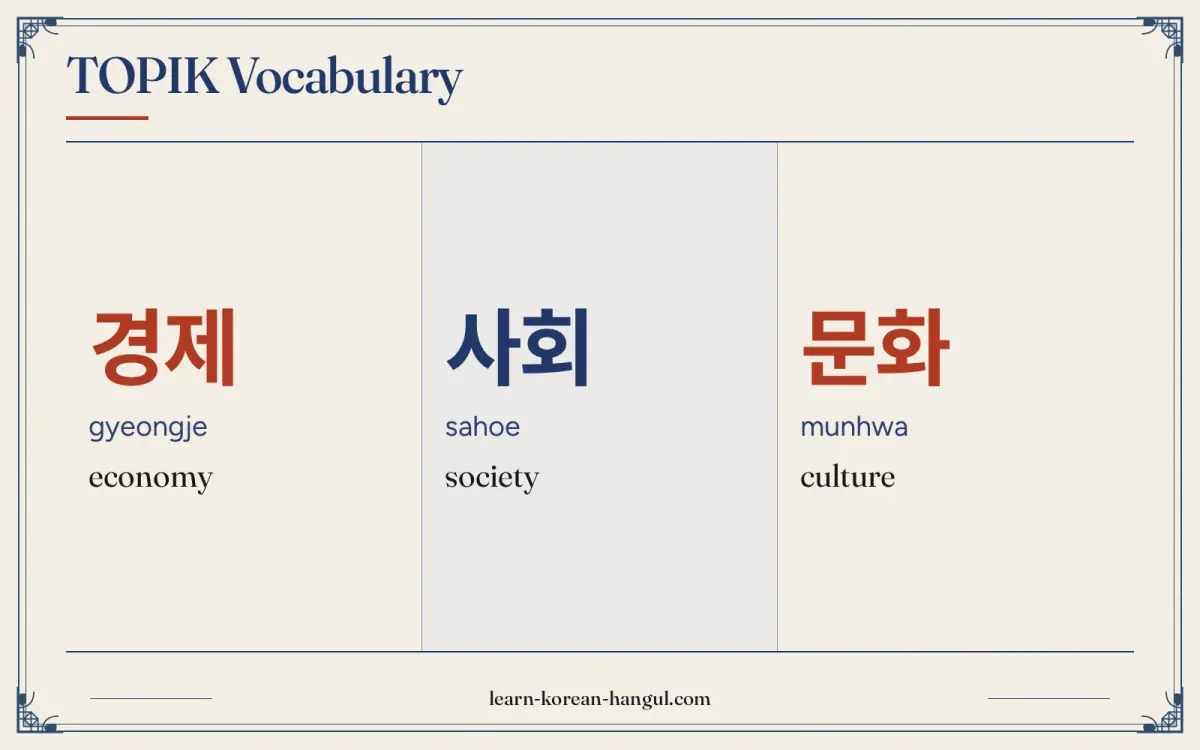
TOPIK II covers levels 3 to 6. Its sections are listening (듣기), writing (쓰기) and reading (읽기), and its passages are about society, the economy, culture and the environment. The words below are abstract, and almost all are Sino-Korean, so they repeat common syllables. For instance, 경 appears in 경제 and 경험, and 계 appears in 관계 and 계획. Once you know the syllable, new words are easier to guess.
| No. | Hangul | Revised Romanization | Origin | Meaning | Example sentence | Audio assetId |
|---|---|---|---|---|---|---|
| 41 | 경제 | gyeongje | Sino-Korean | economy | 경제가 좋아졌어요. (The economy has improved.) | au-pg-vocabulary-topik-vocabulary-41; example: au-pg-vocabulary-topik-vocabulary-141 |
| 42 | 사회 | sahoe | Sino-Korean | society | 사회는 빠르게 변해요. (Society changes quickly.) | au-pg-vocabulary-topik-vocabulary-42; example: au-pg-vocabulary-topik-vocabulary-142 |
| 43 | 문화 | munhwa | Sino-Korean | culture | 한국 문화에 관심이 있어요. (I am interested in Korean culture.) | au-pg-vocabulary-topik-vocabulary-43; example: au-pg-vocabulary-topik-vocabulary-143 |
| 44 | 환경 | hwangyeong | Sino-Korean | environment | 환경을 보호해요. (We protect the environment.) | au-pg-vocabulary-topik-vocabulary-44; example: au-pg-vocabulary-topik-vocabulary-144 |
| 45 | 정보 | jeongbo | Sino-Korean | information | 정보를 찾아요. (I look for information.) | au-pg-vocabulary-topik-vocabulary-45; example: au-pg-vocabulary-topik-vocabulary-145 |
| 46 | 기술 | gisul | Sino-Korean | technology; skill | 새로운 기술이 나왔어요. (A new technology has come out.) | au-pg-vocabulary-topik-vocabulary-46; example: au-pg-vocabulary-topik-vocabulary-146 |
| 47 | 교육 | gyoyuk | Sino-Korean | education | 교육은 중요해요. (Education is important.) | au-pg-vocabulary-topik-vocabulary-47; example: au-pg-vocabulary-topik-vocabulary-147 |
| 48 | 관계 | gwangye | Sino-Korean | relationship | 친구와 좋은 관계를 유지해요. (I keep a good relationship with my friend.) | au-pg-vocabulary-topik-vocabulary-48; example: au-pg-vocabulary-topik-vocabulary-148 |
| 49 | 영향 | yeonghyang | Sino-Korean | influence; effect | 날씨가 기분에 영향을 줘요. (The weather affects one's mood.) | au-pg-vocabulary-topik-vocabulary-49; example: au-pg-vocabulary-topik-vocabulary-149 |
| 50 | 이유 | iyu | Sino-Korean | reason | 이유가 뭐예요? (What is the reason?) | au-pg-vocabulary-topik-vocabulary-50; example: au-pg-vocabulary-topik-vocabulary-150 |
| 51 | 결과 | gyeolgwa | Sino-Korean | result | 결과가 나왔어요. (The result has come out.) | au-pg-vocabulary-topik-vocabulary-51; example: au-pg-vocabulary-topik-vocabulary-151 |
| 52 | 의견 | uigyeon | Sino-Korean | opinion | 제 의견을 말해요. (I state my opinion.) | au-pg-vocabulary-topik-vocabulary-52; example: au-pg-vocabulary-topik-vocabulary-152 |
| 53 | 경험 | gyeongheom | Sino-Korean | experience | 좋은 경험이었어요. (It was a good experience.) | au-pg-vocabulary-topik-vocabulary-53; example: au-pg-vocabulary-topik-vocabulary-153 |
| 54 | 목적 | mokjeok | Sino-Korean | purpose; aim | 방문 목적이 뭐예요? (What is the purpose of your visit?) | au-pg-vocabulary-topik-vocabulary-54; example: au-pg-vocabulary-topik-vocabulary-154 |
| 55 | 계획 | gyehoek | Sino-Korean | plan | 여행 계획을 세웠어요. (I made a travel plan.) | au-pg-vocabulary-topik-vocabulary-55; example: au-pg-vocabulary-topik-vocabulary-155 |
| 56 | 변화 | byeonhwa | Sino-Korean | change | 생활에 변화가 있어요. (There is a change in life.) | au-pg-vocabulary-topik-vocabulary-56; example: au-pg-vocabulary-topik-vocabulary-156 |
| 57 | 발전 | baljeon | Sino-Korean | development; progress | 나라가 발전했어요. (The country has developed.) | au-pg-vocabulary-topik-vocabulary-57; example: au-pg-vocabulary-topik-vocabulary-157 |
| 58 | 필요 | piryo | Sino-Korean | need; necessity | 도움이 필요해요. (I need help.) | au-pg-vocabulary-topik-vocabulary-58; example: au-pg-vocabulary-topik-vocabulary-158 |
| 59 | 가능 | ganeung | Sino-Korean | possibility; being possible | 예약이 가능해요? (Is booking possible?) | au-pg-vocabulary-topik-vocabulary-59; example: au-pg-vocabulary-topik-vocabulary-159 |
| 60 | 중요 | jungyo | Sino-Korean | importance; being important | 이것이 가장 중요해요. (This is the most important.) | au-pg-vocabulary-topik-vocabulary-60; example: au-pg-vocabulary-topik-vocabulary-160 |
| 61 | 정확하다 | jeonghwakada | Sino-Korean | to be accurate | 답이 정확해요. (The answer is accurate.) | au-pg-vocabulary-topik-vocabulary-61; example: au-pg-vocabulary-topik-vocabulary-161 |
| 62 | 선택 | seontaek | Sino-Korean | choice; selection | 선택은 쉽지 않아요. (The choice is not easy.) | au-pg-vocabulary-topik-vocabulary-62; example: au-pg-vocabulary-topik-vocabulary-162 |
| 63 | 비교 | bigyo | Sino-Korean | comparison | 두 가격을 비교해요. (I compare the two prices.) | au-pg-vocabulary-topik-vocabulary-63; example: au-pg-vocabulary-topik-vocabulary-163 |
| 64 | 설명 | seolmyeong | Sino-Korean | explanation | 선생님이 설명해요. (The teacher explains.) | au-pg-vocabulary-topik-vocabulary-64; example: au-pg-vocabulary-topik-vocabulary-164 |
| 65 | 주장 | jujang | Sino-Korean | claim; assertion | 그는 자기 주장을 말했어요. (He stated his claim.) | au-pg-vocabulary-topik-vocabulary-65; example: au-pg-vocabulary-topik-vocabulary-165 |
| 66 | 증가 | jeungga | Sino-Korean | increase | 사람이 증가했어요. (The number of people has increased.) | au-pg-vocabulary-topik-vocabulary-66; example: au-pg-vocabulary-topik-vocabulary-166 |
| 67 | 감소 | gamso | Sino-Korean | decrease | 손님이 감소했어요. (The number of customers has decreased.) | au-pg-vocabulary-topik-vocabulary-67; example: au-pg-vocabulary-topik-vocabulary-167 |
| 68 | 제공 | jegong | Sino-Korean | provision; offering | 회사가 정보를 제공해요. (The company provides information.) | au-pg-vocabulary-topik-vocabulary-68; example: au-pg-vocabulary-topik-vocabulary-168 |
| 69 | 참여 | chamyeo | Sino-Korean | participation | 행사에 참여해요. (I take part in the event.) | au-pg-vocabulary-topik-vocabulary-69; example: au-pg-vocabulary-topik-vocabulary-169 |
| 70 | 노력 | noryeok | Sino-Korean | effort | 매일 노력해요. (I make an effort every day.) | au-pg-vocabulary-topik-vocabulary-70; example: au-pg-vocabulary-topik-vocabulary-170 |
| 71 | 상황 | sanghwang | Sino-Korean | situation | 상황이 달라졌어요. (The situation has changed.) | au-pg-vocabulary-topik-vocabulary-71; example: au-pg-vocabulary-topik-vocabulary-171 |
| 72 | 기회 | gihoe | Sino-Korean | chance; opportunity | 좋은 기회예요. (It is a good opportunity.) | au-pg-vocabulary-topik-vocabulary-72; example: au-pg-vocabulary-topik-vocabulary-172 |
| 73 | 방법 | bangbeop | Sino-Korean | method; way | 좋은 방법이 있어요. (There is a good method.) | au-pg-vocabulary-topik-vocabulary-73; example: au-pg-vocabulary-topik-vocabulary-173 |
| 74 | 과정 | gwajeong | Sino-Korean | process | 과정을 설명했어요. (I explained the process.) | au-pg-vocabulary-topik-vocabulary-74; example: au-pg-vocabulary-topik-vocabulary-174 |
| 75 | 원인 | wonin | Sino-Korean | cause | 사고의 원인을 조사해요. (They investigate the cause of the accident.) | au-pg-vocabulary-topik-vocabulary-75; example: au-pg-vocabulary-topik-vocabulary-175 |
A word such as 증가 (increase) and its opposite 감소 (decrease) are very useful in TOPIK writing, because charts and graphs use them. Learn them as a pair. The written style of TOPIK II essays uses plain endings such as 증가했다, and the examples on this page use the polite -어요 ending that you speak. Both styles use the same words.
EPS-TOPIK Words
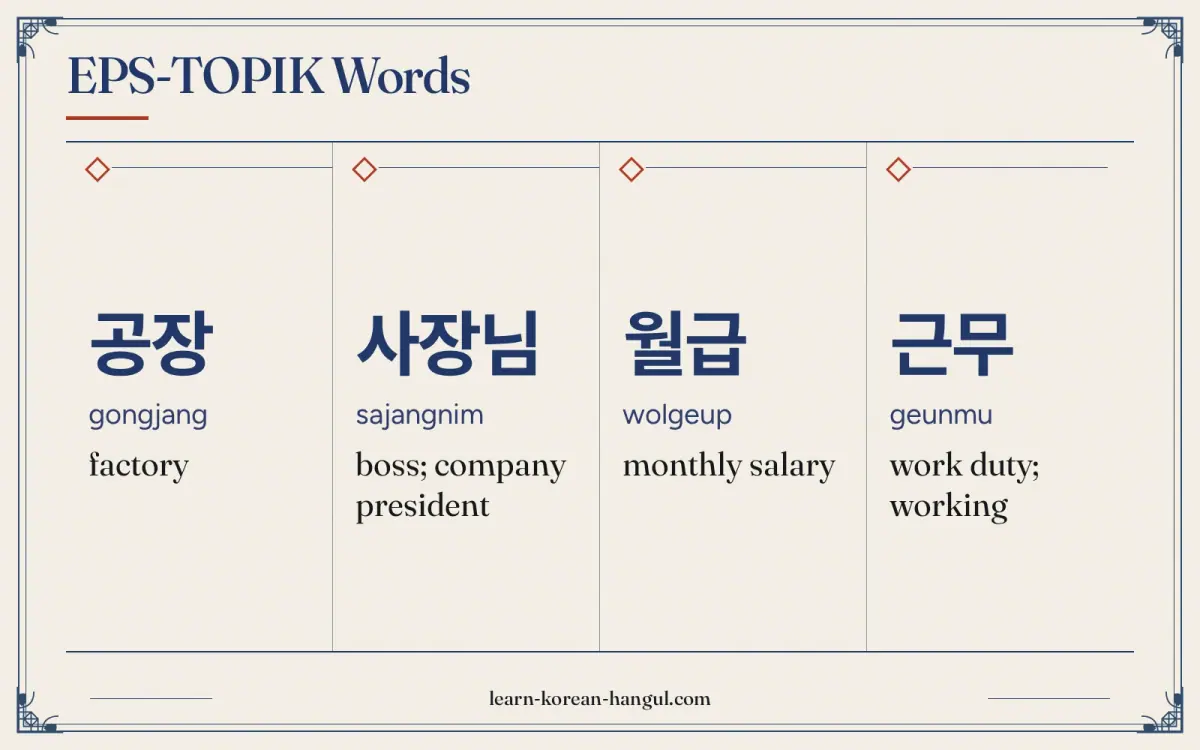
EPS-TOPIK is a different test from the TOPIK this page mostly describes. It is the Korean language test for people who want to work in Korea under the Employment Permit System. Its content is practical: workplaces, safety, wages and daily life as a worker. The words below are the kind that appear there. The rules, the dates and the format of EPS-TOPIK are set by its official administrators and can change, so read the current official EPS-TOPIK notices and not an old summary. The page TOPIK vs EPS TOPIK explains the difference.
| No. | Hangul | Revised Romanization | Origin | Meaning | Example sentence | Audio assetId |
|---|---|---|---|---|---|---|
| 76 | 공장 | gongjang | Sino-Korean | factory | 공장에서 일해요. (I work at a factory.) | au-pg-vocabulary-topik-vocabulary-76; example: au-pg-vocabulary-topik-vocabulary-176 |
| 77 | 사장님 | sajangnim | mixed | boss; company president | 사장님께 인사했어요. (I greeted the boss.) | au-pg-vocabulary-topik-vocabulary-77; example: au-pg-vocabulary-topik-vocabulary-177 |
| 78 | 월급 | wolgeup | Sino-Korean | monthly salary | 월급은 매달 받아요. (I receive my salary every month.) | au-pg-vocabulary-topik-vocabulary-78; example: au-pg-vocabulary-topik-vocabulary-178 |
| 79 | 근무 | geunmu | Sino-Korean | work duty; working | 근무 시간은 아침 아홉 시부터예요. (Working hours start at nine in the morning.) | au-pg-vocabulary-topik-vocabulary-79; example: au-pg-vocabulary-topik-vocabulary-179 |
| 80 | 출근 | chulgeun | Sino-Korean | going to work | 아침 일곱 시에 출근해요. (I go to work at seven in the morning.) | au-pg-vocabulary-topik-vocabulary-80; example: au-pg-vocabulary-topik-vocabulary-180 |
| 81 | 퇴근 | toegeun | Sino-Korean | leaving work | 여섯 시에 퇴근해요. (I leave work at six.) | au-pg-vocabulary-topik-vocabulary-81; example: au-pg-vocabulary-topik-vocabulary-181 |
| 82 | 안전 | anjeon | Sino-Korean | safety | 안전에 주의하세요. (Please be careful about safety.) | au-pg-vocabulary-topik-vocabulary-82; example: au-pg-vocabulary-topik-vocabulary-182 |
| 83 | 기계 | gigye | Sino-Korean | machine | 기계가 고장 났어요. (The machine is broken.) | au-pg-vocabulary-topik-vocabulary-83; example: au-pg-vocabulary-topik-vocabulary-183 |
| 84 | 작업 | jageop | Sino-Korean | work; task | 작업이 끝났어요. (The task is finished.) | au-pg-vocabulary-topik-vocabulary-84; example: au-pg-vocabulary-topik-vocabulary-184 |
| 85 | 휴일 | hyuil | Sino-Korean | day off; holiday | 일요일은 휴일이에요. (Sunday is a day off.) | au-pg-vocabulary-topik-vocabulary-85; example: au-pg-vocabulary-topik-vocabulary-185 |
| 86 | 보험 | boheom | Sino-Korean | insurance | 보험에 가입했어요. (I signed up for insurance.) | au-pg-vocabulary-topik-vocabulary-86; example: au-pg-vocabulary-topik-vocabulary-186 |
| 87 | 외국인 | oegugin | Sino-Korean | foreigner | 저는 외국인이에요. (I am a foreigner.) | au-pg-vocabulary-topik-vocabulary-87; example: au-pg-vocabulary-topik-vocabulary-187 |
| 88 | 비자 | bija | loanword | visa | 비자를 신청했어요. (I applied for a visa.) | au-pg-vocabulary-topik-vocabulary-88; example: au-pg-vocabulary-topik-vocabulary-188 |
| 89 | 숙소 | sukso | Sino-Korean | lodging; accommodation | 숙소는 공장 근처에 있어요. (The lodging is near the factory.) | au-pg-vocabulary-topik-vocabulary-89; example: au-pg-vocabulary-topik-vocabulary-189 |
| 90 | 야근 | yageun | Sino-Korean | overtime at night | 오늘은 야근이 없어요. (There is no overtime tonight.) | au-pg-vocabulary-topik-vocabulary-90; example: au-pg-vocabulary-topik-vocabulary-190 |
| 91 | 일자리 | iljari | native | job; position | 일자리를 구했어요. (I found a job.) | au-pg-vocabulary-topik-vocabulary-91; example: au-pg-vocabulary-topik-vocabulary-191 |
| 92 | 농장 | nongjang | Sino-Korean | farm | 농장에 채소가 많아요. (There are many vegetables on the farm.) | au-pg-vocabulary-topik-vocabulary-92; example: au-pg-vocabulary-topik-vocabulary-192 |
| 93 | 건설 | geonseol | Sino-Korean | construction | 건설 일을 해요. (I do construction work.) | au-pg-vocabulary-topik-vocabulary-93; example: au-pg-vocabulary-topik-vocabulary-193 |
| 94 | 청소 | cheongso | Sino-Korean | cleaning | 매일 청소해요. (I clean every day.) | au-pg-vocabulary-topik-vocabulary-94; example: au-pg-vocabulary-topik-vocabulary-194 |
| 95 | 도구 | dogu | Sino-Korean | tool | 도구를 정리해요. (I tidy the tools.) | au-pg-vocabulary-topik-vocabulary-95; example: au-pg-vocabulary-topik-vocabulary-195 |
| 96 | 장갑 | janggap | Sino-Korean | gloves | 장갑을 꼈어요. (I wore gloves.) | au-pg-vocabulary-topik-vocabulary-96; example: au-pg-vocabulary-topik-vocabulary-196 |
| 97 | 사고 | sago | Sino-Korean | accident | 사고가 났어요. (An accident happened.) | au-pg-vocabulary-topik-vocabulary-97; example: au-pg-vocabulary-topik-vocabulary-197 |
| 98 | 안전모 | anjeonmo | Sino-Korean | safety helmet | 안전모를 써요. (I wear a safety helmet.) | au-pg-vocabulary-topik-vocabulary-98; example: au-pg-vocabulary-topik-vocabulary-198 |
| 99 | 작업복 | jageopbok | Sino-Korean | work clothes | 작업복으로 갈아입었어요. (I changed into work clothes.) | au-pg-vocabulary-topik-vocabulary-99; example: au-pg-vocabulary-topik-vocabulary-199 |
| 100 | 휴게실 | hyugesil | Sino-Korean | break room | 휴게실에서 쉬어요. (I rest in the break room.) | au-pg-vocabulary-topik-vocabulary-100; example: au-pg-vocabulary-topik-vocabulary-200 |
Several of these words also appear in the other groups. 안전 (safety) is useful at any workplace. The word 사고 (accident) has a homograph, 사고 (thinking), and the sentence decides which one is meant. A worker who knows 근무, 출근 and 퇴근 can follow most notices on a workplace wall.
How Many Words Does Each Level Need?
There is no single, official figure to quote here. Numbers such as "level 1 needs 800 words" circulate widely, but they come from different sources, and they change from list to list. This page gives none. For the official picture, read the TOPIK information on topik.go.kr, and see the page on how many words TOPIK needs for the comparison of sources.
What you can use is the level map in the table. It shows how the levels of the exam relate to the level labels used on this site. The labels are editorial estimates, not official levels, and the link between them is approximate.
| TOPIK level | Test | Site label (approximate) | Where to study |
|---|---|---|---|
| 1 | TOPIK I | A1 | the first group of this page and the top 100 words |
| 2 | TOPIK I | A2 | the rest of the first group and the top 500 words |
| 3 | TOPIK II | B1 | the second group and the TOPIK 2 vocabulary list |
| 4 | TOPIK II | B2 | the TOPIK 2 vocabulary list |
| 5 to 6 | TOPIK II | C1 and above | the TOPIK 2 vocabulary list and the longer lists |
Grammar and vocabulary are tested together, so a vocabulary list alone will not be enough. See TOPIK grammar for the patterns that go with the words.
Study Order
A plan that uses the lists on this site takes four steps. Each step ends with a self-check: write the Hangul from memory and say it aloud.
- Start with the most common words. Learn the top 100 Korean words first, then the top 500. These cover many of the everyday words in TOPIK I passages.
- Add the exam words. Learn the eight exam words at the top of the first table so that the instructions make sense.
- Study TOPIK I topic lists. Use the TOPIK 1 vocabulary list to cover topics such as shopping, travel and health.
- Move to TOPIK II. Learn the abstract words in the second table, then use the TOPIK 2 vocabulary list for longer topic lists.
A simple progress checklist: after the first table, you should be able to read the instructions of a practice test. After the second table, you should be able to read a short news paragraph about the economy or society. Check these against a practice paper from the official site.
How Do You Pronounce These Words?
Many words in this list change in speech. The table lists the changes that learners most often miss. Brackets show the spoken sound.
| Spelling | Pronunciation | What happens |
|---|---|---|
| 읽기 | [일끼] | The ㄱ after the ㄹ sound is said tense, and the ㄱ of the final group ㄺ is silent |
| 듣기 | [듣끼] | The ㄱ after a final ㄷ is said tense |
| 합격 | [합껵] | The ㄱ after a final ㅂ is said tense |
| 점수 | [점쑤] | The ㅅ is said tense in this word |
| 학교 | [학꾜] | The ㄱ of 교 is said tense after the final ㄱ |
| 목적 | [목쩍] | The ㅈ after a final ㄱ is said tense |
| 발전 | [발쩐] | In Sino-Korean words, ㅈ after ㄹ is said tense |
| 숙소 | [숙쏘] | The ㅅ after a final ㄱ is said tense |
| 직업 | [지겁] | The final ㄱ moves onto the vowel of 업 |
| 한국어 | [한구거] | The final ㄱ moves onto the vowel of 어 |
| 정확하다 | [정화카다] | The ㄱ and ㅎ join into an aspirated k sound; Revised Romanization writes jeonghwakada |
The rules come from the Standard Pronunciation rules (표준 발음법) of the 국립국어원. Revised Romanization is a learning aid. It writes the aspiration in verbs such as 정확하다 (jeonghwakada), but it does not show tensing caused by a neighbouring sound, so 합격 stays hapgyeok.
Audio and Slow Playback
Each word has a normal clip. Five words with tricky sounds also have a slow clip at 0.8 times the speed: 읽기, 듣기, 합격, 정확하다 and 휴게실. Nothing plays until you press a button. The audio is generated with text-to-speech and checked by a Korean teacher before publication.
Listen to 합격 first. You should hear a closed ㅂ followed by a tense g, [합껵], with no puff of air.
What Mistakes Do Learners Make with TOPIK Words?
- Treating this page as the official TOPIK list. Wrong: assuming every word here will appear on the exam, or that no other word will. Correct: the groups are editorial selections. Use the official TOPIK site for the exam and a learner dictionary for word levels.
- Mixing 문제 and 질문. A 문제 is an exam question or a problem. A 질문 is a question that you ask a person. Wrong: 선생님에게 문제를 했어요. Correct: 선생님에게 질문을 했어요.
- Confusing 읽기 with 읽다. 읽기 is the noun "reading", and 읽다 is the verb "to read". The name of the exam section is 읽기.
- Saying 시험을 합격하다. Wrong: 시험을 합격했어요. Correct: 시험에 합격했어요. The usual pattern uses 에 with 합격.
- Mixing the two 사고. 사고 (accident) and 사고 (thinking) share the spelling. The sentence decides: 사고가 났어요 is an accident.
- Reading 읽기 as il-gi with a plain g. Wrong: pronouncing the ㄱ soft. Correct: [일끼], with a tense g.
- Forgetting the aspiration in 정확하다. Wrong: jeong-hwak-ha-da with a clear h. Correct: [정화카다].
The first mistake is about how to use this list, mistakes 2 to 5 change the meaning or the grammar, and mistakes 6 and 7 change how natural you sound.
Practice: Flashcards and Worksheet
Drill these words with the vocabulary flashcard decks and the TOPIK flashcard decks. A printable worksheet for these words (word list, matching, writing practice, fill-in-the-blank exercises and answer key) is available in A4 and US Letter from the download card on this page. Progress in the decks is saved only in your browser.
TOPIK Vocabulary Worksheet
Try this five-question check, then say all 100 words aloud once more.
Practice · 5
What does 시험 mean?
Show answer
exam; test
시험 (siheom) means exam; test.
What does 합격 mean?
Show answer
passing (an exam)
합격 (hapgyeok) means passing (an exam).
What does 경제 mean?
Show answer
economy
경제 (gyeongje) means economy.
What does 증가 mean?
Show answer
increase
증가 (jeungga) means increase.
What does 월급 mean?
Show answer
monthly salary
월급 (wolgeup) means monthly salary.
Where to Go Next
This list sits inside Korean Vocabulary. After TOPIK vocabulary, many learners move on to Korean Word Types, which explains why so many TOPIK II words are Sino-Korean, or to How to Learn Korean Vocabulary. For the exam itself, start with the TOPIK exam guide, and for the characters behind the words, see TOPIK hanja.
Frequently Asked Questions
How Do You Say Exam in Korean?
Exam is 시험 (siheom). It is a Sino-Korean word with two syllables. A question on an exam is a 문제 (munje), and passing an exam is 합격 (hapgyeok). To say you have an exam tomorrow, use 내일 시험이 있어요 (naeil siheomi isseoyo). Press the audio button to hear the word.
How Do You Pronounce 문제 (munje)?
문제 is said [문제], mun-je, in two beats. The ㅈ at the start of the second syllable is a plain sound, with no puff of air, and the final ㄴ of the first syllable is a clear n. The vowel ㅔ in the second syllable is a short e as in bed. Use the word clip to match the rhythm.
How Many TOPIK Words Should I Learn First?
Learn the eight exam words first: 시험, 문제, 답, 읽기, 듣기, 쓰기, 점수 and 합격. That takes one day. Then add the daily life words and the abstract words. This core list of 100 takes about ten days at 10 to 12 words a day, with review on the eleventh. It is a starter, not the full vocabulary of any TOPIK level. The topik.go.kr site is the source for the exam itself.
Where Can I Practise TOPIK Words with Flashcards?
Use the TOPIK flashcard decks and the vocabulary flashcard decks, which list every deck with audio. A deck for this core list is planned. Progress stays in your browser. Until then, copy a table above onto cards: Hangul on one side, English on the other, and say each word aloud as you flip it.
Is the Romanization on This Page Official?
It follows the Revised Romanization of Korean, which South Korea officially adopted on 7 July 2000 and whose rules the National Institute of Korean Language (국립국어원) publishes. It is a learning aid that does not show tensing caused by a neighbouring sound, so learn the Hangul and use the audio to hear the real sound.
Is There a Printable Worksheet for TOPIK Words?
A printable worksheet for these words (word list, matching, writing practice, fill-in-the-blank exercises and answer key) is available in A4 and US Letter from the download card on this page. The vocabulary worksheets page lists the sheets that exist. For practice, write the Hangul from memory, cover the English column and check your answers against the tables above.