
TOPIK 1 Grammar Flashcards: Study the 27 Cards
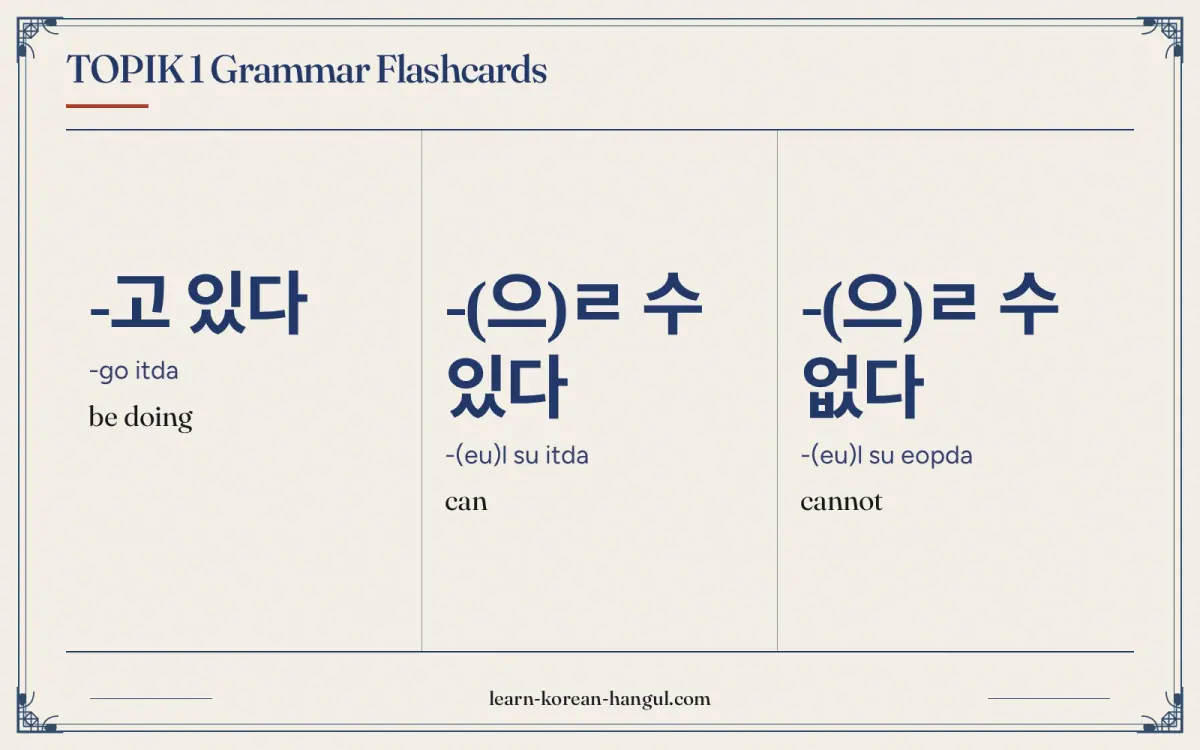
A grammar card works like a vocabulary card, with one difference: the front shows a pattern, and the audio plays an example sentence that contains it. The cards run in groups. Cards 1 to 3 are ability and progress, 4 to 9 are time, reasons, conditions and links between ideas, 10 to 16 are going to do, suggestions and wishes, 17 to 21 are requests, obligation, permission, prohibition and honorifics, 22 and 23 are the two negatives, 24 and 25 are comparison, and 26 and 27 are time range and the person who receives.
How Do I Use These Flashcards?
Use the deck above in four steps. It works with tap, click or keyboard, and nothing plays until you press an audio button.
- Choose a mode. Start with recognition (Hangul to meaning). Switch to recall (meaning to Hangul) or listening (audio to meaning) once recognition feels easy.
- Show the answer. Say the example sentence aloud before you look at the answer, then change one word, such as the verb or the object, and say it again. Then press Show answer (or Space). Turn on the romanization toggle only if you need it; the table below always shows it.
- Grade yourself. Press Got it if you answered correctly without help, or Not yet if you hesitated or guessed.
- Finish the session. A session holds up to 20 cards (you can set 10, 20 or 40). With 27 cards, a first-time learner should expect about 3 days at the default limit of 10 new cards a day, with review sessions on top.
What Do the Three Modes Do?
Recognition shows the Hangul and asks for the meaning, so with the first card it shows -고 있다 and you answer "be doing". Recall reverses this: it shows the meaning and asks for the Hangul, and you may type the answer with your Hangul keyboard or just say it in your head. Listening plays a clip and hides the letters, which trains the ear. Listening mode suits this deck well, because the clip plays a whole sentence and you must hear which pattern it contains. The pronunciation audio is generated with text-to-speech and a Korean teacher approves it before it is switched on. Listening mode only uses cards whose audio is approved, and cards without approved audio are skipped in that mode with a note.
What Do Got It and Not yet Do?
Got it moves a card up one Leitner box, so it comes back later. Not yet sends the card back to box 1, so it returns in the same session or within 10 minutes. The grades are your own judgement; the deck does not score you or claim fluency.
Deck Scope: What Is and Is Not Covered
The deck covers 27 patterns of the kind that beginner textbooks teach for the first TOPIK level. They are -고 있다, -(으)ㄹ 수 있다 and 없다, -(으)ㄹ 때, the links -아서/어서, -(으)니까, -(으)면, -지만 and -고, the movement pattern -(으)러 가다, the sentence endings -(으)ㄹ래요, -네요, -(으)ㅂ시다, -(으)ㄹ까요? and -(으)ㄹ 거예요, wishes, requests, obligation, permission, prohibition, the honorific -(으)세요, the negatives 못 and 안, comparison with 보다 더 and 가장, and the particles 부터/까지 and 에게/한테. The list is typical of level 1 study, not copied from an official source.
What Is Left out of This Deck?
Basic particles such as 은/는 and 이/가 are in the beginner korean grammar flashcards, and the full pattern list for the exam is on the TOPIK grammar page. Patterns for the second level (modifiers, guesses, written-style endings) are in the TOPIK II grammar flashcards. Words for this level are in the TOPIK 1 vocabulary flashcards. The overview of the TOPIK decks is on the TOPIK flashcards page.
All 27 Cards in One Table
All 27 cards appear below in deck order. The table is plain HTML, so you can use it as a drill without the deck: cover the Meaning column, say each item aloud, then uncover it.
| # | Hangul | Revised Romanization | Meaning | Note | Lesson | Audio assetId |
|---|---|---|---|---|---|---|
| 1 | -고 있다 | -go itda | be doing | Example: 지금 책을 읽고 있어요. (jigeum chaegeul ilgo isseoyo) I am reading a book now. Describes an action in progress. | -고 있다 lesson | au-pg-flashcards-topik-1-grammar-flashcards-1 |
| 2 | -(으)ㄹ 수 있다 | -(eu)l su itda | can | Example: 한국어를 할 수 있어요. (hangugeoreul hal su isseoyo) I can speak Korean. Says that something is possible or that you have the ability. | -(으)ㄹ 수 있다 lesson | au-pg-flashcards-topik-1-grammar-flashcards-2 |
| 3 | -(으)ㄹ 수 없다 | -(eu)l su eopda | cannot | Example: 오늘은 갈 수 없어요. (oneureun gal su eopseoyo) I cannot go today. The opposite of -(으)ㄹ 수 있다; the reason can be ability or circumstance. | -(으)ㄹ 수 없다 lesson | au-pg-flashcards-topik-1-grammar-flashcards-3 |
| 4 | -(으)ㄹ 때 | -(eu)l ttae | when | Example: 심심할 때 영화를 봐요. (simsimhal ttae yeonghwareul bwayo) When I am bored, I watch a movie. Marks the time of another action. The part before 때 takes the future-modifier shape. | -(으)ㄹ 때 lesson | au-pg-flashcards-topik-1-grammar-flashcards-4 |
| 5 | -아서/어서 | -aseo/-eoseo | because; and then | Example: 배가 고파서 빵을 먹었어요. (baega gopaseo ppangeul meogeosseoyo) I was hungry, so I ate bread. Gives a reason. Do not follow it with a command. | -아/어서 lesson | au-pg-flashcards-topik-1-grammar-flashcards-5 |
| 6 | -(으)니까 | -(eu)nikka | because, since | Example: 시간이 없으니까 택시를 타요. (sigani eopseunikka taeksireul tayo) I have no time, so I take a taxi. A reason that can be followed by a command or a suggestion. | -(으)니까 lesson | au-pg-flashcards-topik-1-grammar-flashcards-6; slow: au-pg-flashcards-topik-1-grammar-flashcards-28 |
| 7 | -(으)면 | -(eu)myeon | if; when | Example: 시간이 있으면 같이 가요. (sigani isseumyeon gachi gayo) If you have time, let us go together. Sets a condition. The same ending is used for repeated situations. | -(으)면 lesson | au-pg-flashcards-topik-1-grammar-flashcards-7 |
| 8 | -지만 | -jiman | but, although | Example: 한국어는 어렵지만 재미있어요. (hangugeoneun eoryeopjiman jaemiisseoyo) Korean is difficult, but it is fun. Joins two opposite ideas. It attaches to the plain stem. | -지만 lesson | au-pg-flashcards-topik-1-grammar-flashcards-8 |
| 9 | -고 | -go | and; and then | Example: 밥을 먹고 커피를 마셔요. (babeul meokgo keopireul masyeoyo) I eat a meal and drink coffee. Links two actions or descriptions in order. | -고 lesson | au-pg-flashcards-topik-1-grammar-flashcards-9 |
| 10 | -(으)러 가다 | -(eu)reo gada | go in order to | Example: 책을 사러 서점에 가요. (chaegeul sareo seojeome gayo) I go to the bookstore to buy a book. Needs a movement verb (가다 or 오다) after it. | -(으)러 lesson | au-pg-flashcards-topik-1-grammar-flashcards-10 |
| 11 | -(으)ㄹ래요 | -(eu)llaeyo | I will; do you want to? | Example: 저는 커피 마실래요. (jeoneun keopi masillaeyo) I will have coffee. Says what you want or are willing to do. As a question, it asks what the listener wants. | -(으)ㄹ래요 lesson | au-pg-flashcards-topik-1-grammar-flashcards-11 |
| 12 | -네요 | -neyo | oh, I see; how ... | Example: 한국어를 잘하네요. (hangugeoreul jalhaneyo) Oh, you speak Korean well. Shows that you have just noticed or learned something. | -네요 lesson | au-pg-flashcards-topik-1-grammar-flashcards-12; slow: au-pg-flashcards-topik-1-grammar-flashcards-29 |
| 13 | -(으)ㅂ시다 | -(eu)psida | let us | Example: 같이 갑시다. (gachi gapsida) Let us go together. A suggestion between equals or from a senior. To a superior, ask with -(으)ㄹ까요?. | -(으)ㅂ시다 lesson | au-pg-flashcards-topik-1-grammar-flashcards-13 |
| 14 | -(으)ㄹ까요? | -(eu)lkkayo | shall we ...? / I wonder | Example: 같이 점심 먹을까요? (gachi jeomsim meogeulkkayo) Shall we eat lunch together? A suggestion to the listener, or a guess about something unknown. | -(으)ㄹ까요? lesson | au-pg-flashcards-topik-1-grammar-flashcards-14 |
| 15 | -(으)ㄹ 거예요 | -(eu)l geoyeyo | will; be going to | Example: 내일 친구를 만날 거예요. (naeil chingureul mannal geoyeyo) I will meet a friend tomorrow. States a plan, or a guess about someone else. | -(으)ㄹ 거예요 lesson | au-pg-flashcards-topik-1-grammar-flashcards-15 |
| 16 | -고 싶다 | -go sipda | want to | Example: 한국에 가고 싶어요. (hanguge gago sipeoyo) I want to go to Korea. For your own wishes about an action. | -고 싶다 lesson | au-pg-flashcards-topik-1-grammar-flashcards-16 |
| 17 | -아/어 주세요 | -a/eo juseyo | please do (for me) | Example: 문 좀 열어 주세요. (mun jom yeoreo juseyo) Please open the door. A polite request; 좀 makes it softer. | -아/어 주세요 lesson | au-pg-flashcards-topik-1-grammar-flashcards-17 |
| 18 | -아/어야 하다 | -a/eoya hada | must; have to | Example: 내일 일찍 일어나야 해요. (naeil iljjik ireonaya haeyo) I have to get up early tomorrow. States an obligation. | -아/어야 하다 lesson | au-pg-flashcards-topik-1-grammar-flashcards-18 |
| 19 | -아/어도 되다 | -a/eodo doeda | may; it is okay to | Example: 여기 앉아도 돼요? (yeogi anjado dwaeyo) May I sit here? Asks for or gives permission. | -아/어도 되다 lesson | au-pg-flashcards-topik-1-grammar-flashcards-19 |
| 20 | -지 마세요 | -ji maseyo | please do not | Example: 여기에서 사진을 찍지 마세요. (yeogieseo sajineul jjikji maseyo) Please do not take photos here. A polite prohibition. | -지 마세요 lesson | au-pg-flashcards-topik-1-grammar-flashcards-20 |
| 21 | -(으)세요 | -(eu)seyo | honorific; please do | Example: 선생님이 책을 읽으세요. (seonsaengnimi chaegeul ilgeuseyo) The teacher is reading a book. Shows respect to the subject. Said to the listener, it is also a polite request. | -(으)세요 lesson | au-pg-flashcards-topik-1-grammar-flashcards-21 |
| 22 | 못 | mot | cannot (unable to) | Example: 매운 음식을 못 먹어요. (maeun eumsigeul mot meogeoyo) I cannot eat spicy food. Goes before the verb and means unable, not unwilling. | 못 negation lesson | au-pg-flashcards-topik-1-grammar-flashcards-22; slow: au-pg-flashcards-topik-1-grammar-flashcards-30 |
| 23 | 안 | an | not | Example: 오늘은 학교에 안 가요. (oneureun hakgyoe an gayo) I am not going to school today. Goes before the verb and negates a choice or a fact. | 안 negation lesson | au-pg-flashcards-topik-1-grammar-flashcards-23 |
| 24 | 보다 더 | boda deo | more than | Example: 이 가방이 저 가방보다 더 싸요. (i gabangi jeo gabangboda deo ssayo) This bag is cheaper than that bag. Compares two things. 보다 marks the thing you compare with. | 보다 lesson | au-pg-flashcards-topik-1-grammar-flashcards-24 |
| 25 | 가장 | gajang | the most | Example: 이 식당이 가장 맛있어요. (i sikdangi gajang masisseoyo) This restaurant is the tastiest. Goes before an adjective or adverb to make the highest degree. | comparatives and superlatives lesson | au-pg-flashcards-topik-1-grammar-flashcards-25 |
| 26 | 부터 / 까지 | buteo / kkaji | from / until | Example: 아홉 시부터 다섯 시까지 일해요. (ahop sibuteo daseot sikkaji ilhaeyo) I work from nine o'clock until five o'clock. Marks the start and the end of a time or a range. | 부터 까지 lesson | au-pg-flashcards-topik-1-grammar-flashcards-26 |
| 27 | 에게 / 한테 | ege / hante | to (a person) | Example: 친구한테 선물을 줬어요. (chinguhante seonmureul jwosseoyo) I gave a present to a friend. Marks the person who receives something. 한테 is more common in speech. | 에게 한테 께 lesson | au-pg-flashcards-topik-1-grammar-flashcards-27 |
How Do I Read the Table?
Hangul is the pattern, and a leading hyphen shows that it attaches to a verb or adjective stem. Revised Romanization (RR) is a learning aid, so try to read the Hangul first. The Meaning column gives a short English gloss. The Note column gives an example sentence with its RR and meaning, plus a use hint. The Lesson column links to the lesson that explains the pattern. The last column lists the audio assetId, and the clip says the example sentence, not the bare pattern. A second ID marks a slow clip (0.8x).
Usage Notes for These Cards
-(으)ㄹ까요? has two jobs. It can be a suggestion to the listener (같이 점심 먹을까요?, shall we eat lunch together?) or a guess about something you do not know (내일 비가 올까요?, will it rain tomorrow?). Context and the subject tell you which one you hear.
-(으)ㅂ시다 is for equals. It means let us, and a speaker uses it with friends, with people of the same rank or when the speaker is the senior one. To a teacher or a boss, ask with -(으)ㄹ까요? or -(으)세요 instead. The -(으)ㅂ시다 vs -(으)ㄹ까요 vs -자 page compares them.
-네요 shows you just noticed something. 한국어를 잘하네요 reacts to what you hear now. It is not for stating a fact you have known for a long time, so you would not use it for your own name.
-(으)러 가다 needs a movement verb. 먹으러 가요 (I go to eat) is correct, because 가다 shows movement. Writing 먹으러 해요 is not, since 하다 does not move you anywhere.
Two reasons, two jobs. -아서/어서 gives a plain cause and result. -(으)니까 can be followed by a command or a suggestion, as in 아프니까 약을 드세요 (you are sick, so please take medicine). The -아/어서 vs -(으)니까 page explains the rule.
Which Sounds Do Not Match the Spelling?
Several of these patterns sound different from the way they are spelled.
갑시다 is said [갑씨다]. After the final ㅂ, the ㅅ of 시 becomes a tense sound. This is tensification. RR writes the letters, so it is gapsida.
먹으러 is said [머그러]. The final ㄱ of 먹 moves onto the empty ㅇ of 으, so you hear 머 + 그. This is liaison, and 먹으러 가요 is [머그러 가요].
앉지 is said [안찌]. The cluster ㄵ keeps only ㄴ before ㅈ, and the ㅈ becomes tense. So 앉지 마세요 is [안찌 마세요], and RR writes anji maseyo.
What Mistakes Do Learners Make with TOPIK I Grammar?
- Using -아서 before a command, as in 아파서 약을 드세요. Use -(으)니까: 아프니까 약을 드세요.
- Using -(으)ㅂ시다 to a teacher or a boss. Use -(으)세요 or -(으)ㄹ까요? instead.
- Using -네요 for a fact you have known for a long time. It reacts to something you just noticed.
- Pairing -(으)러 with a verb that does not move, as in 먹으러 해요. Use 가다 or 오다 after it.
Reasons and suggestions cause the most slips, so give cards 5, 6, 13 and 14 extra passes in recall mode.
How Does the Review Schedule Work?
The deck uses a simplified Leitner system with five boxes. A new card starts in box 1. Each Got it moves it up one box, and each Not yet returns it to box 1. The box sets how long the card waits before it is due again.
| Box | Wait until the next review |
|---|---|
| 1 | same session or 10 minutes |
| 2 | 1 day |
| 3 | 3 days |
| 4 | 7 days |
| 5 | 21 days |
Each session shows due cards first, oldest due first, then up to 10 new cards a day by default. A deck of 27 cards is introduced over 3 days at 10 new cards a day. If your exam date is close, add a daily 10-minute pass over cards in boxes 1 and 2 first, and leave the long gaps for later. Progress is saved only in this browser, so clearing site data deletes it. Use the export button to save a small file with card IDs, boxes and due dates, and import it on another device. No account is needed.
Cultural and Practical Context
TOPIK I has a listening section and a reading section, and both use short everyday texts and conversations. The same patterns appear in most beginner textbooks because they are what you need for shopping, directions, plans and invitations. Memorize each pattern with a whole sentence and say it aloud, because a pattern alone is hard to recall when you meet it inside a dialogue.
Limits of This Deck
The deck is a study aid made by this site. It is not the official TOPIK I grammar list, it does not predict your score and it does not replace the past exam papers published on topik.go.kr. Each pattern has one example, so the main use is shown, not every nuance. 보다 더 and 가장 are comparison words rather than endings, and they are included because beginner courses teach them with grammar. All Korean text is generated and was reviewed and signed off by Min-ji Park on 15 October 2026, and each audio clip is checked by a Korean teacher before publication.
Next Steps after This Deck
After these TOPIK 1 grammar flashcards, learn the words for the same level with the TOPIK 1 vocabulary flashcards, then move on to the intermediate korean grammar flashcards for modifiers, guesses and longer sentences. To see how the exam works, read the TOPIK I page. The TOPIK flashcards page lists the TOPIK decks, and the Korean flashcards hub lists all topics.
Frequently Asked Questions
Is This the Official TOPIK I Grammar List?
No. It is a study set of 27 common patterns chosen by this site from beginner course material. It is not copied from an official list, it does not predict your score and it does not cover every pattern that could appear. Use it to practise, and check the official TOPIK site (topik.go.kr) for the exact test.
How Do I Tell -아서 and -(으)니까 Apart?
Both mean because. Use -(으)니까 when the second part is a command or a suggestion, as in 시간이 없으니까 택시를 탑시다 (we have no time, so let us take a taxi). Use -아서/어서 for a plain cause and result, as in 배가 고파서 빵을 먹었어요. The -아서/어서 pattern cannot take a command.
When Should I Avoid -(으)ㅂ시다?
Avoid it with teachers, bosses and anyone older or higher in rank. It sounds like the speaker is giving the group a plan. With a respected person, ask with -(으)ㄹ까요? or use -(으)세요. With friends of your own age, it is fine.
How Many Patterns Do I Need for TOPIK I?
There is no single fixed number to aim for. This deck gives you 27 common patterns as a core, and you should add the particles, the polite endings and the vocabulary from your course. A good check is to build a short sentence from each card without looking at the example.
Is My Progress Saved If I Close the Page?
Yes, in the same browser on the same device. Card boxes and due dates are stored locally and nothing is sent to a server. Clearing site data, using a private window or switching browsers removes them, so use the export button to keep a backup file. No account is needed.