Kdrama Korean Words Flashcards: Study the 29 Cards
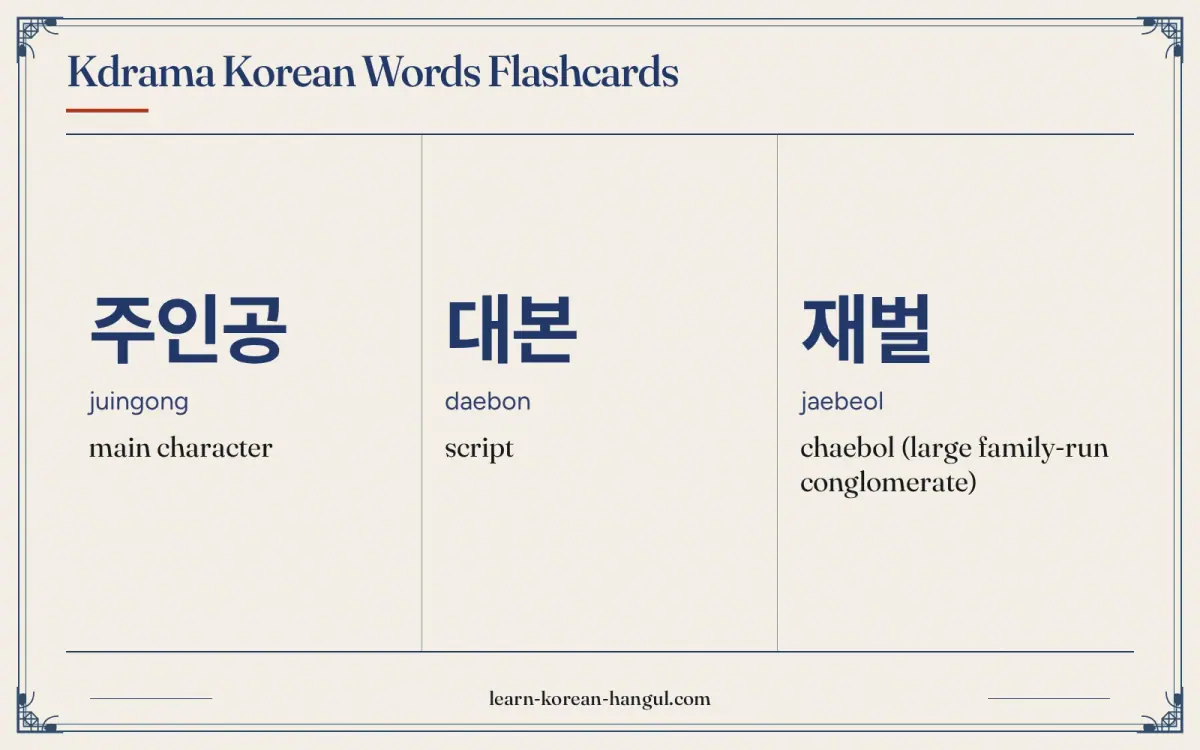
The cards start with the story (cards 1 to 9: 주인공, 대본, 재벌, 첫사랑, 드라마, 회, 시즌, 자막, 삼각관계), then the title 오징어 게임, the cast and crew (11 to 19), the plot and the broadcast (20 to 27), and the closing general words 사랑 and 비밀 (28 to 29).
How Do I Use These Flashcards?
Use the deck above in four steps. It works with tap, click or keyboard, and nothing plays until you press an audio button.
- Choose a mode. Start with recognition (Hangul to meaning). Switch to recall (meaning to Hangul) or listening (audio to meaning) once recognition feels easy.
- Show the answer. Think of the answer first, then press Show answer (or Space). Turn on the romanization toggle only if you need it; the table below always shows it.
- Grade yourself. Press Got it if you answered correctly without help, or Not yet if you hesitated or guessed.
- Finish the session. A session holds up to 20 cards (you can set 10, 20 or 40). With 29 cards, a first-time learner should expect about 3 days at the default limit of 10 new cards a day, with review sessions on top.
The Three Study Modes
Recognition shows the Hangul and asks for the meaning, so with the first card it shows 주인공 and you answer "main character". Recall reverses this: it shows the meaning and asks for the Hangul, and you may type the answer with your Hangul keyboard or just say it in your head. Listening plays a clip and hides the letters, which trains the ear. Listening mode only uses a card once its audio is approved, and cards without approved audio are skipped in that mode with a note. Listening mode helps with the longer compounds such as 시청률, because they change sound at the joins.
Got It and Not Yet
Got it moves a card up one Leitner box, so it comes back later. Not yet sends the card back to box 1, so it returns in the same session or within 10 minutes. The grades are your own judgement; the deck does not score you or claim fluency.
Deck Scope: What Is and Is Not Covered
The deck covers words for plots, characters and viewing habits found in Korean dramas. Slang used by viewers and fans is in the slang and K-pop decks. The words and letters on these cards are explained in the kdrama korean words lesson, so read it first if a card is new.
What This Deck Leaves Out
Traditional-culture words are in the traditional Korean culture words flashcards, and fan words such as 팬클럽 are in the kpop Korean words flashcards. Drama phrases and slang have their own lessons.
All 29 Cards in One Table
All 29 cards appear below in deck order. The table is plain HTML, so you can use it as a drill without the deck: cover the Meaning column, read each word aloud, then uncover it.
| # | Hangul | Revised Romanization | Meaning | Note | Audio assetId |
|---|---|---|---|---|---|
| 1 | 주인공 | juingong | main character | 주인공은 변호사예요 (The main character is a lawyer). | au-pg-flashcards-kdrama-words-1 |
| 2 | 대본 | daebon | script | 대본 리딩 is the first read-through. | au-pg-flashcards-kdrama-words-2 |
| 3 | 재벌 | jaebeol | chaebol (large family-run conglomerate) | A conglomerate-owning family; a common drama character type. | au-pg-flashcards-kdrama-words-3 |
| 4 | 첫사랑 | cheotsarang | first love | Said [첟싸랑]. | au-pg-flashcards-kdrama-words-4; slow: au-pg-flashcards-kdrama-words-32 |
| 5 | 드라마 | deurama | drama (TV series) | 저는 한국 드라마를 좋아해요 (I like Korean dramas). | au-pg-flashcards-kdrama-words-5 |
| 6 | 회 | hoe | episode | 십이 회 (episode 12). | au-pg-flashcards-kdrama-words-6 |
| 7 | 시즌 | sijeun | season (TV series or sports) | 이 드라마는 시즌 2도 있어요 (This drama also has a season 2). | au-pg-flashcards-kdrama-words-7 |
| 8 | 자막 | jamak | subtitles | 한국어 자막을 켜요 (I turn on the Korean subtitles). | au-pg-flashcards-kdrama-words-8 |
| 9 | 삼각관계 | samgakgwangye | love triangle | 그 드라마에는 삼각관계가 나와요 (That drama has a love triangle). | au-pg-flashcards-kdrama-words-9 |
| 10 | 오징어 게임 | ojingeo geim | Squid Game | The title of a Korean series. | au-pg-flashcards-kdrama-words-10 |
| 11 | 배우 | baeu | actor | 저 사람은 배우예요 (That person is an actor). | au-pg-flashcards-kdrama-words-11 |
| 12 | 주연 | juyeon | lead role | 주연 배우 is the lead actor. | au-pg-flashcards-kdrama-words-12 |
| 13 | 조연 | joyeon | supporting role | 조연 배우 is a supporting actor. | au-pg-flashcards-kdrama-words-13 |
| 14 | 악역 | agyeok | villain role | The role of the bad character. | au-pg-flashcards-kdrama-words-14 |
| 15 | 감독 | gamdok | director | The director of a drama or film; 감독님 is the polite form. | au-pg-flashcards-kdrama-words-15 |
| 16 | 작가 | jakga | writer | The writer of the script. | au-pg-flashcards-kdrama-words-16 |
| 17 | 연기 | yeongi | acting | 연기를 잘해요 (He or she acts well). Also means smoke. | au-pg-flashcards-kdrama-words-17 |
| 18 | 출연 | churyeon | appearance (in a show) | 출연하다 means to appear in a show. | au-pg-flashcards-kdrama-words-18 |
| 19 | 장면 | jangmyeon | scene | 이 장면이 좋아요 (I like this scene). | au-pg-flashcards-kdrama-words-19 |
| 20 | 사극 | sageuk | historical drama | Often set in the Joseon dynasty. | au-pg-flashcards-kdrama-words-20 |
| 21 | 시청률 | sicheongnyul | viewer ratings | Said [시청뉼]. | au-pg-flashcards-kdrama-words-21; slow: au-pg-flashcards-kdrama-words-30 |
| 22 | 한류 | hallyu | the Korean Wave | Said [할류]. | au-pg-flashcards-kdrama-words-22; slow: au-pg-flashcards-kdrama-words-31 |
| 23 | 반전 | banjeon | plot twist | 반전이 있어요 (there is a twist). | au-pg-flashcards-kdrama-words-23 |
| 24 | 본방 | bonbang | original broadcast | 본방사수 means making sure to watch it live. | au-pg-flashcards-kdrama-words-24 |
| 25 | 부작 | bujak | number of episodes in a series | 십이 부작 (a 12-part series). | au-pg-flashcards-kdrama-words-25 |
| 26 | 예고편 | yegopyeon | trailer | The trailer or preview shown before an episode or film. | au-pg-flashcards-kdrama-words-26 |
| 27 | 결말 | gyeolmal | ending | 결말이 궁금해요 (I wonder how it ends). | au-pg-flashcards-kdrama-words-27 |
| 28 | 사랑 | sarang | love | 저는 가족을 사랑해요 (I love my family). | au-pg-flashcards-kdrama-words-28 |
| 29 | 비밀 | bimil | secret | 이건 비밀이에요 (This is a secret). | au-pg-flashcards-kdrama-words-29 |
Reading the Table
Hangul is the word. Revised Romanization (RR) is a learning aid, so read the Hangul first. RR follows sound changes between letters, which is why 한류 is written hallyu. The Meaning column gives the English gloss, and the Note column gives a use or sound hint. A second ID in the last column marks a slow clip.
Usage Notes for These Cards
주인공 is the character, 주연 the role. 주인공 is the main character, while the actor in that role is a 주연 배우: 주인공은 변호사예요 (The main character is a lawyer).
재벌 is a family, not just a rich person. 재벌 refers to the family behind a large conglomerate and is a common drama character type.
Episodes and series length. Episodes are counted with 회: 십이 회 (episode 12), and a series length is described with 부작.
본방 and 본방사수. 본방 means the original broadcast, and 본방사수 means making sure to watch it live.
사극 is a genre of its own. A 사극 is a historical drama set in a past dynasty such as Joseon, with its own costumes, speech style and settings.
Which Sounds Do Not Match the Spelling?
시청률 is said [시청뉼]: the ㄹ after a ㅇ final is read as ㄴ. Revised Romanization writes sicheongnyul.
한류 is said [할류]: the ㄴ before ㄹ is read as ㄹ. Revised Romanization writes hallyu.
첫사랑 is said [첟싸랑]: the final ㅅ of 첫 is read as ㄷ and the ㅅ of 사 is tensified. Revised Romanization writes cheotsarang.
What Mistakes Do Learners Make with Drama Words?
- Calling the actor 주인공. Use 주연 배우 for the actor.
- Using 재벌 for any rich person. It means a conglomerate-owning family.
- Using 회 for the whole series. 회 counts one episode; 부작 describes the whole series.
- Treating 연기 as only smoke. In a drama setting 연기 means acting.
Most of these slips are about which word names a person, a role or a unit, so say each example aloud when you answer a card.
How Does the Review Schedule Work?
The deck uses a simplified Leitner system with five boxes. A new card starts in box 1. Each Got it moves it up one box, and each Not yet returns it to box 1. The box sets how long the card waits before it is due again.
| Box | Wait until the next review |
|---|---|
| 1 | same session or 10 minutes |
| 2 | 1 day |
| 3 | 3 days |
| 4 | 7 days |
| 5 | 21 days |
Each session shows due cards first, oldest due first, and then new cards up to the daily limit, which is 10 by default. A deck of 29 cards is introduced in about three days at the default of 10 new cards a day, and the later boxes bring each word back at longer gaps. Progress is saved only in this browser, so clearing site data deletes it. Use the export button to save a small JSON file with card IDs, boxes and due dates, and import it on another device. The file holds no personal data.
Cultural and Practical Context
Dramas often feature conglomerate heirs and first-love stories, and viewer ratings are widely reported in the news. Fans talk about 시청률 (ratings) and 반전 (twists) the way sports fans talk about scores. Watching with Korean subtitles (자막) is a popular way to practise reading, and the vocabulary on these cards appears in almost every show.
Limits of This Deck
The deck holds 29 cards, a starting set rather than a full media glossary. It leaves out fan slang and informal abbreviations such as 로코 (romantic comedy). Calling Joseon the typical 사극 setting is a general statement, not a rule. 연기 has other meanings, such as smoke, so context decides. The Korean text on this page is generated and was reviewed and signed off by Min-ji Park on 15 October 2026.
Next Steps after This Deck
This deck is one of the korean vocabulary flashcards on the site, so browse the full list if you want a different topic. When these cards feel easy, move on to traditional korean culture words flashcards to keep the same routine. For a related topic, try kpop korean words flashcards. After a session, write the same words by hand with the korean culture vocabulary worksheet. All flashcard decks, including Hangul, vocabulary, phrases, grammar and TOPIK, are listed on the Korean flashcards hub.
Frequently Asked Questions
What Is a 대본?
A 대본 is a script, and 대본 리딩 is the first read-through when the cast reads the script together. You will hear both in making-of videos. The word is also used in plays and films.
What Does 반전 Mean?
반전 is a plot twist, a sudden change in the story. People say 반전이 있어요 (there is a twist). The word also means reversal in other contexts, so drama context decides.
Is 한류 Only for Dramas?
No, it covers Korean pop culture broadly, including dramas, music, film and food. 한류 literally means Korean wave. Dramas were an early driver, so the word often comes up with them.
What Is 로맨틱 코미디 in Short?
It is often abbreviated 로코, from 로맨틱 코미디, meaning romantic comedy. 로코 is informal, so it appears in speech and fan writing more than in formal texts. The deck leaves it out for that reason.
Is My Progress Saved If I Close the Page?
Yes, in the same browser on the same device. Card boxes and due dates are stored locally and nothing is sent to a server. Clearing site data, using a private window or switching browsers removes them, so use the export button to keep a backup file. No account is needed.