
Kdrama Korean Words at a Glance
Kdrama Korean words come in three kinds. The first kind is ordinary vocabulary that happens to be used a lot in dramas, such as 사무실 (office) and 눈물 (tears). The second kind is production and broadcast vocabulary, such as 회, 방영 and 시청률. The third kind is fan shorthand, such as 남주, 여주 and 정주행, which comes from online chat. Of the 45 words, 36 are Sino-Korean, 6 are loanwords, 2 are native Korean and 1, 댓글, is a hybrid of Sino-Korean 대 and native 글.
This list is also a hub for two deeper pages: K-Drama Tropes and Roles Vocabulary and Squid Game Korean Vocabulary. It sits inside Korean Culture Words.
| Group | Words | What it covers |
|---|---|---|
| Drama basics | 9 | Episodes, seasons, broadcasting and the people behind the show |
| Characters and roles | 9 | Leads, villains, actors and the chaebol character |
| Plot tropes | 9 | First love, twists, revenge and endings |
| Settings (office, school, palace) | 9 | The places where a story happens |
| Fan words | 9 | Ratings, subtitles, comments and spoilers |
If you want full lines of dialogue, the K-drama phrases page has them. The next section says which words to learn first.
Which K-Drama Words Should You Learn First?
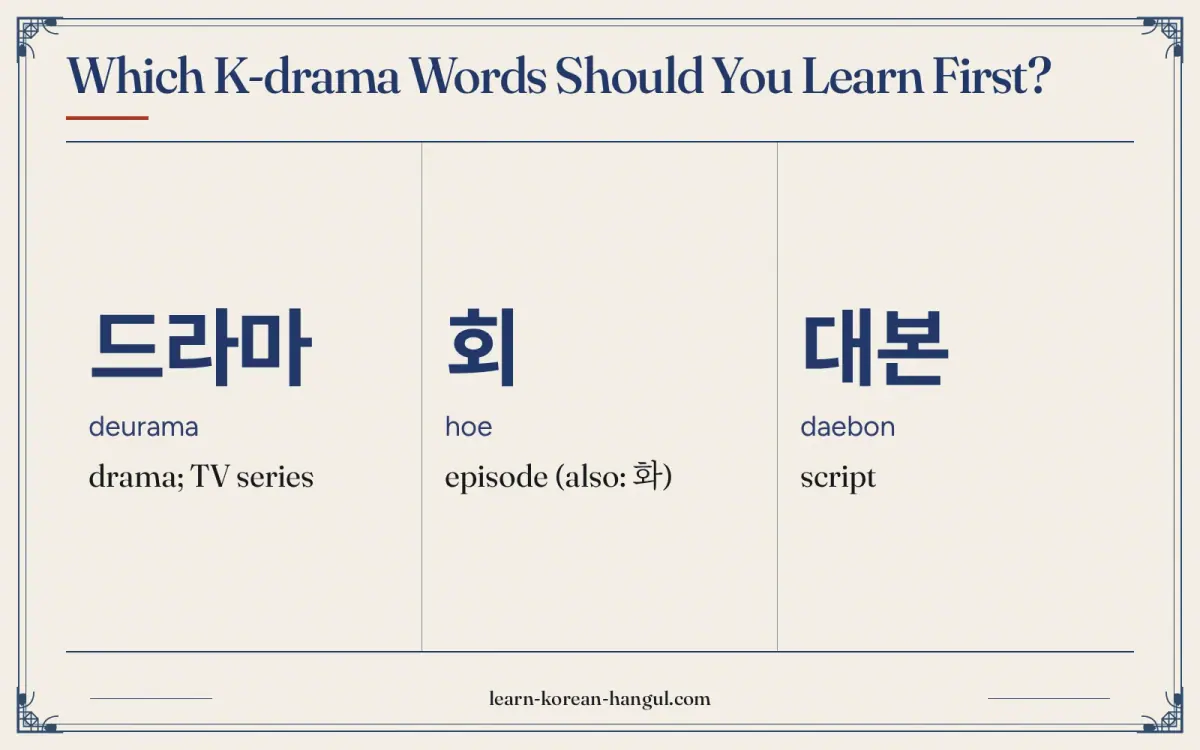
Learn 드라마, 회, 주인공, 배우 and 자막 first. They are the words you see on any streaming page, and 드라마 is easy because it comes from English. Then add 재벌, 첫사랑 and 반전, the words that sum up the most famous Korean drama stories.
- On a streaming page. 드라마, 회, 시즌, 자막, 방영 and 인기.
- To talk about who is in it. 주인공, 배우, 감독, 작가, 조연 and 카메오.
- To describe the story. 재벌, 첫사랑, 삼각관계, 반전, 복수 and 결말.
- To chat with fans. 정주행, 본방, 명장면, 명대사, 스포일러 and 댓글.
At 9 words a day, the list takes five days plus review. The scene below puts eight of the words on one picture.
Word · 8
- 1
드라마
deurama
drama; TV series
- 2
회
hoe
episode (also: 화)
- 3
대본
daebon
script
- 4
주인공
juingong
main character
- 5
재벌
jaebeol
chaebol (a family-controlled business group)
- 6
사무실
samusil
office
- 7
편의점
pyeonuijeom
convenience store
- 8
댓글
daetgeul
online comment
Many of these words are Sino-Korean and are made of two or three short syllables, so you can reuse the syllables. 시 (look or watch) is in 시청률 and 시청자, and 장면 (scene) is in 명장면. Fans also shorten long words: 남자 주인공 becomes 남주, and 본방송 becomes 본방. This clipping is part of how online Korean works.
Drama Basics
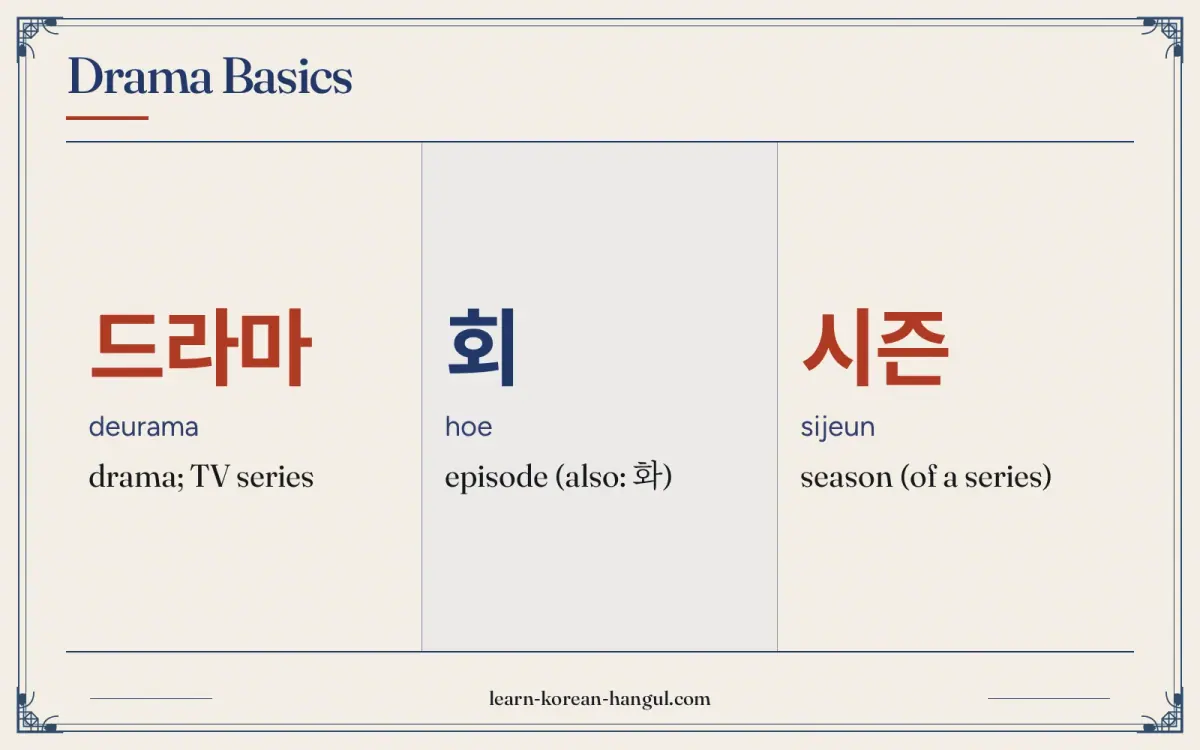
Drama basics are the words on the streaming page. A 드라마 has many 회 (episodes), grouped into a 시즌 (season). It is 방영 (broadcast) on TV, and the 본방 is the first live airing. Behind it are the 작가 (writer), the 감독 (director) and the 대본 (script).
| No. | Hangul | Revised Romanization | Origin | Meaning | Example sentence | Audio assetId |
|---|---|---|---|---|---|---|
| 1 | 드라마 | deurama | loanword | drama; TV series | 저녁에 드라마를 봐요. (I watch a drama in the evening.) | au-pg-vocabulary-culture-kdrama-1; example: au-pg-vocabulary-culture-kdrama-46 |
| 2 | 회 | hoe | Sino-Korean | episode (also: 화) | 이번 회가 재미있어요. (This episode is fun.) | au-pg-vocabulary-culture-kdrama-2; example: au-pg-vocabulary-culture-kdrama-47 |
| 3 | 시즌 | sijeun | loanword | season (of a series) | 시즌 2가 다음 달에 시작해요. (Season 2 starts next month.) | au-pg-vocabulary-culture-kdrama-3; example: au-pg-vocabulary-culture-kdrama-48 |
| 4 | 방영 | bangyeong | Sino-Korean | broadcast; airing | 드라마는 밤 아홉 시에 방영돼요. (The drama airs at nine at night.) | au-pg-vocabulary-culture-kdrama-4; example: au-pg-vocabulary-culture-kdrama-49 |
| 5 | 대본 | daebon | Sino-Korean | script | 배우가 대본을 읽어요. (The actor reads the script.) | au-pg-vocabulary-culture-kdrama-5; example: au-pg-vocabulary-culture-kdrama-50 |
| 6 | 작가 | jakga | Sino-Korean | writer | 이 작가는 유명해요. (This writer is famous.) | au-pg-vocabulary-culture-kdrama-6; example: au-pg-vocabulary-culture-kdrama-51 |
| 7 | 감독 | gamdok | Sino-Korean | director | 감독이 촬영을 시작해요. (The director starts filming.) | au-pg-vocabulary-culture-kdrama-7; example: au-pg-vocabulary-culture-kdrama-52 |
| 8 | 본방 | bonbang | Sino-Korean | first live broadcast (short for 본방송) | 본방을 놓쳤어요. (I missed the live broadcast.) | au-pg-vocabulary-culture-kdrama-8; example: au-pg-vocabulary-culture-kdrama-53 |
| 9 | 정주행 | jeongjuhaeng | Sino-Korean | binge-watching from the first episode (slang) | 주말에 정주행했어요. (I binge-watched on the weekend.) | au-pg-vocabulary-culture-kdrama-9; example: au-pg-vocabulary-culture-kdrama-54 |
회 is the standard counter for episodes, and 화 is also used, so you will see both 1회 and 1화. Each is read with the number before it, as in 일 회 and 일 화, and 회 is the more established word in broadcasting. 정주행 is fan slang for watching a series from the first episode in a row. It comes from 정 (forward, in the right direction) and 주행 (running), and it is now used for any binge-watch. 본방 is short for 본방송, and 재방송 is the rerun. Fans who watch the 본방 live often chat online at the same time.
The word 드라마 is a loanword spelled with ㅡ in the first syllable. Keep your lips relaxed and unrounded for ㅡ. The next group names the people on screen.
Example Sentences
Each example is a short polite sentence. Most follow the pattern noun + 이/가 + adjective, as in 연기가 자연스러워요, or noun + 을/를 + verb, as in 드라마를 봐요. Say each sentence aloud, then swap the noun. Replace 연기 in 연기가 자연스러워요 with 대본 and you get 대본이 자연스러워요, which is also natural.
How Do You Say Characters and Roles in Korean?
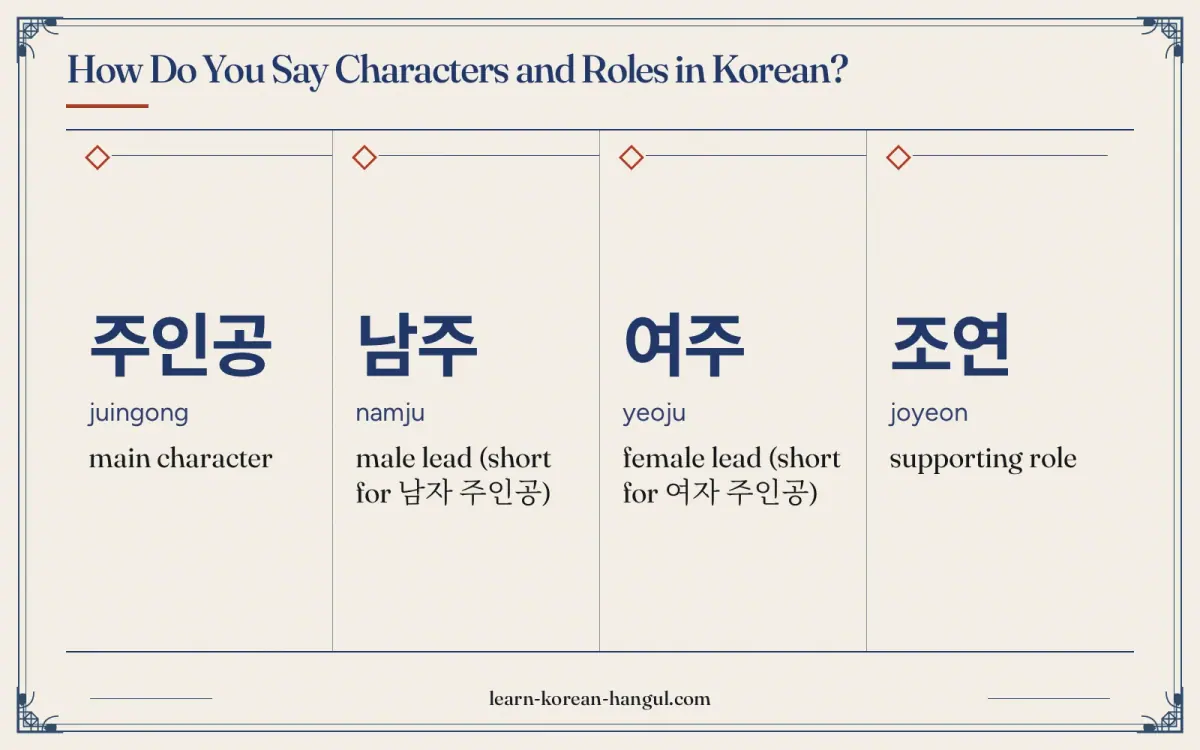
Characters and roles are the people on screen. The 주인공 is the main character, the 남주 and 여주 are the male and female leads, and the 조연 are the supporting cast. A 악당 is the villain. The 배우 gives a performance, and the quality of it is the 연기.
| No. | Hangul | Revised Romanization | Origin | Meaning | Example sentence | Audio assetId |
|---|---|---|---|---|---|---|
| 10 | 주인공 | juingong | Sino-Korean | main character | 주인공이 용감해요. (The main character is brave.) | au-pg-vocabulary-culture-kdrama-10; example: au-pg-vocabulary-culture-kdrama-55 |
| 11 | 남주 | namju | Sino-Korean | male lead (short for 남자 주인공) | 남주가 멋있어요. (The male lead is cool.) | au-pg-vocabulary-culture-kdrama-11; example: au-pg-vocabulary-culture-kdrama-56 |
| 12 | 여주 | yeoju | Sino-Korean | female lead (short for 여자 주인공) | 여주가 예뻐요. (The female lead is pretty.) | au-pg-vocabulary-culture-kdrama-12; example: au-pg-vocabulary-culture-kdrama-57 |
| 13 | 조연 | joyeon | Sino-Korean | supporting role | 조연도 중요해요. (Supporting roles are important too.) | au-pg-vocabulary-culture-kdrama-13; example: au-pg-vocabulary-culture-kdrama-58 |
| 14 | 악당 | akdang | Sino-Korean | villain; bad guy | 악당이 나타나요. (The villain appears.) | au-pg-vocabulary-culture-kdrama-14; example: au-pg-vocabulary-culture-kdrama-59 |
| 15 | 배우 | baeu | Sino-Korean | actor | 이 배우는 연기를 잘해요. (This actor acts well.) | au-pg-vocabulary-culture-kdrama-15; example: au-pg-vocabulary-culture-kdrama-60 |
| 16 | 연기 | yeongi | Sino-Korean | acting | 연기가 자연스러워요. (The acting is natural.) | au-pg-vocabulary-culture-kdrama-16; example: au-pg-vocabulary-culture-kdrama-61 |
| 17 | 재벌 | jaebeol | Sino-Korean | chaebol (a family-controlled business group) | 드라마에 재벌이 많이 나와요. (Chaebol often appear in dramas.) | au-pg-vocabulary-culture-kdrama-17; example: au-pg-vocabulary-culture-kdrama-62 |
| 18 | 카메오 | kameo | loanword | cameo | 카메오가 나와요. (A cameo appears.) | au-pg-vocabulary-culture-kdrama-18; example: au-pg-vocabulary-culture-kdrama-63 |
재벌 is the word that sums up many drama stories. It means a chaebol, a family-controlled business group, and in dramas the 재벌 character is typically the wealthy male lead. This is a stock figure in fiction and not a claim about real people. The single-word page for chaebol in Korean explains the word in detail.
남주 and 여주 are fan abbreviations. The longer forms are 남자 주인공 and 여자 주인공. More roles are on the tropes and roles page. The next group goes from people to plots.
Plot Tropes
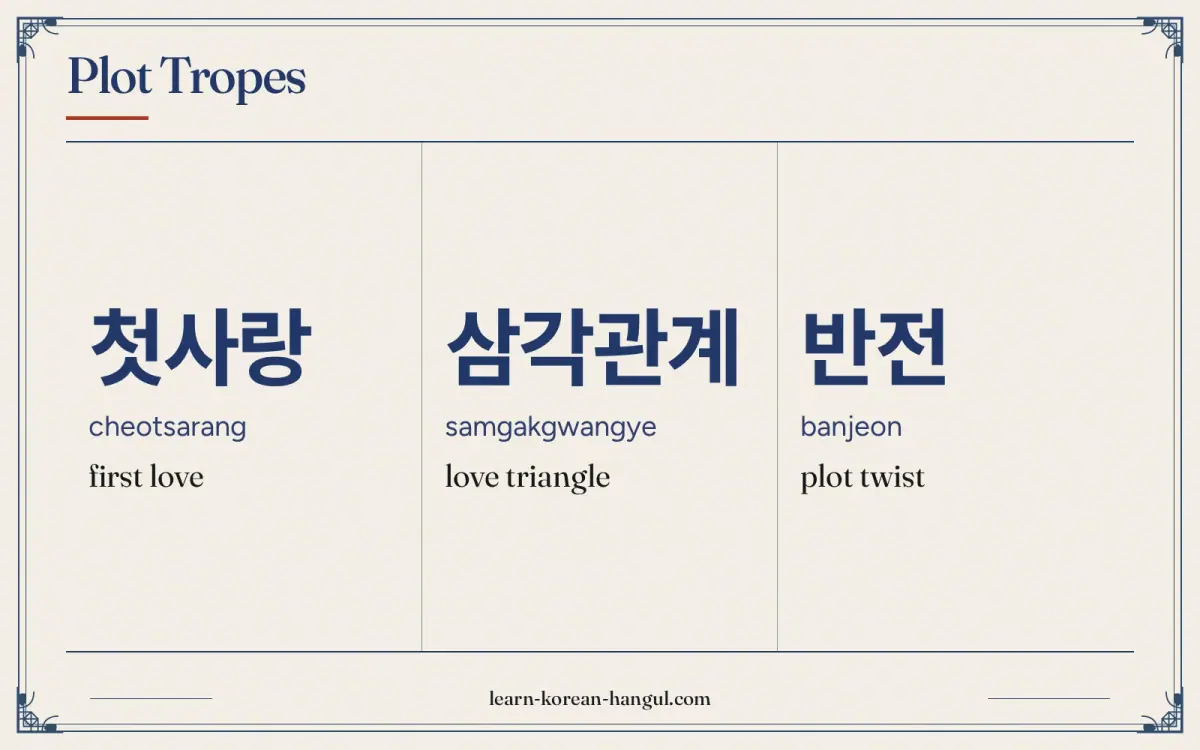
Plot tropes are the story devices that recur in dramas. 첫사랑 is the first love, 삼각관계 is the love triangle, 반전 is the twist and 복수 is revenge. The story ends with a 결말, ideally a 해피엔딩, often after many 눈물.
| No. | Hangul | Revised Romanization | Origin | Meaning | Example sentence | Audio assetId |
|---|---|---|---|---|---|---|
| 19 | 첫사랑 | cheotsarang | native | first love | 첫사랑 이야기가 나와요. (A first-love story appears.) | au-pg-vocabulary-culture-kdrama-19; example: au-pg-vocabulary-culture-kdrama-64 |
| 20 | 삼각관계 | samgakgwangye | Sino-Korean | love triangle | 삼각관계가 재미있어요. (The love triangle is interesting.) | au-pg-vocabulary-culture-kdrama-20; example: au-pg-vocabulary-culture-kdrama-65 |
| 21 | 반전 | banjeon | Sino-Korean | plot twist | 마지막 회에 반전이 있어요. (There is a twist in the last episode.) | au-pg-vocabulary-culture-kdrama-21; example: au-pg-vocabulary-culture-kdrama-66 |
| 22 | 복수 | boksu | Sino-Korean | revenge | 복수 이야기를 좋아해요. (I like revenge stories.) | au-pg-vocabulary-culture-kdrama-22; example: au-pg-vocabulary-culture-kdrama-67 |
| 23 | 기억상실 | gieoksangsil | Sino-Korean | amnesia | 주인공이 기억상실에 걸려요. (The main character gets amnesia.) | au-pg-vocabulary-culture-kdrama-23; example: au-pg-vocabulary-culture-kdrama-68 |
| 24 | 해피엔딩 | haepiending | loanword | happy ending | 해피엔딩이 좋아요. (I like a happy ending.) | au-pg-vocabulary-culture-kdrama-24; example: au-pg-vocabulary-culture-kdrama-69 |
| 25 | 결말 | gyeolmal | Sino-Korean | ending (of a story) | 결말이 궁금해요. (I am curious about the ending.) | au-pg-vocabulary-culture-kdrama-25; example: au-pg-vocabulary-culture-kdrama-70 |
| 26 | 눈물 | nunmul | native | tears | 슬픈 장면에서 눈물이 나요. (Tears come at a sad scene.) | au-pg-vocabulary-culture-kdrama-26; example: au-pg-vocabulary-culture-kdrama-71 |
| 27 | 키스신 | kiseusin | loanword | kiss scene | 키스신이 유명해요. (The kiss scene is famous.) | au-pg-vocabulary-culture-kdrama-27; example: au-pg-vocabulary-culture-kdrama-72 |
삼각관계 is built from 삼각 (triangle) and 관계 (relationship). The word 기억상실, amnesia, appears in the idiom 기억상실에 걸리다 (to get amnesia), with the verb 걸리다 (to catch an illness). 해피엔딩 is a loanword, while 결말 is a Sino-Korean word for the ending of any story. For the single-word answer on love triangles, open love triangle in Korean.
Notice that 눈물 is a native word and is the only everyday word in this group. It also appears in the idiom 눈물이 나요, tears come, which describes crying without sobbing. The next group covers the places where scenes happen.
How Do You Say Settings (office, school, palace) in Korean?
Settings are the places where a drama is shot over and over. An office is a 사무실, a school scene shows a 교복, and a period story takes place in a 궁궐 (palace) and is called a 사극. Other classic settings are the 법정, the 응급실, the 옥상 and the 편의점.
| No. | Hangul | Revised Romanization | Origin | Meaning | Example sentence | Audio assetId |
|---|---|---|---|---|---|---|
| 28 | 사무실 | samusil | Sino-Korean | office | 사무실에서 일해요. (They work in the office.) | au-pg-vocabulary-culture-kdrama-28; example: au-pg-vocabulary-culture-kdrama-73 |
| 29 | 교복 | gyobok | Sino-Korean | school uniform | 학생들이 교복을 입어요. (The students wear school uniforms.) | au-pg-vocabulary-culture-kdrama-29; example: au-pg-vocabulary-culture-kdrama-74 |
| 30 | 궁궐 | gunggwol | Sino-Korean | palace | 궁궐이 아름다워요. (The palace is beautiful.) | au-pg-vocabulary-culture-kdrama-30; example: au-pg-vocabulary-culture-kdrama-75 |
| 31 | 사극 | sageuk | Sino-Korean | historical drama | 사극을 좋아해요. (I like historical dramas.) | au-pg-vocabulary-culture-kdrama-31; example: au-pg-vocabulary-culture-kdrama-76 |
| 32 | 법정 | beopjeong | Sino-Korean | courtroom | 법정에서 재판을 해요. (A trial is held in the courtroom.) | au-pg-vocabulary-culture-kdrama-32; example: au-pg-vocabulary-culture-kdrama-77 |
| 33 | 응급실 | eunggeupsil | Sino-Korean | emergency room | 응급실에 가요. (I go to the emergency room.) | au-pg-vocabulary-culture-kdrama-33; example: au-pg-vocabulary-culture-kdrama-78 |
| 34 | 옥상 | oksang | Sino-Korean | rooftop | 옥상에서 이야기해요. (They talk on the rooftop.) | au-pg-vocabulary-culture-kdrama-34; example: au-pg-vocabulary-culture-kdrama-79 |
| 35 | 편의점 | pyeonuijeom | Sino-Korean | convenience store | 편의점에서 라면을 먹어요. (I eat ramen at the convenience store.) | au-pg-vocabulary-culture-kdrama-35; example: au-pg-vocabulary-culture-kdrama-80 |
| 36 | 포장마차 | pojangmacha | Sino-Korean | street tent bar | 포장마차에서 술을 마셔요. (They drink at the street tent bar.) | au-pg-vocabulary-culture-kdrama-36; example: au-pg-vocabulary-culture-kdrama-81 |
Each of these words points to a type of story. A 사극 is a historical drama set before modern times. A 법정 or 응급실 setting suggests a professional drama. A 포장마차 is a roadside tent where people drink and talk, and it is a popular place for late-night conversations in dramas. 옥상 (rooftop) is where characters go to be alone.
교복 is the school uniform, and school dramas are easy to spot by it. The last group is about the people who watch.
Fan Words
Fan words describe how people watch and talk about a drama. The 시청률 is the rating, the 시청자 are the viewers, and 자막 are subtitles. Fans share 명장면 and 명대사 (famous scenes and lines) in 댓글 (comments) and try to avoid 스포일러 (spoilers).
| No. | Hangul | Revised Romanization | Origin | Meaning | Example sentence | Audio assetId |
|---|---|---|---|---|---|---|
| 37 | 시청률 | sicheongnyul | Sino-Korean | viewership rating | 시청률이 높아요. (The viewership rating is high.) | au-pg-vocabulary-culture-kdrama-37; example: au-pg-vocabulary-culture-kdrama-82 |
| 38 | 시청자 | sicheongja | Sino-Korean | viewer | 시청자가 많아요. (There are many viewers.) | au-pg-vocabulary-culture-kdrama-38; example: au-pg-vocabulary-culture-kdrama-83 |
| 39 | 자막 | jamak | Sino-Korean | subtitles | 영어 자막이 있어요. (There are English subtitles.) | au-pg-vocabulary-culture-kdrama-39; example: au-pg-vocabulary-culture-kdrama-84 |
| 40 | 재방송 | jaebangsong | Sino-Korean | rerun | 재방송을 봐요. (I watch the rerun.) | au-pg-vocabulary-culture-kdrama-40; example: au-pg-vocabulary-culture-kdrama-85 |
| 41 | 댓글 | daetgeul | hybrid (Sino-Korean 대 + native 글) | online comment | 댓글을 읽어요. (I read the comments.) | au-pg-vocabulary-culture-kdrama-41; example: au-pg-vocabulary-culture-kdrama-86 |
| 42 | 명장면 | myeongjangmyeon | Sino-Korean | famous scene | 명장면을 다시 봐요. (I watch the famous scene again.) | au-pg-vocabulary-culture-kdrama-42; example: au-pg-vocabulary-culture-kdrama-87 |
| 43 | 명대사 | myeongdaesa | Sino-Korean | famous line | 명대사를 따라 해요. (I imitate the famous line.) | au-pg-vocabulary-culture-kdrama-43; example: au-pg-vocabulary-culture-kdrama-88 |
| 44 | 스포일러 | seupoilleo | loanword | spoiler | 스포일러는 싫어요. (I do not like spoilers.) | au-pg-vocabulary-culture-kdrama-44; example: au-pg-vocabulary-culture-kdrama-89 |
| 45 | 인기 | ingi | Sino-Korean | popularity | 인기가 많아요. (It is very popular.) | au-pg-vocabulary-culture-kdrama-45; example: au-pg-vocabulary-culture-kdrama-90 |
시청률 is a news word: reports state the rating of each episode. 인기 is the general word for popularity, and it is used for people, songs and shows. 명 in 명장면 and 명대사 means famous or excellent, and the same syllable begins 명곡 (famous song). 댓글 is the word for an online comment, and it is said with a tense last syllable [댇끌].
The subtitle trap: streaming services often translate words such as 오빠 and 선배 differently from each other. Learn the Korean word and the relationship it describes, not just the English subtitle. The next section covers the sounds.
How Do You Pronounce These Words?
Most of these words follow the spelling, but several undergo sound changes between consonants. The table shows eight that learners often get wrong.
| Spelling | Pronunciation | What happens |
|---|---|---|
| 시청률 | [시청뉼] | ㄹ after a final ㅇ becomes ㄴ |
| 댓글 | [댇끌] | The final ㅅ is said as ㄷ, and ㄱ after it is said as a tense sound |
| 옥상 | [옥쌍] | ㅅ after a final ㄱ is said as a tense sound |
| 법정 | [법쩡] | ㅈ after a final ㅂ is said as a tense sound |
| 기억상실 | [기억쌍실] | ㅅ after a final ㄱ is said as a tense sound |
| 편의점 | [펴늬점] or [펴니점] | The final ㄴ links to the next syllable, and ㅢ in a later syllable may be said [이] |
| 첫사랑 | [첟싸랑] | The final ㅅ is said as ㄷ, and the ㅅ of 사 is said as a tense sound |
| 삼각관계 | [삼각꽌계] or [삼각꽌게] | ㄱ after a final ㄱ is said as a tense sound, and ㅖ in 계 may be said [ㅔ] |
The rules come from the Standard Pronunciation rules (표준 발음법) of the 국립국어원. Revised Romanization does not show tensing caused by a neighbouring sound, so it writes 옥상 as oksang even though it is said [옥쌍]. It does show the change in 시청률 (sicheongnyul).
Audio and Slow Playback
Each word has a normal clip, and 5 key words also have a slow clip at 0.8 times the speed: 드라마, 재벌, 정주행, 시청률 and 포장마차. Nothing plays until you press a button.
Listen to 드라마 first. The first vowel, ㅡ, is said with relaxed, unrounded lips and the tongue pulled back, so it does not sound like the u in dura. Then listen to 시청률. You should hear a clear ㄴ at the end, as if the word were spelled 시청뉼.
What Mistakes Do Learners Make with K-Drama Words?
- Treating 재벌 as any rich person. It means a family-controlled business group, and the drama character is a stock figure.
- Using 남주 and 여주 in formal writing. They are fan shorthand, and the full forms suit essays and exams.
- Trusting a single subtitle translation of 오빠 or 선배. Different services translate them differently, so learn the Korean word.
- Mixing up 회 and 화. Both count episodes. 회 is the broadcasting standard and 화 is common online, and each is read with the number before it.
- Reading 시청률 as si-cheong-ryul. The ㄹ becomes ㄴ after ㅇ, so it is [시청뉼].
- Saying 드라마 with a rounded ㅜ in the first syllable. The ㅡ is unrounded.
Of these, the subtitle trap is the one that confuses new fans most. The next section turns the list into practice.
Practice: Flashcards and Worksheet
Drill these words with the Kdrama Korean words flashcards or browse all the vocabulary flashcard decks. A printable worksheet for these words (word list, matching, writing practice, fill-in-the-blank exercises and answer key) is available in A4 and US Letter from the download card on this page. Progress in the decks is saved only in your browser.
K-Drama Words Worksheet
Try this five-question check, then say the 45 words aloud once more.
Practice · 5
What does 대본 mean?
Show answer
script
대본 (daebon) means script.
What does 악당 mean?
Show answer
villain; bad guy
악당 (akdang) means villain; bad guy.
What does 기억상실 mean?
Show answer
amnesia
기억상실 (gieoksangsil) means amnesia.
What does 법정 mean?
Show answer
courtroom
법정 (beopjeong) means courtroom.
What does 댓글 mean?
Show answer
online comment
댓글 (daetgeul) means online comment.
Pages in This Section
Two deeper pages expand this list. K-Drama Tropes and Roles Vocabulary goes further into leads, romance tropes, class and plot twists, and Squid Game Korean Vocabulary teaches the game names and the money words of one famous series.
Where to Go Next
This list sits inside Korean Culture Words. After the K-drama words, many learners move on to K-pop words or to traditional culture words. To turn the words into full lines, open the K-drama phrases page.
Frequently Asked Questions
How Do You Say Chaebol in Korean?
Chaebol is 재벌 (jaebeol). It means a large business group controlled by one family, and in dramas it names the wealthy family of the male lead. Say it as jae-beol, with a plain ㅂ in the second syllable and an unrounded ㅓ. The word is Sino-Korean.
How Do You Pronounce 드라마 (deurama)?
드라마 is said deu-ra-ma, with three short syllables. The first vowel ㅡ is unrounded: keep your lips relaxed and spread, not rounded, and pull your tongue back. The ㄹ in the middle is a single flap of the tongue. Nothing changes between the syllables.
How Many K-Drama Words Should I Learn First?
Learn about 15 first: 드라마, 회, 시즌, 자막, 방영, 주인공, 배우, 감독, 재벌, 첫사랑, 삼각관계, 반전, 결말, 인기 and 정주행. They let you read a streaming page and understand most summaries. Add the setting and fan words later, and review the first 15 again after two days.
Where Can I Practise K-Drama Words with Flashcards?
Use the Kdrama Korean words flashcards, a 29-card deck with audio that shares many words with this page, such as 주인공, 재벌, 첫사랑 and 시청률. Progress stays in your browser. For the words that are not in the deck, copy the five tables above onto cards: Hangul on one side, English on the other, and say each word aloud as you flip the card.
Is the Romanization on This Page Official?
It follows the Revised Romanization of Korean, which South Korea officially adopted on 7 July 2000 and whose rules the National Institute of Korean Language (국립국어원) publishes. It is a learning aid that does not show tensing caused by a neighbouring sound, so learn the Hangul and use the audio.
Is There a Printable Worksheet for K-Drama Words?
A printable worksheet for these words (word list, matching, writing practice, fill-in-the-blank exercises and answer key) is available in A4 and US Letter from the download card on this page. For practice, write the Hangul from memory, cover the English column and check your answers against the tables.