
Kpop Korean Words Flashcards: Study the 30 Cards
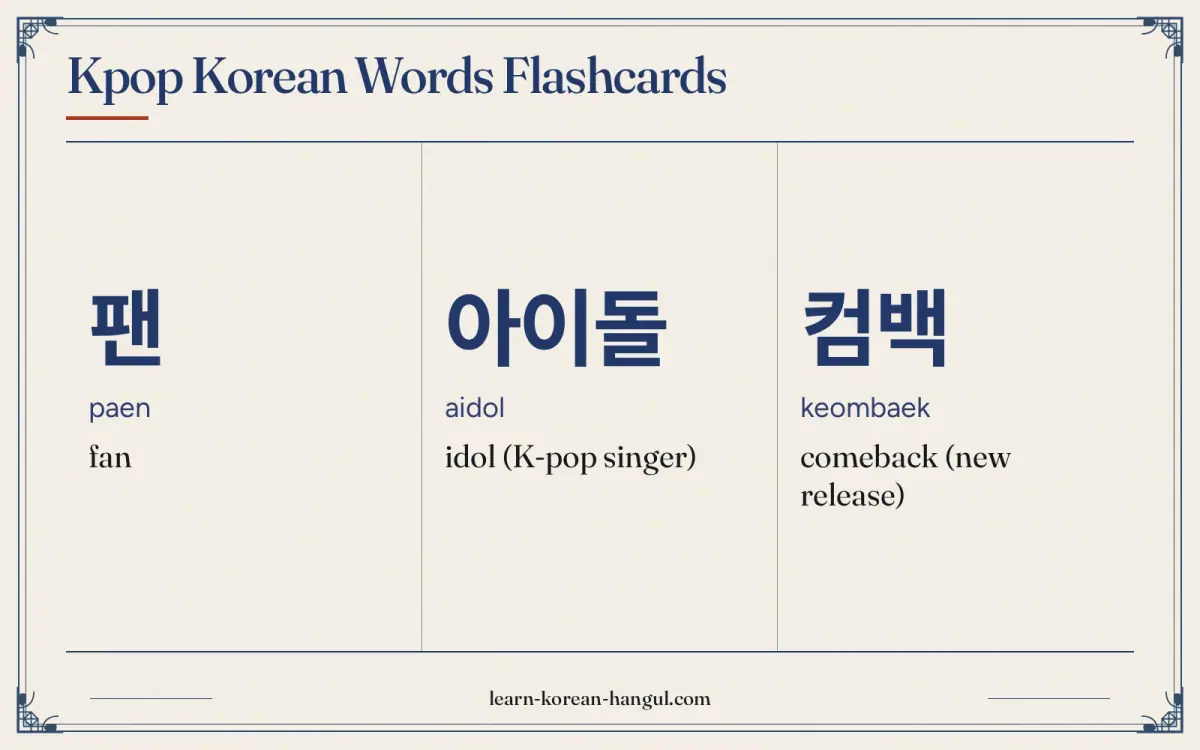
Many K-pop words are English loanwords, while the fan slang is Korean-made and changes quickly. The lesson behind this deck is K-pop Korean words, so read it first if a card is new.
How Do I Use These Flashcards?
Use the deck above in four steps. It works with tap, click or keyboard, and nothing plays until you press an audio button.
- Choose a mode. Start with recognition (Hangul to meaning). Switch to recall (meaning to Hangul) or listening (audio to meaning) once recognition feels easy.
- Show the answer. Think of the answer first, then press Show answer (or Space). Say the word aloud before you reveal it, and for the slang cards try it inside a short sentence such as 입덕했어요. Turn on the romanization toggle only if you need it; the 30-card table below always shows it.
- Grade yourself. Press Got it if you answered correctly without help, or Not yet if you hesitated or guessed.
- Finish the session. A session holds up to 20 cards (you can set 10, 20 or 40). With 30 cards, a first-time learner can split the deck over three days, using the default limit of 10 new cards a day.
The Three Study Modes
Recognition shows the Hangul and asks for the meaning, which trains reading. Recall shows the meaning and asks for the Hangul, which trains remembering; you may type the answer with your Hangul keyboard or just recall it in your head. Listening plays a clip and hides the letters, which trains the ear. Listening mode only uses a card once its audio is approved, and cards without approved audio are skipped in that mode with a note.
Got It and Not Yet
Got it moves a card up one Leitner box, so it comes back later. Not yet sends the card back to box 1, so it returns in the same session or within 10 minutes. The grades are your own judgement; the deck does not score you or claim fluency.
Deck Scope: What Is and Is Not Covered
The deck covers 30 words in four groups: people and groups (팬, 아이돌, 가수, 막내, 리더, 멤버, 연습생, 소속사), releases and events (컴백, 앨범, 콘서트, 팬미팅, 사인회, 음악방송), songs and performance (노래, 타이틀곡, 신곡, 무대, 안무, 가사, 직캠) and fan culture (응원봉, 팬클럽, 최애, 입덕, 탈덕, 덕질, 응원법, 포토카드). Slang cards are labelled as casual in the Note column.
What Is Left out of This Deck?
Drama words are in the K-drama words flashcards, and holiday words are in the Korean holidays flashcards. General music and instrument words belong to a separate music deck, so this deck keeps only the K-pop sense of each word. The lesson page K-pop Korean words holds the longer list.
All 30 Cards in One Table
All 30 cards appear below in deck order. The table is plain HTML, so you can use it as a drill without the deck: cover the Meaning column, say each entry aloud, then uncover it.
| # | Hangul | Revised Romanization | Meaning | Note | Audio assetId |
|---|---|---|---|---|---|
| 1 | 팬 | paen | fan | From English fan; 팬이에요 means I am a fan. | au-pg-flashcards-kpop-words-1 |
| 2 | 아이돌 | aidol | idol (K-pop singer) | A performer trained in the idol system, in a group or solo. | au-pg-flashcards-kpop-words-2 |
| 3 | 컴백 | keombaek | comeback (new release) | A new release, even if the group never left. | au-pg-flashcards-kpop-words-3 |
| 4 | 앨범 | aelbeom | album | A music album; a new one comes with a 컴백. | au-pg-flashcards-kpop-words-4 |
| 5 | 가수 | gasu | singer | Any singer, not only an idol. | au-pg-flashcards-kpop-words-5 |
| 6 | 노래 | norae | song | Also singing; 노래하다 is to sing. | au-pg-flashcards-kpop-words-6 |
| 7 | 콘서트 | konseoteu | concert | Fans bring a 응원봉 to a concert. | au-pg-flashcards-kpop-words-7 |
| 8 | 응원봉 | eungwonbong | lightstick (fan cheering stick) | A group's official light stick; the word means cheering stick. | au-pg-flashcards-kpop-words-8 |
| 9 | 팬클럽 | paenkeulleop | fan club | The official club of a group's fans. | au-pg-flashcards-kpop-words-9 |
| 10 | 팬미팅 | paenmiting | fan meeting | A fan event where idols talk and perform. | au-pg-flashcards-kpop-words-10 |
| 11 | 최애 | choeae | favorite (member/person) | Slang; one's favourite member. Casual. | au-pg-flashcards-kpop-words-11 |
| 12 | 입덕 | ipdeok | becoming a fan (slang) | Said [입떡]; 입덕했어요 means I became a fan. | au-pg-flashcards-kpop-words-12; slow: au-pg-flashcards-kpop-words-31 |
| 13 | 탈덕 | taldeok | leaving a fandom (slang) | The opposite of 입덕. | au-pg-flashcards-kpop-words-13 |
| 14 | 덕질 | deokjil | fan activities (slang) | Said [덕찔]; casual; 덕질하다 is to follow an idol. | au-pg-flashcards-kpop-words-14 |
| 15 | 막내 | mangnae | youngest member | Said [망내]; ㄱ before ㄴ becomes ㅇ. Often spelled maknae in K-pop. | au-pg-flashcards-kpop-words-15 |
| 16 | 리더 | rideo | leader | The leader of a group. | au-pg-flashcards-kpop-words-16 |
| 17 | 멤버 | membeo | member | One person in a group. | au-pg-flashcards-kpop-words-17 |
| 18 | 연습생 | yeonseupsaeng | trainee | Said [연습쌩]; ㅅ after a ㅂ final is tensified. | au-pg-flashcards-kpop-words-18; slow: au-pg-flashcards-kpop-words-32 |
| 19 | 데뷔 | debwi | debut | Loanword; 데뷔하다 is to debut. | au-pg-flashcards-kpop-words-19 |
| 20 | 소속사 | sosoksa | agency | The company that manages an artist; said [소속싸]. | au-pg-flashcards-kpop-words-20 |
| 21 | 타이틀곡 | taiteulgok | title track | The lead song of an album; said [타이틀꼭]. | au-pg-flashcards-kpop-words-21 |
| 22 | 신곡 | singok | new song | 신 means new; 곡 means a piece of music. | au-pg-flashcards-kpop-words-22 |
| 23 | 무대 | mudae | stage | On stage: 무대에서. | au-pg-flashcards-kpop-words-23 |
| 24 | 안무 | anmu | choreography | The dance routine of a song. | au-pg-flashcards-kpop-words-24 |
| 25 | 직캠 | jikkaem | fancam (fan-filmed video) | A video of one performer filmed by a fan. | au-pg-flashcards-kpop-words-25 |
| 26 | 응원법 | eungwonbeop | fan chant (cheering routine) | The chant fans learn for a song; usually said [응원뻡]. | au-pg-flashcards-kpop-words-26; slow: au-pg-flashcards-kpop-words-33 |
| 27 | 사인회 | saihoe | fan signing event | Fans meet the artist to get an autograph. | au-pg-flashcards-kpop-words-27 |
| 28 | 포토카드 | potokadeu | photocard | A collectible card with a member's photo. | au-pg-flashcards-kpop-words-28 |
| 29 | 가사 | gasa | lyrics | The words of a song. | au-pg-flashcards-kpop-words-29 |
| 30 | 음악방송 | eumakbangsong | music show (TV) | Said [으막빵송]; weekly TV shows where groups perform. Also written 음악 방송. | au-pg-flashcards-kpop-words-30 |
Reading the Table
Hangul is the word. Revised Romanization (RR) is a learning aid, so read the Hangul first and check RR afterwards. RR follows the sound of the word, which is why 막내 is written mangnae even though the spelling has ㄱ. The Meaning column gives the English gloss, and the Note column gives a use, a register label or a sound hint. The last column lists the audio assetId; a second ID marks a slow clip. Cards 12, 18 and 26 have slow clips because their tense sounds are easy to miss.
Usage Notes for These Cards
컴백 means a new release. In K-pop, a comeback is a group releasing a new album or song, even if it never went away: 이번 컴백 기대돼요 (I am looking forward to this comeback). It does not mean returning home.
막내 is the youngest member, and 리더 is the leader. 막내 is romanized mangnae, often spelled maknae in K-pop. Fans use 막내 to talk about the group's youngest, as in 우리 막내 (our youngest). 멤버 is a member, and 팬클럽 is the official fan club.
응원봉 is the light stick. Each group has an official 응원봉, and fans bring one to a 콘서트 (concert). The word means a stick for cheering, and 응원법 is the set of chants fans learn for each song.
최애 and 입덕 describe how you became a fan. 최애 means one's favourite member, and 입덕 means becoming a fan: 입덕했어요 (I became a fan). 탈덕 is the opposite, leaving a fandom.
덕질 is fan activity and is casual. 덕질하다 means to follow an idol with devotion, such as watching every video. Use it with friends and online, not in a formal setting.
Which Sounds Do Not Match the Spelling?
막내 is said [망내]. The ㄱ before ㄴ becomes ㅇ (nasalization), so the word sounds like mang-nae. That is why the romanization is mangnae, although K-pop spellings often write maknae.
입덕 is said [입떡]. The ㄷ after a ㅂ final is pronounced as tense ㄸ, and 덕질 is said [덕찔] for the same kind of reason: ㅈ after a ㄱ final is tense.
연습생 is said [연습쌩] and 소속사 is said [소속싸]. The ㅅ after a ㅂ or ㄱ final is pronounced as tense ㅆ.
응원법 is usually said [응원뻡] and 음악방송 is said [으막빵송]. In 응원법 the ㅂ of 법 is usually pronounced tense, as in 문법 [문뻡]. In 음악 the final ㅁ of 음 links to the vowel of 악, so 음악 sounds like eu-mak, and the ㅂ of 방 after that ㄱ final becomes tense ㅃ.
What Mistakes Do Learners Make with K-Pop Words?
- Using 컴백 to mean returning home. It means a new release.
- Using 덕질 in formal settings. It is casual fan slang.
- Calling any singer an 아이돌. 아이돌 is a trained group or solo performer from the idol system; a general singer is a 가수.
- Treating slang as safe everywhere. 최애, 입덕 and 덕질 are casual, so keep them for fans and friends.
The slang cards cause most of the slips, so give cards 11 to 14 extra passes in recall mode.
How Does the Review Schedule Work?
The deck uses a simplified Leitner system with five boxes. A new card starts in box 1. Each Got it moves it up one box, and each Not yet returns it to box 1. The box sets how long the card waits before it is due again.
| Box | Wait until the next review |
|---|---|
| 1 | same session or 10 minutes |
| 2 | 1 day |
| 3 | 3 days |
| 4 | 7 days |
| 5 | 21 days |
Each session shows due cards first, oldest due first, and then up to 10 new cards a day by default. A deck of 30 cards is introduced over three days at the default of 10 new cards a day, and the later boxes bring each card back at longer gaps. Progress is saved only in this browser, so clearing site data deletes it. Use the export button to save a small JSON file with card IDs, boxes and due dates, and import it on another device. No account is needed.
Cultural and Practical Context
K-pop fan culture includes coordinated chants (응원법) that fans learn for each song, and fans often bring matching 응원봉 to concerts. Much of the fan vocabulary starts online and spreads quickly, so some of these words may sound dated or unfamiliar to people outside fan circles.
Limits of This Deck
The deck holds 30 cards and shows one sense of each word, the K-pop one. Fan slang changes quickly, so the casual cards may drift in meaning. The chant remark is general. All Korean text is generated and was reviewed and signed off by Min-ji Park on 15 October 2026. The audio is generated with text-to-speech and is checked by a Korean teacher before publication, and listening mode uses only cards whose clips are approved.
Next Steps after This Deck
After this deck, move on to the K-drama words flashcards to keep the same routine. Go back to the Korean holidays flashcards for earlier material, and write the words by hand with the Korean culture vocabulary worksheet. The K-pop Korean words lesson holds the longer list, the Korean vocabulary flashcards page lists every other deck, and the Korean flashcards hub lists all topics.
Frequently Asked Questions
What Does 탈덕 Mean?
탈덕 means leaving a fandom, the opposite of 입덕. The 탈 part means to leave or get out, and 덕 comes from the fan slang for a devoted fan. You can say 탈덕했어요 (I left the fandom). It is casual, so keep it for friends and fan spaces.
What Is a 직캠?
A 직캠 is a fancam, a video of one performer filmed directly by a fan. The word joins 직 (direct) and 캠 (camera). Fans search for the 직캠 of their favourite member to watch a performance up close.
How Do I Say My Bias in Korean?
Say 제 최애는 ...예요 and add the member's name, such as 제 최애는 민지예요. 최애 means favourite, and it is casual slang. The English word bias is also used in Korean fan talk, but 최애 is the Korean fan term.
What Is a 타이틀곡?
A 타이틀곡 is the title track, the lead song of an album that gets the main music video and the most stage promotion. The other songs on the album are just 수록곡. When a group announces a comeback, the news usually names the 타이틀곡.
Is My Progress Saved If I Close the Page?
Yes, in the same browser on the same device. Card boxes and due dates are stored locally and nothing is sent to a server. Clearing site data, using a private window or switching browsers removes them, so use the export button to keep a backup file. No account is needed.