
Konglish Words Flashcards: Study the 28 Cards
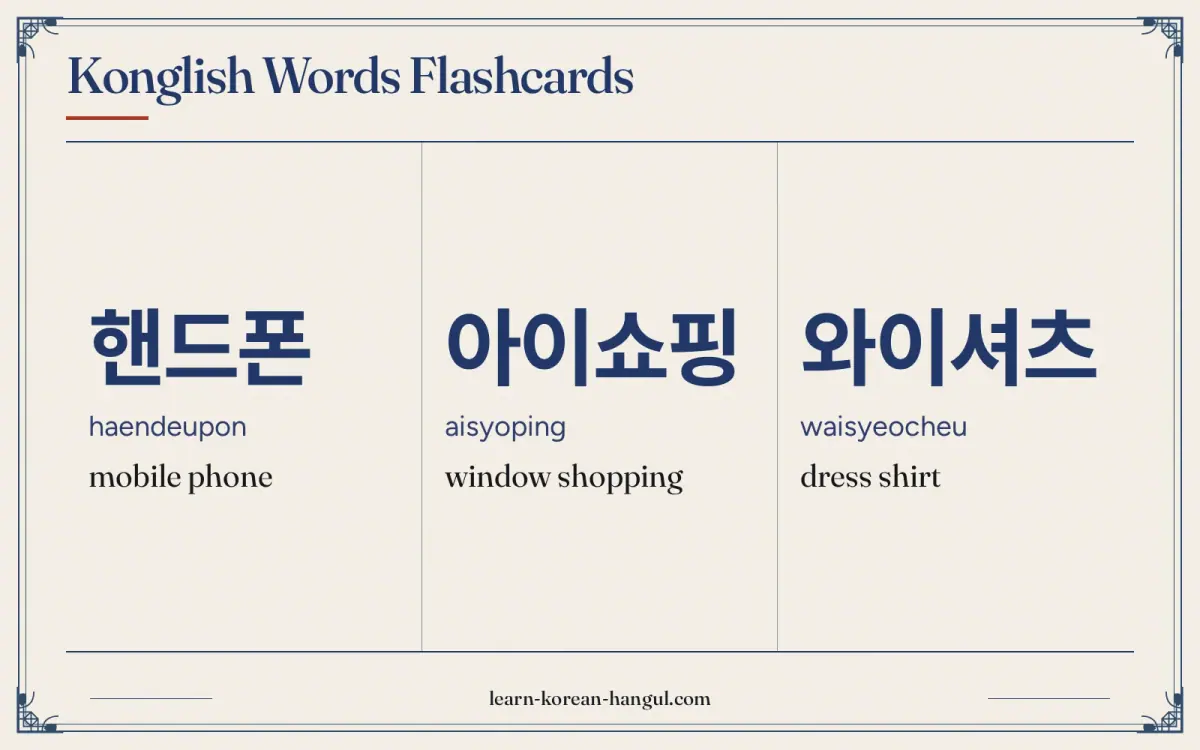
The cards start with words that English speakers would not guess (핸드폰, 아이쇼핑, 와이셔츠, 콘센트, 서비스, 파이팅), then clipped or respelled loans (리모컨, 믹서, 알바, 아르바이트), words made or named in Korea (오피스텔, 원샷, 맨투맨, 호치키스), and everyday objects, places and social words (15 to 28).
How Do I Use These Flashcards?
Use the deck above in four steps. It works with tap, click or keyboard, and nothing plays until you press an audio button.
- Choose a mode. Start with recognition (Hangul to meaning). Switch to recall (meaning to Hangul) or listening (audio to meaning) once recognition feels easy.
- Show the answer. Say the word aloud and guess the English word it came from before you reveal the meaning. Then press Show answer (or Space). Turn on the romanization toggle only if you need it; the table below always shows it.
- Grade yourself. Press Got it if you answered correctly without help, or Not yet if you hesitated or guessed.
- Finish the session. A session holds up to 20 cards (you can set 10, 20 or 40). With 28 cards, a first-time learner should expect about 3 days at the default limit of 10 new cards a day, with review sessions on top.
What Do the Three Modes Do?
Recognition shows the Hangul and asks for the meaning, so with the first card it shows 핸드폰 and you answer "mobile phone". Recall reverses this: it shows the meaning and asks for the Hangul, and you may type the answer with your Hangul keyboard or just say it in your head. Listening plays a clip and hides the letters, which trains the ear. Listening mode is a good test for this deck, because the clips sound like English words said with Korean sounds, and you must decide which word you heard. The pronunciation audio is generated with text-to-speech and a Korean teacher approves it before it is switched on. Listening mode only uses cards whose audio is approved, and cards without approved audio are skipped in that mode with a note.
What Do Got It and Not yet Do?
Got it moves a card up one Leitner box, so it comes back later. Not yet sends the card back to box 1, so it returns in the same session or within 10 minutes. The grades are your own judgement; the deck does not score you or claim fluency.
Deck Scope: What Is and Is Not Covered
The deck covers 28 loanwords that Korean has changed, in four groups: words whose English match is not obvious (핸드폰, 와이셔츠, 콘센트), clipped words (리모컨, 에어컨, 알바), blends made inside Korea (오피스텔, 맨투맨, 개그맨) and everyday items and places (아파트, 노트북, 헬스장). Words that are almost the same as English, such as 컴퓨터, are in the other vocabulary decks and are left out here, because they need no explaining.
What Is Left out of This Deck?
Plain technology and food loanwords are in the Korean vocabulary flashcards decks. Words built from Chinese roots are in the Sino-Korean words flashcards, and sound-imitating words are in the Korean onomatopoeia flashcards. The lesson on konglish explains how English words are respelled in Hangul.
All 28 Cards in One Table
All 28 cards appear below in deck order. The table is plain HTML, so you can use it as a drill without the deck: cover the Meaning column, say each item aloud, then uncover it.
| # | Hangul | Revised Romanization | Meaning | Note | Audio assetId |
|---|---|---|---|---|---|
| 1 | 핸드폰 | haendeupon | mobile phone | From hand + phone. English speakers say cell phone or mobile phone. 휴대폰 (hyudaepon) is the more formal word. | au-pg-flashcards-konglish-words-1 |
| 2 | 아이쇼핑 | aisyoping | window shopping | From eye + shopping. 아이쇼핑 해요 means to look at shop windows without buying. | au-pg-flashcards-konglish-words-2 |
| 3 | 와이셔츠 | waisyeocheu | dress shirt | Often explained as white shirt. 셔츠 alone means any shirt, so use 와이셔츠 for the collared shirt worn with a suit. | au-pg-flashcards-konglish-words-3; slow: au-pg-flashcards-konglish-words-29 |
| 4 | 콘센트 | konsenteu | power outlet | 콘센트가 어디 있어요? (Where is the power outlet?) The plug is 플러그. | au-pg-flashcards-konglish-words-4 |
| 5 | 서비스 | seobiseu | service; a free extra | 서비스로 드릴게요. (I will give it to you as a free extra.) In a restaurant it often means something extra and free. | au-pg-flashcards-konglish-words-5 |
| 6 | 파이팅 | paiting | a cheer: you can do it! | 시험 파이팅! (Good luck on the exam!) It is a cheer to encourage someone, not a call to fight. The spelling 화이팅 is also common. | au-pg-flashcards-konglish-words-6 |
| 7 | 리모컨 | rimokeon | remote control | Clipped from remote control. 리모컨 좀 주세요. (Please give me the remote.) | au-pg-flashcards-konglish-words-7 |
| 8 | 믹서 | mikseo | blender | From mixer. It is the kitchen blender used for smoothies and juice. | au-pg-flashcards-konglish-words-8 |
| 9 | 알바 | alba | part-time job | Short for 아르바이트. 알바를 해요. (I have a part-time job.) Very common in speech. | au-pg-flashcards-konglish-words-9 |
| 10 | 아르바이트 | areubaiteu | part-time job | A loan from German Arbeit. It is the full form of 알바 and sounds a little more formal. | au-pg-flashcards-konglish-words-10 |
| 11 | 오피스텔 | opiseutel | studio flat (office + hotel) | A Korean-made blend of office and hotel for a small flat that can be lived in. It is not a hotel. | au-pg-flashcards-konglish-words-11; slow: au-pg-flashcards-konglish-words-30 |
| 12 | 원샷 | wonsyat | bottoms up; finish the drink | 원샷! (Down it in one go!) Said when drinking. Said [원샏]. | au-pg-flashcards-konglish-words-12 |
| 13 | 맨투맨 | maentumaen | crewneck sweatshirt | Not related to the English phrase man to man. It names a plain pullover sweatshirt. | au-pg-flashcards-konglish-words-13 |
| 14 | 호치키스 | hochikiseu | stapler | Named after a brand. 호치키스로 찍어요. (I staple it.) | au-pg-flashcards-konglish-words-14 |
| 15 | 에어컨 | eeokeon | air conditioner | Clipped from air conditioner. 에어컨을 켜요. (I turn on the air conditioner.) | au-pg-flashcards-konglish-words-15 |
| 16 | 노트북 | noteubuk | laptop | From notebook, but it means a laptop computer, not a paper notebook (that is 공책). | au-pg-flashcards-konglish-words-16 |
| 17 | 아파트 | apateu | apartment block | In Korea it means a flat in a high-rise residential complex. 아파트에 살아요. (I live in an apartment.) | au-pg-flashcards-konglish-words-17 |
| 18 | 샤프 | syapeu | mechanical pencil | Named after a brand. The lead is 샤프심. | au-pg-flashcards-konglish-words-18 |
| 19 | 스탠드 | seutaendeu | desk lamp | 책상 위에 스탠드가 있어요. (There is a desk lamp on the desk.) | au-pg-flashcards-konglish-words-19 |
| 20 | 핸들 | haendeul | steering wheel | From handle. In English the word handle does not mean steering wheel. | au-pg-flashcards-konglish-words-20 |
| 21 | 더치페이 | deochipei | splitting the bill | From go Dutch. 더치페이 해요. (Let us split the bill.) | au-pg-flashcards-konglish-words-21; slow: au-pg-flashcards-konglish-words-31 |
| 22 | 셀카 | selka | selfie | From self + camera. 셀카를 찍어요. (I take a selfie.) | au-pg-flashcards-konglish-words-22 |
| 23 | 사이다 | saida | clear lemon-lime soda | It is a fizzy soft drink, not apple cider. | au-pg-flashcards-konglish-words-23 |
| 24 | 스킨십 | seukinsip | physical affection | From skin + ship. It means touching such as hugs and holding hands. | au-pg-flashcards-konglish-words-24 |
| 25 | 개그맨 | gaegeumaen | comedian | From gag + man. Women comedians are often called 개그우먼. | au-pg-flashcards-konglish-words-25 |
| 26 | 비닐봉지 | binilbongji | plastic bag | 비닐 (from vinyl) + 봉지 (bag). 비닐봉지 필요하세요? (Do you need a bag?) | au-pg-flashcards-konglish-words-26 |
| 27 | 헬스장 | helseujang | gym | 헬스 (from health) + 장 (place). 헬스장에 다녀요. (I go to the gym.) | au-pg-flashcards-konglish-words-27 |
| 28 | 믹스커피 | mikseukeopi | instant coffee mix | A stick packet of coffee, creamer and sugar mixed together. | au-pg-flashcards-konglish-words-28 |
How Do I Read the Table?
Hangul is the word. Revised Romanization (RR) is a learning aid, so try to read the Hangul first. The Meaning column gives the usual English equivalent, which is often not the English source word. The Note column gives the source word, a short example or a use hint, and where the spoken sound differs from the spelling, the sound is shown in brackets. The last column lists the audio assetId, and a second ID marks a slow clip (0.8x).
Usage Notes for These Cards
Some Konglish words have no English match. 핸드폰, 아이쇼핑 and 와이셔츠 would confuse an English speaker, who says cell phone, window shopping and dress shirt. Learn the Korean word as its own item and do not assume the English source word will be understood.
서비스 can mean a free extra. In a restaurant, 서비스로 드릴게요 means I will give it to you as a free extra, such as a side dish or a drink. It does not mean the staff will provide a service.
파이팅 is a cheer. It encourages someone, as in 시험 파이팅! (Good luck on the exam!), and it is not a call to fight. You may see 화이팅 as well, but 파이팅 is the form used in the standard dictionary.
Many loans are clipped. 리모컨 comes from remote control, 에어컨 from air conditioner and 알바 from 아르바이트, which itself comes from German. Korean speakers shorten long loans to the first two syllables or so, which is why the short form is the one you hear.
Some words are made inside Korea. 오피스텔 joins office and hotel for a small flat that can be both a home and an office. 맨투맨 is a Korean name for a sweatshirt, and 호치키스 comes from a brand name. They are normal Korean words, not mistakes.
Which Sounds Do Not Match the Spelling?
Loanwords are respelled with Korean sounds, so some letters stand for sounds that English does not have.
파이팅 is said [파이팅], with an aspirated ㅍ. The first sound is a strong puff of air and not an English f. Korean has no f, so English f is written with ㅍ. RR writes paiting.
서비스 is said [서비스], with a soft b. The ㅂ between two vowels is lightly voiced, so it sounds like b rather than p. RR writes seobiseu.
원샷 is said [원샏]. The final ㅅ of 샷 is read as ㄷ at the end of a word, and RR writes wonsyat.
What Mistakes Do Learners Make with Konglish and Loanwords?
- Using 핸드폰 with English speakers. Say cell phone or mobile phone when you speak English.
- Using 서비스 only for service. In a shop or restaurant it also means a free gift or extra.
- Using 오피스텔 for a hotel. It is a type of studio apartment.
- Treating 알바 as rude. It is casual rather than rude, but use 아르바이트 in formal writing such as a resume.
The most useful habit is to check each loan against the card before you use it with an English speaker, because the same sounds can mean something else.
How Does the Review Schedule Work?
The deck uses a simplified Leitner system with five boxes. A new card starts in box 1. Each Got it moves it up one box, and each Not yet returns it to box 1. The box sets how long the card waits before it is due again.
| Box | Wait until the next review |
|---|---|
| 1 | same session or 10 minutes |
| 2 | 1 day |
| 3 | 3 days |
| 4 | 7 days |
| 5 | 21 days |
Each session shows due cards first, oldest due first, then up to 10 new cards a day by default. A deck of 28 cards is introduced over 3 days at 10 new cards a day, and the later boxes bring every word back at longer gaps. Progress is saved only in this browser, so clearing site data deletes it. Use the export button to save a small file with card IDs, boxes and due dates, and import it on another device. No account is needed.
Cultural and Practical Context
These words are normal Korean vocabulary, not mistakes. They are in everyday use, so they should be learned as Korean words and used without apology. Some Korean teachers prefer a native or Sino-Korean alternative in formal writing, for example 휴대 전화 for 핸드폰, but in speech the loan is natural. Knowing which words are Konglish also helps your English, because you can avoid using them when you speak English with international friends.
Limits of This Deck
The deck holds 28 words and one note for each, so it shows the main meaning and a source, not the full history. Origin remarks, such as the German source of 아르바이트 or the brand source of 호치키스, are given in simple form. The deck does not teach the full rules for writing English words in Hangul. All Korean text is generated and was reviewed and signed off by Min-ji Park on 15 October 2026, and each audio clip is checked by a Korean teacher before publication.
Next Steps after This Deck
After these konglish words flashcards, move on to the Korean onomatopoeia flashcards to keep the same routine, or compare words that came from Chinese characters with the Sino-Korean words flashcards. Read the konglish lesson for the background. The Korean vocabulary flashcards page lists every vocabulary deck, and the Korean flashcards hub lists all topics.
Frequently Asked Questions
Is 핸드폰 Correct Korean?
Yes. 핸드폰 is a normal everyday word for a mobile phone, and everyone understands it. The word 휴대폰 is also correct and is the more formal one, so you will see it in writing and in shops. English speakers will not understand 핸드폰 as a phone, so say cell phone or mobile phone to them.
Why Is 아르바이트 Shortened to 알바?
Korean speakers often clip long loanwords to make them quick to say. 아르바이트 is a long word of five syllables, and 알바 squeezes its first three syllables, 아르바, into two. In speech 알바 is far more common than the full form. The full form still appears in writing and in formal settings.
Which Words Are Really English?
Words such as 아이스크림 and 컴퓨터 are close to English, and an English speaker can often guess them. The words on this deck are different, because their meaning or form has changed in Korea, as with 핸드폰, 와이셔츠 and 콘센트. That is why the deck is useful for learning.
Is 파이팅 Spelled 화이팅?
Both spellings appear online and on signs, and many people also say 화이팅 aloud, with an h sound. The standard form is 파이팅, and this deck uses it. Either way it is a cheer, such as 시험 파이팅 for someone about to take an exam.
Is My Progress Saved If I Close the Page?
Yes, in the same browser on the same device. Card boxes and due dates are stored locally and nothing is sent to a server. Clearing site data, using a private window or switching browsers removes them, so use the export button to keep a backup file. No account is needed.