Sino Korean Words Flashcards: Study the 29 Cards
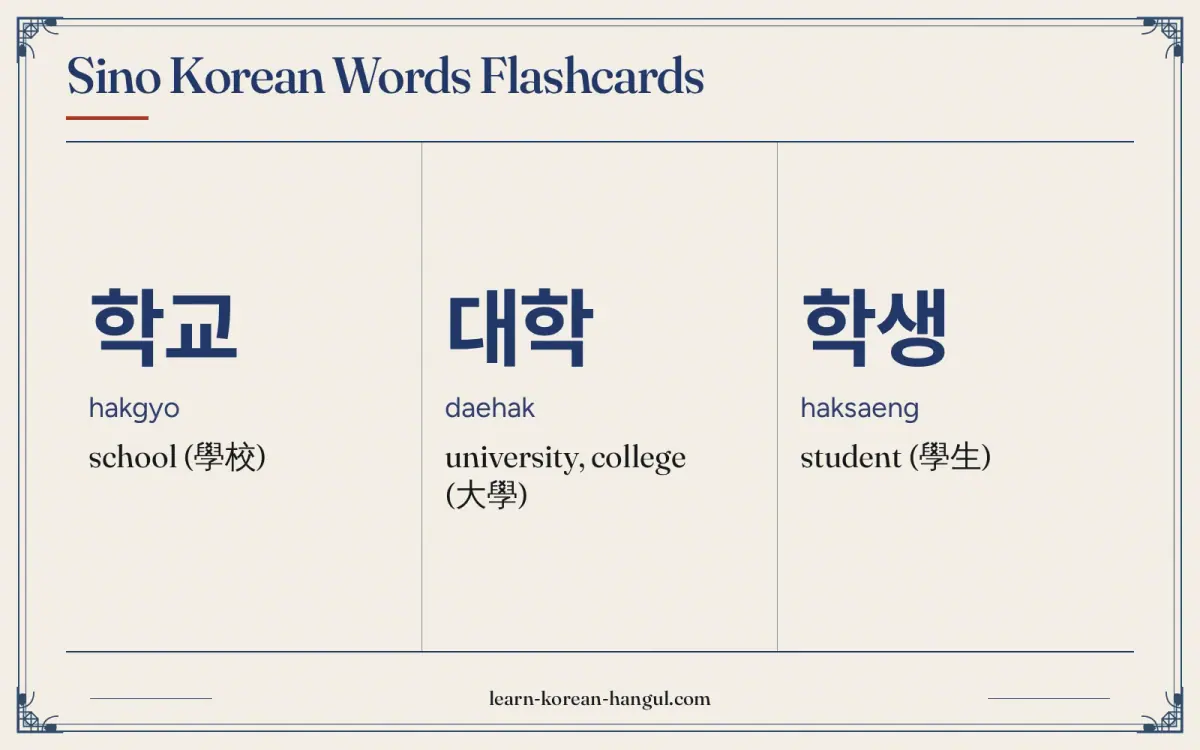
Say each word aloud before you press Show answer. Every card has a short note that explains the characters behind the word or why it sounds different from its spelling.
How Do I Use These Flashcards?
Use the deck above in four steps. It works with tap, click or keyboard, and nothing plays until you press an audio button.
- Choose a mode. Start with recognition (Hangul to meaning). Switch to recall (meaning to Hangul) or listening (audio to meaning) once recognition feels easy.
- Show the answer. Think of the answer first, then press Show answer (or Space). Turn on the romanization toggle only if you need it; the 29-card table below always shows it.
- Grade yourself. Press Got it if you answered correctly without help, or Not yet if you hesitated or guessed.
- Finish the session. A session holds up to 20 cards (you can set 10, 20 or 40). With 29 cards, a first-time learner can split the deck over 3 days, using the default limit of 10 new cards a day.
What Do the Three Modes Do?
Recognition shows the Hangul and asks for the meaning, which trains reading. Recall shows the meaning and asks for the Hangul, which trains remembering; you may type the answer with your Hangul keyboard or just recall it in your head. Listening plays a clip and hides the letters, which trains the ear. Listening mode only uses a card once its audio is approved, and cards without approved audio are skipped in that mode with a note.
What Do Got It and Not yet Do?
Got it moves the card up one Leitner box, so it comes back later. Not yet sends the card back to box 1, so it returns in the same session or within 10 minutes. The grades are your own judgement; the deck does not score you or claim fluency.
Deck Scope: What Is and Is Not Covered
The deck covers common words built from Sino-Korean syllables, with the hanja shown in the gloss so you can see the building blocks. Numbers and counters that use Sino-Korean readings are in the sino korean numbers flashcards. English loanwords are in the konglish words flashcards. The topic lesson is sino korean vocabulary.
What Is Left out of This Deck?
The deck does not teach the characters themselves, stroke order or the full hanja lists. It also leaves out rare formal words and the many Sino-Korean words that appear only in law, medicine or science. The hanja in the notes are there to explain the words, and you do not need to memorise them.
All 29 Cards in One Table
All 29 cards appear below in deck order. The table is plain HTML, so you can use it as a drill without the deck: cover the Meaning column, read each word aloud, then uncover the meaning.
| # | Hangul | Revised Romanization | Meaning | Note | Audio assetId |
|---|---|---|---|---|---|
| 1 | 학교 | hakgyo | school (學校) | 學 "learn" and 校 "school". Said [학꾜]: ㄱ after a ㄱ final is tense. | au-pg-flashcards-sino-korean-words-1; slow: au-pg-flashcards-sino-korean-words-2 |
| 2 | 대학 | daehak | university, college (大學) | 大 "big" and 學 "learn". The full word is 대학교, said [대학꾜]. | au-pg-flashcards-sino-korean-words-3 |
| 3 | 학생 | haksaeng | student (學生) | 學 "learn" and 生 "person, life". Said [학쌩]. | au-pg-flashcards-sino-korean-words-4 |
| 4 | 선생 | seonsaeng | teacher (先生) | 先 "before" and 生 "born". Usually 선생님 with the polite 님. | au-pg-flashcards-sino-korean-words-5 |
| 5 | 학년 | hangnyeon | school year, grade (學年) | Said [항년]: the ㄱ turns to ㅇ before ㄴ. With a Sino-Korean number: 삼 학년 (third year). | au-pg-flashcards-sino-korean-words-6 |
| 6 | 가족 | gajok | family (家族) | 家 "home" and 族 "kin". | au-pg-flashcards-sino-korean-words-7 |
| 7 | 전화 | jeonhwa | phone call (電話) | 電 "electricity" and 話 "talk". Use 하다 for "to call": 전화하다. | au-pg-flashcards-sino-korean-words-8 |
| 8 | 시간 | sigan | time, hour (時間) | 時 "time" and 間 "between". A duration uses a native number: 한 시간. | au-pg-flashcards-sino-korean-words-9 |
| 9 | 회사 | hoesa | company (會社) | 會 "meeting" and 社 "group". | au-pg-flashcards-sino-korean-words-10 |
| 10 | 은행 | eunhaeng | bank (銀行) | 銀 "silver" and 行 "business house". | au-pg-flashcards-sino-korean-words-11 |
| 11 | 병원 | byeongwon | hospital (病院) | 病 "illness" and 院 "institution". | au-pg-flashcards-sino-korean-words-12 |
| 12 | 도서관 | doseogwan | library (圖書館) | 圖 "picture", 書 "book" and 館 "hall". | au-pg-flashcards-sino-korean-words-13 |
| 13 | 약속 | yaksok | promise, appointment (約束) | 約 "promise" and 束 "bind". Said [약쏙]: ㅅ after a ㄱ final is tense. | au-pg-flashcards-sino-korean-words-14; slow: au-pg-flashcards-sino-korean-words-15 |
| 14 | 시험 | siheom | exam, test (試驗) | 試 "try" and 驗 "test". 시험을 보다 means "to take an exam". | au-pg-flashcards-sino-korean-words-16 |
| 15 | 숙제 | sukje | homework (宿題) | 宿 "stay over" and 題 "topic". Said [숙쩨]: the ㅈ is tense after a ㄱ final. | au-pg-flashcards-sino-korean-words-17; slow: au-pg-flashcards-sino-korean-words-18 |
| 16 | 공부 | gongbu | study (工夫) | Add 하다 for the verb: 공부하다. | au-pg-flashcards-sino-korean-words-19 |
| 17 | 운동 | undong | exercise, sport (運動) | 運 "move" and 動 "motion". 운동하다 means "to exercise". | au-pg-flashcards-sino-korean-words-20 |
| 18 | 음식 | eumsik | food (飲食) | 飲 "drink" and 食 "eat". | au-pg-flashcards-sino-korean-words-21 |
| 19 | 영화 | yeonghwa | movie (映畫) | 映 "reflect" and 畫 "picture". 영화를 보다 means "to watch a movie". | au-pg-flashcards-sino-korean-words-22 |
| 20 | 사진 | sajin | photo (寫眞) | 寫 "copy" and 眞 "true". 사진을 찍다 means "to take a photo". | au-pg-flashcards-sino-korean-words-23 |
| 21 | 사회 | sahoe | society (社會) | 社 "group" and 會 "meeting". The 사 here is not the 사 of 의사. | au-pg-flashcards-sino-korean-words-24 |
| 22 | 의사 | uisa | doctor (醫師) | 醫 "medicine" and 師 "master". Same 사 sound as 사회, but a different character. | au-pg-flashcards-sino-korean-words-25 |
| 23 | 준비 | junbi | preparation (準備) | 準 "aim" and 備 "prepare". 준비하다 means "to prepare". | au-pg-flashcards-sino-korean-words-26 |
| 24 | 사용 | sayong | use (使用) | 使 "use" and 用 "use". 사용하다 means "to use". | au-pg-flashcards-sino-korean-words-27 |
| 25 | 질문 | jilmun | question (質問) | 質 "inquire" and 問 "ask". 질문하다 means "to ask a question". | au-pg-flashcards-sino-korean-words-28 |
| 26 | 방문 | bangmun | visit (訪問) | 訪 "visit" and 問 "ask". 방문하다 sounds more formal than 찾아가다. | au-pg-flashcards-sino-korean-words-29 |
| 27 | 문법 | munbeop | grammar (文法) | 文 "writing" and 法 "rule". Said [문뻡]: the second ㅂ is tense. | au-pg-flashcards-sino-korean-words-30 |
| 28 | 발음 | bareum | pronunciation (發音) | 發 "send out" and 音 "sound". Said [바름]: the ㄹ final links to the next vowel. | au-pg-flashcards-sino-korean-words-31 |
| 29 | 약국 | yakguk | pharmacy (藥局) | 藥 "medicine" and 局 "office". Said [약꾹]: the ㄱ after a ㄱ final is tense. | au-pg-flashcards-sino-korean-words-32 |
How Do I Read the Table?
Hangul is the word. Revised Romanization (RR) is a learning aid, so try to read the Hangul before you look at it. RR follows the spelling rules of the official system, not every sound change, so it can differ from what you hear. The Meaning column gives the English gloss with the hanja in brackets, and the Note column explains the characters or a sound hint. The last column lists the audio assetId; a second ID marked slow is a slower clip for 3 cards whose sound differs from their spelling (학교, 약속 and 숙제).
Usage Notes for These Cards
One syllable, many words. Sino-Korean syllables recur. 學 (study) is in 학교, 대학, 학생 and 학년, so recognising it gives you four words at once. The same works for 問 in 질문 and 방문, and for 會 in 회사 and 사회.
Nouns turn into verbs with 하다. Many Sino-Korean nouns become verbs when you add 하다: 운동하다 (to exercise), 준비하다 (to prepare), 사용하다 (to use), 질문하다 (to ask a question) and 방문하다 (to visit). Some native nouns work this way too (일하다, to work), but the pattern is especially common with Sino-Korean nouns. Learn the noun and you get the verb.
They often sound more formal. Sino-Korean words tend to sound more formal or written than their native equivalents. 방문하다 (to visit) is more formal than 찾아가다 (to go and see someone), and 사용하다 is a little more formal than 쓰다. Both are correct. Choose by the situation.
Check the number each counter takes. Some Sino-Korean counters take Sino-Korean numbers: 삼 학년 (third year) and 이 층 (second floor). Others take native numbers even though they are Sino-Korean: 한 시간 (one hour) and 세 명 (three people). Learn each counter with its number.
One sound can stand for several characters. The 사 in 사회 (社) is not the 사 in 의사 (師). This is why Korean has so many homophones, which are words that sound the same but have different meanings. Context, and sometimes the hanja, tells them apart.
Which Sounds Do Not Match the Spelling?
학교 is said [학꾜]. The ㄱ after a ㄱ final is tense. Revised Romanization follows the plain spelling and writes hakgyo.
약속 is said [약쏙]: the ㅅ after a ㄱ final is tense. The same happens in 약국 [약꾹] and 숙제 [숙쩨].
문법 is said [문뻡]. In many Sino-Korean words, a ㅂ, ㄷ, ㅅ or ㅈ after certain sounds becomes tense even when the spelling does not show it. This is covered in tensification in Sino-Korean words.
학년 is said [항년]: the ㄱ turns into ㅇ before ㄴ. Revised Romanization follows the sound here, so the card shows hangnyeon.
발음 is said [바름]: the final ㄹ moves to the next syllable because ㅇ is silent. The card shows bareum.
These forms follow the standard pronunciation rules (표준 발음법) of the 국립국어원 (National Institute of Korean Language).
What Mistakes Do Learners Make with Sino-Korean Words?
- Assuming a same-sounding syllable always has the same meaning. 사 can be 社 (group), 師 (master), 使 (use) or 寫 (copy), among others. Use the whole word.
- Picking the wrong number for a counter. Say 삼 학년, not 세 학년, but say 한 시간 and 세 명 with native numbers.
- Using a Sino-Korean word in a casual chat where a native word sounds more natural. 방문하다 fits a formal visit, while 놀러 가다 fits a friend's house.
- Copying the hanja from another language. A character may have a different shape or meaning in Japanese or Chinese. Check a Korean dictionary.
How Does the Review Schedule Work?
The deck uses a simplified Leitner system with five boxes. A new card starts in box 1. Each Got it moves it up one box, and each Not yet returns it to box 1. The box sets how long the card waits before it is due again.
| Box | Wait until the next review |
|---|---|
| 1 | same session or 10 minutes |
| 2 | 1 day |
| 3 | 3 days |
| 4 | 7 days |
| 5 | 21 days |
Each session shows due cards first, oldest due first, and then up to 10 new cards a day by default. Progress is saved only in this browser, so clearing site data deletes it. Use the export button to save a small JSON file with card IDs, boxes and due dates, and import it on another device. No account is needed.
Cultural and Practical Context
Korean borrowed a large body of vocabulary from Chinese over many centuries, and these words fill formal, academic and technical language. Korean pronounces them in its own way, and many new words were also made in Korea and Japan from the same characters. Schools still teach some hanja in a 한문 subject, but everyday writing uses Hangul alone. For the story of how Hangul and hanja relate, see Hangul vs hanja.
You can use Sino-Korean knowledge as a shortcut. If you know that 學 means "study", then a new word with 학 in it, such as 학원 (a private academy), is easier to guess. This is the main reason this deck shows the characters.
Next Steps after This Deck
The words on these cards are explained in the sino korean vocabulary lesson, so read it first if a card is new. This deck is one of the korean vocabulary flashcards on the site, so browse the full list if you want a different topic. When these cards feel easy, compare them with words borrowed from English in the konglish words flashcards. All flashcard decks, including Hangul, vocabulary, phrases, grammar and TOPIK, are listed on the korean flashcards hub.
About this page. Last updated 2026-10-09. The Korean text and spoken forms on this page were machine-generated and reviewed and signed off by Min-ji Park on 15 October 2026. Romanization follows the Revised Romanization of Korean and is shown only as a learning aid.
Frequently Asked Questions
How Do I Find the Hanja of a Word?
A dictionary lists the hanja for Sino-Korean words. The National Institute of Korean Language dictionaries show the hanja next to the headword, for example 學校 after 학교. You do not need to learn hanja to read Korean, but seeing the characters helps you spot patterns, such as 學 in four of these cards.
Do All Korean Words Have Hanja?
No. Only Sino-Korean words have hanja behind them. Native Korean words such as 사람 (person), 하늘 (sky) and 먹다 (eat) do not, and loanwords such as 컴퓨터 have none either. A large part of the dictionary is Sino-Korean, so many words you meet will have hanja, but not all.
Why Are Some Words so Similar to Chinese and Japanese?
Korean, Japanese and Chinese share many word roots written with the same characters, but each language gives them its own sound. 學校 is hakgyo in Korean, gakkō in Japanese and xuéxiào in Mandarin. The meanings are often close, but a few words differ, so check a dictionary before you assume.
Is 시간 Time or Hour?
시간 means time in general and also an hour as a length of time. 시간이 없어요 means "I have no time", and 한 시간 means "one hour". Note that the hour count uses the native number 한, although 시간 itself is Sino-Korean. The clock time uses 시, as in 세 시, "three o'clock".
Is My Progress Saved If I Close the Page?
Yes, in the same browser on the same device. Card boxes and due dates are stored locally and nothing is sent to a server. Clearing site data, using a private window or switching browsers removes them, so use the export button to keep a backup file. No account is needed.