Korean Onomatopoeia Flashcards: Study the 28 Cards
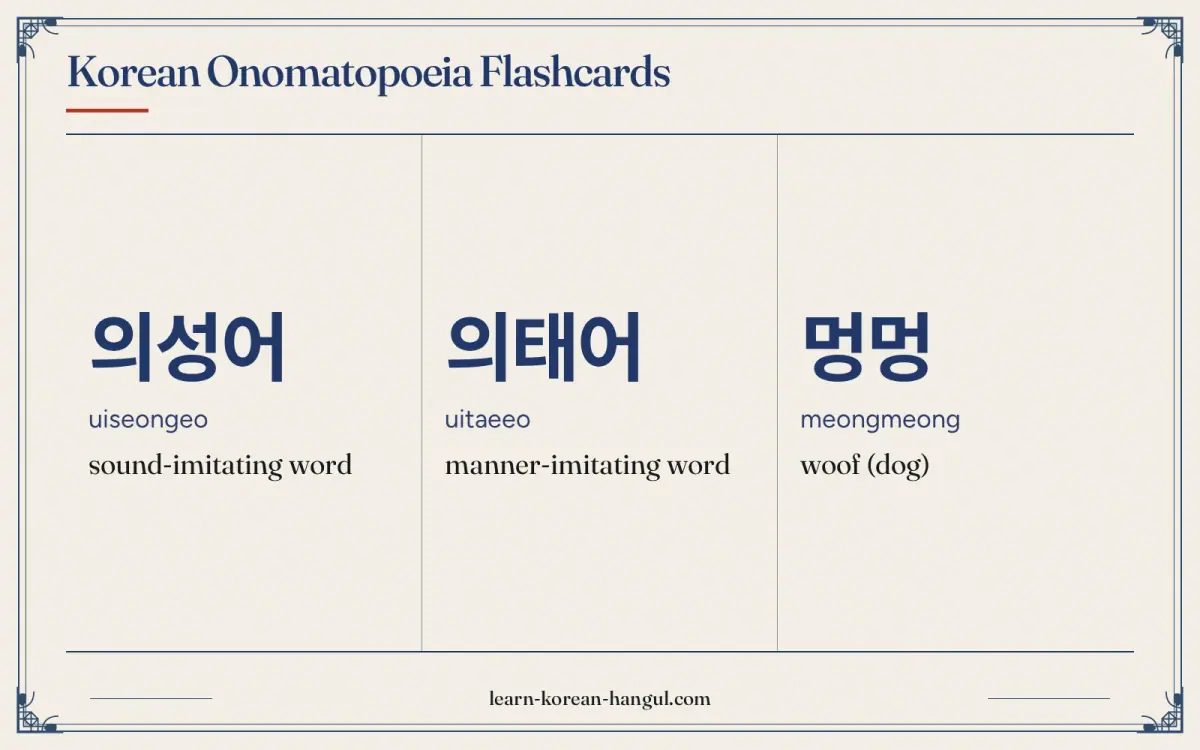
The cards start with the two names (cards 1 and 2), then animal and door sounds (3 to 9), sleep, weather and water (10 to 14), looks and feelings (15 to 18), movement (19 to 23), and finish with touch and texture words and two quick-action words (24 to 28).
How Do I Use These Flashcards?
Use the deck above in four steps. It works with tap, click or keyboard, and nothing plays until you press an audio button.
- Choose a mode. Start with recognition (Hangul to meaning). Switch to recall (meaning to Hangul) or listening (audio to meaning) once recognition feels easy.
- Show the answer. Say the word aloud with the sound or the movement it describes, then think of the verb it usually goes with. Then press Show answer (or Space). Turn on the romanization toggle only if you need it; the table below always shows it.
- Grade yourself. Press Got it if you answered correctly without help, or Not yet if you hesitated or guessed.
- Finish the session. A session holds up to 20 cards (you can set 10, 20 or 40). With 28 cards, a first-time learner should expect about 3 days at the default limit of 10 new cards a day, with review sessions on top.
What Do the Three Modes Do?
Recognition shows the Hangul and asks for the meaning, so with the first card it shows 의성어 and you answer "sound-imitating word". Recall reverses this: it shows the meaning and asks for the Hangul, and you may type the answer with your Hangul keyboard or just say it in your head. Listening plays a clip and hides the letters, which trains the ear. Listening mode is fun for this deck, because the clips sound like the thing they name, and you can match the sound to the picture in your head. The pronunciation audio is generated with text-to-speech and a Korean teacher approves it before it is switched on. Listening mode only uses cards whose audio is approved, and cards without approved audio are skipped in that mode with a note.
What Do Got It and Not yet Do?
Got it moves a card up one Leitner box, so it comes back later. Not yet sends the card back to box 1, so it returns in the same session or within 10 minutes. The grades are your own judgement; the deck does not score you or claim fluency.
Deck Scope: What Is and Is Not Covered
The deck covers 28 imitative words. Two cards give the names of the kinds (의성어 and 의태어), seven cover animal and door sounds, and the rest cover weather and water, looks and feelings, movement, texture and speed. Most come as a doubled word, such as 반짝반짝, because doubling gives a repeated or continuing feel. The deck does not try to list the thousands of imitative words in Korean, and it leaves out words that are mainly written, such as those found in poems.
What Is Left out of This Deck?
Fixed sayings that use these words are in the Korean idioms flashcards, and proverbs in the Korean proverbs flashcards. Loanwords are in the Konglish words flashcards, and the usage notes below show how these words work as adverbs. The wider background is in the korean onomatopoeia lesson.
All 28 Cards in One Table
All 28 cards appear below in deck order. The table is plain HTML, so you can use it as a drill without the deck: cover the Meaning column, say each item aloud, then uncover it.
| # | Hangul | Revised Romanization | Meaning | Note | Audio assetId |
|---|---|---|---|---|---|
| 1 | 의성어 | uiseongeo | sound-imitating word | A word that copies a sound, such as 멍멍 or 똑똑. | au-pg-flashcards-onomatopoeia-words-1 |
| 2 | 의태어 | uitaeeo | manner-imitating word | A word that describes manner or appearance, such as 반짝반짝 or 느릿느릿. | au-pg-flashcards-onomatopoeia-words-2 |
| 3 | 멍멍 | meongmeong | woof (dog) | 개가 멍멍 짖어요. (The dog barks woof.) | au-pg-flashcards-onomatopoeia-words-3 |
| 4 | 야옹 | yaong | meow (cat) | 고양이가 야옹 해요. (The cat says meow.) | au-pg-flashcards-onomatopoeia-words-4 |
| 5 | 꼬끼오 | kkokkio | cock-a-doodle-doo (rooster) | The rooster call; the English equivalent is also a made-up word. | au-pg-flashcards-onomatopoeia-words-5 |
| 6 | 꿀꿀 | kkulkkul | oink (pig) | 돼지가 꿀꿀 해요. (The pig says oink.) | au-pg-flashcards-onomatopoeia-words-6 |
| 7 | 짹짹 | jjaekjjaek | tweet (small bird) | 새가 짹짹 울어요. (The bird tweets.) | au-pg-flashcards-onomatopoeia-words-7 |
| 8 | 개굴개굴 | gaegulgaegul | ribbit (frog) | 개구리가 개굴개굴 울어요. (The frog croaks.) | au-pg-flashcards-onomatopoeia-words-8 |
| 9 | 똑똑 | ttokttok | knock knock | 똑똑 문을 두드려요. (I knock on the door.) | au-pg-flashcards-onomatopoeia-words-9 |
| 10 | 쿨쿨 | kulkul | sound asleep | 아기가 쿨쿨 자요. (The baby is sound asleep.) | au-pg-flashcards-onomatopoeia-words-10 |
| 11 | 주룩주룩 | jurukjuruk | pouring (rain) | 비가 주룩주룩 와요. (The rain pours down.) Said [주룩쭈룩]. | au-pg-flashcards-onomatopoeia-words-11; slow: au-pg-flashcards-onomatopoeia-words-29 |
| 12 | 펑펑 | peongpeong | heavily (snow); bang | 눈이 펑펑 와요. (Snow falls heavily.) The sound of a pop or small blast is 펑. | au-pg-flashcards-onomatopoeia-words-12 |
| 13 | 졸졸 | joljol | trickling (thin stream) | 물이 졸졸 흘러요. (Water trickles.) A thin, light flow. | au-pg-flashcards-onomatopoeia-words-13 |
| 14 | 줄줄 | juljul | flowing freely (heavier flow) | 땀이 줄줄 흘러요. (Sweat runs down.) A heavier flow than 졸졸. | au-pg-flashcards-onomatopoeia-words-14 |
| 15 | 반짝반짝 | banjjakbanjjak | twinkling; sparkling | 별이 반짝반짝 빛나요. (The stars twinkle.) Said [반짝빤짝]. | au-pg-flashcards-onomatopoeia-words-15; slow: au-pg-flashcards-onomatopoeia-words-30 |
| 16 | 느릿느릿 | neurinneurit | slowly; sluggishly | 거북이가 느릿느릿 걸어요. (The turtle walks slowly.) Said [느린느릳]. | au-pg-flashcards-onomatopoeia-words-16; slow: au-pg-flashcards-onomatopoeia-words-31 |
| 17 | 두근두근 | dugeundugeun | thump-thump (heart beating) | 가슴이 두근두근해요. (My heart is pounding.) 두근거리다 is the matching verb. | au-pg-flashcards-onomatopoeia-words-17 |
| 18 | 싱글벙글 | singgeulbeonggeul | beaming with smiles | 아이가 싱글벙글 웃어요. (The child smiles broadly.) | au-pg-flashcards-onomatopoeia-words-18 |
| 19 | 깡충깡충 | kkangchungkkangchung | hopping | 토끼가 깡충깡충 뛰어요. (The rabbit hops.) | au-pg-flashcards-onomatopoeia-words-19 |
| 20 | 아장아장 | ajangajang | toddling | 아기가 아장아장 걸어요. (The baby toddles.) | au-pg-flashcards-onomatopoeia-words-20 |
| 21 | 살금살금 | salgeumsalgeum | tiptoeing; stealthily | 고양이가 살금살금 다가와요. (The cat creeps up.) | au-pg-flashcards-onomatopoeia-words-21 |
| 22 | 엉금엉금 | eonggeumeonggeum | crawling slowly | 거북이가 엉금엉금 기어가요. (The turtle crawls along.) | au-pg-flashcards-onomatopoeia-words-22 |
| 23 | 터벅터벅 | teobeokteobeok | trudging (heavy steps) | 터벅터벅 걸어가요. (He trudges along.) | au-pg-flashcards-onomatopoeia-words-23 |
| 24 | 말랑말랑 | mallangmallang | soft and squishy | 떡이 말랑말랑해요. (The rice cake is soft.) | au-pg-flashcards-onomatopoeia-words-24 |
| 25 | 쫄깃쫄깃 | jjolgitjjolgit | chewy | 면이 쫄깃쫄깃해요. (The noodles are chewy.) Said [쫄긷쫄긷]. | au-pg-flashcards-onomatopoeia-words-25 |
| 26 | 울퉁불퉁 | ultungbultung | bumpy; uneven | 길이 울퉁불퉁해요. (The road is bumpy.) | au-pg-flashcards-onomatopoeia-words-26 |
| 27 | 퐁당 | pongdang | plop (a small thing falling in water) | 돌이 퐁당 빠졌어요. (The stone plopped in.) | au-pg-flashcards-onomatopoeia-words-27 |
| 28 | 후다닥 | hudadak | in a flash; hurriedly | 후다닥 뛰어갔어요. (He ran off in a flash.) | au-pg-flashcards-onomatopoeia-words-28 |
How Do I Read the Table?
Hangul is the word. Revised Romanization (RR) is a learning aid, so try to read the Hangul first. The Meaning column gives a short English equivalent, which is often a sound word or an adverb. The Note column gives a short example sentence or a use hint, and where the spoken sound differs from the spelling, the sound is shown in brackets. The last column lists the audio assetId, and a second ID marks a slow clip (0.8x).
Usage Notes for These Cards
There are two kinds. 의성어 imitate sounds, like 멍멍 and 똑똑. 의태어 describe manner or appearance, like 반짝반짝 and 느릿느릿. Both kinds work the same way in a sentence, so you do not need to sort them to use them.
They act as adverbs. They sit before the verb and add detail: 비가 주룩주룩 와요 (the rain pours down) and 눈이 펑펑 와요 (snow falls heavily). In English you would pick a different verb, but in Korean you usually keep the same verb and change the imitative word.
Many become verbs. Add 하다, 거리다 or 이다 to make a verb or adjective: 반짝이다 and 반짝거리다 (to twinkle), 두근거리다 (to pound), 말랑말랑하다 (to be soft). The bare doubled word is an adverb and is not a verb by itself.
Vowels and consonants change the feel. 졸졸 is a thin trickle and 줄줄 is a heavier flow. In general, a bright vowel such as ㅗ or ㅏ feels light and small, while a dark vowel such as ㅜ or ㅓ feels heavy and big.
Animal sounds differ from English. A dog says 멍멍, a cat says 야옹, a pig says 꿀꿀 and a rooster says 꼬끼오. Learn these as Korean words, because you will not guess them from English.
Which Sounds Do Not Match the Spelling?
Doubled words often change a sound at the join, so the spoken form differs from the spelling.
느릿느릿 is said [느린느릳]. The final ㅅ of 릿 is read as ㄷ, and ㄷ turns into ㄴ before the ㄴ of 느. This is neutralization and then nasalization. RR writes the sound, neurinneurit.
반짝반짝 is said [반짝빤짝]. The second ㅂ becomes a tense sound after the final ㄱ of 짝. This is tensification, and RR does not show it, so it writes banjjakbanjjak.
주룩주룩 is said [주룩쭈룩]. The ㅈ after the final ㄱ becomes a tense sound, so the second half sounds like 쭈룩. RR writes jurukjuruk.
What Mistakes Do Learners Make with Onomatopoeia and Mimetic Words?
- Using them only for children. Adults use them in everyday speech, in comics and in food and weather talk too.
- Using the bare doubled word as a verb. 반짝반짝 is an adverb. To make a verb, say 반짝이다 or 반짝거리다.
- Treating 졸졸 and 줄줄 as the same word. They differ in size and flow, so choose the vowel that fits the amount.
- Copying English animal sounds. A dog does not say woof in Korean; it says 멍멍.
The doubled shapes are easy to mix up, so give cards 13 and 14 extra passes in recall mode.
How Does the Review Schedule Work?
The deck uses a simplified Leitner system with five boxes. A new card starts in box 1. Each Got it moves it up one box, and each Not yet returns it to box 1. The box sets how long the card waits before it is due again.
| Box | Wait until the next review |
|---|---|
| 1 | same session or 10 minutes |
| 2 | 1 day |
| 3 | 3 days |
| 4 | 7 days |
| 5 | 21 days |
Each session shows due cards first, oldest due first, then up to 10 new cards a day by default. A deck of 28 cards is introduced over 3 days at 10 new cards a day, and the later boxes bring every word back at longer gaps. Progress is saved only in this browser, so clearing site data deletes it. Use the export button to save a small file with card IDs, boxes and due dates, and import it on another device. No account is needed.
Cultural and Practical Context
Onomatopoeia and mimetic words fill Korean children's books, comics and everyday description. They let speakers add vivid detail with a single word, so a short sentence can feel rich. You will hear them in food talk (쫄깃쫄깃, chewy), in weather talk (주룩주룩) and in describing feelings (두근두근). Adults use them often, so learning them early makes both speech and reading feel more natural.
Limits of This Deck
The deck holds 28 words and one example for each, so it shows the main sense and not every shade of meaning. The size and intensity contrasts, such as 졸졸 and 줄줄, are general tendencies and not strict rules. Some words listed as sounds are also used as manner words in other settings. All Korean text is generated and was reviewed and signed off by Min-ji Park on 15 October 2026, and each audio clip is checked by a Korean teacher before publication.
Next Steps after This Deck
After these korean onomatopoeia flashcards, try the Konglish words flashcards for another group of words that English speakers find surprising. Read the korean onomatopoeia lesson for the background. The Korean vocabulary flashcards page lists every vocabulary deck, and the Korean flashcards hub lists all topics.
Frequently Asked Questions
Why Are Korean Imitative Words Doubled?
Doubling gives a repeated or continuing feel. 반짝 is one flash, while 반짝반짝 is twinkling again and again. Not every word is doubled, though: 퐁당 (plop) and 후다닥 (in a flash) are single events, so the shape of the word often mirrors the action.
Are Onomatopoeia Always Informal?
No. Many are everyday and neutral, and you hear them in the news in weather reports, such as 눈이 펑펑 내려요. Some are playful and suit friends or children more. In formal writing, speakers often choose a plain adverb instead, so notice where you meet each word.
How Do I Learn so Many Imitative Words?
Learn each one with the verb it pairs with, for example 비가 주룩주룩 와요 and 별이 반짝반짝 빛나요. A whole phrase sticks better than a bare word. Study a few at a time, and use the audio to link the sound of the word to its meaning.
Does the Sound of a Word Change Its Meaning?
Yes, vowel and consonant shifts change size, strength or feeling. 졸졸 is a thin trickle and 줄줄 is a heavier flow. A tense consonant usually sounds firmer and stronger than a plain one. These are tendencies, so check each word on its card.
Is My Progress Saved If I Close the Page?
Yes, in the same browser on the same device. Card boxes and due dates are stored locally and nothing is sent to a server. Clearing site data, using a private window or switching browsers removes them, so use the export button to keep a backup file. No account is needed.