
Korean Drama Vocabulary Flashcards: Study the 29 Cards
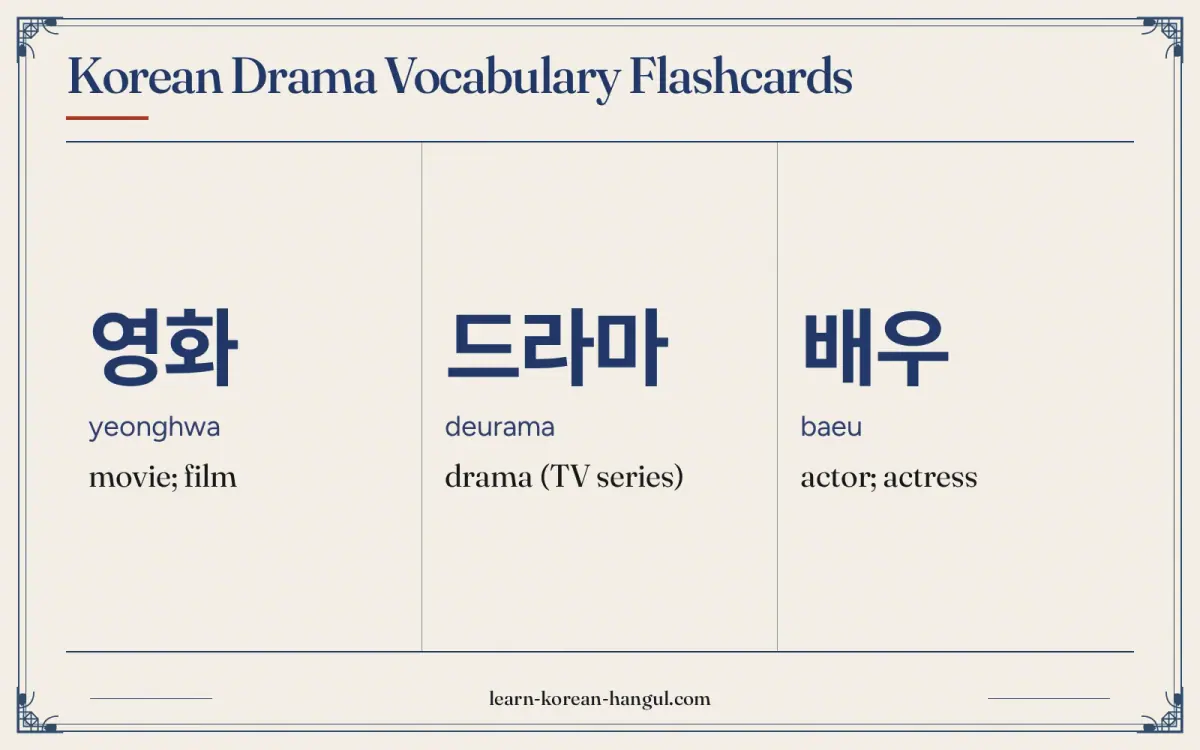
Each card shows the Hangul, the Revised Romanization (RR), the meaning and an audio button. The words are the core film and TV vocabulary, and the lesson page drama in Korean explains 드라마 in more detail.
How Do I Use These Flashcards?
Use the deck above in four steps. It works with tap, click or keyboard, and nothing plays until you press an audio button.
- Choose a mode. Start with recognition (Hangul to meaning). Switch to recall (meaning to Hangul) or listening (audio to meaning) once recognition feels easy.
- Show the answer. Think of the answer first, then press Show answer (or Space). Say the word aloud before you reveal it. Turn on the romanization toggle only if you need it; the 29-card table below always shows it.
- Grade yourself. Press Got it if you answered correctly without help, or Not yet if you hesitated or guessed.
- Finish the session. A session holds up to 20 cards (you can set 10, 20 or 40). With 29 cards, a first-time learner can split the deck over three days, using the default limit of 10 new cards a day.
The Three Study Modes
Recognition shows the Hangul and asks for the meaning, which trains reading. Recall shows the meaning and asks for the Hangul, which trains remembering; you may type the answer with your Hangul keyboard or just recall it in your head. Listening plays a clip and hides the letters, which trains the ear. Listening mode only uses a card once its audio is approved, and cards without approved audio are skipped in that mode with a note.
Got It and Not Yet
Got it moves the card up one Leitner box, so it comes back later. Not yet sends the card back to box 1, so it returns in the same session or within 10 minutes. The grades are your own judgement; the deck does not score you or claim fluency.
Deck Scope: What Is and Is Not Covered
The deck covers 29 film and TV words: genres, people, places to watch, TV categories, the words for counting episodes and films, and the words for watching and releasing. Words that belong to the drama story, such as 재벌 and 첫사랑, are in the K-drama deck.
What Is Left out of This Deck?
Fan and music words are in the K-pop deck, and the story words of dramas are in the K-drama deck. Webtoons, variety shows and more are covered by the movies and TV lesson. See also movie in Korean and subtitles in Korean.
All 29 Cards in One Table
All 29 cards appear below in deck order. The table is plain HTML, so you can use it as a drill without the deck: cover the Meaning column, say each word aloud, then uncover it.
| # | Hangul | Revised Romanization | Meaning | Note | Audio assetId |
|---|---|---|---|---|---|
| 1 | 영화 | yeonghwa | movie; film | Watch it with 보다: 영화를 봐요. | au-pg-flashcards-movies-and-tv-1; slow: au-pg-flashcards-movies-and-tv-31 |
| 2 | 드라마 | deurama | drama (TV series) | Watch it with 보다: 드라마를 봐요. | au-pg-flashcards-movies-and-tv-2 |
| 3 | 배우 | baeu | actor; actress | One word for both sexes. | au-pg-flashcards-movies-and-tv-3 |
| 4 | 감독 | gamdok | director | The person who directs a film or drama. | au-pg-flashcards-movies-and-tv-4 |
| 5 | 주인공 | juingong | main character; protagonist | The lead of a story. | au-pg-flashcards-movies-and-tv-5 |
| 6 | 자막 | jamak | subtitles; captions | Ask 한국어 자막 있어요? | au-pg-flashcards-movies-and-tv-6; slow: au-pg-flashcards-movies-and-tv-32 |
| 7 | 영화관 | yeonghwagwan | movie theater; cinema | The building where films play. | au-pg-flashcards-movies-and-tv-7 |
| 8 | 극장 | geukjang | theater; cinema | Said [극짱]. A second word for a cinema. | au-pg-flashcards-movies-and-tv-8; slow: au-pg-flashcards-movies-and-tv-30 |
| 9 | 표 | pyo | ticket | A ticket, as in 영화 표 (movie ticket). A different 표 means a table or chart. | au-pg-flashcards-movies-and-tv-9 |
| 10 | 텔레비전 | tellebijeon | television; TV | Loanword for television. | au-pg-flashcards-movies-and-tv-10 |
| 11 | 방송 | bangsong | broadcast; TV or radio programme | The act of broadcasting, and the programme itself. | au-pg-flashcards-movies-and-tv-11 |
| 12 | 채널 | chaeneol | channel | Loanword for a TV channel. | au-pg-flashcards-movies-and-tv-12 |
| 13 | 뉴스 | nyuseu | news | Loanword; a separate category from dramas. | au-pg-flashcards-movies-and-tv-13 |
| 14 | 예능 | yeneung | variety show; entertainment programme | The umbrella word for variety shows. | au-pg-flashcards-movies-and-tv-14 |
| 15 | 다큐멘터리 | dakyumenteori | documentary | Loanword; the 큐 is an aspirated k plus yu. | au-pg-flashcards-movies-and-tv-15 |
| 16 | 만화 | manhwa | comics; cartoon | Comics or cartoons. | au-pg-flashcards-movies-and-tv-16 |
| 17 | 시리즈 | sirijeu | series | Loanword for a series of films or shows. | au-pg-flashcards-movies-and-tv-17 |
| 18 | 시즌 | sijeun | season (TV series or sports) | A season of a show, not of the year. | au-pg-flashcards-movies-and-tv-18 |
| 19 | 회 | hoe | episode; round, time (counter) | Counts or numbers episodes: 십육 회 can mean 16 episodes or episode 16. | au-pg-flashcards-movies-and-tv-19 |
| 20 | 편 | pyeon | film or programme (counter) | Counts films: 영화 한 편 is one movie. | au-pg-flashcards-movies-and-tv-20 |
| 21 | 부작 | bujak | part (of a series) | 십육 부작 드라마 is a 16-part drama. | au-pg-flashcards-movies-and-tv-21 |
| 22 | 예고편 | yegopyeon | trailer; preview | 편 here means film or programme. | au-pg-flashcards-movies-and-tv-22 |
| 23 | 개봉 | gaebong | release (of a film) | 내일 개봉해요 means it opens tomorrow. | au-pg-flashcards-movies-and-tv-23; slow: au-pg-flashcards-movies-and-tv-33 |
| 24 | 장면 | jangmyeon | scene | A scene in a film or drama. | au-pg-flashcards-movies-and-tv-24 |
| 25 | 대사 | daesa | line; dialogue | The words an actor says. | au-pg-flashcards-movies-and-tv-25 |
| 26 | 줄거리 | julgeori | plot; storyline | What happens in the story. | au-pg-flashcards-movies-and-tv-26 |
| 27 | 코미디 | komidi | comedy | Loanword. | au-pg-flashcards-movies-and-tv-27 |
| 28 | 로맨스 | romaenseu | romance | Loanword for the genre. | au-pg-flashcards-movies-and-tv-28 |
| 29 | 액션 | aeksyeon | action | Loanword for the genre. | au-pg-flashcards-movies-and-tv-29 |
Reading the Table
Hangul is the word. Revised Romanization (RR) is a learning aid, so try to read the Hangul before you look at it. RR follows the spelling rules of the official system, not every sound change, so it can differ from what you hear. The Meaning column gives the English gloss, and the Note column gives a use or sound hint. The last column lists the audio assetId; a second ID marks a slow clip at 0.8 times the speed. Cards 19-21 are the counting words 회, 편 and 부작, used for episodes, films and parts.
Usage Notes for These Cards
Movies and TV both take 보다. You watch a movie or a drama with 보다: 영화를 봐요 (I watch a movie), 드라마를 봐요. Do not use 듣다 (to listen) for TV.
Episodes use 회, films use 편. 일 회 is episode 1 and 마지막 회 is the final episode, while 영화 한 편 means one movie. Do not count films with 개.
부작 gives the length. 십육 부작 드라마 is a 16-part drama, one that runs for a fixed number of episodes.
Ask for subtitles with 자막. 한국어 자막 있어요? means Are there Korean subtitles? 자막 covers both subtitles and captions.
영화관 and 극장 are both cinemas. 영화관 is the building where films play. 극장 is a theater and also means a cinema. 예능 is the umbrella word for variety and entertainment shows, while 뉴스 and 다큐멘터리 are separate categories.
Which Sounds Do Not Match the Spelling?
Some of these words are said differently from how they are written. The table follows the standard pronunciation rules (표준 발음법) of the 국립국어원 (National Institute of Korean Language).
| Spelling | Sounds like | What changes |
|---|---|---|
| 극장 | [극짱] | After a final ㄱ, ㅈ becomes tense [ㅉ]. |
| 영화 | [영화], close to [영와] in fast speech | The standard keeps the ㅎ, but after ㅇ it is often weakened in casual speech. |
The ㅎ in 영화 is very light in everyday speech, so the word can sound close to yeong-wa. Revised Romanization writes yeonghwa. Tense ㅉ in 극장 is not shown in RR, so listen to the clip.
What Mistakes Do Learners Make with Movies and TV Words?
- Using 듣다 for TV. Say 드라마를 보다.
- Counting films with 개. Use 편.
- Using 영화관 for the film itself. 영화관 is the building.
- Confusing 회 (episode) with 번 (times). 회 counts episodes, 번 counts occasions.
- Reading the romanization instead of the Hangul.
How Does the Review Schedule Work?
The deck uses a simplified Leitner system with five boxes. A new card starts in box 1. Each Got it moves it up one box, and each Not yet returns it to box 1. The box sets how long the card waits before it is due again.
| Box | Wait until the next review |
|---|---|
| 1 | same session or 10 minutes |
| 2 | 1 day |
| 3 | 3 days |
| 4 | 7 days |
| 5 | 21 days |
Each session shows due cards first, oldest due first, and then up to 10 new cards a day by default. A deck of 29 cards is introduced over three days at the default of 10 new cards a day, and the later boxes bring each card back at longer gaps. Progress is saved only in this browser, so clearing site data deletes it. Use the export button to save a small JSON file with card IDs, boxes and due dates, and import it on another device. No account is needed.
Cultural and Practical Context
TV dramas in Korea often run as limited series of around 16 episodes, and 예능 variety shows are a separate and very popular category. Learners can turn on Korean 자막 to match sound and spelling.
Limits of This Deck
The deck holds 29 words and does not teach story words for dramas, or the verbs of watching beyond 보다. The 16-episode remark is a general pattern, not a rule, and many dramas run longer or shorter. All Korean text is generated and was reviewed and signed off by Min-ji Park on 15 October 2026.
Next Steps after This Deck
The words and letters on these cards are explained in the Korean drama vocabulary lesson, so read it first if a card is new. This deck is one of the Korean vocabulary flashcards on the site, so browse the full list if you want a different topic. When these cards feel easy, move on to Korean gaming vocabulary flashcards to keep the same routine. If a word here still feels shaky, go back to Korean music vocabulary flashcards for the earlier material. After a session, write the same words by hand with the Korean hobbies vocabulary worksheet. All flashcard decks, including Hangul, vocabulary, phrases, grammar and TOPIK, are listed on the Korean flashcards hub.
Frequently Asked Questions
What Is the Difference between 드라마 and 연속극?
드라마 is the common word for a TV drama today. 연속극 is an older word for a serial drama and is less common in everyday talk.
What Does 개봉 Mean?
개봉 is the release of a film in cinemas. 내일 개봉해요 means It opens tomorrow.
What Is 만화 Exactly?
만화 means comics or cartoons. A webtoon is the online form of 만화.
Do I Say 영화관 or 극장?
Both can mean a cinema. 영화관 is the more specific word for a movie theater, and 극장 is also used for a theater in general.
Is My Progress Saved If I Close the Page?
Yes, in the same browser on the same device. Card boxes and due dates are stored locally and nothing is sent to a server. Clearing site data, using a private window or switching browsers removes them, so use the export button to keep a backup file. No account is needed.