
Korean Gaming Vocabulary Flashcards: Study the 28 Cards
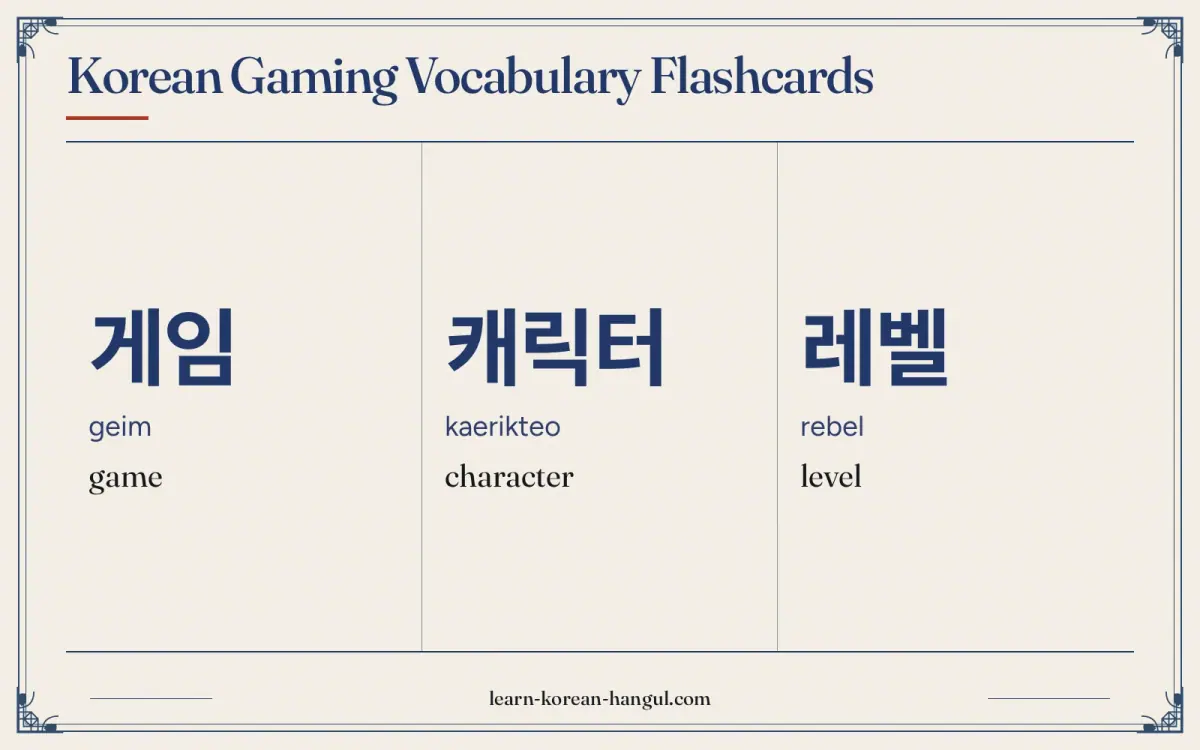
Say each word aloud before you press Show answer. Every card has a short note that explains how the word is used or why it sounds different from its spelling.
How Do I Use These Flashcards?
Use the deck above in four steps. It works with tap, click or keyboard, and nothing plays until you press an audio button.
- Choose a mode. Start with recognition (Hangul to meaning). Switch to recall (meaning to Hangul) or listening (audio to meaning) once recognition feels easy.
- Show the answer. Think of the answer first, then press Show answer (or Space). Turn on the romanization toggle only if you need it; the 28-card table below always shows it.
- Grade yourself. Press Got it if you answered correctly without help, or Not yet if you hesitated or guessed.
- Finish the session. A session holds up to 20 cards (you can set 10, 20 or 40). With 28 cards, a first-time learner can split the deck over 3 days, using the default limit of 10 new cards a day.
What Do the Three Modes Do?
Recognition shows the Hangul and asks for the meaning, which trains reading. Recall shows the meaning and asks for the Hangul, which trains remembering; you may type the answer with your Hangul keyboard or just recall it in your head. Listening plays a clip and hides the letters, which trains the ear. Listening mode only uses a card once its audio is approved, and cards without approved audio are skipped in that mode with a note.
What Do Got It and Not yet Do?
Got it moves the card up one Leitner box, so it comes back later. Not yet sends the card back to box 1, so it returns in the same session or within 10 minutes. The grades are your own judgement; the deck does not score you or claim fluency.
Deck Scope: What Is and Is Not Covered
The deck covers gaming loanwords and the Korean terms around playing, from 게임 and 고수 to 길드 and 업데이트. Hardware and internet words are in the korean technology vocabulary flashcards. The topic lesson is games in korean.
What Is Left out of This Deck?
Gaming slang changes quickly, and several cards are English loanwords whose spelling can vary between writers. The deck does not cover hardware, esports teams or slang.
All 28 Cards in One Table
All 28 cards appear below in deck order. The table is plain HTML, so you can use it as a drill without the deck: cover the Meaning column, read each word aloud, then uncover the meaning.
| # | Hangul | Revised Romanization | Meaning | Note | Audio assetId |
|---|---|---|---|---|---|
| 1 | 게임 | geim | game | Play with 하다, not 놀다: 게임을 해요 (I play games). | au-pg-flashcards-gaming-vocabulary-1 |
| 2 | 캐릭터 | kaerikteo | character | Loanword for a character in a game or a cartoon. | au-pg-flashcards-gaming-vocabulary-2 |
| 3 | 레벨 | rebel | level | Level up is 레벨이 오르다 (the level goes up). | au-pg-flashcards-gaming-vocabulary-3 |
| 4 | PC방 | pisibang | PC cafe | Said [피씨방]: the letters P and C are read as 피 and 씨. Customers often pay by the hour. | au-pg-flashcards-gaming-vocabulary-4; slow: au-pg-flashcards-gaming-vocabulary-29 |
| 5 | 판 | pan | round; one game | Counts rounds of a game: 한 판 더 해요 (Let us play one more round). | au-pg-flashcards-gaming-vocabulary-5 |
| 6 | 고수 | gosu | expert; skilled player | The opposite of 초보. Same spelling as 고수 (coriander); the context tells them apart. | au-pg-flashcards-gaming-vocabulary-6 |
| 7 | 초보 | chobo | beginner | 저는 아직 초보예요 (I am still a beginner). | au-pg-flashcards-gaming-vocabulary-7 |
| 8 | 접속하다 | jeopsokada | to connect; to log in to a server | 서버에 접속했어요 (I connected to the server). Do not say 서버를 가다. | au-pg-flashcards-gaming-vocabulary-8 |
| 9 | 플레이하다 | peulleihada | to play (a game) | An English loanword plus 하다, the same pattern as 로그인하다. | au-pg-flashcards-gaming-vocabulary-9 |
| 10 | 로그인하다 | rogeuinhada | to log in | To log in. An English loanword plus 하다. | au-pg-flashcards-gaming-vocabulary-10 |
| 11 | 승리 | seungni | victory; win | Said [승니]: ㄹ after a ㅇ final is read as ㄴ. RR follows the sound. | au-pg-flashcards-gaming-vocabulary-11; slow: au-pg-flashcards-gaming-vocabulary-30 |
| 12 | 온라인 게임 | ollain geim | online game | Online game communities play a large part in Korean youth culture. | au-pg-flashcards-gaming-vocabulary-12 |
| 13 | 보드게임 | bodeugeim | board game | A board game. Play it with 하다 too: 보드게임을 해요. | au-pg-flashcards-gaming-vocabulary-13 |
| 14 | 이기다 | igida | to win | To win. The opposite is 지다. | au-pg-flashcards-gaming-vocabulary-14 |
| 15 | 지다 | jida | to lose (a game) | To lose a game. The opposite is 이기다. | au-pg-flashcards-gaming-vocabulary-15 |
| 16 | 아이템 | aitem | item (in a game) | Loanword for an in-game item. | au-pg-flashcards-gaming-vocabulary-16 |
| 17 | 점수 | jeomsu | score; points | The number of points you earn in a round. | au-pg-flashcards-gaming-vocabulary-17 |
| 18 | 팀 | tim | team | Loanword; one syllable with a short vowel. | au-pg-flashcards-gaming-vocabulary-18 |
| 19 | 서버 | seobeo | server | Connect to it with 접속하다, not with 가다. | au-pg-flashcards-gaming-vocabulary-19 |
| 20 | 모바일 게임 | mobail geim | mobile game | A game played on a phone. | au-pg-flashcards-gaming-vocabulary-20 |
| 21 | 랭킹 | raengking | ranking | Loanword for a ranking list or leaderboard. | au-pg-flashcards-gaming-vocabulary-21 |
| 22 | 퀘스트 | kweseuteu | quest | Loanword for a task given in a game. | au-pg-flashcards-gaming-vocabulary-22 |
| 23 | 보스 | boseu | boss (in a game) | Loanword for the strong enemy at the end of a stage. | au-pg-flashcards-gaming-vocabulary-23 |
| 24 | 스트리머 | seuteurimeo | streamer | Loanword for a person who streams games live. | au-pg-flashcards-gaming-vocabulary-24 |
| 25 | 길드 | gildeu | guild | A group of players who team up. | au-pg-flashcards-gaming-vocabulary-25 |
| 26 | 게이머 | geimeo | gamer | Loanword for a person who plays games. | au-pg-flashcards-gaming-vocabulary-26 |
| 27 | 업데이트 | eopdeiteu | update | Loanword for a game update or patch. | au-pg-flashcards-gaming-vocabulary-27 |
| 28 | 채팅 | chaeting | chat | Loanword for typed chat while playing. | au-pg-flashcards-gaming-vocabulary-28 |
How Do I Read the Table?
Hangul is the word. Revised Romanization (RR) is a learning aid, so try to read the Hangul before you look at it. RR follows the spelling rules of the official system, not every sound change, so it can differ from what you hear. The Meaning column gives the English gloss, and the Note column gives a use or sound hint. The last column lists the audio assetId; a second ID marked slow is a slower clip for the 2 cards whose sound differs from their spelling.
Usage Notes for These Cards
Play with 하다, not 놀다. The normal verb is 하다: 게임을 해요 (I play games). 놀다 means to hang out or to play in a general way, and it does not take 게임 as its object.
Counting rounds. Rounds of a game are counted with 판: 한 판 더 해요 (Let us play one more round).
Skill levels. A 고수 is an expert and a 초보 is a beginner: 저는 아직 초보예요 (I am still a beginner).
Logging in. To log into a server use 접속하다: 서버에 접속했어요 (I connected to the server).
English verbs take 하다. 플레이하다 and 로그인하다 follow the same pattern: an English loanword plus 하다.
Which Sounds Do Not Match the Spelling?
PC방 is said [피씨방]. The letters P and C are read as 피 and 씨, the Korean way of saying the English letter names. Revised Romanization writes pisibang.
승리 is said [승니]: ㄹ after a ㅇ final is read as ㄴ. Revised Romanization follows the sound, so the card shows seungni.
The related word 공략 (a strategy guide) behaves the same way and is said [공냑].
These forms follow the standard pronunciation rules (표준 발음법) of the 국립국어원 (National Institute of Korean Language).
What Mistakes Do Learners Make with Gaming Vocabulary?
- Saying 게임을 놀다. Use 게임을 하다.
- Confusing 고수 (expert) with 고수 (coriander). They are spelled the same, and the topic tells you which one is meant.
- Saying 서버를 가다. Use 서버에 접속하다.
How Does the Review Schedule Work?
The deck uses a simplified Leitner system with five boxes. A new card starts in box 1. Each Got it moves it up one box, and each Not yet returns it to box 1. The box sets how long the card waits before it is due again.
| Box | Wait until the next review |
|---|---|
| 1 | same session or 10 minutes |
| 2 | 1 day |
| 3 | 3 days |
| 4 | 7 days |
| 5 | 21 days |
Each session shows due cards first, oldest due first, and then up to 10 new cards a day by default. Progress is saved only in this browser, so clearing site data deletes it. Use the export button to save a small JSON file with card IDs, boxes and due dates, and import it on another device. No account is needed.
Cultural and Practical Context
The 피씨방 is a familiar hangout where people pay by the hour to play games, and 온라인 게임 communities have a strong role in Korean youth culture.
Next Steps after This Deck
The words and letters on these cards are explained in the korean gaming vocabulary lesson, so read it first if a card is new. This deck is one of the korean vocabulary flashcards on the site, so browse the full list if you want a different topic. When these cards feel easy, move on to korean holidays flashcards to keep the same routine. If a word here still feels shaky, go back to korean drama vocabulary flashcards for the earlier material. After a session, write the same words by hand with the korean hobbies vocabulary worksheet. All flashcard decks, including Hangul, vocabulary, phrases, grammar and TOPIK, are listed on the korean flashcards hub.
Frequently Asked Questions
What Is the Difference between 게임 and 놀이?
게임 is a game, usually with rules and a result, such as a video game or a board game. 놀이 is play in the wider sense, such as children's play. Use 게임을 하다 for playing a game.
What Does 렉 Mean?
렉 is lag in online games, the delay between your action and what appears on screen. It is gamer slang borrowed from English and is not one of the 28 cards in this deck.
How Do I Say Level Up?
Say 레벨이 오르다, which means that the level goes up. The 레벨 card in this deck gives you the noun, and 오르다 (to rise) is the verb.
What Is a 길드?
A 길드 is a guild, a group of players who team up in an online game. It is a loanword, so the card is easy to remember if you know the English word.
Is My Progress Saved If I Close the Page?
Yes, in the same browser on the same device. Card boxes and due dates are stored locally and nothing is sent to a server. Clearing site data, using a private window or switching browsers removes them, so use the export button to keep a backup file. No account is needed.