
Korean Drinks Flashcards: Study the 28 Cards
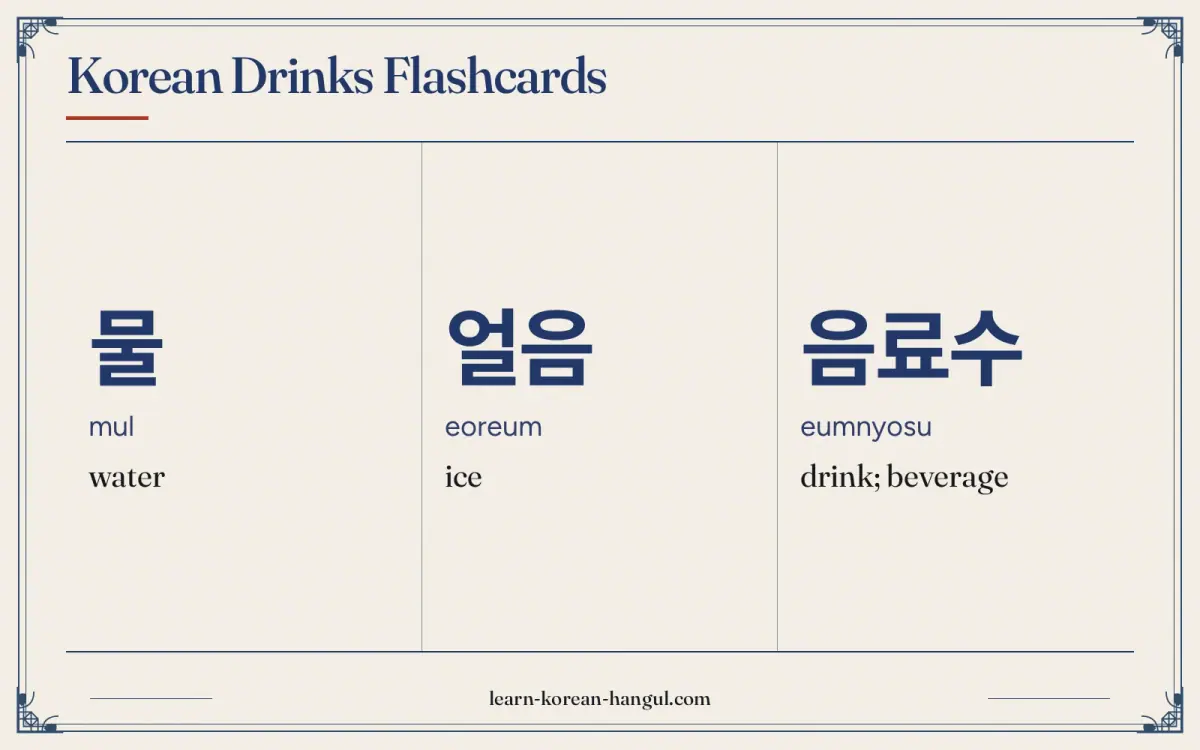
Each card shows the Hangul, the Revised Romanization (RR), the meaning and an audio button. The words come from the Korean drinks vocabulary lesson, which also has example sentences.
How Do I Use These Flashcards?
Use the deck above in four steps. It works with tap, click or keyboard, and nothing plays until you press an audio button.
- Choose a mode. Start with recognition (Hangul to meaning). Switch to recall (meaning to Hangul) or listening (audio to meaning) once recognition feels easy.
- Show the answer. Think of the answer first, then press Show answer (or Space). Say the word aloud before you reveal it. Turn on the romanization toggle only if you need it; the 28-card table below always shows it.
- Grade yourself. Press Got it if you answered correctly without help, or Not yet if you hesitated or guessed.
- Finish the session. A session holds up to 20 cards (you can set 10, 20 or 40). With 28 cards, a first-time learner can split the deck over three days, using the default limit of 10 new cards a day.
The Three Study Modes
Recognition shows the Hangul and asks for the meaning, which trains reading. Recall shows the meaning and asks for the Hangul, which trains remembering; you may type the answer with your Hangul keyboard or just recall it in your head. Listening plays a clip and hides the letters, which trains the ear. Listening mode only uses a card once its audio is approved, and cards without approved audio are skipped in that mode with a note.
Got It and Not Yet
Got it moves the card up one Leitner box, so it comes back later. Not yet sends the card back to box 1, so it returns in the same session or within 10 minutes. The grades are your own judgement; the deck does not score you or claim fluency.
Deck Scope: What Is and Is Not Covered
The deck covers 28 of the 45 words in the drinks lesson. It starts with water and ice, moves through soft drinks, coffee and tea, then traditional drinks and alcohol, and ends with the words you say in a cafe (아이스, 핫, 테이크아웃).
Which Drink Words Are Left out of This Deck?
The lesson words 생수, 탄산음료, 허브차, 티백, 매실차, 오미자차, 대추차, 인삼차, 쌍화차, 숙취, 해장, 메뉴, 샷, 시럽, 사이즈, 톨 and 휘핑크림 are not cards here. For a full cafe order see the cafe menu page.
All 28 Cards in One Table
All 28 cards appear below in deck order. The table is plain HTML, so you can use it as a drill without the deck: cover the Meaning column, say each word aloud, then uncover it.
| # | Hangul | Revised Romanization | Meaning | Note | Audio assetId |
|---|---|---|---|---|---|
| 1 | 물 | mul | water | The plain word. At a restaurant, water is usually free and self-serve. | au-pg-flashcards-drinks-1 |
| 2 | 얼음 | eoreum | ice | Said [어름]. 얼음물 is iced water. | au-pg-flashcards-drinks-2; slow: au-pg-flashcards-drinks-32 |
| 3 | 음료수 | eumnyosu | drink; beverage | Said [음뇨수]. The general word for a soft drink or juice. | au-pg-flashcards-drinks-3; slow: au-pg-flashcards-drinks-31 |
| 4 | 사이다 | saida | lemon-lime soda | Not cider. In Korea 사이다 is a clear, fizzy lemon-lime drink, like Sprite. | au-pg-flashcards-drinks-4 |
| 5 | 콜라 | kolla | cola | A loanword with a doubled l sound. | au-pg-flashcards-drinks-5 |
| 6 | 주스 | juseu | juice | A loanword. Say the fruit first: 오렌지 주스. | au-pg-flashcards-drinks-6 |
| 7 | 우유 | uyu | milk | 딸기 우유 (strawberry milk) and 바나나 우유 (banana milk) are common convenience-store drinks. | au-pg-flashcards-drinks-7 |
| 8 | 커피 | keopi | coffee | A loanword. The ㅍ is aspirated. | au-pg-flashcards-drinks-8 |
| 9 | 아메리카노 | amerikano | Americano | The most ordered espresso drink in Korean cafes. Usually ordered iced or hot. | au-pg-flashcards-drinks-9 |
| 10 | 라테 | rate | latte | A loanword. Short for 카페라테. | au-pg-flashcards-drinks-10 |
| 11 | 믹스커피 | mikseukeopi | instant mix coffee | A stick of instant coffee, sugar and creamer. A common office and home drink. | au-pg-flashcards-drinks-11 |
| 12 | 차 | cha | tea | 차 also means car. Context tells you which. | au-pg-flashcards-drinks-12 |
| 13 | 녹차 | nokcha | green tea | 녹 means green and 차 means tea. A well-known tea in Korea. | au-pg-flashcards-drinks-13 |
| 14 | 홍차 | hongcha | black tea | 홍 means red, as the leaves oxidise. The English name is "black tea". | au-pg-flashcards-drinks-14 |
| 15 | 보리차 | boricha | barley tea | 보리 means barley. Served as the everyday drink in many homes. | au-pg-flashcards-drinks-15 |
| 16 | 유자차 | yujacha | yuzu tea | 유자 is a citrus fruit. Made from yuzu preserved in sugar or honey. | au-pg-flashcards-drinks-16 |
| 17 | 식혜 | sikhye | sweet rice drink | Said [시켸] or [시케]. A cold, sweet drink of rice and malt, often served after a meal. | au-pg-flashcards-drinks-17 |
| 18 | 수정과 | sujeonggwa | cinnamon punch | A cold drink of cinnamon and ginger, often with dried persimmon. | au-pg-flashcards-drinks-18 |
| 19 | 술 | sul | alcohol; liquor | The general word. 술을 마시다 is to drink alcohol. | au-pg-flashcards-drinks-19 |
| 20 | 소주 | soju | soju (distilled spirit) | The best-known Korean spirit. Sold in green bottles and served in small glasses. | au-pg-flashcards-drinks-20 |
| 21 | 맥주 | maekju | beer | Said [맥쭈]. 생맥주 is draught beer. | au-pg-flashcards-drinks-21; slow: au-pg-flashcards-drinks-30 |
| 22 | 막걸리 | makgeolli | makgeolli (rice wine) | Said [막껄리]. A milky, lightly sparkling drink made from rice. | au-pg-flashcards-drinks-22; slow: au-pg-flashcards-drinks-29 |
| 23 | 와인 | wain | wine | A loanword. 레드 와인 is red wine. | au-pg-flashcards-drinks-23 |
| 24 | 건배 | geonbae | toast; cheers | Said as a call when glasses are raised, as in 건배 (cheers). | au-pg-flashcards-drinks-24 |
| 25 | 안주 | anju | food eaten with drinks | Dishes ordered to go with alcohol. Not the same as a main meal. | au-pg-flashcards-drinks-25 |
| 26 | 아이스 | aiseu | iced | Put before the drink name: 아이스 아메리카노. | au-pg-flashcards-drinks-26 |
| 27 | 핫 | hat | hot (drink) | A loanword, put before the drink: 핫 라테. 따뜻한 is the Korean for warm. | au-pg-flashcards-drinks-27 |
| 28 | 테이크아웃 | teikeuaut | takeout | A loanword. The staff ask whether you want it here or to go. | au-pg-flashcards-drinks-28 |
Reading the Table
Hangul is the word. Revised Romanization (RR) is a learning aid, so try to read the Hangul before you look at it. RR follows the spelling rules of the official system, not every sound change, so it can differ from what you hear. The Meaning column gives the English gloss, and the Note column gives a use or sound hint. The last column lists the audio assetId; a second ID marks a slow clip at 0.8 times the speed. Cards 8-11 are the coffee words, which are all loanwords.
Usage Notes for These Cards
Use 마시다 for every drink. Whatever the liquid, the verb is 마시다: 커피를 마셔요 (I drink coffee). Learners who use 먹다 for drinks are understood, but 마시다 is the standard verb.
Count cups with 잔 and bottles with 병. 커피 두 잔 means two cups of coffee, and 소주 한 병 means one bottle of soju. In shops you may hear 개 for cans and bottles, but 잔 and 병 are the precise counters.
Order hot or iced first. 아이스 아메리카노 주세요 means An iced Americano, please. 아이스 and 핫 go before the drink name.
차 is tea and also car. 차를 마셔요 is I drink tea, and the verb is what tells it apart from the car. Tea names usually end in 차: 녹차, 홍차, 보리차, 유자차.
술 covers all alcohol. 소주, 맥주, 막걸리 and 와인 are kinds of 술. Ask for a round with the counter: 맥주 세 병 주세요 (Three bottles of beer, please).
Which Sounds Do Not Match the Spelling?
Some of these words are said differently from how they are written. The table follows the standard pronunciation rules (표준 발음법) of the 국립국어원 (National Institute of Korean Language).
| Spelling | Sounds like | What changes |
|---|---|---|
| 막걸리 | [막껄리] | After a final ㄱ, ㄱ becomes tense [ㄲ]. |
| 맥주 | [맥쭈] | After a final ㄱ, ㅈ becomes tense [ㅉ]. |
| 음료수 | [음뇨수] | ㄹ becomes [ㄴ] after ㅁ. |
| 얼음 | [어름] | The final ㄹ links to the vowel of 음. |
| 식혜 | [시켸] or [시케] | ㄱ and ㅎ merge into [ㅋ]; 혜 may be said [케]. |
The tense sounds in 맥주 and 막걸리 are the ones learners miss most. A tense consonant is said with a tight throat and no puff of air. The doubled l in 콜라 is one long l.
What Mistakes Do Learners Make with Drink Words?
- Hearing 사이다 as cider. In Korea it is a clear lemon-lime soda.
- Using 차 without context. 차를 마셔요 is tea, 차를 타요 is a car.
- Counting glasses with 개. Count glasses and cups with 잔 and bottles with 병.
- Saying 물 for any liquid. 물 is plain water.
- Reversing cafe order. Say hot or iced first, then the drink.
How Does the Review Schedule Work?
The deck uses a simplified Leitner system with five boxes. A new card starts in box 1. Each Got it moves it up one box, and each Not yet returns it to box 1. The box sets how long the card waits before it is due again.
| Box | Wait until the next review |
|---|---|
| 1 | same session or 10 minutes |
| 2 | 1 day |
| 3 | 3 days |
| 4 | 7 days |
| 5 | 21 days |
Each session shows due cards first, oldest due first, and then up to 10 new cards a day by default. A deck of 28 cards is introduced over three days at the default of 10 new cards a day, and the later boxes bring each card back at longer gaps. Progress is saved only in this browser, so clearing site data deletes it. Use the export button to save a small JSON file with card IDs, boxes and due dates, and import it on another device. No account is needed.
Cultural and Practical Context
When drinking with elders it is polite to pour for them and to receive a glass with both hands, and younger people often turn slightly away to drink. 건배 is the word for a toast, said as glasses are raised.
Limits of This Deck
The deck holds 28 words, so it is a starter for ordering and not a full drink list. Alcohol words are included for reading menus and for ordering where it is legal, and the deck gives no advice on drinking. Customs for pouring and toasting vary by group. All Korean text is generated and was reviewed and signed off by Min-ji Park on 15 October 2026.
Next Steps after This Deck
The words and letters on these cards are explained in the Korean drinks vocabulary lesson, so read it first if a card is new. This deck is one of the Korean vocabulary flashcards on the site, so browse the full list if you want a different topic. When these cards feel easy, move on to Korean restaurant vocabulary flashcards to keep the same routine. If a word here still feels shaky, go back to Korean fruits and vegetables flashcards for the earlier material. After a session, write the same words by hand with the Korean food vocabulary worksheet. All flashcard decks, including Hangul, vocabulary, phrases, grammar and TOPIK, are listed on the Korean flashcards hub.
Frequently Asked Questions
What Is the Difference between 소주 and 막걸리?
소주 is a clear distilled spirit sold in small green bottles. 막걸리 is a milky, lightly sparkling rice wine. Both are kinds of 술.
How Do I Say a Glass of Water?
Say 물 한 잔. 물 is water and the counter 잔 counts glasses and cups.
Is 사이다 Cider?
No. 사이다 is a clear, fizzy lemon-lime soda. For an apple drink, say 사과 주스.
What Do I Say to Toast?
Say 건배, which is a call said as glasses are raised, like Cheers.
Is My Progress Saved If I Close the Page?
Yes, in the same browser on the same device. Card boxes and due dates are stored locally and nothing is sent to a server. Clearing site data, using a private window or switching browsers removes them, so use the export button to keep a backup file. No account is needed.