Korean Restaurant Vocabulary Flashcards: Study the 28 Cards
Listen first, then read. Several table words, such as 숟가락 and 젓가락, are written one way and said another. The lesson behind the deck is korean restaurant vocabulary, so read it first if a card is new.
How Do I Use These Flashcards?
Use the deck above in four steps. It works with tap, click or keyboard, and nothing plays until you press an audio button.
- Choose a mode. Start with recognition (Hangul to meaning). Switch to recall (meaning to Hangul) or listening (audio to meaning) once recognition feels easy.
- Show the answer. Think of the answer first, then press Show answer (or Space). Turn on the romanization toggle only if you need it; the 28-card table below always shows it.
- Grade yourself. Press Got it if you answered correctly without help, or Not yet if you hesitated or guessed.
- Finish the session. A session holds up to 20 cards (you can set 10, 20 or 40). With 28 cards, a first-time learner can split the deck over three days, using the default limit of 10 new cards a day.
The Three Study Modes
Recognition shows the Hangul and asks for the meaning, which trains reading. Recall shows the meaning and asks for the Hangul, which trains remembering; you may type the answer with your Hangul keyboard or just recall it in your head. Listening plays a clip and hides the letters, which trains the ear. Listening mode only uses a card once its audio is approved, and cards without approved audio are skipped in that mode with a note.
Got It and Not Yet
Got it moves the card up one Leitner box, so it comes back later. Not yet sends the card back to box 1, so it returns in the same session or within 10 minutes. The grades are your own judgement; the deck does not score you or claim fluency.
Deck Scope: What Is and Is Not Covered
The deck covers kinds of restaurants (식당, 분식집, 고깃집, 횟집, 술집, 뷔페), table and tableware words (자리, 숟가락, 젓가락, 앞접시, 그릇, 컵, 냅킨, 불판, 가위), menu and ordering words (메뉴, 메뉴판, 주문, 인분, 세트, 추천, 리필, 서비스, 잔) and the bill (계산서, 영수증). Names of dishes are in the dishes deck.
What Is Left out of This Deck?
Cooking verbs and kitchen words are in the korean cooking vocabulary flashcards, and coffee and other drinks are in the korean drinks flashcards. The deck does not include delivery and takeaway words such as 배달 and 포장, which are on the lesson page, or the full set of table-manners phrases.
All 28 Cards in One Table
All 28 cards appear below in deck order. The table is plain HTML, so you can use it as a drill without the deck: cover the Meaning column, read each Hangul word aloud, then uncover the meaning.
| # | Hangul | Revised Romanization | Meaning | Note | Audio assetId |
|---|---|---|---|---|---|
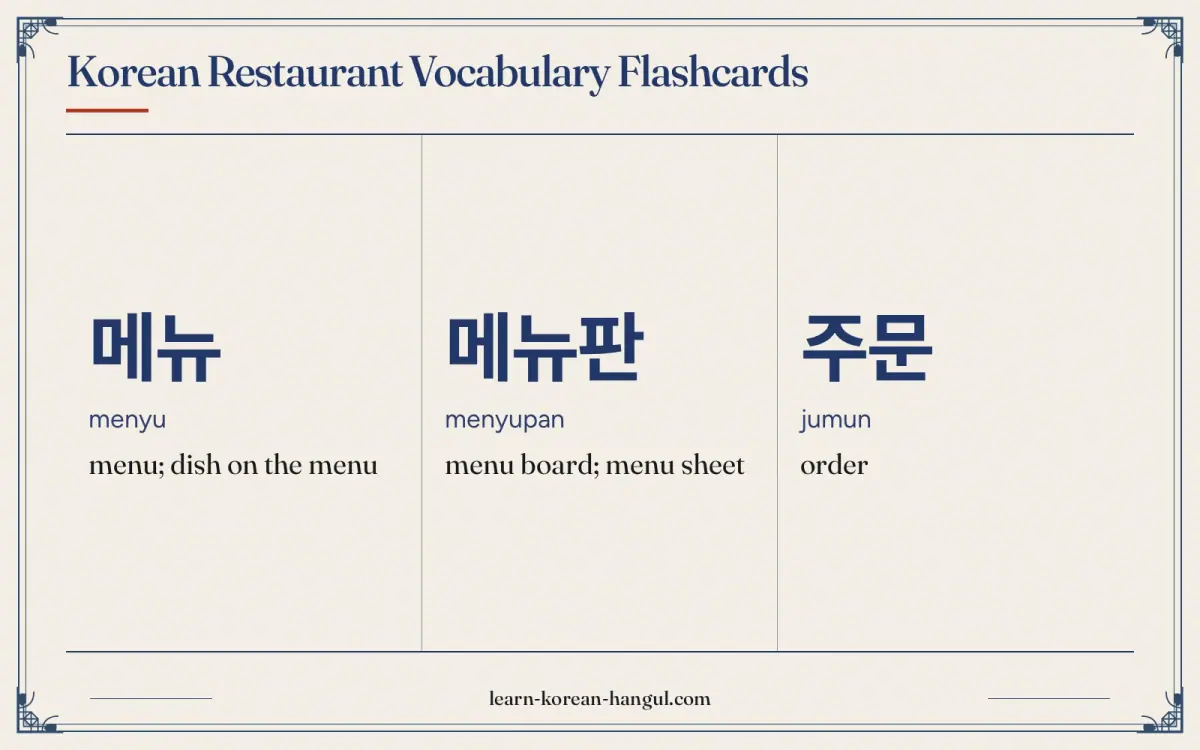
| 1 | 메뉴 | menyu | menu; dish on the menu | Loanword. Example: 메뉴 좀 주세요. (Please give me the menu) | au-pg-flashcards-restaurant-vocabulary-1 |
| 2 | 메뉴판 | menyupan | menu board; menu sheet | Mixed word (more than one origin). Example: 메뉴판은 벽에 있어요. (The menu board is on the wall) | au-pg-flashcards-restaurant-vocabulary-2 |
| 3 | 주문 | jumun | order | Sino-Korean word. Example: 주문하시겠어요? (Would you like to order?) | au-pg-flashcards-restaurant-vocabulary-3 |
| 4 | 인분 | inbun | serving; portion | Sino-Korean word. Example: 삼겹살 이 인분 주세요. (Two servings of pork belly, please) | au-pg-flashcards-restaurant-vocabulary-4; slow: au-pg-flashcards-restaurant-vocabulary-32 |
| 5 | 식당 | sikdang | restaurant | Sino-Korean word. Example: 이 근처에 맛있는 식당이 있어요? (Is there a tasty restaurant near here?) | au-pg-flashcards-restaurant-vocabulary-5 |
| 6 | 분식집 | bunsikjip | snack restaurant | Mixed word (more than one origin). Example: 점심에는 분식집에 가요. (I go to a snack restaurant at lunch) | au-pg-flashcards-restaurant-vocabulary-6 |
| 7 | 고깃집 | gogitjip | grilled meat restaurant | Native Korean word. Example: 고깃집에서 삼겹살을 구워요. (We grill pork belly at a meat restaurant) | au-pg-flashcards-restaurant-vocabulary-7 |
| 8 | 횟집 | hoetjip | raw fish restaurant | Mixed word (more than one origin). Example: 횟집에서 생선회를 먹었어요. (We ate raw fish at a sashimi restaurant) | au-pg-flashcards-restaurant-vocabulary-8 |
| 9 | 술집 | suljip | pub; drinking place | Native Korean word. Example: 술집은 저녁에 열어요. (The pub opens in the evening) | au-pg-flashcards-restaurant-vocabulary-9 |
| 10 | 뷔페 | bwipe | buffet | Loanword. Example: 뷔페에서 마음껏 먹을 수 있어요. (You can eat as much as you like at a buffet) | au-pg-flashcards-restaurant-vocabulary-10 |
| 11 | 자리 | jari | seat; place | Native Korean word. Example: 창가 자리로 주세요. (A window seat, please) | au-pg-flashcards-restaurant-vocabulary-11 |
| 12 | 숟가락 | sutgarak | spoon | Native Korean word. Example: 숟가락 하나 더 주세요. (One more spoon, please) | au-pg-flashcards-restaurant-vocabulary-12; slow: au-pg-flashcards-restaurant-vocabulary-29 |
| 13 | 젓가락 | jeotgarak | chopsticks | Native Korean word. Example: 젓가락은 서랍에 있어요. (The chopsticks are in the drawer) | au-pg-flashcards-restaurant-vocabulary-13; slow: au-pg-flashcards-restaurant-vocabulary-30 |
| 14 | 앞접시 | apjeopsi | small individual plate | Native Korean word. Example: 앞접시 두 개 주세요. (Two small plates, please) | au-pg-flashcards-restaurant-vocabulary-14; slow: au-pg-flashcards-restaurant-vocabulary-31 |
| 15 | 그릇 | geureut | bowl; dish | Native Korean word. Example: 밥 한 그릇 주세요. (One bowl of rice, please) | au-pg-flashcards-restaurant-vocabulary-15 |
| 16 | 컵 | keop | cup | Loanword. Example: 컵은 정수기 옆에 있어요. (The cups are next to the water purifier) | au-pg-flashcards-restaurant-vocabulary-16 |
| 17 | 냅킨 | naepkin | napkin | Loanword. Example: 냅킨 좀 주세요. (Please give me some napkins) | au-pg-flashcards-restaurant-vocabulary-17 |
| 18 | 불판 | bulpan | grill plate | Mixed word (more than one origin). Example: 불판을 갈아 주세요. (Please change the grill plate) | au-pg-flashcards-restaurant-vocabulary-18 |
| 19 | 가위 | gawi | scissors | Native Korean word. Example: 가위로 고기를 잘라요. (We cut the meat with scissors) | au-pg-flashcards-restaurant-vocabulary-19 |
| 20 | 세트 | seteu | set meal | Loanword. Example: 점심 세트로 주세요. (I will have the lunch set) | au-pg-flashcards-restaurant-vocabulary-20 |
| 21 | 추천 | chucheon | recommendation | Sino-Korean word. Example: 추천 메뉴가 뭐예요? (What is the recommended dish?) | au-pg-flashcards-restaurant-vocabulary-21 |
| 22 | 직원 | jigwon | staff member; employee | Sino-Korean word. Example: 직원에게 물어보세요. (Ask the staff) | au-pg-flashcards-restaurant-vocabulary-22 |
| 23 | 사장님 | sajangnim | owner; boss (polite address) | Mixed word (more than one origin). Example: 사장님, 맛있게 먹었습니다. (Boss, I enjoyed the meal) | au-pg-flashcards-restaurant-vocabulary-23 |
| 24 | 리필 | ripil | refill | Loanword. Example: 반찬은 리필이 돼요. (Side dishes can be refilled) | au-pg-flashcards-restaurant-vocabulary-24 |
| 25 | 서비스 | seobiseu | free extra; complimentary item | Loanword. Example: 서비스로 음료수를 드릴게요. (We will give you a drink on the house) | au-pg-flashcards-restaurant-vocabulary-25 |
| 26 | 잔 | jan | glass; cup (counter) | Sino-Korean word. Example: 맥주 두 잔 주세요. (Two glasses of beer, please) | au-pg-flashcards-restaurant-vocabulary-26 |
| 27 | 계산서 | gyesanseo | bill; check | Sino-Korean word. Example: 계산서 주세요. (The bill, please) | au-pg-flashcards-restaurant-vocabulary-27 |
| 28 | 영수증 | yeongsujeung | receipt | Sino-Korean word. Example: 영수증 필요하세요? (Do you need a receipt?) | au-pg-flashcards-restaurant-vocabulary-28 |
Reading the Table
Hangul is the word. Revised Romanization (RR) is a learning aid, so try to read the Hangul before you look at it. RR follows the sound of the word, which is why some spellings change. The Meaning column gives the English gloss, and the Note column shows where each word comes from (native, Sino-Korean or loanword) and gives a short example sentence from the lesson. The last column lists the audio assetId; a second ID marks a slow clip.
Usage Notes for These Cards
Call staff with 여기요. Say 여기요! (Over here, please) to get attention. 실례합니다 is for excusing yourself and is not the usual call in a restaurant.
Count portions with 인분. Meat and shared dishes are ordered by 인분 (serving): 불고기 이 인분 주세요 (Two servings of bulgogi, please). The number before 인분 is Sino-Korean.
Ask for tableware by name. Spoons and chopsticks together are called 수저: 수저 주세요 (A spoon and chopsticks, please). 앞접시 is the small plate that each guest gets for shared dishes.
Ask for more with 더 주세요. Extra side dishes or refills can be requested with 더 주세요 (More, please). 리필 names a refill, and 서비스 means a free extra from the house.
Say thanks at the table. 잘 먹겠습니다 is said before eating and 잘 먹었습니다 afterwards, to thank the host or cook. They do not appear as cards, but they go with every meal.
Which Sounds Do Not Match the Spelling?
Table words often change sound at syllable borders.
- 숟가락 is said [숟까락]. The final ㄷ of 숟 stays closed and the ㄱ after it is tensified.
- 젓가락 is said [저까락], and [젇까락] is also allowed. The ㅅ at the end of 젓 makes the ㄱ tense. RR still writes the spelled ㅅ as t: jeotgarak.
- 맛없다 (not tasty) is said [마덥따] and 먹겠습니다 is said [먹껟씀니다]. Neither is a card, but both are common at the table, and they follow the same tensing rules.
The pronunciations follow the 국립국어원 (National Institute of Korean Language) standard pronunciation rules (표준 발음법), and the romanization follows the Revised Romanization of Korean (2000).
What Mistakes Do Learners Make at the Restaurant?
- Saying 실례합니다 to call a waiter. Use 여기요.
- Counting dishes with 개 when ordering meat. Use 인분.
- Saying 맛없어요 to your host. Avoid it, and say 잘 먹었습니다.
- Mixing up 주문 and 메뉴. 주문 is the order you place, and 메뉴 is the list or a dish on the list.
- Calling the owner 주인 to their face. Use 사장님, which is polite.
How Does the Review Schedule Work?
The deck uses a simplified Leitner system with five boxes. A new card starts in box 1. Each Got it moves it up one box, and each Not yet returns it to box 1. The box sets how long the card waits before it is due again.
| Box | Wait until the next review |
|---|---|
| 1 | same session or 10 minutes |
| 2 | 1 day |
| 3 | 3 days |
| 4 | 7 days |
| 5 | 21 days |
Each session shows due cards first, oldest due first, and then up to 10 new cards a day by default. A deck of 28 cards is introduced over three days at the default of 10 new cards a day, and the later boxes bring each card back at longer gaps. Progress is saved only in this browser, so clearing site data deletes it. Use the export button to save a small JSON file with card IDs, boxes and due dates, and import it on another device. No account is needed.
Cultural and Practical Context
In many Korean restaurants you pay at the counter on the way out, and shared side dishes are placed in the middle of the table. Grill restaurants (고깃집) give each table a 불판, and staff may cut the meat with 가위 at the table.
Limits of This Deck
The deck has 28 cards, so it teaches the core set of restaurant words and leaves out about half of the lesson list. The custom notes about paying at the counter and free side dishes are general, and they depend on the type of restaurant. Dish names, drinks and delivery words are in other pages. All Korean text is generated and was reviewed and signed off by Min-ji Park on 15 October 2026. The audio is generated with text-to-speech and is checked by a Korean teacher before publication, and listening mode uses only cards whose clips are approved.
Next Steps after This Deck
Continue with the korean cooking vocabulary flashcards, or go back to the korean drinks flashcards if a word here still feels shaky. Write the same words by hand with the korean food vocabulary worksheet. The korean vocabulary flashcards page lists every other deck, and the korean flashcards hub lists all topics.
Frequently Asked Questions
What Is 반찬?
반찬 means small shared side dishes. They are often free and refilled on request, but this varies by restaurant. The word is on the lesson page and not on this deck. When you want more, ask the staff with 더 주세요 and point to the dish.
How Do I Ask for More?
Say 더 주세요 (More, please). For a refill of a drink, you can say 리필해 주세요, because 리필 is a card in this deck. Some restaurants offer free refills on side dishes, and in others you pay for extras, so listen for the staff's answer.
Is 주문 a Verb?
주문 is a noun. To say "to order", add 하다: 주문하다, as in 주문할게요 (I will order). In casual speech 시키다 is also common, and it feels a little more relaxed. The card for 주문 shows the noun form, and the verb forms come with the grammar lessons.
How Do I Ask for the Bill?
Say 계산서 주세요 (The bill, please). Many places also expect you to go to the counter and pay there, so you may take the slip to the 계산대 instead. If you want a receipt as well, add 영수증 주세요 (A receipt, please).
Is My Progress Saved If I Close the Page?
Yes, in the same browser on the same device. Card boxes and due dates are stored locally and nothing is sent to a server. Clearing site data, using a private window or switching browsers removes them, so use the export button to keep a backup file. No account is needed.