Key facts
Korean Drinks Vocabulary at a Glance
This page holds 45 words in five groups of nine and works as the hub of the Drinks section. It starts with water and soft drinks, adds coffee and tea, moves to traditional drinks, covers alcohol and ends with the words you use at a cafe counter. It sits inside Food and Drink. Each word has an example sentence, so the page doubles as a ready deck.
| Group | Words | Use |
|---|---|---|
| Water and soft drinks | 9 | Everyday drinks and ice |
| Coffee and tea | 9 | Cafe and tea drinks |
| Traditional drinks | 9 | Korean drinks served at meals and tea houses |
| Alcohol | 9 | Drinks, toasts and the morning after |
| Cafe menu words | 9 | Ordering a drink exactly as you want it |
The words are nouns. Many pair with the verb 마시다 (to drink), and the example sentences show the pairing. The next section picks the words to learn first.
Which Drink Words Should You Learn First?
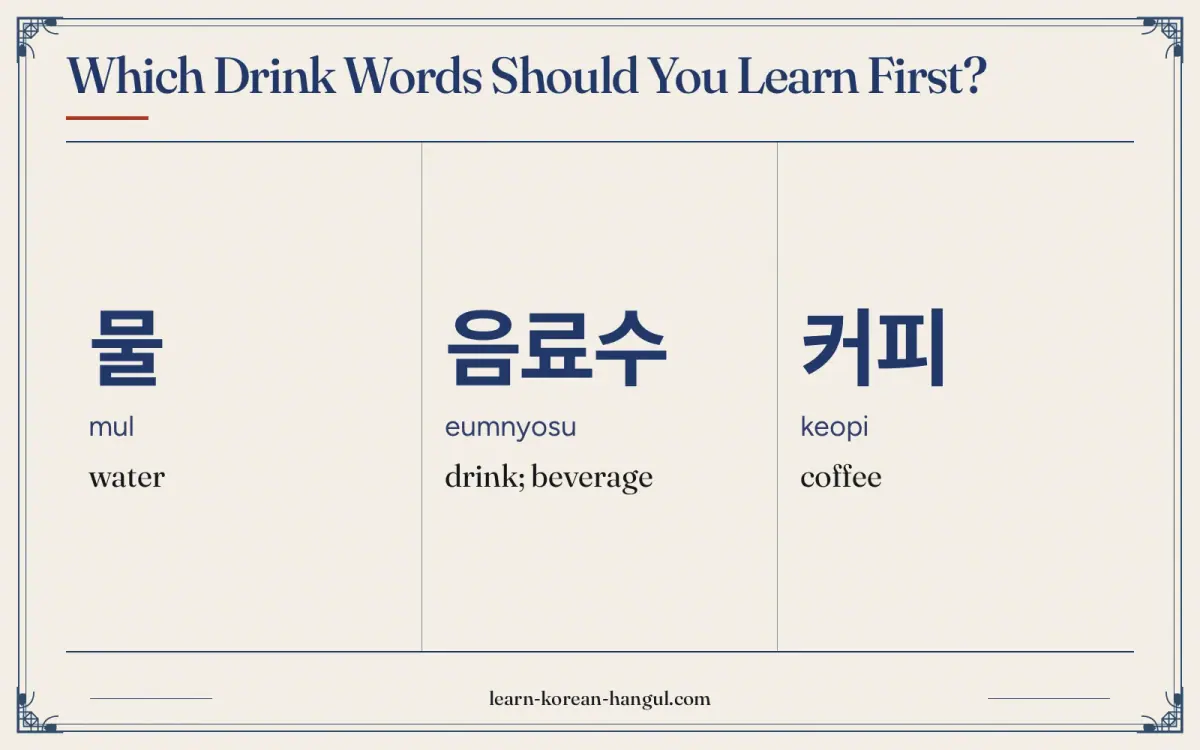
Learn 물 (water), 커피 (coffee), 차 (tea), 음료수 (beverage) and 주세요 with a counter, such as 한 잔 (one glass), first. With these you can ask for a drink in any shop or restaurant. After that, add 아이스 (iced) and 핫 (hot), because they come before the drink name in every cafe.
- Words to say. 물, 커피, 차, 주스, 아이스, 한 잔. These go straight into your order.
- Words to recognise. 식혜, 수정과, 보리차, 유자차. You will see these on traditional menus and in convenience stores.
- Words to understand when spoken. 사이즈, 휘핑크림, 테이크아웃. The staff say these as questions after you order.
Three contrasts save confusion. 물 is water, 음료수 is any soft drink and 차 is tea. Second, 차 is also "car", so the verb tells you which. Third, 사이다 is not cider; it is a clear lemon-lime soda. The single-word pages on water in korean and coffee in korean look at those words in more depth.
Word · 8
- 1
물
mul
water
- 2
음료수
eumnyosu
drink; beverage
- 3
커피
keopi
coffee
- 4
아메리카노
amerikano
Americano
- 5
식혜
sikhye
sweet rice drink
- 6
수정과
sujeonggwa
cinnamon punch
- 7
소주
soju
soju (distilled spirit)
- 8
아이스
aiseu
iced
Water and Soft Drinks
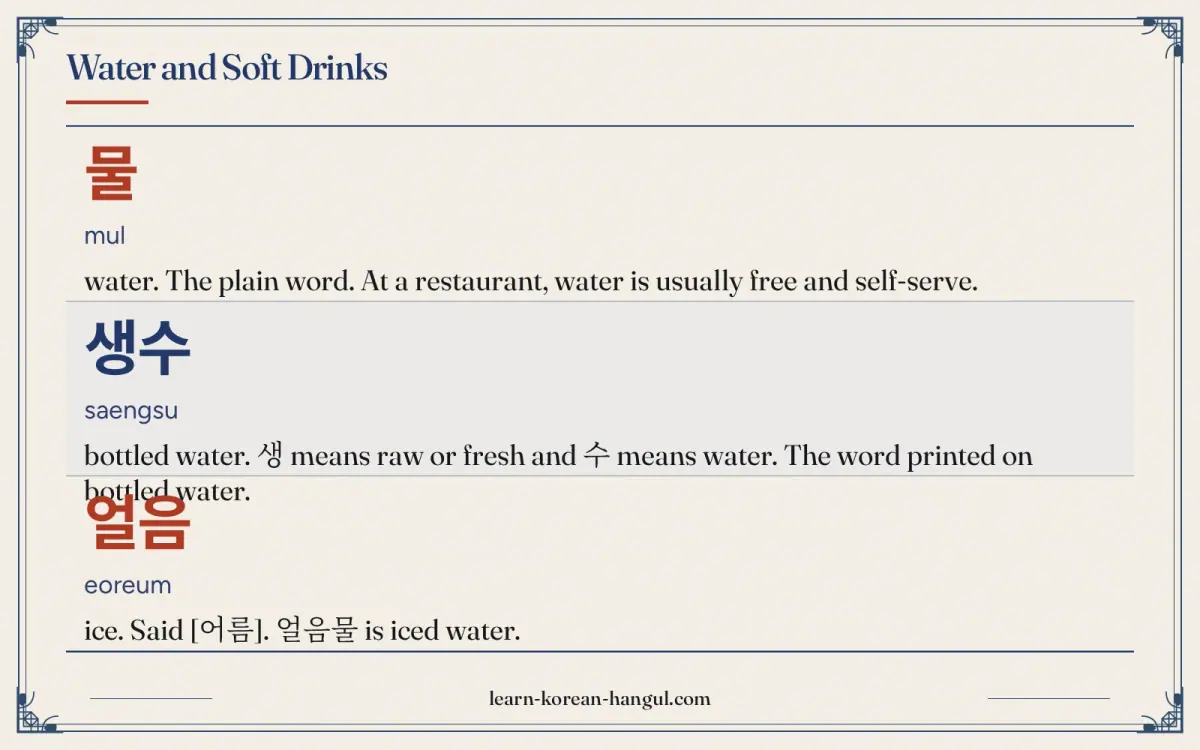
The plainest drink words come first. Korean separates 물 (water) from 음료수 (beverages in general), and it has a particular word, 사이다, for a drink that English speakers might expect to be cider. The group ends with milk, which Koreans group with drinks and not with food.
| No. | Hangul | Revised Romanization | Meaning and note | Example sentence | Audio assetId |
|---|---|---|---|---|---|
| 1 | 물 | mul | water. The plain word. At a restaurant, water is usually free and self-serve. | 물 한 잔 주세요. (A glass of water, please.) | au-pg-vocabulary-food-drinks-1; example: au-pg-vocabulary-food-drinks-46 |
| 2 | 생수 | saengsu | bottled water. 생 means raw or fresh and 수 means water. The word printed on bottled water. | 생수를 마셔요. (I drink bottled water.) | au-pg-vocabulary-food-drinks-2; example: au-pg-vocabulary-food-drinks-47 |
| 3 | 얼음 | eoreum | ice. Said [어름]. 얼음물 is iced water. | 얼음 많이 주세요. (Lots of ice, please.) | au-pg-vocabulary-food-drinks-3; example: au-pg-vocabulary-food-drinks-48 |
| 4 | 음료수 | eumnyosu | drink; beverage. Said [음뇨수]. The general word for a soft drink or juice. 음료 is a shorter form. | 시원한 음료수가 마시고 싶어요. (I want to drink a cold beverage.) | au-pg-vocabulary-food-drinks-4; example: au-pg-vocabulary-food-drinks-49 |
| 5 | 탄산음료 | tansaneumnyo | carbonated soft drink. Said [탄사늠뇨]. 탄산 means carbonation. The standard name for soda. | 탄산음료는 건강에 안 좋아요. (Soda is not good for your health.) | au-pg-vocabulary-food-drinks-5; example: au-pg-vocabulary-food-drinks-50 |
| 6 | 사이다 | saida | lemon-lime soda. Not cider. In Korea 사이다 is a clear, fizzy lemon-lime drink, like Sprite. | 사이다는 레몬 맛이에요. (Saida is lemon-lime flavoured.) | au-pg-vocabulary-food-drinks-6; example: au-pg-vocabulary-food-drinks-51 |
| 7 | 콜라 | kolla | cola. A loanword with a doubled l sound. | 콜라 한 캔 주세요. (One can of cola, please.) | au-pg-vocabulary-food-drinks-7; example: au-pg-vocabulary-food-drinks-52 |
| 8 | 주스 | juseu | juice. A loanword. Say the fruit first: 오렌지 주스. | 오렌지 주스를 마셔요. (I drink orange juice.) | au-pg-vocabulary-food-drinks-8; example: au-pg-vocabulary-food-drinks-53 |
| 9 | 우유 | uyu | milk. Flavoured milks such as 딸기 우유 (strawberry milk) and 바나나 우유 (banana milk) are convenience-store staples. | 아침에 우유를 마셔요. (I drink milk in the morning.) | au-pg-vocabulary-food-drinks-9; example: au-pg-vocabulary-food-drinks-54 |
Example Sentences
The examples use two frames. The first is drink + counter + 주세요 (please give me drink), as in 물 한 잔 주세요. The second is drink + 을/를 마셔요 (I drink drink), as in 우유를 마셔요. The particle 을 follows a noun that ends in a consonant and 를 follows a noun that ends in a vowel, so it is 우유를 and 생수를 but 물을. Say each sentence aloud after the audio clip, and swap in other drinks to make new ones.
Which Counters Go with Drinks?
Drinks are counted by the container, not by the liquid. The table lists four counters you need at a counter or a shop.
| Counter | Meaning | Example |
|---|---|---|
| 잔 | glass or cup | 물 한 잔 (a glass of water) |
| 병 | bottle | 소주 한 병 (a bottle of soju) |
| 캔 | can | 콜라 한 캔 (a can of cola) |
| 컵 | cup (takeout) | 커피 두 컵 (two cups of coffee) |
The numbers before these counters are native Korean numbers: 한, 두, 세, 네. See the food and drink counters page for the full list.
How Do You Say Coffee and Tea in Korean?
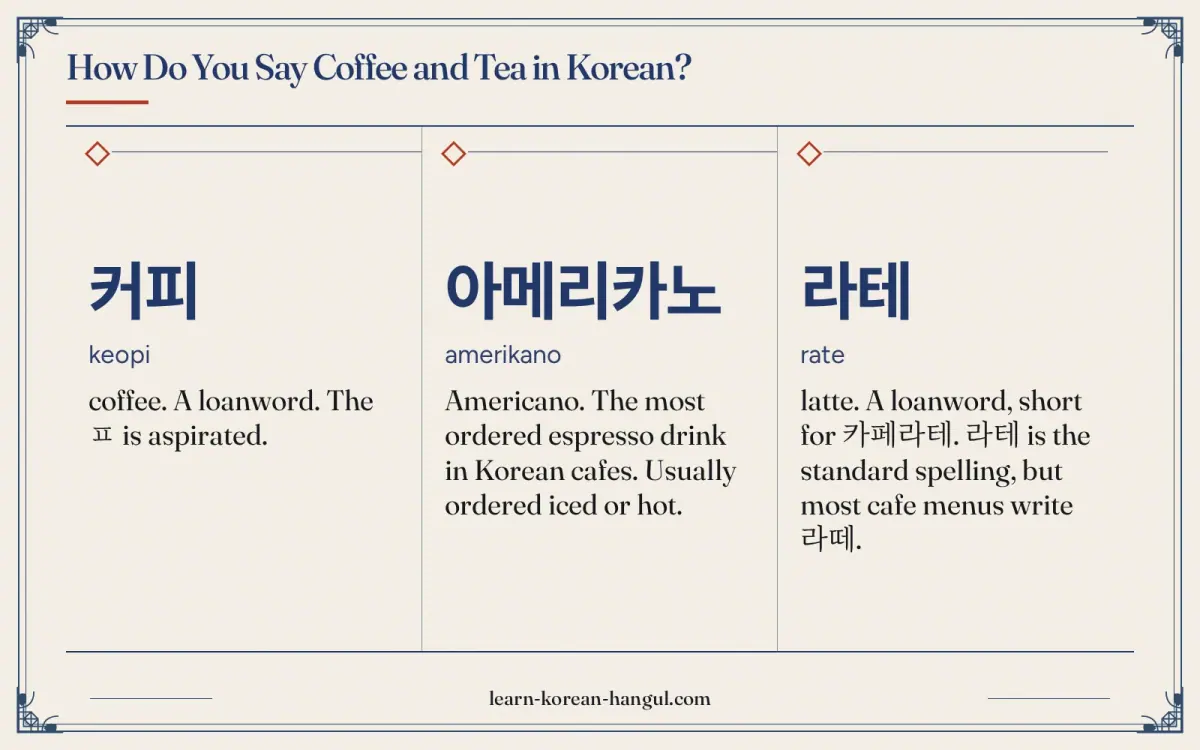
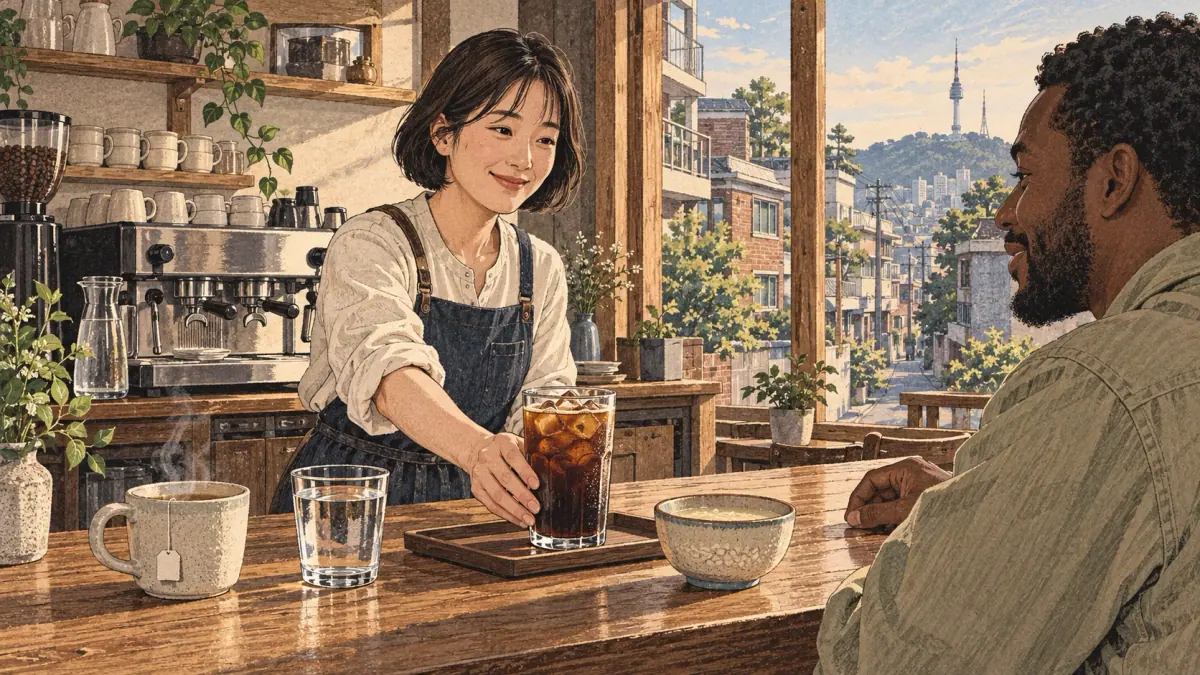
Coffee is a major part of daily life in Korea, and most coffee words are loanwords. Tea has its own native and Sino-Korean words, and the plain word 차 has a second meaning that you must watch. This group covers the drinks you order every day.
| No. | Hangul | Revised Romanization | Meaning and note | Example sentence | Audio assetId |
|---|---|---|---|---|---|
| 10 | 커피 | keopi | coffee. A loanword. The ㅍ is aspirated. | 커피 한 잔 마셔요. (I drink a cup of coffee.) | au-pg-vocabulary-food-drinks-10; example: au-pg-vocabulary-food-drinks-55 |
| 11 | 아메리카노 | amerikano | Americano. The most ordered espresso drink in Korean cafes. Usually ordered iced or hot. | 아메리카노 한 잔 주세요. (One Americano, please.) | au-pg-vocabulary-food-drinks-11; example: au-pg-vocabulary-food-drinks-56 |
| 12 | 라테 | rate | latte. A loanword, short for 카페라테. 라테 is the standard spelling, but most cafe menus write 라떼. | 라테는 우유가 들어가요. (A latte has milk in it.) | au-pg-vocabulary-food-drinks-12; example: au-pg-vocabulary-food-drinks-57 |
| 13 | 믹스커피 | mikseukeopi | instant mix coffee. A stick of instant coffee, sugar and creamer. A common office and home drink. | 믹스커피를 타요. (I make instant mix coffee.) | au-pg-vocabulary-food-drinks-13; example: au-pg-vocabulary-food-drinks-58 |
| 14 | 차 | cha | tea. 차 also means car. Context tells you which. Tea is usually 차 after a word, as in 녹차. | 따뜻한 차를 마셔요. (I drink warm tea.) | au-pg-vocabulary-food-drinks-14; example: au-pg-vocabulary-food-drinks-59 |
| 15 | 녹차 | nokcha | green tea. 녹 means green and 차 means tea. A well-known tea in Korea. | 녹차를 좋아해요. (I like green tea.) | au-pg-vocabulary-food-drinks-15; example: au-pg-vocabulary-food-drinks-60 |
| 16 | 홍차 | hongcha | black tea. 홍 means red, as the leaves oxidise. The English name is "black tea". | 홍차에 설탕을 넣어요. (I put sugar in black tea.) | au-pg-vocabulary-food-drinks-16; example: au-pg-vocabulary-food-drinks-61 |
| 17 | 허브차 | heobeucha | herbal tea. 허브 is the English "herb". Mint or chamomile tea. | 자기 전에 허브차를 마셔요. (I drink herbal tea before bed.) | au-pg-vocabulary-food-drinks-17; example: au-pg-vocabulary-food-drinks-62 |
| 18 | 티백 | tibaek | tea bag. A loanword. 티백을 우리다 means to steep a tea bag. | 티백을 우려요. (I steep a tea bag.) | au-pg-vocabulary-food-drinks-18; example: au-pg-vocabulary-food-drinks-63 |
The word 차 means both "tea" and "car". Written alone, the context decides: 차를 마셔요 means "I drink tea" because 마시다 goes with drinks, and 차를 타요 means "I ride in a car" because 타다 goes with vehicles. Verbs make the sentence clear, which is one reason to learn nouns together with their verbs. Single-word pages give more on coffee in korean and tea in korean.
Traditional Drinks
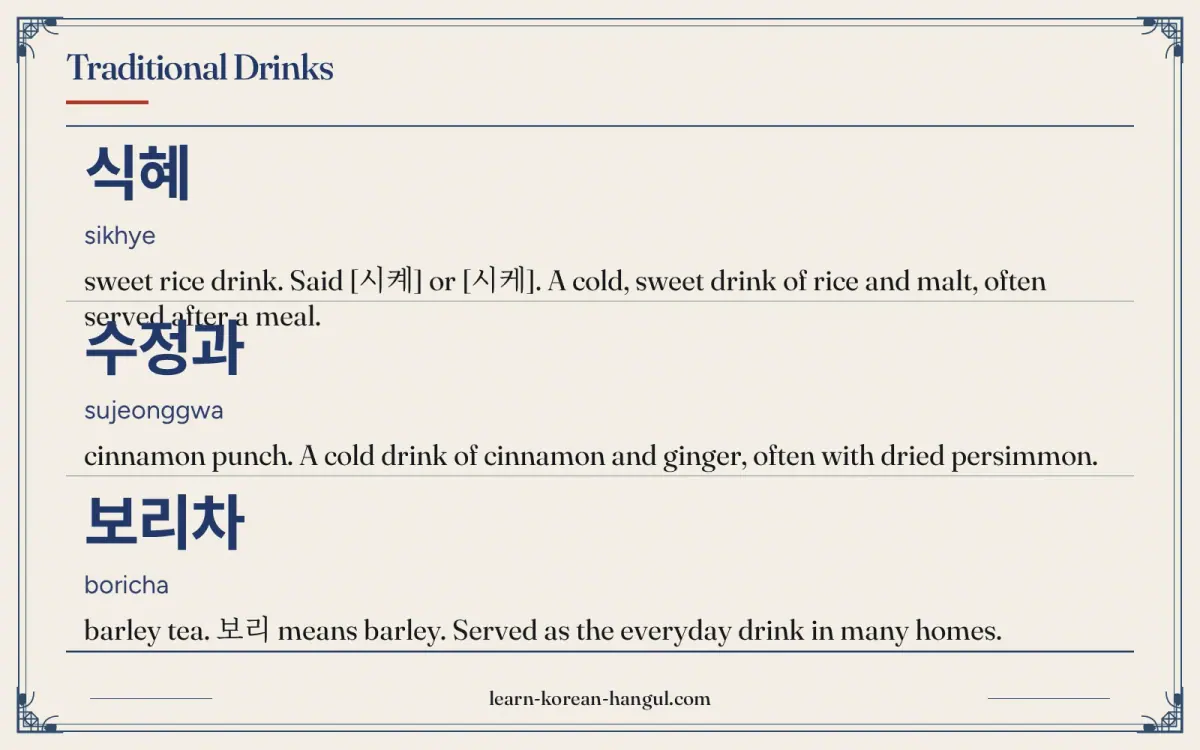
Traditional Korean drinks are served at family meals, in tea houses and at holidays, and most are made from grain, fruit or roots. They have native or Sino-Korean names that look unfamiliar at first, but each name tells you the main ingredient. These nine are the ones you meet on menus and in shops.
| No. | Hangul | Revised Romanization | Meaning and note | Example sentence | Audio assetId |
|---|---|---|---|---|---|
| 19 | 식혜 | sikhye | sweet rice drink. Said [시켸] or [시케]. A cold, sweet drink of rice and malt, often served after a meal. | 식혜는 달콤해요. (Sikhye is sweet.) | au-pg-vocabulary-food-drinks-19; example: au-pg-vocabulary-food-drinks-64 |
| 20 | 수정과 | sujeonggwa | cinnamon punch. A cold drink of cinnamon and ginger, often with dried persimmon. | 수정과는 계피 맛이 나요. (Sujeonggwa tastes of cinnamon.) | au-pg-vocabulary-food-drinks-20; example: au-pg-vocabulary-food-drinks-65 |
| 21 | 보리차 | boricha | barley tea. 보리 means barley. Served as the everyday drink in many homes. | 보리차를 끓여요. (I boil barley tea.) | au-pg-vocabulary-food-drinks-21; example: au-pg-vocabulary-food-drinks-66 |
| 22 | 유자차 | yujacha | yuzu tea. 유자 is a citrus fruit. Made from yuzu preserved in sugar or honey. | 유자차는 새콤달콤해요. (Yuzu tea is sweet and sour.) | au-pg-vocabulary-food-drinks-22; example: au-pg-vocabulary-food-drinks-67 |
| 23 | 매실차 | maesilcha | plum tea. 매실 is the Japanese plum. Often served cold in summer. | 매실차를 시원하게 마셔요. (I drink plum tea cold.) | au-pg-vocabulary-food-drinks-23; example: au-pg-vocabulary-food-drinks-68 |
| 24 | 오미자차 | omijacha | omija (five-flavour berry) tea. 오미자 means five flavours. A red tea with sweet, sour, bitter, salty and spicy notes. | 오미자차는 붉은색이에요. (Omija tea is red.) | au-pg-vocabulary-food-drinks-24; example: au-pg-vocabulary-food-drinks-69 |
| 25 | 대추차 | daechucha | jujube tea. 대추 is the jujube. A warm, sweet tea. | 대추차를 따뜻하게 마셔요. (I drink jujube tea warm.) | au-pg-vocabulary-food-drinks-25; example: au-pg-vocabulary-food-drinks-70 |
| 26 | 인삼차 | insamcha | ginseng tea. 인삼 is ginseng. A slightly bitter tea. | 인삼차는 조금 써요. (Ginseng tea is a little bitter.) | au-pg-vocabulary-food-drinks-26; example: au-pg-vocabulary-food-drinks-71 |
| 27 | 쌍화차 | ssanghwacha | ssanghwa tea (herbal). A thick herbal tea. Served in traditional tea houses. | 쌍화차는 한방차예요. (Ssanghwa tea is a herbal medicinal tea.) | au-pg-vocabulary-food-drinks-27; example: au-pg-vocabulary-food-drinks-72 |
The suffix 차 (tea) turns an ingredient into a drink: 보리 + 차 is barley tea, 유자 + 차 is yuzu tea and 대추 + 차 is jujube tea. You can build new names this way, and a tea house menu uses the same pattern. Note that 식혜 and 수정과 do not end in 차, since they are cold drinks with their own names. Learn them as a pair: they are the two classic after-meal drinks.
How Do You Say Alcohol in Korean?
Alcohol words matter in Korea because drinking is a common part of meals and work gatherings. The vocabulary covers the drinks, the toast and the food that goes with them. It also covers the morning after. These words are for adults, and the conversation around them has its own etiquette, which a separate page covers.
| No. | Hangul | Revised Romanization | Meaning and note | Example sentence | Audio assetId |
|---|---|---|---|---|---|
| 28 | 술 | sul | alcohol; liquor. The general word. 술을 마시다 is to drink alcohol. | 술을 마셔요. (I drink alcohol.) | au-pg-vocabulary-food-drinks-28; example: au-pg-vocabulary-food-drinks-73 |
| 29 | 소주 | soju | soju (distilled spirit). The best-known Korean spirit. Sold in green bottles and served in small glasses. | 소주 한 병 주세요. (One bottle of soju, please.) | au-pg-vocabulary-food-drinks-29; example: au-pg-vocabulary-food-drinks-74 |
| 30 | 맥주 | maekju | beer. Said [맥쭈]. 생맥주 is draught beer, often shortened to 생맥. | 맥주 한 잔 주세요. (A glass of beer, please.) | au-pg-vocabulary-food-drinks-30; example: au-pg-vocabulary-food-drinks-75 |
| 31 | 막걸리 | makgeolli | makgeolli (rice wine). Said [막껄리]. A milky, lightly sparkling drink made from rice. | 막걸리는 쌀로 만들어요. (Makgeolli is made from rice.) | au-pg-vocabulary-food-drinks-31; example: au-pg-vocabulary-food-drinks-76 |
| 32 | 와인 | wain | wine. A loanword. 레드 와인 is red wine. | 와인 한 잔 마셔요. (I drink a glass of wine.) | au-pg-vocabulary-food-drinks-32; example: au-pg-vocabulary-food-drinks-77 |
| 33 | 건배 | geonbae | toast; cheers. Said as a call when glasses are raised, as in 건배 (cheers). | 다 같이 건배해요. (Let us all make a toast together.) | au-pg-vocabulary-food-drinks-33; example: au-pg-vocabulary-food-drinks-78 |
| 34 | 안주 | anju | food eaten with drinks. Dishes ordered to go with alcohol. Not the same as a main meal. | 안주는 뭐가 좋아요? (What goes well with the drinks?) | au-pg-vocabulary-food-drinks-34; example: au-pg-vocabulary-food-drinks-79 |
| 35 | 숙취 | sukchwi | hangover. 숙 means staying overnight and 취 means drunk. | 숙취가 있어요. (I have a hangover.) | au-pg-vocabulary-food-drinks-35; example: au-pg-vocabulary-food-drinks-80 |
| 36 | 해장 | haejang | curing a hangover. 해장하다 is the verb. 해장국 is a soup eaten for this. | 해장하러 국밥을 먹어요. (I eat gukbap to cure my hangover.) | au-pg-vocabulary-food-drinks-36; example: au-pg-vocabulary-food-drinks-81 |
Look at the word 안주. It is a Korean concept with no direct English word: food ordered to accompany drinks, and not eaten as a meal. In a bar the staff will ask 안주는 뭘로 하시겠어요? (what would you like for food?). See Korean Drinking Culture Vocabulary.
Cafe Menu Words
A cafe menu mixes English loanwords with a few Korean question forms, and the order of choices is always the same: hot or iced, size, extras. Knowing this order lets you order a drink exactly as you want it. The list gives the nine words that fill in the blanks.
| No. | Hangul | Revised Romanization | Meaning and note | Example sentence | Audio assetId |
|---|---|---|---|---|---|
| 37 | 메뉴 | menyu | menu. A loanword. 메뉴판 is the menu board. | 메뉴 좀 보여 주세요. (Please show me the menu.) | au-pg-vocabulary-food-drinks-37; example: au-pg-vocabulary-food-drinks-82 |
| 38 | 아이스 | aiseu | iced. Put before the drink name: 아이스 아메리카노. | 아이스 아메리카노 주세요. (An iced Americano, please.) | au-pg-vocabulary-food-drinks-38; example: au-pg-vocabulary-food-drinks-83 |
| 39 | 핫 | hat | hot (drink). A loanword, put before the drink: 핫 라테. 따뜻한 is the Korean for warm. | 핫 라테 주세요. (A hot latte, please.) | au-pg-vocabulary-food-drinks-39; example: au-pg-vocabulary-food-drinks-84 |
| 40 | 샷 | syat | shot (of espresso). A loanword. 샷 추가 is an extra shot. | 샷 추가해 주세요. (Please add a shot.) | au-pg-vocabulary-food-drinks-40; example: au-pg-vocabulary-food-drinks-85 |
| 41 | 시럽 | sireop | syrup. A loanword. 시럽 빼 주세요 asks for no syrup. | 시럽은 빼 주세요. (Please leave out the syrup.) | au-pg-vocabulary-food-drinks-41; example: au-pg-vocabulary-food-drinks-86 |
| 42 | 사이즈 | saijeu | size. A loanword. Depending on the chain, sizes are 톨, 그란데 and 벤티, or 레귤러 and 라지. | 사이즈는 어떻게 하시겠어요? (What size would you like?) | au-pg-vocabulary-food-drinks-42; example: au-pg-vocabulary-food-drinks-87 |
| 43 | 톨 | tol | tall (small-medium size). A loanword from the cafe size name. | 톨 사이즈로 주세요. (A tall size, please.) | au-pg-vocabulary-food-drinks-43; example: au-pg-vocabulary-food-drinks-88 |
| 44 | 휘핑크림 | hwipingkeurim | whipped cream. A loanword. 휘핑 means whipped. | 휘핑크림 올려 드릴까요? (Shall I put whipped cream on top?) | au-pg-vocabulary-food-drinks-44; example: au-pg-vocabulary-food-drinks-89 |
| 45 | 테이크아웃 | teikeuaut | takeout. A loanword. The staff ask whether you want it here or to go. | 테이크아웃이에요. (It is takeout.) | au-pg-vocabulary-food-drinks-45; example: au-pg-vocabulary-food-drinks-90 |
How Do You Order a Drink at a Korean Cafe?
A typical order has four steps. This sample shows them in order and uses mostly words from this page.
| Speaker | Korean | English |
|---|---|---|
| Staff | 주문하시겠어요? | Would you like to order? |
| Customer | 아이스 아메리카노 한 잔 주세요. | One iced Americano, please. |
| Staff | 사이즈는 어떻게 하시겠어요? | What size would you like? |
| Customer | 톨 사이즈로 주세요. | A tall size, please. |
| Staff | 드시고 가세요? | Will you drink it here? |
| Customer | 테이크아웃이에요. | It is takeout. |
The particle 로 in 사이즈로 marks the choice: "as a tall size". For a fuller menu vocabulary, with more drinks, extras, pastries and the eat-in or takeaway question, see the cafe menu page.
How Do You Pronounce These Words?
Drink words contain several sound changes. The Hangul shows the written form, while the spoken form shifts where a final consonant meets another sound. Standard pronunciation follows the National Institute of Korean Language (국립국어원) rules, and the romanization follows the Revised Romanization of Korean, which records some sound changes and ignores others.
| Spelling | Sounds like | What changes |
|---|---|---|
| 음료수 | [음뇨수] | ㄹ becomes [ㄴ] after ㅁ. |
| 탄산음료 | [탄사늠뇨] | The final ㄴ links to the vowel of 음, and ㄹ becomes [ㄴ] after ㅁ. |
| 맥주 | [맥쭈] | After a final ㄱ, ㅈ becomes tense [ㅉ]. |
| 막걸리 | [막껄리] | After a final ㄱ, the ㄱ of 걸 becomes tense [ㄲ]. |
| 식혜 | [시켸] or [시케] | ㄱ and ㅎ merge into [ㅋ]; 혜 may be said [케]. |
| 얼음 | [어름] | The final ㄹ links to the vowel of 음. |
The tense sounds in 맥주 and 막걸리 are the ones learners miss most. A tense consonant is said with a tight throat and no puff of air. The doubled l in 콜라 is one long l, held slightly longer than a single l.
Audio and Slow Playback
Every headword and every example sentence has its own audio. The five clips below replay the trickiest words slowly. Play one, repeat it aloud, then play it again and compare.
What Mistakes Do Learners Make with Drink Words?
These five mistakes come up often with drink words.
- Hearing 사이다 as cider. Cider in English is an apple drink. In Korea, 사이다 is a clear lemon-lime soda. If you want an apple drink, say 사과 주스.
- Using 차 without context. 차를 마셔요 is tea and 차를 타요 is a car. The verb makes the difference.
- Using 개 for drinks. Count drinks with 잔, 병, 캔 or 컵, as in 커피 두 잔. Using 개 sounds odd.
- Saying 물 for any liquid. 물 means plain water. Juice is 주스 and tea is 차. Use 물 only for water.
- Forgetting the order at a cafe. Say hot or iced first, then the drink, then the size: 아이스 아메리카노, 톨 사이즈. Reversing the order still works but sounds less natural.
If you meet only one, make it the counter mistake, because it comes up whenever you order more than one drink.
Practice: Flashcards and Worksheet
Study in three steps. First, run the flashcard deck in recognition mode until you know each of the 45 words. Second, switch to listening mode and answer from the audio alone. Third, take the quiz. The deck covers all 45 words with audio, and your progress stays in your browser. The vocabulary flashcard decks page lists the other decks.
Practice · 95
- 01물
Show answer
headword 1: water
- 02물 한 잔 주세요.
Show answer
example sentence for 물: A glass of water, please.
- 03생수
Show answer
headword 2: bottled water
- 04생수를 마셔요.
Show answer
example sentence for 생수: I drink bottled water.
- 05얼음
Show answer
headword 3: ice
- 06얼음 많이 주세요.
Show answer
example sentence for 얼음: Lots of ice, please.
- 07음료수
Show answer
headword 4: drink; beverage
- 08시원한 음료수가 마시고 싶어요.
Show answer
example sentence for 음료수: I want to drink a cold beverage.
- 09탄산음료
Show answer
headword 5: carbonated soft drink
- 10탄산음료는 건강에 안 좋아요.
Show answer
example sentence for 탄산음료: Soda is not good for your health.
- 11사이다
Show answer
headword 6: lemon-lime soda
- 12사이다는 레몬 맛이에요.
Show answer
example sentence for 사이다: Saida is lemon-lime flavoured.
- 13콜라
Show answer
headword 7: cola
- 14콜라 한 캔 주세요.
Show answer
example sentence for 콜라: One can of cola, please.
- 15주스
Show answer
headword 8: juice
- 16오렌지 주스를 마셔요.
Show answer
example sentence for 주스: I drink orange juice.
- 17우유
Show answer
headword 9: milk
- 18아침에 우유를 마셔요.
Show answer
example sentence for 우유: I drink milk in the morning.
- 19커피
Show answer
headword 10: coffee
- 20커피 한 잔 마셔요.
Show answer
example sentence for 커피: I drink a cup of coffee.
- 21아메리카노
Show answer
headword 11: Americano
- 22아메리카노 한 잔 주세요.
Show answer
example sentence for 아메리카노: One Americano, please.
- 23라테
Show answer
headword 12: latte
- 24라테는 우유가 들어가요.
Show answer
example sentence for 라테: A latte has milk in it.
- 25믹스커피
Show answer
headword 13: instant mix coffee
- 26믹스커피를 타요.
Show answer
example sentence for 믹스커피: I make instant mix coffee.
- 27차
Show answer
headword 14: tea
- 28따뜻한 차를 마셔요.
Show answer
example sentence for 차: I drink warm tea.
- 29녹차
Show answer
headword 15: green tea
- 30녹차를 좋아해요.
Show answer
example sentence for 녹차: I like green tea.
- 31홍차
Show answer
headword 16: black tea
- 32홍차에 설탕을 넣어요.
Show answer
example sentence for 홍차: I put sugar in black tea.
- 33허브차
Show answer
headword 17: herbal tea
- 34자기 전에 허브차를 마셔요.
Show answer
example sentence for 허브차: I drink herbal tea before bed.
- 35티백
Show answer
headword 18: tea bag
- 36티백을 우려요.
Show answer
example sentence for 티백: I steep a tea bag.
- 37식혜
Show answer
headword 19: sweet rice drink
- 38식혜는 달콤해요.
Show answer
example sentence for 식혜: Sikhye is sweet.
- 39수정과
Show answer
headword 20: cinnamon punch
- 40수정과는 계피 맛이 나요.
Show answer
example sentence for 수정과: Sujeonggwa tastes of cinnamon.
- 41보리차
Show answer
headword 21: barley tea
- 42보리차를 끓여요.
Show answer
example sentence for 보리차: I boil barley tea.
- 43유자차
Show answer
headword 22: yuzu tea
- 44유자차는 새콤달콤해요.
Show answer
example sentence for 유자차: Yuzu tea is sweet and sour.
- 45매실차
Show answer
headword 23: plum tea
- 46매실차를 시원하게 마셔요.
Show answer
example sentence for 매실차: I drink plum tea cold.
- 47오미자차
Show answer
headword 24: omija (five-flavour berry) tea
- 48오미자차는 붉은색이에요.
Show answer
example sentence for 오미자차: Omija tea is red.
- 49대추차
Show answer
headword 25: jujube tea
- 50대추차를 따뜻하게 마셔요.
Show answer
example sentence for 대추차: I drink jujube tea warm.
- 51인삼차
Show answer
headword 26: ginseng tea
- 52인삼차는 조금 써요.
Show answer
example sentence for 인삼차: Ginseng tea is a little bitter.
- 53쌍화차
Show answer
headword 27: ssanghwa tea (herbal)
- 54쌍화차는 한방차예요.
Show answer
example sentence for 쌍화차: Ssanghwa tea is a herbal medicinal tea.
- 55술
Show answer
headword 28: alcohol; liquor
- 56술을 마셔요.
Show answer
example sentence for 술: I drink alcohol.
- 57소주
Show answer
headword 29: soju (distilled spirit)
- 58소주 한 병 주세요.
Show answer
example sentence for 소주: One bottle of soju, please.
- 59맥주
Show answer
headword 30: beer
- 60맥주 한 잔 주세요.
Show answer
example sentence for 맥주: A glass of beer, please.
- 61막걸리
Show answer
headword 31: makgeolli (rice wine)
- 62막걸리는 쌀로 만들어요.
Show answer
example sentence for 막걸리: Makgeolli is made from rice.
- 63와인
Show answer
headword 32: wine
- 64와인 한 잔 마셔요.
Show answer
example sentence for 와인: I drink a glass of wine.
- 65건배
Show answer
headword 33: toast; cheers
- 66다 같이 건배해요.
Show answer
example sentence for 건배: Let us all make a toast together.
- 67안주
Show answer
headword 34: food eaten with drinks
- 68안주는 뭐가 좋아요?
Show answer
example sentence for 안주: What goes well with the drinks?
- 69숙취
Show answer
headword 35: hangover
- 70숙취가 있어요.
Show answer
example sentence for 숙취: I have a hangover.
- 71해장
Show answer
headword 36: curing a hangover
- 72해장하러 국밥을 먹어요.
Show answer
example sentence for 해장: I eat gukbap to cure my hangover.
- 73메뉴
Show answer
headword 37: menu
- 74메뉴 좀 보여 주세요.
Show answer
example sentence for 메뉴: Please show me the menu.
- 75아이스
Show answer
headword 38: iced
- 76아이스 아메리카노 주세요.
Show answer
example sentence for 아이스: An iced Americano, please.
- 77핫
Show answer
headword 39: hot (drink)
- 78핫 라테 주세요.
Show answer
example sentence for 핫: A hot latte, please.
- 79샷
Show answer
headword 40: shot (of espresso)
- 80샷 추가해 주세요.
Show answer
example sentence for 샷: Please add a shot.
- 81시럽
Show answer
headword 41: syrup
- 82시럽은 빼 주세요.
Show answer
example sentence for 시럽: Please leave out the syrup.
- 83사이즈
Show answer
headword 42: size
- 84사이즈는 어떻게 하시겠어요?
Show answer
example sentence for 사이즈: What size would you like?
- 85톨
Show answer
headword 43: tall (small-medium size)
- 86톨 사이즈로 주세요.
Show answer
example sentence for 톨: A tall size, please.
- 87휘핑크림
Show answer
headword 44: whipped cream
- 88휘핑크림 올려 드릴까요?
Show answer
example sentence for 휘핑크림: Shall I put whipped cream on top?
- 89테이크아웃
Show answer
headword 45: takeout
- 90테이크아웃이에요.
Show answer
example sentence for 테이크아웃: It is takeout.
- 91음료수
Show answer
slow playback of headword 4: drink; beverage
- 92식혜
Show answer
slow playback of headword 19: sweet rice drink
- 93수정과
Show answer
slow playback of headword 20: cinnamon punch
- 94막걸리
Show answer
slow playback of headword 31: makgeolli (rice wine)
- 95맥주
Show answer
slow playback of headword 30: beer
Practice · 5
What does 물 (mul) mean?
Show answer
water
물 means water. Example: 물 한 잔 주세요. (A glass of water, please.)
What does 음료수 (eumnyosu) mean?
Show answer
drink; beverage
음료수 means drink; beverage. Example: 시원한 음료수가 마시고 싶어요. (I want to drink a cold beverage.)
What does 차 (cha) mean?
Show answer
tea
차 means tea. Example: 따뜻한 차를 마셔요. (I drink warm tea.)
What does 식혜 (sikhye) mean?
Show answer
sweet rice drink
식혜 means sweet rice drink. Example: 식혜는 달콤해요. (Sikhye is sweet.)
What does 막걸리 (makgeolli) mean?
Show answer
makgeolli (rice wine)
막걸리 means makgeolli (rice wine). Example: 막걸리는 쌀로 만들어요. (Makgeolli is made from rice.)
Korean Drinks Vocabulary Worksheet (PDF)
A printable worksheet for these words (word list, matching, writing practice, fill-in-the-blank exercises and answer key) is available in A4 and US Letter from the download card on this page. For practice, write your own cafe order in Korean: the drink, the temperature, the size and the counter. Read it aloud, then compare it with the sample in the cafe menu section.
Where to Go Next
After this page, continue with At the Restaurant, which teaches the words for ordering a meal, or Fruits and Vegetables. To move up a level, return to Food and Drink.
Pages in This Section
Two deeper pages sit under this one. Choose the one that matches what you want to order.
- Korean Cafe Menu Vocabulary: 35 words for coffee and tea drinks, sizes and extras, pastries, and eat-in or takeaway, plus the slang 아아 and 뜨아.
- Korean Drinking Culture Vocabulary: soju, beer, toasts, rounds and hangover words.
Frequently Asked Questions
How Do You Say Water in Korean?
Water is 물 (mul). Ask for a glass with 물 한 잔 주세요 (mul han jan juseyo), meaning "a glass of water, please". Bottled water is 생수 (saengsu). Add 을 to make an object: 물을 마셔요 (mureul masyeoyo), "I drink water". In most restaurants water is free and self-serve.
How Do You Pronounce 음료수 (eumnyosu)?
Say eum-nyo-su, written [음뇨수]. The ㄹ in 료 becomes [ㄴ] after the ㅁ in 음, so the middle sounds like "nyo", not "ryo". The vowel ㅡ in 음 is flat, with spread lips. Press the audio button on this page for the normal and slow versions.
How Many Drink Words Should I Learn First?
Five first: 물, 커피, 차, 음료수 and 한 잔. At five new words a day, the whole list of 45 takes nine days plus review. Add 아이스 and 핫 on day two, since every cafe order uses them.
Where Can I Practise Drink Words with Flashcards?
Use the vocabulary flashcard decks. The deck for this page holds all 45 words with Hangul, romanization and audio, and it offers recognition and listening modes. Your progress stays in your browser, so return daily and review the cards you missed.
Is the Romanization on This Page Official?
It follows the Revised Romanization of Korean, which South Korea adopted on 7 July 2000 and whose rules the National Institute of Korean Language (국립국어원) publishes. It is a learning aid and does not mark every sound change, so rely on the Hangul and the audio.
Is There a Printable Worksheet for Drink Words?
A printable worksheet for these words (word list, matching, writing practice, fill-in-the-blank exercises and answer key) is available in A4 and US Letter from the download card on this page. For practice, copy the tables on this page by hand or use the flashcard deck, which carries the same 45 words.