
Korean Personality Words Flashcards: Study the 24 Cards
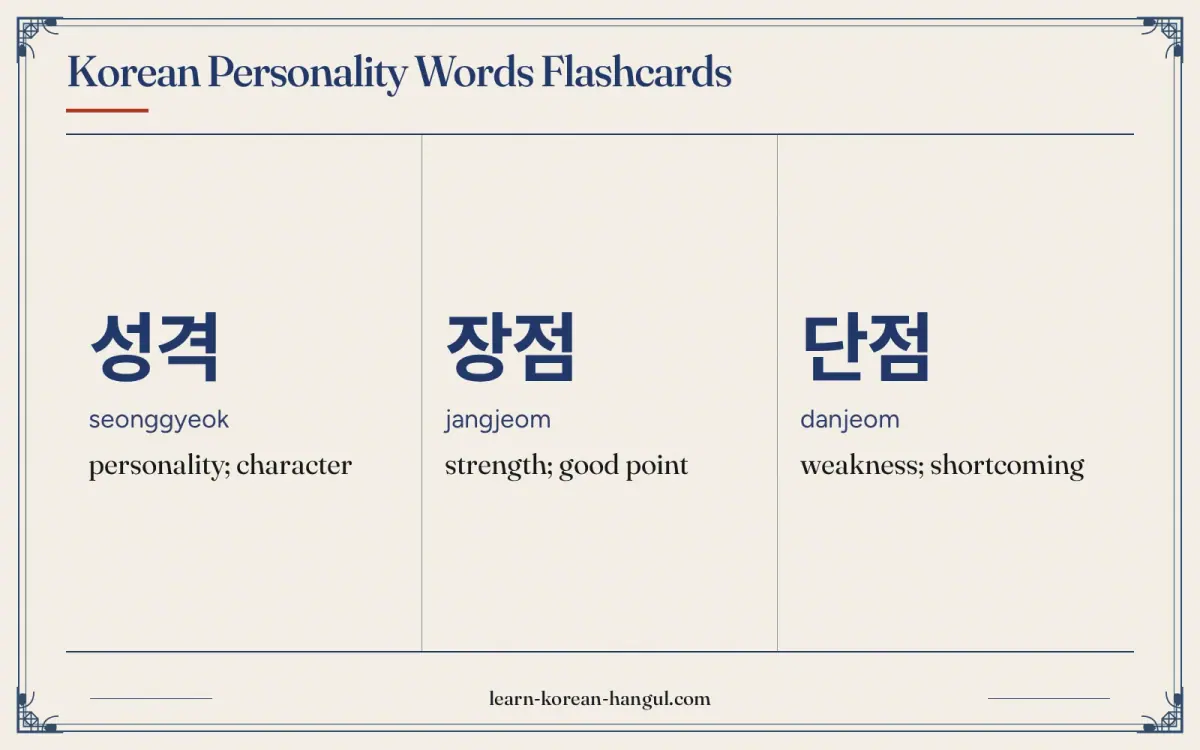
Most of these cards are nouns. To describe a person, add 하다 or 이다: 친절 becomes 친절하다 (to be kind), and 친절해요 in polite speech. The lesson behind the deck is korean personality words, so read it first if a card is new.
How Do I Use These Flashcards?
Use the deck above in four steps. It works with tap, click or keyboard, and nothing plays until you press an audio button.
- Choose a mode. Start with recognition (Hangul to meaning). Switch to recall (meaning to Hangul) or listening (audio to meaning) once recognition feels easy.
- Show the answer. Think of the answer first, then press Show answer (or Space). Turn on the romanization toggle only if you need it; the 24-card table below always shows it.
- Grade yourself. Press Got it if you answered correctly without help, or Not yet if you hesitated or guessed.
- Finish the session. A session holds up to 20 cards (you can set 10, 20 or 40). With 24 cards, a first-time learner can split the deck over three days, using the default limit of 10 new cards a day.
The Three Study Modes
Recognition shows the Hangul and asks for the meaning, which trains reading. Recall shows the meaning and asks for the Hangul, which trains remembering; you may type the answer with your Hangul keyboard or just recall it in your head. Listening plays a clip and hides the letters, which trains the ear. Listening mode only uses a card once its audio is approved, and cards without approved audio are skipped in that mode with a note.
Got It and Not Yet
Got it moves the card up one Leitner box, so it comes back later. Not yet sends the card back to box 1, so it returns in the same session or within 10 minutes. The grades are your own judgement; the deck does not score you or claim fluency.
Deck Scope: What Is and Is Not Covered
The deck covers the core word 성격, strengths and weaknesses (장점, 단점), the first-impression words (인상, 첫인상), the -적 words for how outgoing or active someone is (외향적, 내향적, 사교적, 적극적, 소극적) and the nouns for traits such as 친절, 배려, 겸손 and 책임감. Moods and feelings belong to the emotions deck, and body words belong to the body-parts deck.
What Is Left out of This Deck?
Feeling words such as 기쁨 and 슬픔 are in the korean emotions flashcards, and words for the body are in the korean body parts flashcards. Longer personality talk, such as MBTI and blood type, is on the lesson page but not on these cards. The deck also leaves out looks words such as height and build.
All 24 Cards in One Table
All 24 cards appear below in deck order. The table is plain HTML, so you can use it as a drill without the deck: cover the Meaning column, read each Hangul word aloud, then uncover the meaning.
| # | Hangul | Revised Romanization | Meaning | Note | Audio assetId |
|---|---|---|---|---|---|
| 1 | 성격 | seonggyeok | personality; character | The core word. The usual frame is 성격이 좋다 (to have a good personality). | au-pg-flashcards-personality-words-1 |
| 2 | 장점 | jangjeom | strength; good point | Literally "long point". Used for people and for things. Said [장쩜]. | au-pg-flashcards-personality-words-2 |
| 3 | 단점 | danjeom | weakness; shortcoming | Literally "short point". The standard partner of 장점 in interviews. Said [단쩜]. | au-pg-flashcards-personality-words-3 |
| 4 | 매력 | maeryeok | charm; appeal | 매력이 있다 means to be charming. | au-pg-flashcards-personality-words-4 |
| 5 | 개성 | gaeseong | individuality; distinct character | A positive word for a person's own style. | au-pg-flashcards-personality-words-5 |
| 6 | 태도 | taedo | attitude; manner | How a person acts toward others or toward a task. | au-pg-flashcards-personality-words-6 |
| 7 | 인상 | insang | impression; look | The look or feel a person gives. 인상이 좋다 means to look pleasant. | au-pg-flashcards-personality-words-7 |
| 8 | 첫인상 | cheotinsang | first impression | Said [처딘상]. 첫 means first and 인상 means impression. | au-pg-flashcards-personality-words-8 |
| 9 | 외향적 | oehyangjeok | extroverted; outgoing | 외향 means facing outward and 적 makes it descriptive. Used with 이에요: 외향적이에요. | au-pg-flashcards-personality-words-9 |
| 10 | 내향적 | naehyangjeok | introverted | 내향 means facing inward. The opposite of 외향적. Very common in MBTI talk. | au-pg-flashcards-personality-words-10 |
| 11 | 사교적 | sagyojeok | sociable | 사교 means social contact. Describes someone who easily makes friends. | au-pg-flashcards-personality-words-11 |
| 12 | 적극적 | jeokgeukjeok | proactive; active | Said [적끅쩍]. Takes the initiative. | au-pg-flashcards-personality-words-12; slow: au-pg-flashcards-personality-words-25 |
| 13 | 소극적 | sogeukjeok | passive; reserved | Said [소극쩍]. The opposite of 적극적. Holds back from taking the lead. | au-pg-flashcards-personality-words-13 |
| 14 | 수줍음 | sujubeum | shyness | The noun for the feeling. 수줍음이 많다 means to be shy. | au-pg-flashcards-personality-words-14 |
| 15 | 낯가림 | natgarim | shyness around strangers | Said [낟까림]. Literally "avoiding faces". Also used for babies who fuss with strangers. | au-pg-flashcards-personality-words-15; slow: au-pg-flashcards-personality-words-26 |
| 16 | 친절 | chinjeol | kindness; friendliness | The adjective is 친절하다: 친절한 사람 (a kind person). | au-pg-flashcards-personality-words-16 |
| 17 | 배려 | baeryeo | consideration; thoughtfulness | A very positive noun. 배려하다 means to be considerate. | au-pg-flashcards-personality-words-17 |
| 18 | 다정 | dajeong | warmth; affection | Used as 다정하다, to be warm and caring toward others. | au-pg-flashcards-personality-words-18 |
| 19 | 엄격 | eomgyeok | strictness | Said [엄껵]. 엄격하다 describes a teacher or parent with firm rules. | au-pg-flashcards-personality-words-19; slow: au-pg-flashcards-personality-words-27 |
| 20 | 고집 | gojip | stubbornness | 고집이 세다 means to be stubborn. | au-pg-flashcards-personality-words-20 |
| 21 | 예의 | yeui | manners; etiquette | 예의가 바르다 means to be well-mannered. | au-pg-flashcards-personality-words-21 |
| 22 | 겸손 | gyeomson | modesty; humility | 겸손하다 describes someone who does not boast. | au-pg-flashcards-personality-words-22 |
| 23 | 성실 | seongsil | diligence; sincerity | The most common praise word for a worker. 성실하다 means to be diligent. | au-pg-flashcards-personality-words-23 |
| 24 | 책임감 | chaegimgam | sense of responsibility | Said [채김감]. 책임 is responsibility and 감 means feeling. A standard interview word. | au-pg-flashcards-personality-words-24; slow: au-pg-flashcards-personality-words-28 |
Reading the Table
Hangul is the word. Revised Romanization (RR) is a learning aid, so try to read the Hangul before you look at it. RR follows the sound of the word, which is why some spellings change. The Meaning column gives the English gloss, and the Note column gives a hint about form or sound. Many words end in -적 (like) or take -하다; the notes say which. The last column lists the audio assetId; a second ID marks a slow clip.
Usage Notes for These Cards
Add 하다 to make a description. Most of these nouns become adjectives with 하다, and 하다 changes to 해요 in polite speech: 친절하다 turns into 친절해요 (He is kind). 겸손하다, 성실하다 and 엄격하다 work the same way.
Talk about yourself with 제. 제 성격은 조용해요 (My personality is quiet) is the usual frame. 제 장점은 성실함이에요 and 제 단점은 너무 급한 거예요 are the standard interview pair.
-적 words describe a style. The suffix -적 works like English "-ive" or "-ish": 외향적 (outgoing), 내향적 (introverted), 적극적 (proactive). Add 이다 or 인 to use them: 저는 외향적인 사람이에요 (I am an outgoing person).
친절 and 친하다 are different. 친절하다 is about helpful behaviour, while 친하다 means being close to a person: 우리는 친해요 (We are close). A kind stranger can be 친절해요 without being 친해요.
Strong traits take 이 or 가. Many trait phrases use a particle: 고집이 세다 (to be stubborn), 예의가 바르다 (to be well-mannered), 매력이 있다 (to be charming).
Which Sounds Do Not Match the Spelling?
Several words in this deck change sound when they are said. The table shows the Revised Romanization of the standard spelling, and the notes give the pronounced form.
- 적극적 is said [적끅쩍] and 소극적 is said [소극쩍]. Tense consonants appear after the closed ㄱ sound in each word.
- 낯가림 is said [낟까림]. The ㅈ of 낯 becomes a closed [t] sound, and the ㄱ after it is tense.
- 엄격 is said [엄껵]: the dictionary lists a tense ㄲ after the ㅁ in this word. 책임감 is said [채김감]: the ㄱ of 책 links to the vowel of 임.
The pronunciations follow the 국립국어원 (National Institute of Korean Language) standard pronunciation rules (표준 발음법), and the romanization follows the Revised Romanization of Korean (2000).
What Mistakes Do Learners Make with Personality Words?
- Leaving the -적 words bare. Add 이에요 at the end (저는 외향적이에요) and 인 before a noun (외향적인 사람), the everyday form.
- Mixing up 친절하다 (kind in action) and 친하다 (close to someone).
- Using 고집 as praise. It means stubbornness and is usually a criticism; the positive word is 끈기 (perseverance).
- Saying 수줍음 and 낯가림 are the same. 수줍음 is general shyness, while 낯가림 is shyness around strangers.
- Copying English word order. Say 성격이 좋다 (to have a good personality), not 좋은 성격을 가지고 있다, a word-for-word copy of the English that sounds stiff.
How Does the Review Schedule Work?
The deck uses a simplified Leitner system with five boxes. A new card starts in box 1. Each Got it moves it up one box, and each Not yet returns it to box 1. The box sets how long the card waits before it is due again.
| Box | Wait until the next review |
|---|---|
| 1 | same session or 10 minutes |
| 2 | 1 day |
| 3 | 3 days |
| 4 | 7 days |
| 5 | 21 days |
Each session shows due cards first, oldest due first, and then up to 10 new cards a day by default. A deck of 24 cards is introduced over three days at the default of 10 new cards a day, and the later boxes bring each card back at longer gaps. Progress is saved only in this browser, so clearing site data deletes it. Use the export button to save a small JSON file with card IDs, boxes and due dates, and import it on another device. No account is needed.
Cultural and Practical Context
Personality talk is a common social topic in Korea, and 낯가림 and 첫인상 are discussed openly. Job interviews often ask for 장점 and 단점, and 성실 is among the most common words of praise for a worker. Asking what someone's MBTI type is has become a popular opener, but this deck stays with the core words.
Limits of This Deck
The deck has 24 cards, so it teaches the words themselves and not full sentences about people. It gives one main meaning per word, and it does not teach adjectives for looks. The trait nouns are shown in their noun forms, so you will still need the 하다 forms from the grammar lessons. Praise and criticism carry different weights in Korean, so check the context before you describe a real person. All Korean text is generated and was reviewed and signed off by Min-ji Park on 15 October 2026. The audio is generated with text-to-speech and is checked by a Korean teacher before publication, and listening mode uses only cards whose clips are approved.
Next Steps after This Deck
Continue with the korean emotions flashcards, or go back to the korean body parts flashcards if a word here still feels shaky. Write the same words by hand with the korean family words worksheet. The korean vocabulary flashcards page lists every other deck, and the korean flashcards hub lists all topics.
Frequently Asked Questions
How Do I Ask What Someone Is Like?
Ask 어떤 사람이에요? (What kind of person is he or she?). The answer can use any of these words, such as 친절한 사람이에요 (He is a kind person) or 성실한 사람이에요 (She is a diligent person). Add 하다 to the trait noun and put 한 before 사람.
What Is the Difference between 성격 and 성향?
성격 is the personality or character as a whole. 성향 is a tendency or leaning, such as being careful or bold, and it describes one side of a person. 성격 is on the deck. 성향 appears in the lesson page, where it comes with the MBTI words.
Is 내향적 a Negative Word?
No. It describes a person who looks inward and prefers quiet or small groups, and it does not mean shy by default. It is the plain opposite of 외향적 and is used in neutral talk about personality types, especially when people discuss MBTI.
Why Are Most Cards Nouns?
Korean often forms adjectives from nouns by adding 하다, so learning the noun first gives you the adjective too. For example, 친절 gives 친절하다 and 겸손 gives 겸손하다. The deck teaches the noun because it is the part that carries the meaning.
Is My Progress Saved If I Close the Page?
Yes, in the same browser on the same device. Card boxes and due dates are stored locally and nothing is sent to a server. Clearing site data, using a private window or switching browsers removes them, so use the export button to keep a backup file. No account is needed.