
Korean Personality Words at a Glance
This list has 34 words in five groups. The first group names the general ideas (personality, strengths, weaknesses), the middle three describe types of character, and the last group covers the labels people use in small talk, including MBTI. It sits inside People and Relationships, beside Emotions and Body Parts.
| Group | Words | Use |
|---|---|---|
| Character and traits | 7 | General words for character |
| Outgoing and shy | 7 | Sociable and reserved people |
| Kind and strict | 7 | Warm and demanding characters |
| Hard-working and lazy | 7 | Effort, responsibility and laziness |
| Types and labels | 6 | MBTI, blood type and first impression |
Words that describe a person, such as 착하다 (to be kind) or 조용하다 (to be quiet), are adjectives. They conjugate like verbs, so they are taught in the verbs section, for example on the feelings adjectives page. This page teaches the nouns around them and shows how to combine the two. For one headline word on its own, see personality in korean.
Which Personality Words Should You Learn First?
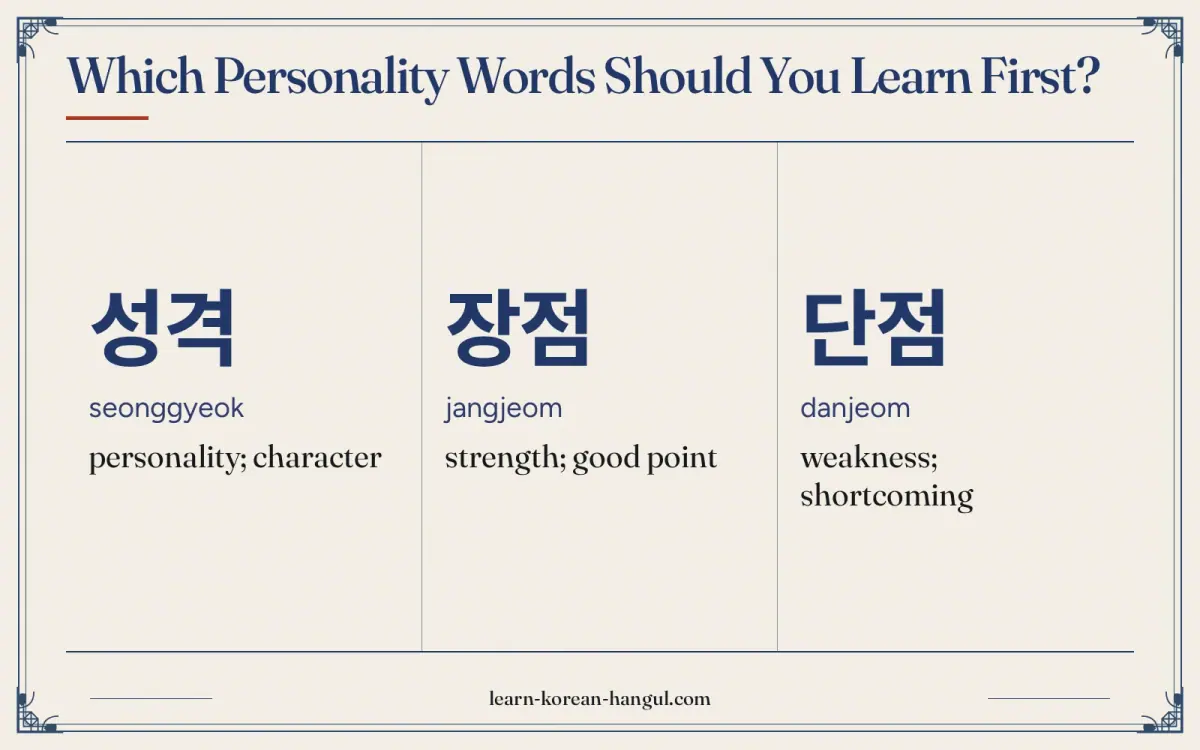
Learn 성격 (personality), 장점 (strength) and 단점 (weakness) first, then 외향적 (outgoing) and 내향적 (introverted), then 성실 (diligence). With these seven, you can ask and answer the questions that start most conversations about people: 성격이 어때요? (What is their personality like?) and 장점이 뭐예요? (What is your strength?).
- Words to use in small talk. 성격, 외향적, 내향적, MBTI, 첫인상.
- Words for interviews and writing. 장점, 단점, 책임감, 열정, 성실.
- Words to recognise when others describe someone. 고집, 낯가림, 배려, 예의.
Two Korean habits help here. Koreans often describe a person with a compound frame, noun + 이/가 + adjective, such as 성격이 급해요 (the personality is hasty). And, unlike English, they usually avoid saying a person is "bad"; they use 단점 or a softer expression. That is why the weakness word is so common.
Word · 8
- 1
성격
seonggyeok
personality; character
- 2
장점
jangjeom
strength; good point
- 3
단점
danjeom
weakness; shortcoming
- 4
외향적
oehyangjeok
extroverted; outgoing
- 5
내향적
naehyangjeok
introverted
- 6
배려
baeryeo
consideration; thoughtfulness
- 7
성실
seongsil
diligence; sincerity
- 8
MBTI
embitiai
MBTI personality type
Character and Traits
These seven nouns are the building blocks of every personality conversation. They name the idea itself, the good and bad sides, and the way a person comes across.
| No. | Hangul | Revised Romanization | Meaning and note | Example sentence | Audio assetId |
|---|---|---|---|---|---|
| 1 | 성격 | seonggyeok | personality; character. The core word. The usual frame is 성격이 좋다 (to have a good personality). | 제 성격은 조용해요. (My personality is quiet.) | au-pg-vocabulary-people-personality-1; example: au-pg-vocabulary-people-personality-2 |
| 2 | 장점 | jangjeom | strength; good point. Literally "long point". Used for people and for things. | 제 장점은 성실함이에요. (My strength is diligence.) | au-pg-vocabulary-people-personality-3; example: au-pg-vocabulary-people-personality-4 |
| 3 | 단점 | danjeom | weakness; shortcoming. Literally "short point". The standard partner of 장점 in interviews. | 제 단점은 너무 급한 거예요. (My weakness is that I am too hasty.) | au-pg-vocabulary-people-personality-5; example: au-pg-vocabulary-people-personality-6 |
| 4 | 매력 | maeryeok | charm; appeal. 매력이 있다 means to be charming. | 그 사람은 매력이 있어요. (That person has charm.) | au-pg-vocabulary-people-personality-7; example: au-pg-vocabulary-people-personality-8 |
| 5 | 개성 | gaeseong | individuality; distinct character. A positive word for a person's own style. | 저는 개성이 강한 편이에요. (I tend to have a strong individuality.) | au-pg-vocabulary-people-personality-9; example: au-pg-vocabulary-people-personality-10 |
| 6 | 태도 | taedo | attitude; manner. How a person acts toward others or toward a task. | 태도가 좋아요. (Their attitude is good.) | au-pg-vocabulary-people-personality-11; example: au-pg-vocabulary-people-personality-12 |
| 7 | 인상 | insang | impression; look. The look or feel a person gives. 인상이 좋다 means to look pleasant. | 그분은 인상이 좋아요. (That person gives a good impression.) | au-pg-vocabulary-people-personality-13; example: au-pg-vocabulary-people-personality-14 |
The pairs 장점 and 단점 are the interview pair, and both are on Korean job applications. The word for first impression, 첫인상, appears in the last group. English "personality" and "character" both map to 성격 in everyday speech, so you do not need two words.
Outgoing and Shy
Korean sorts people on a scale from lively to reserved, and the words below describe both ends. Most end in -적 (like, in the manner of), which turns a noun into a describing word that takes 이에요.
| No. | Hangul | Revised Romanization | Meaning and note | Example sentence | Audio assetId |
|---|---|---|---|---|---|
| 8 | 외향적 | oehyangjeok | extroverted; outgoing. 외향 means facing outward and 적 makes it descriptive. Used with 이에요: 외향적이에요. | 저는 외향적이에요. (I am outgoing.) | au-pg-vocabulary-people-personality-15; example: au-pg-vocabulary-people-personality-16 |
| 9 | 내향적 | naehyangjeok | introverted. 내향 means facing inward. The opposite of 외향적. Very common in MBTI talk. | 동생은 내향적이에요. (My younger sibling is introverted.) | au-pg-vocabulary-people-personality-17; example: au-pg-vocabulary-people-personality-18 |
| 10 | 사교적 | sagyojeok | sociable. 사교 means social contact. Describes someone who easily makes friends. | 그 친구는 사교적이에요. (That friend is sociable.) | au-pg-vocabulary-people-personality-19; example: au-pg-vocabulary-people-personality-20 |
| 11 | 적극적 | jeokgeukjeok | proactive; active. Said [적끅쩍]. Takes the initiative. | 적극적으로 말해요. (I speak up proactively.) | au-pg-vocabulary-people-personality-21; example: au-pg-vocabulary-people-personality-22 |
| 12 | 소극적 | sogeukjeok | passive; reserved. Said [소극쩍]. The opposite of 적극적. Holds back from taking the lead. | 발표할 때 소극적이에요. (I am reserved when giving presentations.) | au-pg-vocabulary-people-personality-23; example: au-pg-vocabulary-people-personality-24 |
| 13 | 수줍음 | sujubeum | shyness. The noun for the feeling. 수줍음이 많다 means to be shy. | 수줍음이 많아요. (I am very shy.) | au-pg-vocabulary-people-personality-25; example: au-pg-vocabulary-people-personality-26 |
| 14 | 낯가림 | natgarim | shyness around strangers. Said [낟까림]. Literally "avoiding faces". Also used for babies who fuss with strangers. | 저는 낯가림이 있어요. (I am shy around new people.) | au-pg-vocabulary-people-personality-27; example: au-pg-vocabulary-people-personality-28 |
The ending -적 appears in 외향적, 내향적, 사교적, 적극적 and 소극적. All five become sentence predicates with 이에요 or 예요, so they behave like the noun-based job words on the Jobs and Occupations page. Add 인 before a noun to turn the word into a modifier: 외향적인 사람 (an outgoing person).
Kind and Strict
Politeness and warmth matter in Korean social life, so this group is large in daily talk. Seven words describe care for others, strictness and the habits that people notice first.
| No. | Hangul | Revised Romanization | Meaning and note | Example sentence | Audio assetId |
|---|---|---|---|---|---|
| 15 | 친절 | chinjeol | kindness; friendliness. The adjective is 친절하다; the noun is used in 친절한 사람. | 직원이 친절해요. (The staff are friendly.) | au-pg-vocabulary-people-personality-29; example: au-pg-vocabulary-people-personality-30 |
| 16 | 배려 | baeryeo | consideration; thoughtfulness. A very positive noun. 배려하다 means to be considerate. | 그 친구는 배려가 많아요. (That friend is very considerate.) | au-pg-vocabulary-people-personality-31; example: au-pg-vocabulary-people-personality-32 |
| 17 | 다정 | dajeong | warmth; affection. Used as 다정하다, to be warm and caring toward others. | 남편은 다정해요. (My husband is warm.) | au-pg-vocabulary-people-personality-33; example: au-pg-vocabulary-people-personality-34 |
| 18 | 엄격 | eomgyeok | strictness. Said [엄껵]. 엄격하다 describes a teacher or parent with firm rules. | 선생님은 엄격해요. (The teacher is strict.) | au-pg-vocabulary-people-personality-35; example: au-pg-vocabulary-people-personality-36 |
| 19 | 고집 | gojip | stubbornness. 고집이 세다 means to be stubborn. | 아버지는 고집이 세요. (My father is stubborn.) | au-pg-vocabulary-people-personality-37; example: au-pg-vocabulary-people-personality-38 |
| 20 | 예의 | yeui | manners; etiquette. Said [예의] or [예이]. 예의가 바르다 means to be well-mannered. | 그 학생은 예의가 발라요. (That student is well-mannered.) | au-pg-vocabulary-people-personality-39; example: au-pg-vocabulary-people-personality-40 |
| 21 | 겸손 | gyeomson | modesty; humility. 겸손하다 describes someone who does not boast. | 그분은 정말 겸손해요. (That person is really modest.) | au-pg-vocabulary-people-personality-41; example: au-pg-vocabulary-people-personality-42 |
Notice the sentence frames: noun + 이/가 + adjective. 고집이 세요 (stubbornness is strong), 예의가 발라요 and 배려가 많아요 (consideration is plentiful) all use this pattern. In English you say "he is stubborn"; in Korean you often say "his stubbornness is strong". The phrase for good manners, 예의가 바르다, is fixed, and its polite form 예의가 발라요 is often written wrongly.
Hard-Working and Lazy
Work ethic is a major theme in Korean small talk and in job interviews. These seven words name the qualities that employers and teachers praise, and the one weakness that nobody wants.
| No. | Hangul | Revised Romanization | Meaning and note | Example sentence | Audio assetId |
|---|---|---|---|---|---|
| 22 | 성실 | seongsil | diligence; sincerity. The most common praise word for a worker. 성실하다 means to be diligent. | 동료는 성실해요. (My colleague is diligent.) | au-pg-vocabulary-people-personality-43; example: au-pg-vocabulary-people-personality-44 |
| 23 | 노력 | noryeok | effort. 노력하다 means to make an effort. | 노력이 필요해요. (Effort is needed.) | au-pg-vocabulary-people-personality-45; example: au-pg-vocabulary-people-personality-46 |
| 24 | 책임감 | chaegimgam | sense of responsibility. Said [채김감], often heard as [채김깜]. 책임 is responsibility and 감 means feeling. A standard interview word. | 저는 책임감이 강해요. (I have a strong sense of responsibility.) | au-pg-vocabulary-people-personality-47; example: au-pg-vocabulary-people-personality-48 |
| 25 | 끈기 | kkeungi | perseverance; persistence. The ability to stick with something. 끈기가 있다 means to have staying power. | 끈기가 필요해요. (Persistence is needed.) | au-pg-vocabulary-people-personality-49; example: au-pg-vocabulary-people-personality-50 |
| 26 | 열정 | yeoljeong | passion; enthusiasm. 열정이 있다 means to be passionate. | 그 사람은 열정이 있어요. (That person is passionate.) | au-pg-vocabulary-people-personality-51; example: au-pg-vocabulary-people-personality-52 |
| 27 | 게으름 | geeureum | laziness. The noun for laziness. The adjective is 게으르다, and 게으름을 피우다 means to slack off. | 게으름을 피우지 마세요. (Please do not slack off.) | au-pg-vocabulary-people-personality-53; example: au-pg-vocabulary-people-personality-54 |
| 28 | 인내심 | innaesim | patience; endurance. 인내 is endurance and 심 means mind or heart. 인내심이 많다 means to be patient. | 선생님은 인내심이 많아요. (The teacher is very patient.) | au-pg-vocabulary-people-personality-55; example: au-pg-vocabulary-people-personality-56 |
Two points about this group. First, 성실 and 책임감 are the safe words to use for yourself, because Korean interviews value them as modest, concrete qualities. Second, the adjective 게으르다 changes in the polite form to 게을러요 (an irregular verb of the 르 type), so the dictionary form 게으르다 does not simply add -어요. The conjugation is covered in the verbs section.
Types and Labels
The last group is the vocabulary of personality as a topic of conversation. Korean small talk often reaches for a type label, so these words are as useful as the descriptive ones.
| No. | Hangul | Revised Romanization | Meaning and note | Example sentence | Audio assetId |
|---|---|---|---|---|---|
| 29 | MBTI | embitiai | MBTI personality type. Read letter by letter in Korean: 엠비티아이. A very common small-talk topic. | MBTI가 뭐예요? (What is your MBTI?) | au-pg-vocabulary-people-personality-57; example: au-pg-vocabulary-people-personality-58 |
| 30 | 유형 | yuhyeong | type; category. A word for kind or sort of person. | 어떤 유형이에요? (What type are you?) | au-pg-vocabulary-people-personality-59; example: au-pg-vocabulary-people-personality-60 |
| 31 | 성향 | seonghyang | tendency; disposition. A person's natural leaning, as in 보수적 성향 (conservative leaning). | 저는 내향적인 성향이에요. (I have an introverted disposition.) | au-pg-vocabulary-people-personality-61; example: au-pg-vocabulary-people-personality-62 |
| 32 | 혈액형 | hyeoraekhyeong | blood type. Said [혀래켱]. Blood type is also used in casual personality talk. | 혈액형이 뭐예요? (What is your blood type?) | au-pg-vocabulary-people-personality-63; example: au-pg-vocabulary-people-personality-64 |
| 33 | 궁합 | gunghap | compatibility. Originally about marriage compatibility; now used for any pair. | 우리는 궁합이 잘 맞아요. (We are a good match.) | au-pg-vocabulary-people-personality-67; example: au-pg-vocabulary-people-personality-68 |
| 34 | 첫인상 | cheodinsang | first impression. Said [처딘상], and romanized from that sound. 첫 means first and 인상 means impression. | 첫인상이 좋았어요. (The first impression was good.) | au-pg-vocabulary-people-personality-69; example: au-pg-vocabulary-people-personality-70 |
MBTI is a pronunciation case of its own, explained in the MBTI section below. 혈액형 is an everyday topic in small talk, and it is usually asked in a light, playful tone, not a scientific one. 궁합 is used for couples, but also for foods and colleagues, as in 두 음식은 궁합이 잘 맞아요 (the two foods go well together).
How Do You Describe a Person with 성격이?
The core frame for describing a person is 성격이 + adjective. It means "their personality is ...". The adjective takes the polite ending -아요 or -어요 (or -해요 for 하다 adjectives). Ten ready examples are in the table.
| Sentence | Meaning |
|---|---|
| 성격이 좋아요. | Their personality is good. |
| 성격이 밝아요. | Their personality is bright and cheerful. |
| 성격이 조용해요. | Their personality is quiet. |
| 성격이 활발해요. | Their personality is lively. |
| 성격이 급해요. | Their personality is hasty. |
| 성격이 착해요. | Their personality is kind. |
| 성격이 꼼꼼해요. | Their personality is meticulous. |
| 성격이 느긋해요. | Their personality is easygoing. |
| 성격이 차분해요. | Their personality is calm. |
| 성격이 부드러워요. | Their personality is gentle. |
To ask the question, say 성격이 어때요? (What is their personality like?). To describe yourself, start with 저는 and add the same predicate: 저는 성격이 급해요. You can also link two traits with -고: 성격이 밝고 활발해요 (their personality is bright and lively). Look at the feelings adjectives page for more adjectives and their endings.
What Does the MBTI Craze Mean in Korean Small Talk?
MBTI is a very common conversation starter in Korea. The usual question is MBTI가 뭐예요? (What is your MBTI?). The answer is a four-letter code, and Koreans say each English letter by name: E is 이, N is 엔, F is 에프, P is 피, so ENFP is 이엔에프피. Many people use a short nickname instead, such as 엔프피 for ENFP. The code is then followed by a comment about how well it fits: 저는 ENFP예요. 외향적이고 활발해요 (I am an ENFP. I am outgoing and lively).
The two sides of the first MBTI letter match the words you have already learned: E is 외향적 and I is 내향적. The label is used as a shortcut for a character description, so you will hear 완전 내향적이라서 (because I am totally introverted) used to explain behaviour. People use it playfully, not as a serious test.
With a friend your own age you can use the casual form, 너는 MBTI가 뭐야?; with anyone else, keep to MBTI가 뭐예요?
How Do You Talk about Strengths and Weaknesses?
The pair 장점 and 단점 is the standard way to talk about strengths and weaknesses. A typical interview pattern is 제 장점은 ...이고, 단점은 ...입니다. The formal sentence ending -입니다 is used in interviews and presentations. A polite everyday version uses 이에요 or 예요: 제 장점은 책임감이에요 (My strength is a sense of responsibility). Say a weakness more gently with 편이에요 (I tend to be ...): 저는 성격이 조금 급한 편이에요 (I tend to be a bit hasty).
Two cautions. A weakness is not a flaw in Korean interviews; applicants often name a small, fixable one and say how they handle it. And praise is usually about behaviour you can see: Koreans often say 배려가 많아요 or 성실해요 about a coworker.
How Do You Pronounce Korean Personality Words?
Many of these words contain sound changes that the spelling hides. The Revised Romanization of Korean records the spelling and ignores some changes. The standard pronunciation rules published by the National Institute of Korean Language (국립국어원) decide the spoken form.
| Spelling | Sounds like | What changes |
|---|---|---|
| 적극적 | [적끅쩍] | After a final ㄱ, the ㄱ and ㅈ of the next syllable become tense [ㄲ] and [ㅉ]. |
| 책임감 | [채김감] | The final ㄱ of 책 links to the next syllable; many speakers also tense 감 to [깜]. |
| 혈액형 | [혀래켱] | The final ㄱ of 액 and the following ㅎ combine into an aspirated [ㅋ]. |
| 첫인상 | [처딘상] | The final ㅅ of 첫 is said [ㄷ] and links to the next vowel. |
| 엄격 | [엄껵] | After a final ㅁ, the ㄱ of 격 becomes tense [ㄲ]. |
| 성격 | [성껵] | The dictionary lists a tense [ㄲ] in this Sino-Korean word, which the spelling does not show. |
| 장점 / 단점 | [장쩜] / [단쩜] | The same happens with the ㅈ of 점: it is said tense [ㅉ]. |
Tense sounds are the main difficulty. In 적극적 and 소극적, the middle and final syllables both tense, so the words sound almost like a short drum roll: jeok-kkeuk-jjeok. Listen to the slow clips and copy the rhythm before you speed up.
Audio and Slow Playback
Each headword and each example sentence has its own audio clip. The clips below replay the trickiest words at a slower pace. Play one, repeat it aloud, then play it again and compare.
What Mistakes Do Learners Make with Personality Words?
These five mistakes come up most in Korean character talk.
- Saying 나는 외향적 without 이에요. The word 외향적 needs a verb. Say 저는 외향적이에요.
- Using 성격 for an object. 성격 is for people (and sometimes animals). For objects, use 특징 (feature).
- Writing 예의가 바라요. The correct polite form of 바르다 is 발라요 (예의가 발라요). 바르다 is an irregular 르 verb.
- Treating 단점 as an insult. It is a neutral word for a weak point and the standard partner of 장점.
- Using the topic marker by default. In 성격이 좋아요, 성격 is marked with 이/가 and the adjective is the predicate. Do not use the topic marker 은/는 for the trait unless you are contrasting it: 성격은 좋아요 means "as for personality, it is good (but something else is not)".
If you remember only one, remember the 이/가 frame, because it works with every adjective.
Practice: Flashcards and Worksheet
Study in three steps. First, run the flashcard deck in recognition mode until you know each of the 34 words. Second, switch to listening mode and answer from the audio alone. Third, take the quiz. The deck covers all 34 words with audio, and your progress stays in your browser. The vocabulary flashcard decks page lists the other decks.
Practice · 73
- 01성격
Show answer
headword 1: personality; character
- 02제 성격은 조용해요.
Show answer
example sentence for 성격: My personality is quiet.
- 03장점
Show answer
headword 2: strength; good point
- 04제 장점은 성실함이에요.
Show answer
example sentence for 장점: My strength is diligence.
- 05단점
Show answer
headword 3: weakness; shortcoming
- 06제 단점은 너무 급한 거예요.
Show answer
example sentence for 단점: My weakness is that I am too hasty.
- 07매력
Show answer
headword 4: charm; appeal
- 08그 사람은 매력이 있어요.
Show answer
example sentence for 매력: That person has charm.
- 09개성
Show answer
headword 5: individuality; distinct character
- 10저는 개성이 강한 편이에요.
Show answer
example sentence for 개성: I tend to have a strong individuality.
- 11태도
Show answer
headword 6: attitude; manner
- 12태도가 좋아요.
Show answer
example sentence for 태도: Their attitude is good.
- 13인상
Show answer
headword 7: impression; look
- 14그분은 인상이 좋아요.
Show answer
example sentence for 인상: That person gives a good impression.
- 15외향적
Show answer
headword 8: extroverted; outgoing
- 16저는 외향적이에요.
Show answer
example sentence for 외향적: I am outgoing.
- 17내향적
Show answer
headword 9: introverted
- 18동생은 내향적이에요.
Show answer
example sentence for 내향적: My younger sibling is introverted.
- 19사교적
Show answer
headword 10: sociable
- 20그 친구는 사교적이에요.
Show answer
example sentence for 사교적: That friend is sociable.
- 21적극적
Show answer
headword 11: proactive; active
- 22적극적으로 말해요.
Show answer
example sentence for 적극적: I speak up proactively.
- 23소극적
Show answer
headword 12: passive; reserved
- 24발표할 때 소극적이에요.
Show answer
example sentence for 소극적: I am reserved when giving presentations.
- 25수줍음
Show answer
headword 13: shyness
- 26수줍음이 많아요.
Show answer
example sentence for 수줍음: I am very shy.
- 27낯가림
Show answer
headword 14: shyness around strangers
- 28저는 낯가림이 있어요.
Show answer
example sentence for 낯가림: I am shy around new people.
- 29친절
Show answer
headword 15: kindness; friendliness
- 30직원이 친절해요.
Show answer
example sentence for 친절: The staff are friendly.
- 31배려
Show answer
headword 16: consideration; thoughtfulness
- 32그 친구는 배려가 많아요.
Show answer
example sentence for 배려: That friend is very considerate.
- 33다정
Show answer
headword 17: warmth; affection
- 34남편은 다정해요.
Show answer
example sentence for 다정: My husband is warm.
- 35엄격
Show answer
headword 18: strictness
- 36선생님은 엄격해요.
Show answer
example sentence for 엄격: The teacher is strict.
- 37고집
Show answer
headword 19: stubbornness
- 38아버지는 고집이 세요.
Show answer
example sentence for 고집: My father is stubborn.
- 39예의
Show answer
headword 20: manners; etiquette
- 40그 학생은 예의가 발라요.
Show answer
example sentence for 예의: That student is well-mannered.
- 41겸손
Show answer
headword 21: modesty; humility
- 42그분은 정말 겸손해요.
Show answer
example sentence for 겸손: That person is really modest.
- 43성실
Show answer
headword 22: diligence; sincerity
- 44동료는 성실해요.
Show answer
example sentence for 성실: My colleague is diligent.
- 45노력
Show answer
headword 23: effort
- 46노력이 필요해요.
Show answer
example sentence for 노력: Effort is needed.
- 47책임감
Show answer
headword 24: sense of responsibility
- 48저는 책임감이 강해요.
Show answer
example sentence for 책임감: I have a strong sense of responsibility.
- 49끈기
Show answer
headword 25: perseverance; persistence
- 50끈기가 필요해요.
Show answer
example sentence for 끈기: Persistence is needed.
- 51열정
Show answer
headword 26: passion; enthusiasm
- 52그 사람은 열정이 있어요.
Show answer
example sentence for 열정: That person is passionate.
- 53게으름
Show answer
headword 27: laziness
- 54게으름을 피우지 마세요.
Show answer
example sentence for 게으름: Please do not slack off.
- 55인내심
Show answer
headword 28: patience; endurance
- 56선생님은 인내심이 많아요.
Show answer
example sentence for 인내심: The teacher is very patient.
- 57MBTI
Show answer
headword 29: MBTI personality type
- 58MBTI가 뭐예요?
Show answer
example sentence for MBTI: What is your MBTI?
- 59유형
Show answer
headword 30: type; category
- 60어떤 유형이에요?
Show answer
example sentence for 유형: What type are you?
- 61성향
Show answer
headword 31: tendency; disposition
- 62저는 내향적인 성향이에요.
Show answer
example sentence for 성향: I have an introverted disposition.
- 63혈액형
Show answer
headword 32: blood type
- 64혈액형이 뭐예요?
Show answer
example sentence for 혈액형: What is your blood type?
- 65궁합
Show answer
headword 33: compatibility
- 66우리는 궁합이 잘 맞아요.
Show answer
example sentence for 궁합: We are a good match.
- 67첫인상
Show answer
headword 34: first impression
- 68첫인상이 좋았어요.
Show answer
example sentence for 첫인상: The first impression was good.
- 69적극적
Show answer
slow playback of 적극적
- 70책임감
Show answer
slow playback of 책임감
- 71혈액형
Show answer
slow playback of 혈액형
- 72첫인상
Show answer
slow playback of 첫인상
- 73인내심
Show answer
slow playback of 인내심
Practice · 5
What does 장점 (jangjeom) mean?
Show answer
strength; good point
장점 means strength; good point. Example: 제 장점은 성실함이에요. (My strength is diligence.)
What does 내향적 (naehyangjeok) mean?
Show answer
introverted
내향적 means introverted. Example: 동생은 내향적이에요. (My younger sibling is introverted.)
What does 고집 (gojip) mean?
Show answer
stubbornness
고집 means stubbornness. Example: 아버지는 고집이 세요. (My father is stubborn.)
What does 게으름 (geeureum) mean?
Show answer
laziness
게으름 means laziness. Example: 게으름을 피우지 마세요. (Please do not slack off.)
What does 궁합 (gunghap) mean?
Show answer
compatibility
궁합 means compatibility. Example: 우리는 궁합이 잘 맞아요. (We are a good match.)
Korean Personality Words Worksheet (PDF)
A printable worksheet for these words (word list, matching, writing practice, fill-in-the-blank exercises and answer key) is available in A4 and US Letter from the download card on this page. For practice, copy the 34 words by hand and write the meaning next to each. Write three sentences about someone you know with the 성격이 frame, then say them aloud.
Where to Go Next
After this page, continue with Emotions, the next list in the section, or Body Parts. For the adjectives that complete these nouns, see feelings adjectives. For one headline word on its own, see personality in korean. To move up a level, return to People and Relationships.
Frequently Asked Questions
How Do You Say Personality in Korean?
Personality is 성격 (seonggyeok). Use it in the frame 성격이 좋아요 (their personality is good) or 성격이 어때요? (what is their personality like?). The word is used for people. For an object, use 특징 (feature) instead.
How Do You Say Strength in Korean?
Strength, in the sense of a good point about a person, is 장점 (jangjeom). Its partner is 단점 (danjeom), weakness. Say 제 장점은 책임감이에요 (my strength is a sense of responsibility). The word for physical strength is 힘, which is a different word.
How Do You Say Weakness in Korean?
Weakness, meaning a flaw or shortcoming, is 단점 (danjeom). It is a neutral word, not an insult, and it is used in interviews: 제 단점은 급한 성격이에요 (my weakness is a hasty personality). It is the partner of 장점.
How Do You Pronounce 성격?
Say seong-gyeok. The first syllable ends in [ㅇ]. The final ㄱ of 격 is held without a release, so it sounds like a stop at the end of the word, and the dictionary lists a tense [ㄲ] at the start of that syllable: [성껵]. Use the audio button on this page for the normal and slow versions.
How Do You Ask Someone's MBTI in Korean?
Ask MBTI가 뭐예요? (What is your MBTI?). The answer is the four-letter code, said letter by letter in Korean. With a friend, you can ask 너는 MBTI가 뭐야? Many people add a comment about how well it fits.
Is the Romanization on This Page Official?
It follows the Revised Romanization of Korean, which South Korea adopted on 7 July 2000 and whose rules the National Institute of Korean Language (국립국어원) publishes. It is a learning aid and does not mark every sound change, so rely on the Hangul and the audio.