Korean Body Parts Flashcards: Study the 29 Cards
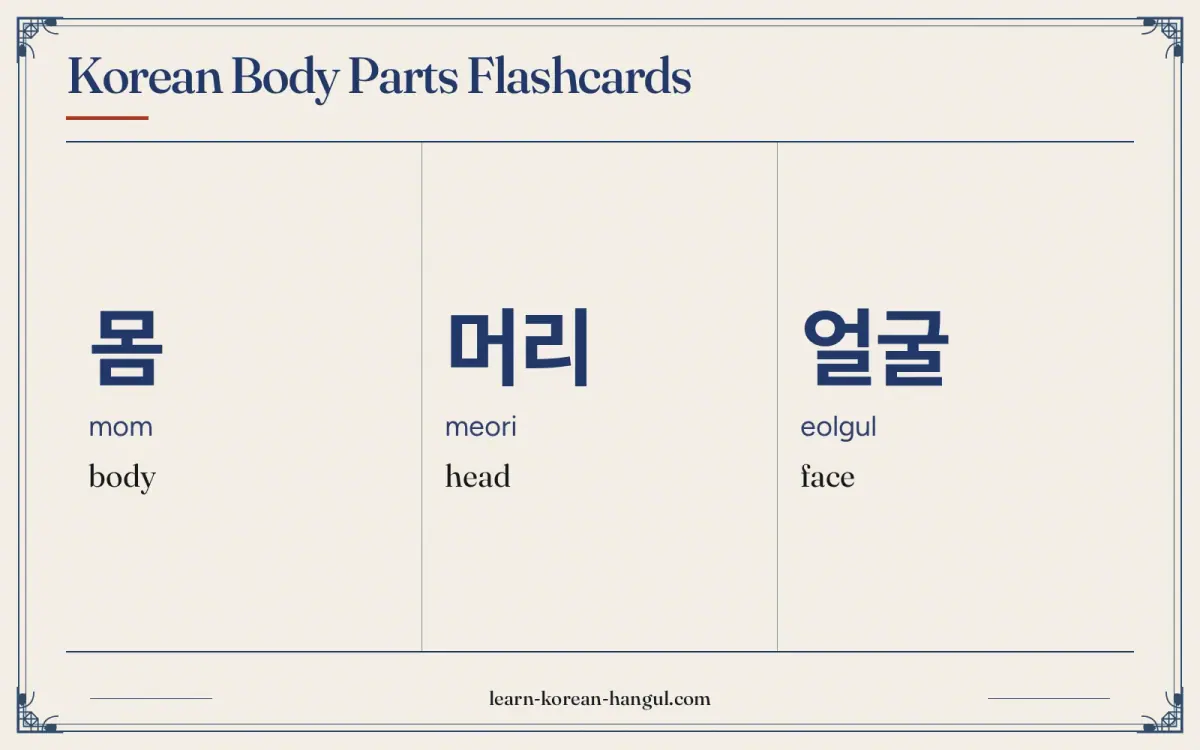
The cards run from the whole body (몸) and the head (cards 1 to 8: 몸, 머리, 얼굴, 눈, 코, 입, 귀, 목), through the arms and trunk (9 to 16), then the legs and feet (17 to 20), then skin, organs and smaller parts of the face (21 to 28). The last card is 아프다, which you use with any body part.
How Do I Use These Flashcards?
Use the deck above in four steps. It works with tap, click or keyboard, and nothing plays until you press an audio button.
- Choose a mode. Start with recognition (Hangul to meaning). Switch to recall (meaning to Hangul) or listening (audio to meaning) once recognition feels easy.
- Show the answer. Think of the answer first, then press Show answer (or Space). Turn on the romanization toggle only if you need it; the table below always shows it.
- Grade yourself. Press Got it if you answered correctly without help, or Not yet if you hesitated or guessed.
- Finish the session. A session holds up to 20 cards (you can set 10, 20 or 40). With 29 cards, a first-time learner should expect about 3 days at the default limit of 10 new cards a day, with review sessions on top.
The Three Study Modes
Recognition shows the Hangul and asks for the meaning, so with the first card it shows 몸 and you answer "body". Recall reverses this: it shows the meaning and asks for the Hangul, and you may type the answer with your Hangul keyboard or just say it in your head. Listening plays a clip and hides the letters, which trains the ear. Listening mode only uses a card once its audio is approved, and cards without approved audio are skipped in that mode with a note. Recall mode suits this deck, because it makes you produce the body word when you see the English one.
Got It and Not Yet
Got it moves a card up one Leitner box, so it comes back later. Not yet sends the card back to box 1, so it returns in the same session or within 10 minutes. The grades are your own judgement; the deck does not score you or claim fluency.
Deck Scope: What Is and Is Not Covered
The deck covers words for the body from head to foot plus 아프다 for saying where it hurts. Detailed hospital, pharmacy and medicine vocabulary are left to their own lessons. The words and letters on these cards are explained in the korean body parts lesson, so read it first if a card is new.
What This Deck Leaves Out
Hospital, medicine and illness words are in the health vocabulary lessons, and family words are in the family decks. Personality words are in the Korean personality words flashcards deck, which is the next topic after this one.
All 29 Cards in One Table
All 29 cards appear below in deck order. The table is plain HTML, so you can use it as a drill without the deck: cover the Meaning column, read each word aloud, then uncover it.
| # | Hangul | Revised Romanization | Meaning | Note | Audio assetId |
|---|---|---|---|---|---|
| 1 | 몸 | mom | body | 몸이 안 좋아요 means I do not feel well. | au-pg-flashcards-body-parts-1 |
| 2 | 머리 | meori | head | Head and the hair on it: 머리를 자르다 (to cut hair). | au-pg-flashcards-body-parts-2 |
| 3 | 얼굴 | eolgul | face | The face, not the head (머리). | au-pg-flashcards-body-parts-3 |
| 4 | 눈 | nun | eye | Also snow. 눈이 아파요 (my eyes hurt); 눈이 와요 (it is snowing). | au-pg-flashcards-body-parts-4 |
| 5 | 코 | ko | nose | 코가 커요 (My nose is big). | au-pg-flashcards-body-parts-5 |
| 6 | 입 | ip | mouth | 입을 크게 벌리세요 (Please open your mouth wide). | au-pg-flashcards-body-parts-6 |
| 7 | 귀 | gwi | ear | 귀가 아파요 (My ear hurts). | au-pg-flashcards-body-parts-7 |
| 8 | 목 | mok | neck | 목이 아파요 (My neck hurts). | au-pg-flashcards-body-parts-8 |
| 9 | 어깨 | eokkae | shoulder | 어깨가 아파요 (My shoulder hurts). | au-pg-flashcards-body-parts-9 |
| 10 | 팔 | pal | arm | Also the number eight (Sino-Korean); context decides. | au-pg-flashcards-body-parts-10 |
| 11 | 손 | son | hand | 손을 씻으세요 (Please wash your hands). | au-pg-flashcards-body-parts-11 |
| 12 | 손가락 | songarak | finger | Finger; said [손까락]. | au-pg-flashcards-body-parts-12; slow: au-pg-flashcards-body-parts-31 |
| 13 | 가슴 | gaseum | chest | The upper front of the body: 가슴이 아파요 (my chest hurts). | au-pg-flashcards-body-parts-13 |
| 14 | 배 | bae | stomach | Belly. Same sound as ship and pear. 배가 고파요 (I am hungry). | au-pg-flashcards-body-parts-14 |
| 15 | 등 | deung | back (of the body) | 등이 아파요 (My back hurts). | au-pg-flashcards-body-parts-15 |
| 16 | 허리 | heori | waist; lower back | 허리가 아파요 (my lower back hurts). | au-pg-flashcards-body-parts-16 |
| 17 | 다리 | dari | leg | The leg, not the foot (발). Also bridge. | au-pg-flashcards-body-parts-17 |
| 18 | 무릎 | mureup | knee | Said [무릅]; 무릎이 is said [무르피]. | au-pg-flashcards-body-parts-18; slow: au-pg-flashcards-body-parts-30 |
| 19 | 발 | bal | foot | The foot; 다리 is the leg. | au-pg-flashcards-body-parts-19 |
| 20 | 발가락 | balgarak | toe | Said [발까락], like 손가락. | au-pg-flashcards-body-parts-20 |
| 21 | 피부 | pibu | skin | 피부가 좋아요 (Your skin is nice). | au-pg-flashcards-body-parts-21 |
| 22 | 심장 | simjang | heart (the organ) | 심장이 빨리 뛰어요 (My heart is beating fast). | au-pg-flashcards-body-parts-22 |
| 23 | 이 | i | tooth | Also means two and this; context tells them apart. | au-pg-flashcards-body-parts-23 |
| 24 | 입술 | ipsul | lip | 입술이 말랐어요 (my lips are dry). | au-pg-flashcards-body-parts-24; slow: au-pg-flashcards-body-parts-32 |
| 25 | 혀 | hyeo | tongue | 혀를 내밀어 보세요 (please stick out your tongue). | au-pg-flashcards-body-parts-25 |
| 26 | 이마 | ima | forehead | 이마가 아파요 (my forehead hurts). | au-pg-flashcards-body-parts-26 |
| 27 | 턱 | teok | chin; jaw | 턱이 아파요 (my jaw hurts). | au-pg-flashcards-body-parts-27 |
| 28 | 머리카락 | meorikarak | hair (a strand) | A single strand of hair; 머리 is the head and hair as a whole. | au-pg-flashcards-body-parts-28 |
| 29 | 아프다 | apeuda | sick; painful | 머리가 아파요 (My head hurts). The body part takes 이/가. | au-pg-flashcards-body-parts-29 |
Reading the Table
Hangul is the word. Revised Romanization (RR) is a learning aid, so read the Hangul first. RR follows sound changes between letters but not tensing, so 손가락 is written songarak although it is said with a tense [까]. The Meaning column gives the English gloss, and the Note column gives an example or a sound hint. A second ID in the last column marks a slow clip.
Usage Notes for These Cards
Pain takes the body part as the subject. Say the body part, then 가 or 이, then 아프다: 머리가 아파요 (My head hurts). The body part is not the object, so it takes 이/가 and not 을/를.
눈 is both eye and snow. 눈이 아파요 means my eyes hurt, while 눈이 와요 means it is snowing. The sound is the same, so the verb tells you which one is meant.
배 is the belly, ship and pear. 배가 고파요 (I am hungry) uses the belly. Context carries the meaning for the other two.
머리 covers head and hair. You cut hair with 머리를 자르다, and a single strand is 머리카락. 얼굴 is the face, not the head.
손 is the hand and 손가락 the fingers. Wash your hands with 씻다: 손을 씻으세요 (Please wash your hands). 다리 is the leg and 발 is the foot, so keep them apart.
Which Sounds Do Not Match the Spelling?
무릎 is said [무릅]: the final ㅍ is neutralized to ㅂ at the end of a word. With a particle, 무릎이 is said [무르피].
손가락 is said [손까락]: it is a compound of 손 and 가락, and the ㄱ at the join is tensified, as in many compounds. 발가락 is said [발까락] and follows the same pattern. Revised Romanization does not mark tensing, so it writes songarak and balgarak.
입술 is said [입쑬]: the ㅅ after the ㅂ final is tensified. Revised Romanization does not mark tensing, so it writes ipsul.
What Mistakes Do Learners Make with Body Parts?
- Using the object particle with pain. Say 머리가 아파요, not 머리를 아파요.
- Saying 감기가 걸렸어요 for a cold. The verb takes 에, so say 감기에 걸렸어요 (I caught a cold).
- Mixing up 다리 and 발. 다리 is the leg and 발 is the foot.
- Using 얼굴 for the head. 얼굴 is the face, and 머리 is the head.
Most of these slips come from particles and from words that share a sound, so say the example phrase aloud when you answer a card.
How Does the Review Schedule Work?
The deck uses a simplified Leitner system with five boxes. A new card starts in box 1. Each Got it moves it up one box, and each Not yet returns it to box 1. The box sets how long the card waits before it is due again.
| Box | Wait until the next review |
|---|---|
| 1 | same session or 10 minutes |
| 2 | 1 day |
| 3 | 3 days |
| 4 | 7 days |
| 5 | 21 days |
Each session shows due cards first, oldest due first, and then new cards up to the daily limit, which is 10 by default. A deck of 29 cards is introduced in about three days at the default of 10 new cards a day, and the later boxes bring each body word back at longer gaps. Progress is saved only in this browser, so clearing site data deletes it. Use the export button to save a small JSON file with card IDs, boxes and due dates, and import it on another device. The file holds no personal data.
Cultural and Practical Context
Body words turn up in many Korean idioms, and the nursery action song 머리 어깨 무릎 발 is a familiar way children learn them, with the singer touching each part in turn. A teacher or doctor will often ask 어디가 아파요? (Where does it hurt?), so the answer pattern on the 아프다 card is useful in real life.
Limits of This Deck
The deck holds 29 cards, a starting set rather than an anatomy list. It does not include organs beyond 심장, illness words or medicine. The Korean text on this page is generated and was reviewed and signed off by Min-ji Park on 15 October 2026.
Next Steps after This Deck
This deck is one of the korean vocabulary flashcards on the site, so browse the full list if you want a different topic. When these cards feel easy, move on to korean personality words flashcards to keep the same routine. For a related topic, try korean jobs flashcards. After a session, write the same words by hand with the korean family words worksheet. To check what you recalled, take the body parts in korean quiz next. All flashcard decks, including Hangul, vocabulary, phrases, grammar and TOPIK, are listed on the Korean flashcards hub.
Frequently Asked Questions
Is 이 Always Tooth?
It is tooth here, but 이 also means two (as a Sino-Korean number) and this, which context tells apart. In 이가 아파요 (my tooth hurts), the particle and the word 아파요 make the meaning clear.
How Do I Say I Have a Headache?
머리가 아파요 or 두통이 있어요 both work, and the first is more common in everyday speech. 머리가 아파요 literally means my head hurts. 두통이 있어요 means there is a headache and sounds a little more medical.
What Is the Difference between 다리 and 발?
다리 is the leg and 발 is the foot. 다리 also means bridge, so the context decides. A short example is 다리가 아파요 (my leg hurts) and 발이 아파요 (my foot hurts).
Can I Use 얼굴 for Head?
No. 얼굴 is the face, while 머리 is the head, and 머리 also covers the hair. To say my face is red, you say 얼굴이 빨개요. To say I washed my hair, use 머리를 감았어요.
Is My Progress Saved If I Close the Page?
Yes, in the same browser on the same device. Card boxes and due dates are stored locally and nothing is sent to a server. Clearing site data, using a private window or switching browsers removes them, so use the export button to keep a backup file. No account is needed.