
Korean Proverbs Flashcards: Study the 22 Cards
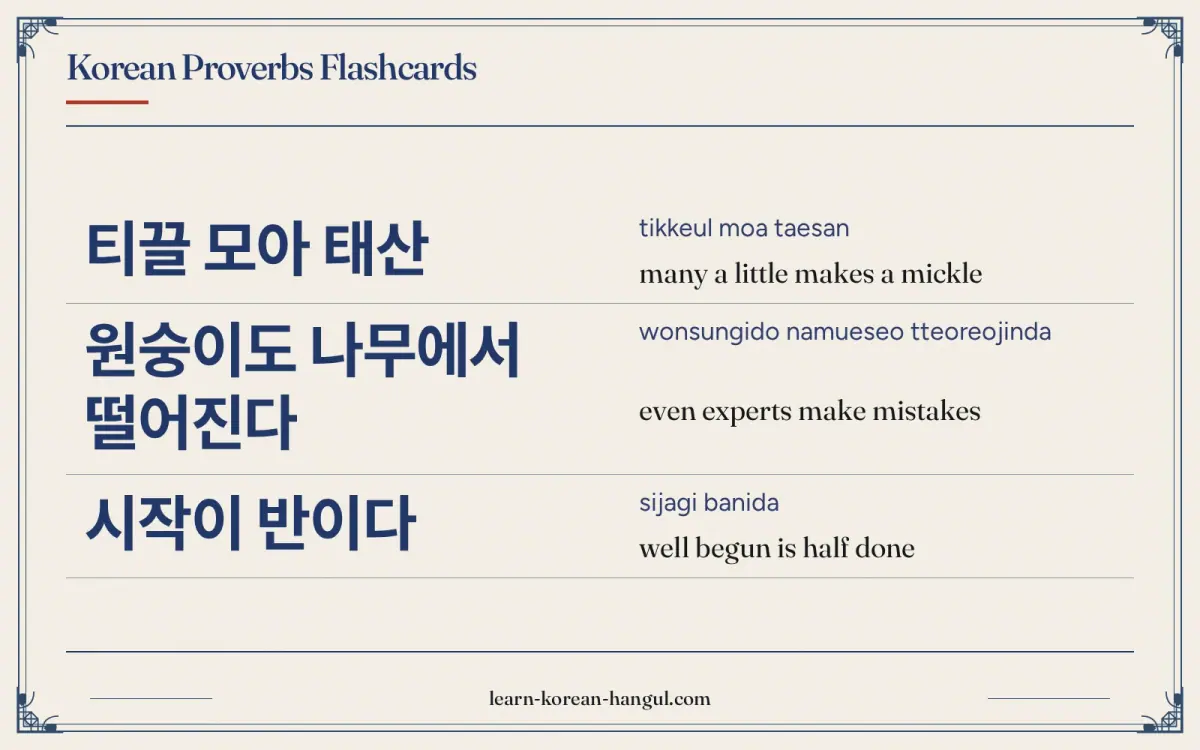
The cards start with sayings about words and kindness (cards 1 and 2), then effort, mistakes and habits (3 to 10), more sayings about speech (11 to 13), sayings about seeing and luck (14 to 17), and finish with animal and everyday-life proverbs (18 to 22).
How Do I Use These Flashcards?
Use the deck above in four steps. It works with tap, click or keyboard, and nothing plays until you press an audio button.
- Choose a mode. Start with recognition (Hangul to meaning). Switch to recall (meaning to Hangul) or listening (audio to meaning) once recognition feels easy.
- Show the answer. Say the proverb aloud in one breath, then recall the lesson before you look. Picture the literal scene, such as a monkey falling from a tree, and ask what point it makes. Then press Show answer (or Space). Turn on the romanization toggle only if you need it; the table below always shows it.
- Grade yourself. Press Got it if you answered correctly without help, or Not yet if you hesitated or guessed.
- Finish the session. A session holds up to 20 cards (you can set 10, 20 or 40). With 22 cards, a first-time learner should expect about 3 days at the default limit of 10 new cards a day, with review sessions on top.
What Do the Three Modes Do?
Recognition shows the Hangul and asks for the meaning, so with the first card it shows 가는 말이 고와야 오는 말이 곱다 and you answer "speak kindly to get kindness back". Recall reverses this: it shows the meaning and asks for the Hangul, and you may type the answer with your Hangul keyboard or just say it in your head. Listening plays a clip and hides the letters. Proverbs are long, so listening mode is where you learn their rhythm, for example the pause in the middle of 낮말은 새가 듣고 밤말은 쥐가 듣는다.
What Do Got It and Not yet Do?
Got it moves a card up one Leitner box, so it comes back later. Not yet sends the card back to box 1, so it returns in the same session or within 10 minutes. The grades are your own judgement; the deck does not score you or claim fluency.
Deck Scope: What Is and Is Not Covered
The deck covers 22 proverbs. Each is a complete saying with a lesson, shown in its fixed form: most end in the plain 다 form, one ends in -랴, and the rest are short phrases such as 하늘의 별 따기. The first thirteen cards are about speech, effort and habits, cards 14 to 17 are about seeing, luck and consequences, and cards 18 to 22 use animals and everyday life. The deck does not try to list every Korean proverb, and it leaves out sayings that are rarely heard today.
What Is Left out of This Deck?
Short phrases that you fit into your own sentence, such as 손이 크다, are in the Korean idioms flashcards. Four-syllable phrases from Chinese characters, such as 일석이조, are in the Korean four character idioms flashcards. The background and all 40 sayings, including these 22, are in the korean proverbs lesson.
All 22 Cards in One Table
All 22 cards appear below in deck order. The table is plain HTML, so you can use it as a drill without the deck: cover the Meaning column, say each item aloud, then uncover it.
| # | Hangul | Revised Romanization | Meaning | Note | Audio assetId |
|---|---|---|---|---|---|
| 1 | 가는 말이 고와야 오는 말이 곱다 | ganeun mari gowaya oneun mari gopda | speak kindly to get kindness back | [가는 마리 고와야 오는 마리 곱따] Literally: words that go must be kind for words that come to be kind. 친구에게 먼저 친절하게 말해요. (Speak kindly to your friends first.) | au-pg-flashcards-proverb-flashcards-1; slow: au-pg-flashcards-proverb-flashcards-23 |
| 2 | 낮말은 새가 듣고 밤말은 쥐가 듣는다 | nanmareun saega deutgo bammareun jwiga deunneunda | walls have ears | [난마른 새가 듣꼬 밤마른 쥐가 든는다] Literally: birds hear day talk and mice hear night talk. 비밀은 조용히 말해요. (Tell secrets quietly.) | au-pg-flashcards-proverb-flashcards-2; slow: au-pg-flashcards-proverb-flashcards-24 |
| 3 | 티끌 모아 태산 | tikkeul moa taesan | many a little makes a mickle | Literally: gather dust and make a great mountain. 티끌 모아 태산이에요. 매일 조금씩 저축해요. (Many a little makes a mickle. I save a little every day.) | au-pg-flashcards-proverb-flashcards-3 |
| 4 | 원숭이도 나무에서 떨어진다 | wonsungido namueseo tteoreojinda | even experts make mistakes | [원숭이도 나무에서 떠러진다] Literally: even monkeys fall from trees. 요리사도 가끔 실수해요. 원숭이도 나무에서 떨어진다. (Even chefs make mistakes sometimes. Nobody is perfect.) | au-pg-flashcards-proverb-flashcards-4 |
| 5 | 시작이 반이다 | sijagi banida | well begun is half done | [시자기 바니다] Literally: the start is half. 오늘 처음 운동했어요. 시작이 반이에요! (I worked out for the first time today. Well begun is half done!) | au-pg-flashcards-proverb-flashcards-5 |
| 6 | 천 리 길도 한 걸음부터 | cheon ri gildo han georeumbuteo | a journey of a thousand miles begins with a single step | [철리 길도 한 거름부터] Literally: even a thousand-li road starts with one step. 한국어가 어려워요? 천 리 길도 한 걸음부터예요. (Is Korean hard? A journey of a thousand miles begins with one step.) | au-pg-flashcards-proverb-flashcards-6 |
| 7 | 고생 끝에 낙이 온다 | gosaeng kkeute nagi onda | after hardship comes happiness | [고생 끄테 나기 온다] Literally: at the end of hardship, joy comes. 조금만 더 힘내요. (Hang in there a little longer.) | au-pg-flashcards-proverb-flashcards-7 |
| 8 | 열 번 찍어 안 넘어가는 나무 없다 | yeol beon jjigeo an neomeoganeun namu eopda | persistence always wins | [열 번 찌거 안 너머가는 나무 업따] Literally: no tree fails to fall after ten chops. 계속 도전하세요. (Keep trying.) | au-pg-flashcards-proverb-flashcards-8 |
| 9 | 공든 탑이 무너지랴 | gongdeun tabi muneojirya | hard work never goes to waste | [공든 타비 무너지랴] Literally: would a carefully built tower collapse? 삼 년 동안 열심히 준비했어요. 공든 탑이 무너지랴! (I prepared hard for three years. Hard work never goes to waste!) | au-pg-flashcards-proverb-flashcards-9 |
| 10 | 세 살 버릇 여든까지 간다 | se sal beoreut yeodeunkkaji ganda | old habits die hard | Literally: a habit at three lasts until eighty. 어릴 때 좋은 습관을 만들어요. (Build good habits when you are young.) | au-pg-flashcards-proverb-flashcards-10 |
| 11 | 말 한마디로 천 냥 빚을 갚는다 | mal hanmadiro cheon nyang bijeul gamneunda | a kind word can work wonders | [말 한마디로 천 냥 비즐 감는다] Literally: one word pays off a debt of a thousand nyang. 사과 한마디가 중요해요. (One word of apology matters.) | au-pg-flashcards-proverb-flashcards-11 |
| 12 | 발 없는 말이 천 리 간다 | bal eomneun mari cheon ri ganda | word travels fast | [발 엄는 마리 철리 간다] Literally: words without feet travel a thousand li. 벌써 모두 알아요? (Everyone knows already?) | au-pg-flashcards-proverb-flashcards-12; slow: au-pg-flashcards-proverb-flashcards-25 |
| 13 | 말이 씨가 된다 | mari ssiga doenda | be careful what you say; words can come true | [마리 씨가 된다] Literally: words become seeds. 나쁜 말은 조심해요. (Watch out for bad words.) | au-pg-flashcards-proverb-flashcards-13 |
| 14 | 백문이 불여일견 | baengmuni buryeoilgyeon | seeing is believing | [뱅무니 부려일견] Literally: a hundred hearings are not as good as one seeing. 백문이 불여일견이에요. 직접 가서 보세요. (Seeing is believing. Go and see it yourself.) | au-pg-flashcards-proverb-flashcards-14 |
| 15 | 등잔 밑이 어둡다 | deungjan michi eodupda | the thing you seek is often right under your nose | [등잔 미치 어둡따] Literally: it is dark under the oil lamp. 한참 안경을 찾았어요. 그런데 머리 위에 있었어요. 등잔 밑이 어두워요. (I looked for my glasses for ages. They were on my head.) | au-pg-flashcards-proverb-flashcards-15 |
| 16 | 하늘의 별 따기 | haneurui byeol ttagi | next to impossible | [하느릐 별 따기], also [하느레 별 따기] Literally: picking a star from the sky. 요즘 서울에서 집 사기는 하늘의 별 따기예요. (Buying a home in Seoul these days is next to impossible.) | au-pg-flashcards-proverb-flashcards-16 |
| 17 | 누워서 침 뱉기 | nuwoseo chim baetgi | harming yourself by attacking others | [누워서 침 밷끼] Literally: spitting while lying down. 회사 욕을 하는 건 누워서 침 뱉기예요. (Badmouthing your own company only hurts you.) | au-pg-flashcards-proverb-flashcards-17 |
| 18 | 소 잃고 외양간 고친다 | so ilko oeyanggan gochinda | to lock the stable door after the horse has bolted | [소 일코 외양간 고친다] Literally: fixing the cowshed after losing the cow. 집에 도둑이 들었어요. 그다음에 문을 고쳤어요. (A burglar got into our house. Only then did we fix the door.) | au-pg-flashcards-proverb-flashcards-18 |
| 19 | 고래 싸움에 새우 등 터진다 | gorae ssaume saeu deung teojinda | the small get hurt when the powerful fight | [고래 싸우메 새우 등 터진다] Literally: when whales fight, the shrimp's back bursts. 부모님이 싸우면 아이들이 힘들어요. (When parents fight, the children suffer.) | au-pg-flashcards-proverb-flashcards-19 |
| 20 | 빈 수레가 요란하다 | bin surega yoranhada | empty vessels make the most noise | Literally: an empty cart is noisy. 그 사람은 말만 많아요. 빈 수레가 요란해요. (He is all talk. Empty vessels make the most noise.) | au-pg-flashcards-proverb-flashcards-20 |
| 21 | 제 눈에 안경 | je nune angyeong | beauty is in the eye of the beholder | [제 누네 안경] Literally: glasses for my own eyes. 저는 이 그림이 정말 좋아요. 제 눈에 안경이에요. (I really like this painting. Beauty is in the eye of the beholder.) | au-pg-flashcards-proverb-flashcards-21 |
| 22 | 꿩 먹고 알 먹고 | kkwong meokgo al meokgo | to kill two birds with one stone | [꿩 먹꼬 알 먹꼬] Literally: eat the pheasant and eat the eggs. 자전거로 출근해요. 운동도 하고 돈도 아껴요. 꿩 먹고 알 먹고! (I cycle to work. I get exercise and save money. Two birds with one stone!) | au-pg-flashcards-proverb-flashcards-22 |
How Do I Read the Table?
Hangul is the expression itself. Revised Romanization (RR) is a learning aid, so try to read the Hangul first. The Meaning column gives the usual meaning, often with an English saying that does the same job. The Note column starts with the literal picture, then gives an example of when to say it. Where the spoken sound differs from the spelling, the sound is shown in brackets. The last column lists the audio assetId, and a second ID marks a slow clip (0.8x).
Usage Notes for These Cards
A proverb is quoted in a fixed form. You can introduce it with 라는 말이 있어요: '시작이 반이다'라는 말이 있어요 (There is a saying, well begun is half done). The words inside stay the same. In casual talk people also apply the saying directly, as in 시작이 반이에요!, but the quotation itself keeps the plain 다 form.
Particles often set up a contrast. 낮말은 새가 듣고 밤말은 쥐가 듣는다 uses 은 twice to set day talk against night talk. The saying has two halves, and the second half answers the first.
Beware of 말. In 가는 말이 고와야 오는 말이 곱다, 말 means words or speech, not a horse. The proverb says that the words you send out must be kind for the words you get back to be kind. 고와야 comes from the ㅂ-irregular adjective 곱다 (to be gentle, pretty), which becomes 고와 before -아야. In 발 없는 말이 천 리 간다, the picture is a word with no feet that still travels far.
Speakers often quote only the first half. People say 소 잃고... and let the listener finish with 외양간 고친다. If you know the whole saying, you can follow a half-quote.
Many proverbs have a close English partner. 티끌 모아 태산 matches many a little makes a mickle, and 꿩 먹고 알 먹고 matches two birds with one stone. The match is a guide, not an exact translation, so keep the literal picture in mind as well.
Which Sounds Do Not Match the Spelling?
Proverbs run several words together, so the sound changes pile up. Play the clips and say each phrase after the audio.
듣는다 is said [든는다]. The final ㄷ of 듣 changes to ㄴ before the ㄴ of 는. This is nasalization, and RR writes the sound it hears: deunneunda.
발 없는 말이 is said [발 엄는 마리]. The cluster ㅄ in 없 is read as ㅂ, and ㅂ becomes ㅁ before the ㄴ of 는, giving 엄는. The final ㄹ of 말 moves to the vowel of 이, giving 마리. RR writes bal eomneun mari.
낮말은 is said [난마른]. The final ㅈ of 낮 is read as ㄷ, and then ㄷ becomes ㄴ before the ㅁ of 말, giving 난말. The ㄹ of 말 then links to 은, so you hear 난마른. RR writes nanmareun.
What Mistakes Do Learners Make with Korean Proverbs?
- Reading 말 as a horse in the first proverb. It means words or speech, so the saying is about kind talk.
- Changing words inside the saying. 낮말은 새가 듣고 밤말은 쥐가 듣는다 keeps 새 (bird) and 쥐 (mouse); if you swap them, listeners hear a different phrase.
- Taking a proverb as literal advice about animals or farm tools. 소 잃고 외양간 고친다 is about acting too late, not about cattle.
- Mixing up two sayings that sound alike. 말 한마디로 천 냥 빚을 갚는다 is about kind words, while 발 없는 말이 천 리 간다 is about gossip spreading.
- Applying a critical saying to someone's face. 빈 수레가 요란하다 calls a person a noisy boaster, so say it only about a situation, or leave it unsaid.
Cards 11 to 13 all turn on the word 말 and are easy to confuse. Give them extra passes in recall mode.
How Does the Review Schedule Work?
The deck uses a simplified Leitner system with five boxes. A new card starts in box 1. Each Got it moves it up one box, and each Not yet returns it to box 1. The box sets how long the card waits before it is due again.
| Box | Wait until the next review |
|---|---|
| 1 | same session or 10 minutes |
| 2 | 1 day |
| 3 | 3 days |
| 4 | 7 days |
| 5 | 21 days |
Each session shows due cards first, oldest due first, then up to 10 new cards a day by default. A deck of 22 cards is introduced over 3 days at 10 new cards a day, and the later boxes bring every card back at longer gaps. Progress is saved only in this browser, so clearing site data deletes it. Use the export button to save a small file with card IDs, boxes and due dates, and import it on another device. No account is needed.
Cultural and Practical Context
Many Korean proverbs draw on farm life and animals such as cows, monkeys, whales and pheasants, and on old measures such as the 리 (li, a unit of distance) and the 냥 (nyang, an old coin). They appear in speeches, textbooks and everyday advice. A teacher or a parent may answer a complaint with 시작이 반이다, and a friend may joke 소 잃고 외양간 고친다 after an avoidable mistake. Using the right proverb at the right moment is seen as a sign of a well-read speaker.
Limits of This Deck
The deck holds 22 proverbs and one example for each, so it shows the main sense and not every shade of meaning. Some proverbs vary slightly in wording across sources, and the English sayings are guides, not exact translations. The Korean text is AI-assisted and goes through Korean-teacher review before publication, and each audio clip is checked by a Korean teacher before publication.
Next Steps after This Deck
After these korean proverbs flashcards, move on to the Korean four character idioms flashcards to keep the same routine. If a phrase here still feels shaky, go back to the Korean idioms flashcards. Read the korean proverbs lesson for 40 sayings with full examples. The Korean vocabulary flashcards page lists every vocabulary deck, and the Korean flashcards hub lists all topics.
Frequently Asked Questions
What Is the Difference between 속담 and 사자성어?
A 속담 (sokdam) is a spoken saying in ordinary Korean words, such as 시작이 반이다. A 사자성어 (sajaseongeo) is a fixed phrase of four syllables taken from Chinese characters, such as 일석이조. Proverbs are quoted as whole sentences, while four-character idioms work like nouns.
Which Proverb Should I Learn First?
시작이 반이다 is a good first choice because it is short, friendly and widely used to encourage someone who has just started something. 티끌 모아 태산 is another early favourite, especially when people talk about saving money.
Are Proverbs Polite?
They are neutral and you can use them with anyone, but the way you apply them matters. A comment such as 빈 수레가 요란하다 is a criticism of a person, so keep it for a situation, not for someone's face. Encouraging sayings such as 고생 끝에 낙이 온다 are safe in almost any setting.
Do All Korean Proverbs Have English Equivalents?
Many do, such as 소 잃고 외양간 고친다 and locking the stable door after the horse has bolted. The match is rarely exact, though. Treat the English line on each card as a guide to the meaning, and read the literal picture in the Note column as well.
Is My Progress Saved If I Close the Page?
Yes, in the same browser on the same device. Card boxes and due dates are stored locally and nothing is sent to a server. Clearing site data, using a private window or switching browsers removes them, so use the export button to keep a backup file. No account is needed.